

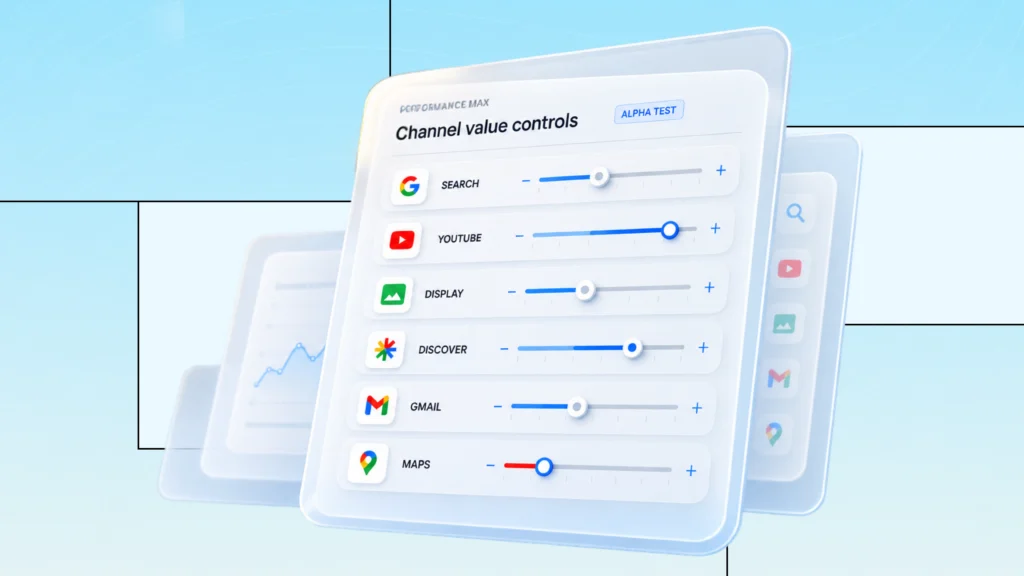
Google is reportedly in the early stages of alpha-testing a significant new feature within its Performance Max (PMax) advertising platform: channel-level controls. This development, if broadly rolled out, could empower advertisers with unprecedented influence over how Google’s automated systems perceive and prioritize individual advertising channels, including Search, YouTube, Display, Discover, Gmail, and Maps. While Google has not officially confirmed the test, initial observations suggest these controls will function akin to conversion value rules, allowing advertisers to assign relative importance to each channel rather than dictating budget allocations directly. This move signals a potential shift towards providing advertisers with more granular strategic input within Google’s increasingly automated advertising ecosystem.
The existence of this nascent functionality was first brought to light by search marketing advisor Heidi Sturrock, who shared her findings on LinkedIn. The exact parameters and user interface are still subject to change as the feature progresses through its testing phases. However, the core concept revolves around enabling advertisers to adjust the perceived value of specific channels within a PMax campaign. This is a notable departure from the current PMax model, where the algorithm autonomously optimizes across channels based on conversion signals. The implications of such a feature are far-reaching, potentially offering advertisers a powerful new tool to align PMax performance with their unique business objectives, while simultaneously underscoring the critical importance of high-quality data signals in fueling Google’s automation.
The Growing Imperative for Enhanced Measurement
The efficacy of any potential channel-level control feature is inextricably linked to the robustness of an advertiser’s measurement infrastructure. In an era where automated platforms like Performance Max are designed to leverage vast datasets, the quality and accuracy of the signals fed into these systems become paramount. Accurate conversion tracking, the implementation of Consent Mode to respect user privacy preferences, the utilization of enhanced conversions to improve data accuracy, and sophisticated store visit measurement all play a crucial role. Furthermore, the strategic deployment of first-party data—information collected directly from customers—provides invaluable context for Google’s algorithms, helping them to understand not only which outcomes are being achieved but also the true value they generate for the business.
Beyond technical measurement, advertisers must cultivate a nuanced understanding of the interconnected roles each channel plays throughout the customer journey. A channel that may appear to have a high cost-per-acquisition (CPA) when viewed in isolation could be instrumental in nurturing a lead or influencing a customer’s decision-making process much earlier in the funnel. Display advertising, for instance, often receives less direct attribution for final conversions, yet the impressions it generates can significantly contribute to brand awareness and subsequent engagement on other platforms. As advertisers gain the ability to directly influence how Performance Max values these channels, these decisions must be grounded in a holistic comprehension of customer behavior, moving beyond superficial efficiency metrics reported in isolation. For advertisers who have invested in sophisticated measurement frameworks, this feature could unlock a powerful mechanism to translate their insights into tangible performance improvements by guiding PMax towards the interactions and journeys that demonstrably yield higher-value customers.
Strategic Applications of Channel-Level Valuation
Should Google decide to implement channel-level controls more broadly, they are likely to prove particularly beneficial for businesses where different Google channels serve distinct and vital roles in the path to conversion. Consider a local service business that relies heavily on foot traffic; the visibility and engagement generated through Google Maps might hold significantly more commercial weight than it would for a pure-play e-commerce entity. Similarly, a travel company might leverage YouTube for initial destination discovery, encounter potential customers again through Display advertising, and then see those users convert via Search. In such scenarios, the on-platform attributed CPA for each channel might only capture a fraction of the overall value contributed by those interactions along the entire customer journey.
These channel-level controls would offer such advertisers a more sophisticated method to reflect their proprietary understanding of customer behavior. This is especially pertinent when their internal measurement indicates that certain touchpoints are contributing more value than the final conversion data might initially suggest.
An additional compelling use case emerges for advertisers who strategically run Performance Max campaigns concurrently with dedicated, standalone Search campaigns. The potential for channel overlap between these two campaign types has been a persistent concern since PMax’s inception, prompting Google to gradually introduce measures like brand exclusions and negative keywords to mitigate it. If an advertiser has an established Search campaign effectively capturing high-intent demand within a specific niche, they could potentially de-emphasize the value of the Search channel within their PMax campaigns. This would introduce a new layer of strategic management for the interplay between these campaign types, allowing advertisers greater flexibility to explore how PMax can contribute value across the broader spectrum of Google’s advertising inventory.
More broadly, the introduction of channel-level controls would equip advertisers with an additional lever for experimentation within Performance Max. Much of the optimization discourse surrounding PMax has historically centered on bidding strategies, creative asset development, and measurement precision. The ability to directly influence the perceived value of individual channels introduces a novel dimension for testing and understanding how the campaign operates within the unique context of a specific business and its customer journeys.
Crucially, the effectiveness of these channel-specific value adjustments will also hinge on the quality of creative assets tailored for each channel. If an advertiser decides to elevate the perceived value of YouTube, for instance, they must possess compelling video creative that is capable of driving performance on that platform. The same principle applies to Display, Discover, and other visually driven environments. Enhanced channel-specific signals will yield the most significant benefits when the campaign is supported by the appropriate and high-performing assets.
Navigating the Risks of Increased Control
However, the introduction of greater advertiser control into a platform inherently designed for automation also carries inherent risks. Performance Max is engineered to harness signals from across Google’s vast ecosystem to make complex optimization decisions that would be exceedingly difficult, if not impossible, for an individual advertiser to replicate at scale. If advertisers begin to manipulate channel valuations based on incomplete or biased performance data, they could inadvertently steer the automated system away from valuable activities that were contributing more than their immediate reporting suggested.
Consider a scenario where Display advertising appears to have a high CPA in isolation. An advertiser might then reduce the value assigned to this channel. If, however, Display was consistently introducing new customers who subsequently converted through Search, this decision, based on a partial view of the customer journey, would render the automated system less effective. The advertiser gains more control, but the information underpinning that control has led to a suboptimal outcome for the campaign.
This underscores the critical need for channel-level controls to be viewed as a mechanism for injecting valuable business context into Performance Max, rather than as a means to override the algorithm based on potentially flawed interpretations of data. Advertisers must have a clear, data-supported rationale for altering how Google values a particular channel, with sufficient evidence to substantiate their adjustments.
The Imperative for Rigorous Experimentation
If Google proceeds with a wider rollout of these channel-level controls, it is imperative that they are accompanied by robust experimentation capabilities. This will enable advertisers to empirically determine when and how these adjustments genuinely enhance campaign performance. For example, an advertiser might possess a strong conviction that Google Maps holds exceptional value for their specific business, or conversely, that the Search channel within PMax should carry less weight due to existing standalone Search campaigns effectively capturing that demand. The logical next step is to rigorously test whether acting on these beliefs leads to demonstrable improvements in key performance indicators.
A comprehensive A/B testing framework would empower advertisers to compare Performance Max campaigns with and without these channel-specific adjustments. Such testing would allow for a precise measurement of the impact on incremental performance, overall efficiency, and profitability. Furthermore, it would serve as an invaluable tool for distinguishing between assumptions that sound intuitively correct and changes that demonstrably drive superior outcomes.
The prospect of channel-level controls within Performance Max is met with cautious optimism. For advertisers navigating intricate customer journeys, these controls could offer a vital avenue to infuse their unique business insights into Google’s sophisticated automation. Nevertheless, the introduction of an additional control mechanism inherently elevates the standard for its judicious application. The true value of these controls will ultimately be dictated by how effectively advertisers comprehend the multifaceted role of each channel, their confidence in measuring channel contributions, and their commitment to rigorously testing their hypotheses before implementing them within the live system.
At its core, this forthcoming development serves as a potent reminder of a fundamental principle in contemporary digital advertising: the power of artificial intelligence is directly proportional to the quality of the data, the strategic acumen, and the informed judgment of the humans who direct it.









