


Manual A/B testing remains far more prevalent in the digital ecosystem than current industry discourse often suggests, as many organizations continue to bypass dedicated experimentation platforms in favor of custom-built solutions. While the market for experimentation software—led by giants such as VWO, Optimizely, and AB Tasty—has expanded significantly, a substantial number of product and engineering teams rely on feature flags, custom scripts, and existing analytics suites to validate their hypotheses. This preference for manual testing is frequently driven by a combination of budget constraints, stringent data compliance requirements, and the need for deep integration within highly customized technology stacks. However, as these testing programs scale, organizations often encounter significant operational friction, statistical pitfalls, and SEO risks that can undermine the validity of their findings.
The Strategic Shift Toward In-House Experimentation
The decision to run experiments manually is rarely a matter of convenience; rather, it is a strategic response to specific organizational constraints. For startups and small-to-medium enterprises (SMEs) running fewer than five tests per quarter, the annual licensing fees for enterprise-grade experimentation platforms can be difficult to justify against projected returns. In these instances, leveraging existing tools like Google Analytics 4 (GA4) or internal feature flagging systems appears to be a more economical entry point.
Beyond cost, the "Build vs. Buy" debate is heavily influenced by the technical architecture of modern applications. Teams utilizing headless frontends, server-side rendering (SSR), or native mobile frameworks often find that third-party "plug-and-play" tools introduce latency or conflict with existing codebases. By building their own randomization logic and traffic allocation systems, engineering teams maintain total control over the user experience and the data schema.
Furthermore, the tightening of global data privacy regulations, such as the GDPR in Europe and the CCPA in California, has forced many organizations in the financial and healthcare sectors to keep experimental data within their own firewalls. For these entities, third-party platforms that require the transmission of user identifiers to external servers pose a compliance risk that manual, self-hosted systems effectively mitigate.
A Chronology of the Experimentation Evolution
To understand the current state of manual testing, one must look at the historical trajectory of digital optimization:
- 2000–2010: The Dawn of Testing. Google famously tested 41 shades of blue for its toolbar links. During this era, almost all testing was manual, requiring hard-coded changes and manual database queries to analyze results.
- 2010–2015: The Rise of Visual Editors. Tools like Optimizely and VWO democratized testing by allowing non-technical marketers to make changes via a "What You See Is What You Get" (WYSIWYG) interface. This led to an explosion in front-end experimentation.
- 2015–2020: The Engineering Counter-Movement. As web performance became a critical ranking factor, the "flicker effect" caused by client-side testing tools led developers to pull experimentation back into the server-side and feature-flagging realms.
- 2020–Present: The Hybrid Era. Organizations now utilize a mix of sophisticated platforms for marketing and custom-built "warehouse-native" experimentation for product development, where data is processed directly in BigQuery or Snowflake.
Technical Methodologies in Manual Testing
Organizations that opt for manual experimentation typically employ one of six primary methodologies, each with distinct advantages and technical trade-offs.
1. Split URL Testing
This involves creating two distinct versions of a page (e.g., example.com/page-a and example.com/page-b) and using a server-side redirect or a Content Management System (CMS) to split traffic. While effective for major redesigns, it often results in "split" SEO authority unless canonical tags are meticulously managed.
2. JavaScript-Based DOM Manipulation
Engineers inject custom scripts—often via a Tag Management System (TMS) like Google Tag Manager—to dynamically alter headlines, button colors, or layouts. While fast to deploy, this method is prone to the "flicker effect," where the original content is briefly visible before the variant loads, potentially skewing user behavior data.
3. Feature Flag-Based Testing
Modern DevOps teams use feature flags (or toggles) to wrap new code. By randomly enabling a flag for a subset of users, teams can run experiments on backend logic or new features. This method is highly reliable but requires disciplined "code cleanup" to prevent the accumulation of technical debt.
4. Server-Side Experimentation
In this configuration, the server determines which version a user sees before the HTML is even sent to the browser. This is the gold standard for performance and security, as it eliminates layout shifts and prevents users from "peeking" at other variants in the source code.
5. Custom User Bucketing
Teams use cookies or LocalStorage to assign users to a specific "bucket" (e.g., Variant A or Variant B). Maintaining "stickiness"—ensuring a user sees the same variant across multiple sessions—is the primary technical challenge here, especially in an era of increasing cookie restrictions.
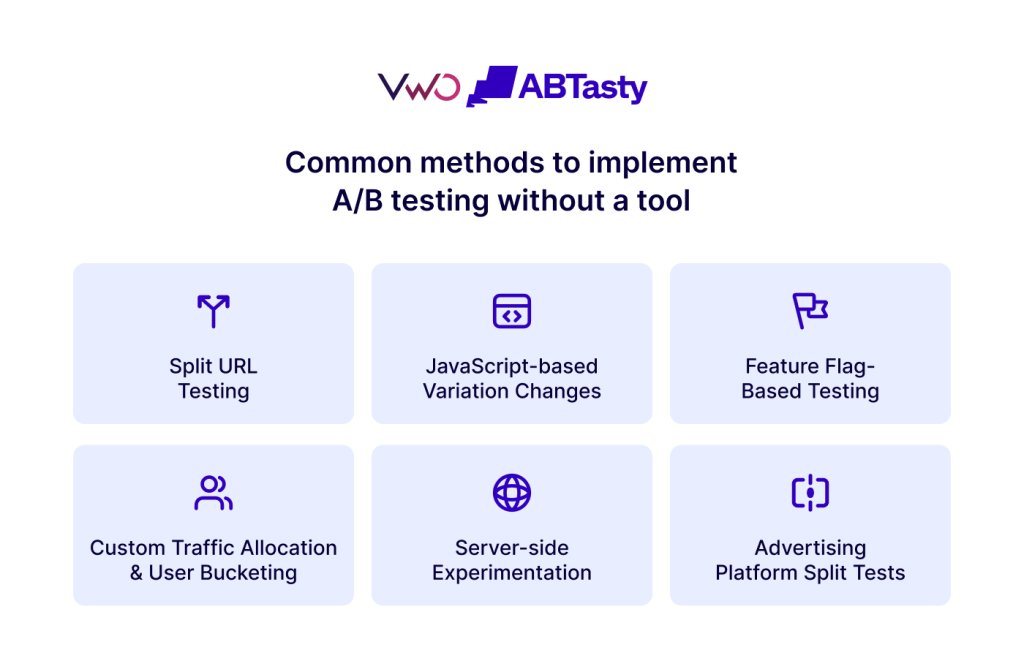
6. Advertising Platform Split Tests
Platforms like Meta Ads and Google Ads offer built-in "Experiments" features. While useful for testing ad creative or landing page efficacy for paid traffic, these tests are siloed and do not account for the behavior of organic visitors.
The Statistical Minefield: Why Manual Tests Often Fail
The most significant risk of manual A/B testing is not the implementation of the change, but the interpretation of the data. Professional experimentation platforms include built-in statistical engines designed to prevent common errors that lead to "false winners."
The Peeking Problem
In manual setups, stakeholders often monitor results daily. If they see a "95% confidence" result on day three, they may be tempted to stop the test. However, statistical significance is not a static milestone; it fluctuates. Stopping a test early because it "looks like a winner" (p-hacking) dramatically increases the probability of a false positive. Professional tools use "Sequential Testing" or "Bayesian" models to allow for continuous monitoring without compromising validity.
Sample Ratio Mismatch (SRM)
SRM occurs when the actual traffic split (e.g., 48/52) deviates significantly from the intended split (50/50). This often indicates a technical bug, such as a specific browser blocking the experiment script. While a 2% difference might seem negligible, it can render the entire dataset mathematically invalid. Manual testers rarely perform the Chi-squared tests necessary to detect SRM.
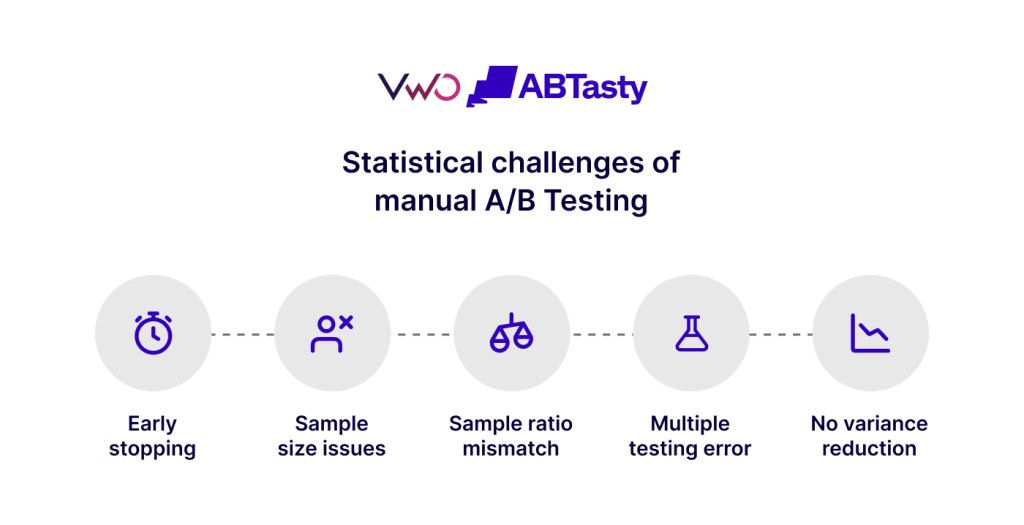
Variance Reduction
Advanced platforms utilize techniques like CUPED (Controlled-experiment Using Pre-Experiment Data) to reduce "noise" in the data. By accounting for how users behaved before the experiment, these systems can reach statistical significance up to 50% faster than manual calculations, which typically rely on standard t-tests.
SEO Implications and Search Engine Compliance
Manual testing can inadvertently trigger search engine penalties if not executed according to Google’s Webmaster Guidelines. Two primary risks stand out:
- Cloaking: If the server shows one version of a page to Googlebot and another to human users to "hide" the experiment, the site may be flagged for cloaking—a deceptive practice that can lead to de-indexing.
- Ranking Signal Dilution: When running Split URL tests, if both versions are indexed, the "link equity" and engagement signals are divided between two URLs. Without a
rel="canonical"tag pointing to the original version, the site’s overall search authority may drop.
The Operational Cost of "Free" Testing
While manual testing avoids software licensing fees, it incurs high "hidden" costs in human capital. An analysis of engineering workflows suggests that manual testing requires significantly more hours for:
- Setup and Deployment: Manually writing the randomization logic for every test.
- Data Cleaning: Manually filtering out internal traffic, bots, and "outliers" (e.g., a single wholesale customer whose massive purchase skews the average order value).
- Analysis: Data scientists spending hours in SQL or Python to calculate uplift and confidence intervals.
- Governance: Keeping track of which tests are running to ensure that two overlapping experiments do not contaminate each other’s results.
Industry experts suggest that once a company reaches a cadence of more than two experiments per month, the cost of engineering hours spent on manual maintenance typically exceeds the cost of a dedicated platform subscription.

Impact and Future Outlook
The industry is currently seeing a move toward "Experimentation Governance." Even companies that continue to use manual methods are beginning to adopt standardized frameworks to ensure data integrity. The rise of open-source tools like GrowthBook and PostHog provides a middle ground, offering the control of a manual setup with the statistical guardrails of a professional platform.
In conclusion, manual A/B testing is a viable starting point for organizations building an experimentation culture. It provides deep technical insights and total control over the user journey. However, the transition to a dedicated platform is an inevitable milestone for any business that intends to use data-driven decision-making as a primary growth lever. The shift from "testing to see what happens" to "scaling a systematic optimization program" requires a level of statistical rigor and operational efficiency that manual processes—no matter how well-engineered—struggle to sustain in the long term.







