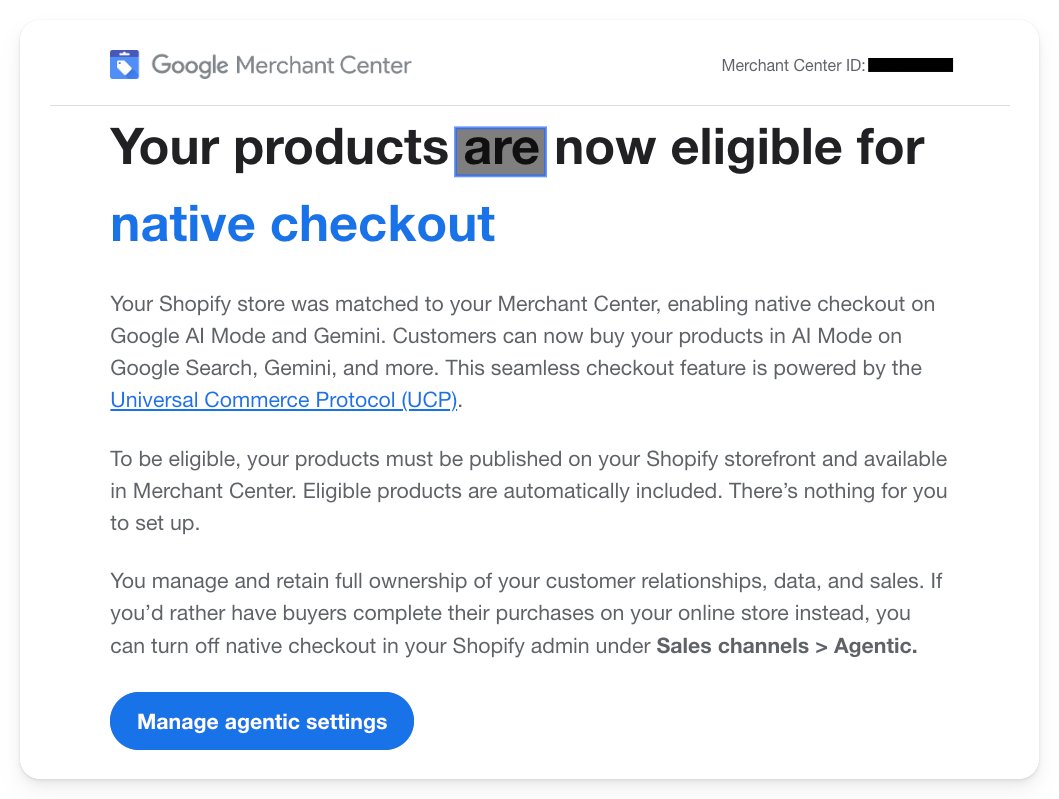
The core of this new capability lies in the Universal Commerce Protocol (UCP), an integration announced by Google in January and subsequently launched for limited merchants in February. Last Friday, Google expanded this UCP-powered checkout to a broader base of retailers, prompting email notifications to Google Merchant Center users whose systems, like Shopify, are already integrated with UCP. These emails inform merchants that their "products are now eligible for native checkout" and are automatically included, highlighting the proactive nature of Google’s enablement. For instance, Menachem Ani, an industry professional, shared an email he received on X (formerly Twitter), confirming that his client’s Shopify store had been matched to their Merchant Center, thereby enabling native checkout on Google AI Mode and Gemini. This allows customers to complete purchases using Google Pay without ever leaving the Google ecosystem, representing a pivotal evolution in how transactions are facilitated online.
The Strategic Imperative: Google’s Evolving Commerce Vision
Google’s foray into direct-to-consumer transactions is not new, but the current implementation through UCP, AI Mode, and Gemini represents a more sophisticated and integrated approach. Historically, Google’s role in e-commerce primarily involved driving traffic to merchant websites through search results and advertising. Initiatives like "Google Shopping" and "Shopping Actions" aimed to centralize product discovery, but the transaction often remained external. The "Buy on Google" program, while allowing direct purchases, faced challenges related to merchant adoption and a perceived lack of control over customer relationships. This latest iteration appears to address some of those concerns by emphasizing merchant ownership of customer data and sales, even as the transaction occurs within Google’s interface.
The broader context for this shift is Google’s strategic pivot towards an AI-first future. With the rise of generative AI models like Gemini and the integration of AI capabilities into Search, Google is transforming from a traditional information retrieval engine into a comprehensive assistant. In this AI-powered paradigm, users expect more than just links; they anticipate direct answers, personalized recommendations, and seamless task completion. Facilitating direct purchases aligns perfectly with this vision, positioning Google as an end-to-end platform for discovery, research, and transaction. By reducing friction points, Google aims to capture a larger share of the rapidly growing global e-commerce market, which is projected to reach over $7 trillion by 2027, according to Statista. This move also intensifies competition with e-commerce giants like Amazon, which has long dominated the direct purchase landscape, and other platforms that offer integrated shopping experiences.
Universal Commerce Protocol: The Technical Backbone
The Universal Commerce Protocol (UCP) is central to Google’s new native checkout system. Introduced earlier this year, UCP is designed to standardize how product data, inventory, pricing, and checkout processes are shared between e-commerce platforms and Google’s services. This protocol aims to overcome the fragmentation often encountered in integrating diverse online retail systems, creating a more cohesive and efficient data flow. For merchants, UCP simplifies the process of making their products discoverable and purchasable across Google’s various surfaces.
Shopify’s early and robust integration with UCP highlights its importance. As one of the world’s leading e-commerce platforms, powering millions of businesses, Shopify’s seamless compatibility with UCP makes a vast catalog of products immediately eligible for native checkout. This partnership underscores Google’s strategy to leverage existing e-commerce infrastructure rather than building it entirely from scratch. The UCP ensures that when a customer initiates a purchase on Google, the necessary product information, inventory status, and order details are accurately and securely transmitted to the merchant’s backend, maintaining data integrity and order fulfillment processes. This technical standardization is crucial for scaling the native checkout feature across a diverse ecosystem of online retailers.
A Phased Rollout and Merchant Notifications
The timeline for this initiative indicates a deliberate and phased approach. Google first announced the UCP integration in January, setting the stage for future commerce capabilities. By February, UCP-powered checkout had soft-launched, available to a limited set of merchants. This initial phase likely served as a testing ground, allowing Google to refine the protocol and integration points. The significant expansion occurred last Friday, as reported, pushing the functionality to a broader array of retailers whose platforms, particularly Shopify, support UCP.
The email notifications sent to Google Merchant Center users are a critical component of this rollout. These messages serve as both an announcement and a directive, informing merchants of the automatic enablement and, crucially, detailing the steps required to opt-out. The email shared by Menachem Ani explicitly states, "Your Shopify store was matched to your Merchant Center, enabling native checkout on Google AI Mode and Gemini. Customers can now buy your products in AI Mode on Google Search, Gemini, and more." This direct communication ensures that merchants are aware of the change, even if it requires them to take action if they wish to opt out. Google has provided clear instructions, noting that merchants can disable native checkout in their Shopify admin under "Sales channels > Agentic." This specific naming, "Agentic," likely refers to the "agent-like" nature of Google’s AI facilitating the transaction on behalf of the user. The screenshot provided in the original reporting further illustrates these steps, ensuring clarity for merchants navigating the new settings.
Implications for Merchants: Opportunities and Challenges
The automatic enablement of native checkout presents a dual-edged sword for online retailers, offering both compelling opportunities and potential challenges.
Opportunities:
- Reduced Friction and Higher Conversion: One of the most significant benefits is the potential for increased conversion rates. By allowing customers to complete purchases directly within Google’s interface, the number of steps in the buying journey is drastically reduced. This frictionless experience can lead to fewer abandoned carts, a persistent problem in e-commerce, with average abandonment rates often exceeding 70% according to studies by the Baymard Institute.
- Expanded Reach and Visibility: Native checkout provides merchants with unprecedented access to Google’s massive user base, particularly within its burgeoning AI-powered interfaces like AI Mode and Gemini. As more users interact with Google through these conversational and assistive modalities, having products directly purchasable within these environments offers a new, highly visible sales channel.
- Leveraging Google’s Trust and Infrastructure: Consumers generally trust Google’s brand and its payment systems like Google Pay. This inherent trust can translate into greater confidence in completing purchases directly through Google, potentially benefiting smaller or less-known brands.
- Simplified Selling for Integrated Platforms: For merchants using platforms like Shopify that have robust UCP integration, the setup is largely automatic, minimizing technical overhead. This ease of integration can lower barriers to entry for businesses looking to expand their sales channels.
Challenges and Considerations:
- Loss of Direct Website Traffic and Data: This is perhaps the most significant concern for many merchants. While Google states that merchants "manage and retain full ownership of your customer relationships, data, and sales," the transaction occurring off-site means customers do not visit the merchant’s dedicated storefront. This can impact website analytics, retargeting efforts, and the ability to capture valuable first-party data directly through website interactions. Merchants rely on website traffic not just for sales but also for brand building, content marketing, and understanding customer behavior through on-site navigation.
- Branding and Customer Experience Control: While the products are theirs, merchants have less control over the visual branding and overall user experience during the native checkout process itself. The transaction will adhere to Google’s interface design, potentially diluting the merchant’s unique brand identity at a crucial stage of the customer journey.
- Default-On Nature and Opt-Out Requirement: The automatic enablement means merchants must be proactive in managing their preferences. For those who prioritize direct website traffic and customer engagement above all else, the need to actively disable the feature adds a layer of administrative burden and could lead to inadvertent adoption if not closely monitored.
- Dependency on Google’s Ecosystem: Increased reliance on Google for sales channels, while offering benefits, also ties merchants more closely to Google’s policies, algorithms, and technical infrastructure. Any changes to these could have significant impacts on sales.
- Impact on SEO Strategies: If a substantial portion of sales shifts to native checkout, it could potentially alter the dynamics of search engine optimization. While product visibility within Google remains high, the reduced direct traffic to merchant websites might influence certain organic ranking signals over time, requiring a re-evaluation of SEO priorities.
Statements and Reactions from the Ecosystem

While official statements directly addressing this specific rollout beyond the email notifications are pending, logical inferences can be drawn about the perspectives of key stakeholders.
Google’s Stance: Based on the communication, Google positions this as an enhancement designed to "enable native checkout" and offer a "seamless checkout feature." The emphasis is on consumer convenience and expanded reach for merchants, with a clear reassurance regarding data ownership: "You manage and retain full ownership of your customer relationships, data, and sales." This messaging aims to alleviate concerns about losing control while highlighting the benefits of a frictionless buying experience.
Shopify’s Perspective: As a key partner with UCP integration, Shopify likely views this as a strategic advantage for its merchants. Their platform’s compatibility ensures that Shopify store owners can easily tap into Google’s new commerce capabilities. Shopify’s mission has always been to empower merchants to sell wherever their customers are, and this integration with Google’s AI-driven commerce fits perfectly within that ethos. They would likely emphasize the expanded sales opportunities and ease of integration for their users.
Merchant Community Sentiment: Initial reactions from the merchant community, as observed in forums and social media like X, are typically mixed. Many are excited by the prospect of increased sales and reduced cart abandonment, recognizing the power of Google’s reach. However, a significant segment expresses apprehension about losing direct customer interaction, controlling the brand experience, and the implications for website analytics and customer relationship management. The default-on nature is a particular point of discussion, with some advocating for an opt-in model to ensure merchants maintain full agency over their sales channels. The general consensus appears to be a cautious optimism, with merchants keen to understand the full impact on their business models.
Broader Market Impact and Future Outlook
This move by Google is poised to have a ripple effect across the broader e-commerce landscape. It intensifies the competitive dynamic between Google and Amazon, as both vie to be the primary gateway for online purchases. Google’s advantage lies in its dominant position in search and its rapidly advancing AI capabilities, allowing it to integrate commerce directly into the discovery phase of the buying journey. For other e-commerce platforms and payment providers, UCP could emerge as a de facto standard, compelling them to adapt their integrations to remain competitive and ensure their merchants have access to Google’s ecosystem.
The role of AI in shaping future commerce is undeniable. As AI models become more sophisticated in understanding user intent and preferences, direct purchasing within AI interfaces is likely to become increasingly prevalent. This could lead to a future where transactional queries are handled almost entirely within AI assistants, further blurring the lines between search, discovery, and purchase.
However, potential challenges remain. Regulatory bodies worldwide are increasingly scrutinizing the market power of large tech companies. Google’s move into direct transactions, especially with a default-on approach, could attract attention regarding fair competition and merchant autonomy. Ensuring transparency, providing clear controls, and demonstrating tangible benefits for merchants will be crucial for Google to navigate this evolving regulatory environment. Ultimately, the success of native checkout will depend on its ability to genuinely empower merchants with more sales while addressing their legitimate concerns about brand control, data ownership, and direct customer relationships in an increasingly AI-driven commerce world.