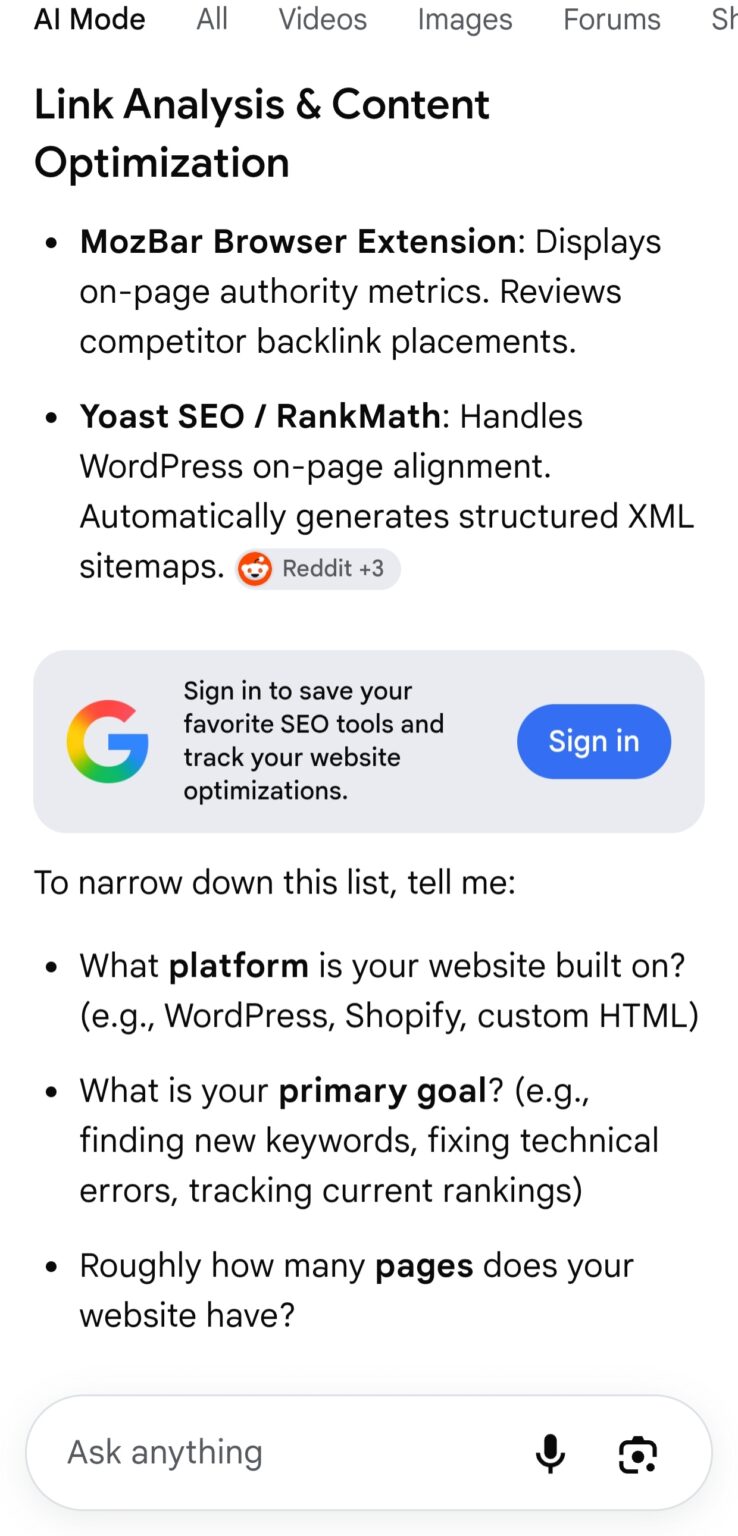
Google is currently experimenting with a new feature within its AI Mode, prompting users to sign in to their Google accounts when interacting with AI-generated search responses. This development, observed in a limited test, presents a significant shift towards more personalized and potentially data-rich AI interactions within the world’s dominant search engine. The prompt, featuring a prominent Google logo and a "Sign in to save your…" button, suggests a move to integrate AI-driven search results more deeply into individual user profiles.
The test was initially brought to light by Sachin Patel, who shared screenshots and observations on social media platform X (formerly Twitter) and via Search Engine Watch. These early reports indicate that upon receiving an AI-generated response, a distinct overlay appears, encouraging users to log in. While the precise functionalities unlocked by signing in are not yet universally confirmed or replicable, the implication is that users would gain the ability to save their AI interactions, access historical conversations, and potentially receive more contextually relevant and "smarter" AI responses in subsequent queries, particularly those related to specialized tools or recurring interests. The limited nature of the rollout suggests Google is gathering data and feedback before a broader deployment.
The Evolution of AI in Search: A Contextual Overview
This latest test comes amidst Google’s ambitious push to integrate generative AI capabilities across its product ecosystem, most notably with the introduction of the Search Generative Experience (SGE). SGE aims to transform traditional search by providing synthesized, conversational answers directly within the search results page, moving beyond a simple list of links. This initiative is Google’s strategic response to the burgeoning field of generative AI, spearheaded by competitors like OpenAI’s ChatGPT and Microsoft’s Copilot, which have redefined user expectations for digital information retrieval.
Google’s journey with AI in search is not new; it has been leveraging machine learning for ranking, understanding queries, and personalizing results for over a decade. From RankBrain to MUM (Multitask Unified Model), AI has incrementally enhanced Google’s ability to process complex queries and provide more nuanced answers. SGE, however, marks a more overt and interactive integration of generative AI. The current sign-in prompt within AI Mode can be seen as a natural progression in this journey, aiming to elevate the AI experience from a generic interaction to a highly personalized one. By linking AI conversations to a user’s Google account, the system gains access to a wealth of historical data, preferences, and previous interactions, allowing for a more tailored and continuous experience.

Driving Personalization: Why Google Wants You to Sign In
The primary motivation behind prompting users to sign in for AI Mode is likely multi-faceted, centered around enhancing the user experience, enriching data collection, and strengthening Google’s competitive edge.
Enhanced User Experience:
For users, signing in could unlock a more powerful and coherent AI experience. Imagine asking a question about a complex topic, receiving an AI summary, and then, in a subsequent session, being able to refer back to that conversation or build upon it without repeating context. This continuity is a significant advantage, especially for research, planning, or learning. Personalized AI responses can also factor in a user’s location, language preferences, past search history, and even their interactions with other Google services (like Calendar, Gmail, or Maps) to provide highly relevant and actionable insights. For instance, an AI planning a trip could suggest activities based on previous travel interests saved in Google Photos or calendar entries.
Richer Data Collection and Model Training:
From Google’s perspective, signed-in AI interactions offer an invaluable source of data. While Google already collects vast amounts of data from logged-in users, tying AI conversations directly to user profiles provides an even deeper understanding of individual needs, preferences, and information-seeking behaviors. This data can be crucial for:
- Improving AI Models: The more personalized and context-rich interactions Google’s AI models can analyze, the better they can learn and adapt to diverse user needs, leading to more accurate, nuanced, and helpful responses over time.
- Targeted Advertising: A deeper understanding of user intent derived from AI conversations could refine ad targeting, making advertisements more relevant and effective for both users and advertisers.
- Cross-Service Integration: Signed-in AI data could enable seamless integration with other Google products, creating a more cohesive and intelligent ecosystem.
Competitive Advantage:
In the rapidly evolving AI landscape, personalization is a key differentiator. Many advanced AI chatbots, such as custom GPTs within ChatGPT or specialized Copilot features, already require user accounts to save conversations and tailor experiences. By offering a similar, deeply integrated personalized AI search experience, Google can maintain its leadership position and prevent users from migrating to alternative AI platforms for more sophisticated interactions. This move ensures that Google remains at the forefront of AI innovation in a highly competitive market.
Implications for Users: Benefits and Privacy Concerns
The introduction of a sign-in requirement for enhanced AI Mode presents a mixed bag of benefits and potential concerns for users.
Potential Benefits:
- Persistent Memory: The ability to save AI conversations allows users to pick up where they left off, revisit past queries, and track the evolution of their research or creative processes.
- Contextual Relevance: Over time, the AI can learn individual preferences, previous questions, and even communication styles, leading to more relevant, accurate, and satisfying answers.
- Seamless Integration: Future iterations could see AI Mode deeply integrated with other Google services, allowing for actions like "add this event to my calendar" or "draft an email based on this information" directly from the AI response.
- Proactive Assistance: With a better understanding of user patterns, the AI could potentially offer proactive suggestions or information even before a direct query is made.
Privacy and Data Concerns:
The flip side of enhanced personalization is the increased collection and linkage of personal data. Users might express concerns regarding:
- Data Aggregation: The fear that an ever-growing repository of personal data, including sensitive AI conversations, could be used in ways they don’t anticipate or consent to.
- Filter Bubbles: Overly personalized AI responses might inadvertently create "filter bubbles," limiting exposure to diverse viewpoints or information that doesn’t align with past preferences.
- Security Risks: Centralizing more personal data within a single account increases the potential impact of a data breach, should one occur.
- Transparency and Control: Users may demand greater transparency on what data is collected, how it’s used, and robust controls over their personal information and AI interaction history.
Google has a history of addressing privacy concerns through user controls and privacy policies, and it would be expected to emphasize these aspects if the sign-in prompt becomes a permanent feature. However, the balance between utility and privacy will remain a critical consideration for user adoption.
Implications for Publishers and Search Engine Optimization (SEO)
For website publishers, content creators, and SEO professionals, Google’s move towards a signed-in, personalized AI Mode introduces several significant considerations and potential shifts in strategy.
Traffic Diversion and Zero-Click Searches:
If AI Mode becomes highly effective at summarizing information and providing direct answers, especially for signed-in users who receive tailored responses, it could further contribute to "zero-click searches." This means users get their answers directly from Google’s AI, reducing the need to click through to external websites. For publishers reliant on organic search traffic, this trend could impact website visits and, consequently, advertising revenue.

SEO Strategy Evolution:
Traditional SEO has focused on ranking for keywords and optimizing for click-through rates. With a personalized AI, the emphasis might shift towards:
- Content Quality and Authority: The AI is likely to prioritize highly authoritative, well-researched, and comprehensive content to synthesize its answers. Publishers might need to focus even more on becoming definitive sources of information.
- Entity-Based SEO: Ensuring that content clearly defines entities (people, places, things, concepts) and their relationships could become more crucial, as AI models excel at understanding and connecting these entities.
- Schema Markup: Structured data (schema markup) could play an even more vital role in helping AI models accurately understand the content and context of a webpage, making it easier for them to extract and present information.
- Direct Answer Optimization: Content might need to be structured in a way that provides clear, concise answers to common questions, making it easier for the AI to pull out snippets for its generative responses.
Data Siloing and Competitive Landscape:
A personalized AI experience could lead to a greater "siloing" of user data within Google’s ecosystem. If user preferences and interactions are primarily leveraged to improve Google’s AI, it might further entrench Google’s position as the primary gateway to information, potentially at the expense of independent publishers who rely on data to understand their audience. The challenge for publishers will be to find new ways to demonstrate value and attract users directly, or to adapt their strategies to be prominently featured within Google’s AI responses.
Expert Analysis and Industry Reactions (Inferred)
While no official statements from Google specifically on this sign-in test have been released, and reactions from industry experts are yet to fully materialize, we can infer potential perspectives:
SEO Analysts: Many SEO professionals would likely view this as another layer of complexity in an already dynamic field. The consensus might be that while core SEO principles (quality content, technical soundness) remain important, a deeper understanding of AI’s interpretive capabilities and user intent will be paramount. Discussions would likely revolve around how to "optimize for AI" rather than just for algorithms. There would also be a push for more transparency from Google on how personalization impacts AI rankings and visibility.
Privacy Advocates: Groups focused on digital privacy would likely voice concerns over the expansion of personalized data collection. They would emphasize the need for clear opt-out mechanisms, robust data governance, and user education regarding the implications of signing in for AI features. The debate around data ownership and control would intensify.

Google’s Internal Perspective (Inferred): Google would likely frame this initiative as a natural evolution towards a more helpful and intuitive search experience. Their public messaging would probably highlight user benefits like efficiency, relevance, and continuity, while reassuring users about their commitment to privacy and data security through established controls and policies. They would emphasize that personalization is key to delivering on the promise of truly intelligent AI.
Broader Market Context and Future Outlook
The AI sign-in prompt reflects a broader trend in the tech industry: the race to deliver personalized, intelligent assistance across all digital touchpoints. Companies are investing heavily in making AI not just a tool, but a companion that understands individual needs and preferences. This move by Google is an indication of its long-term vision for search, which is moving beyond a simple query-and-response model to a more interactive, conversational, and deeply integrated AI assistant.
This test signals Google’s commitment to making its AI Mode a central, indispensable part of the user experience. It hints at a future where search is less about finding links and more about engaging in an ongoing dialogue with an intelligent system that understands context, remembers past interactions, and provides highly tailored insights. The success of this approach will hinge on Google’s ability to balance the immense utility of personalization with legitimate user concerns about privacy and data control. As this and other AI experiments continue, the digital landscape for users, publishers, and marketers alike is set for a profound transformation, with personalization at its very core.