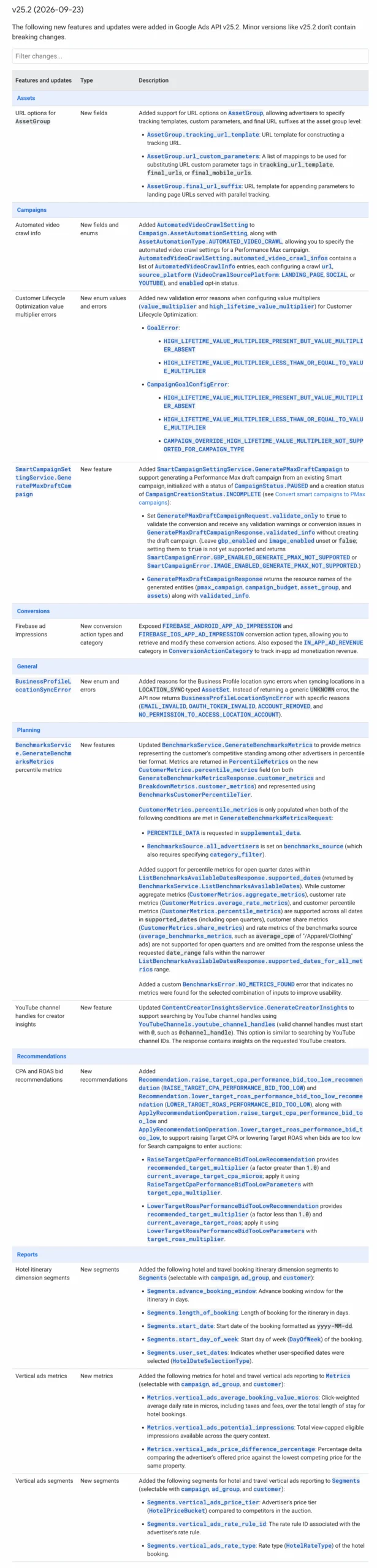
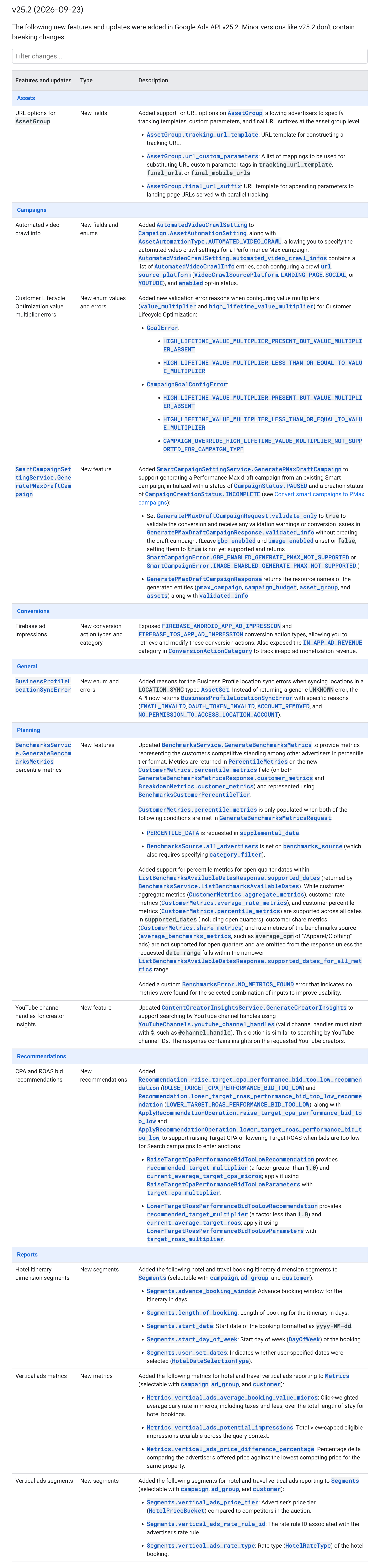
Google has officially rolled out version 25.2 of its Google Ads API, a minor but significant update that introduces a suite of new functionalities designed to empower developers, advertisers, and marketing technology platforms with enhanced control, deeper insights, and greater automation capabilities. This release, announced on September 23, 2026, continues Google’s consistent commitment to refining its programmatic interface for its vast advertising ecosystem. The update specifically features competitive benchmarks percentile metrics, the ability to generate Performance Max drafts directly from Smart campaigns, expanded asset group URL options, and advanced Search bid adjustment recommendations, among other improvements. Developers are advised to update their client libraries and code promptly to leverage these new features, as detailed in the official Google Ads Developers Blog.
Unpacking the Enhancements in Version 25.2
The latest iteration of the Google Ads API, version 25.2, introduces several key features that address critical needs within the digital advertising landscape, focusing on competitive intelligence, campaign migration, granular control, and automated optimization. Each addition reflects Google’s strategic push towards more intelligent, efficient, and data-driven advertising.
Competitive Benchmarks Percentile Metrics: This new capability provides advertisers with a more nuanced understanding of their performance relative to competitors. Traditional competitive benchmarks often offer aggregate averages, which can sometimes mask the full spectrum of market performance. By introducing percentile metrics, the API now allows users to see where their campaigns stand across various performance indicators—such as click-through rates, conversion rates, or cost-per-acquisition—in comparison to other advertisers within the same industry or keyword set. For instance, an advertiser might discover their campaign is performing at the 75th percentile for click-through rate, indicating strong ad copy and targeting, but only at the 25th percentile for conversion rate, suggesting issues with landing page experience or post-click funnel. This granular insight, derived from anonymized and aggregated data across the Google Ads platform, is invaluable for strategic adjustments, allowing advertisers to identify areas of strength to leverage and weaknesses to address, thereby sharpening their competitive edge in a highly saturated market.
Performance Max Drafts from Smart Campaigns: One of the most anticipated features in this release is the ability to generate Performance Max drafts directly from existing Smart campaigns. Performance Max (PMax) campaigns represent Google’s most advanced, AI-driven, and goal-based campaign type, designed to maximize conversions across all Google channels (Search, Display, YouTube, Gmail, Discover). Smart campaigns, conversely, are simpler, more automated solutions often favored by small businesses or those new to Google Ads, offering ease of use with less manual control. The new API functionality streamlines the migration path for advertisers looking to transition from the simpler Smart campaign structure to the more sophisticated and expansive capabilities of Performance Max. This feature facilitates experimentation and adoption of PMax by allowing advertisers to create a draft configuration based on their proven Smart campaign settings. This not only saves significant time and effort in manually recreating campaigns but also enables A/B testing and iterative optimization, ensuring a smoother transition and maximizing the potential of Google’s latest AI-powered advertising solutions without disrupting live campaigns.
Asset Group URL Options: Asset groups are fundamental components of Performance Max campaigns, comprising all the creative elements (headlines, descriptions, images, videos) and audience signals that Google’s AI uses to generate dynamic ads across various placements. With version 25.2, the API now provides enhanced URL options for these asset groups. Previously, URL options might have been more constrained, limiting advertisers’ ability to precisely control where users land after clicking an ad. The expanded URL options now offer greater flexibility for deep linking, specifying different landing pages based on context, or implementing sophisticated tracking parameters. This granular control is crucial for advertisers managing complex campaigns, ensuring that users are directed to the most relevant and optimized landing pages, which directly impacts conversion rates and user experience. It also allows for more precise measurement and attribution, integrating seamlessly with broader analytics strategies.
Search Bid Adjustment Recommendations: Bid adjustments are a cornerstone of effective campaign optimization, allowing advertisers to modify bids based on various factors such as device, location, time of day, or audience segment. The new API version introduces Search bid adjustment recommendations, leveraging Google’s machine learning to suggest optimal bid modifications. Instead of advertisers manually analyzing performance data to determine where to increase or decrease bids, the API can now provide data-driven recommendations. These recommendations are based on vast amounts of historical performance data, predictive analytics, and real-time market signals. This feature enhances efficiency and accuracy in bid management, helping advertisers maximize their return on ad spend (ROAS) by allocating budget more effectively. For agencies managing hundreds or thousands of campaigns, programmatic access to these recommendations through the API translates into significant time savings and performance improvements that would be impossible to achieve through manual oversight alone.
The Foundational Role of the Google Ads API
The Google Ads API serves as a critical bridge between Google’s massive advertising platform and the sophisticated tools and systems developed by agencies, large advertisers, and marketing technology companies. At its core, the API provides programmatic access to Google Ads data and functionality, allowing users to build custom applications that interact directly with their advertising accounts. This includes everything from automating campaign creation and management to generating highly customized reports, integrating ad data with business intelligence (BI) platforms, and implementing advanced bidding strategies that go beyond the native Google Ads interface.
For enterprises managing thousands of campaigns, millions of keywords, and billions in ad spend, manual operation is simply not feasible. The API enables automation at scale, reducing human error, saving countless hours, and unlocking efficiencies that directly impact profitability. Marketing technology platforms, in particular, rely heavily on the API to power their own offerings, such as bid management software, creative optimization tools, and comprehensive analytics dashboards, offering added value to their clients who might not have the in-house expertise or resources to build such systems themselves. The strategic importance of the API cannot be overstated; it is the backbone of advanced digital advertising operations, facilitating innovation and customization in an increasingly complex and competitive landscape.
A Chronology of Consistent Development
Google’s release of version 25.2 is part of a relentless and rapid development cycle for the Google Ads API, demonstrating the company’s continuous investment in its programmatic interface. The history of the API is marked by frequent updates, both minor and major, reflecting the dynamic nature of digital advertising and Google’s commitment to providing developers with the tools they need.
The cadence of releases has been remarkably consistent, with major versions often appearing every two to four months, interspersed with minor updates like v25.2. For context, the immediate predecessors to v25.2 included:
- v25.1 in August 2026
- v25.0 in July 2026 (a major release, typically introducing more significant changes or potential breaking changes)
- v24.2 in June 2026
- v24.1 in May 2026
- v24.0 in April 2026
- v23.2 in March 2026
- v23.1 in February 2026
- v23.0 at the end of January 2026
- v22.0 on October 15, 2025
- v21.0 on August 6, 2025
- v20.0 on June 5, 2025
- v19.1 in April 2025
- v19.0 in February 2025
- v18.0 in October 2024
- v17.1 in August 2024
- v17.0 in June 2024
- v16.1 and v16.0 in February 2024
- v15.0 in October 2023
- v14.1 in August 2023
- v13.1 in April 2023
- v13.0 in February 2023
- v12.0 in October 2022
- v11.1 in August 2022
- v11.0 in June 2022
- v10.1 on April 27, 2022
- v10.0 on February 9, 2022
This extensive chronology underscores a pattern of continuous improvement and adaptation. Each major version typically introduces foundational changes, new resource types, or significant feature sets, while minor versions usually add incremental features, refine existing functionalities, or address specific developer feedback without introducing breaking changes. This rapid iteration cycle ensures that the API remains current with Google Ads platform innovations, such as the introduction and evolution of Performance Max campaigns, enhanced reporting capabilities, and new ad formats.
A pivotal moment in this timeline was the sunset of the legacy AdWords API. On April 27, 2022, the AdWords API was officially deprecated, with complete functionality ceasing by the end of July 2022. This transition marked a significant architectural shift, moving to the more modern Google Ads API which offered improved performance, a more consistent design based on gRPC and REST principles, and better alignment with Google’s broader cloud ecosystem. The sunsetting forced a complete migration for all developers and platforms, highlighting Google’s strategy to move towards a more robust and scalable API infrastructure capable of supporting the increasing complexity and demands of modern digital advertising. This historical context illustrates Google’s long-term vision for programmatic advertising and its commitment to providing a powerful, evolving toolset.
Official Stance and Developer Mandates
Google’s communication regarding API updates is consistently delivered through its Google Ads Developers Blog, serving as the primary channel for official announcements and technical guidance. For version 25.2, Google explicitly stated, "Today we are announcing the release of v25.2 of the Google Ads API. To use the new capabilities, you must upgrade your client libraries and client code. All the updated client libraries and code examples have been published."
This directive is standard practice for API releases. The requirement to upgrade client libraries (Software Development Kits or SDKs) and client code is essential for developers to access the newly implemented features and to ensure compatibility with the latest API version. These libraries, available in multiple programming languages, abstract away much of the complexity of interacting with the API, making it easier for developers to integrate new functionalities into their applications. Google also provides updated code examples, which are critical resources for developers to understand how to implement the new features correctly.
The emphasis on upgrading underscores a critical aspect of API development: maintaining a synchronized ecosystem. As Google continually evolves its advertising platform, the API must keep pace. Developers who fail to update risk their applications becoming outdated, potentially losing access to new features or encountering compatibility issues with future API changes. This ongoing dialogue between Google and its developer community ensures that the tools and resources are always available to facilitate seamless integration and innovation.
Broader Implications and Future Outlook
The release of Google Ads API version 25.2 carries significant implications for the entire digital advertising ecosystem, reinforcing several key trends and offering a glimpse into the future of programmatic advertising.
Enhanced Automation and Efficiency: The new features, particularly the Search bid adjustment recommendations and the ability to generate Performance Max drafts, directly contribute to greater automation and operational efficiency. For agencies and large advertisers, this means less time spent on manual configuration and optimization, freeing up resources to focus on higher-level strategic planning and creative development. The drive towards AI-powered recommendations signals a future where machines handle more of the tactical execution, allowing human advertisers to leverage their creativity and strategic insights more effectively. This shift is crucial for managing the sheer scale and complexity of modern digital campaigns, which often involve thousands of ad groups, millions of keywords, and dynamic creative assets across multiple channels.
Deeper Competitive Intelligence: The introduction of competitive benchmarks percentile metrics highlights the increasing importance of competitive intelligence in digital marketing. In a highly saturated online advertising environment, understanding one’s position relative to competitors is paramount. These new metrics empower advertisers to make more informed decisions about their budget allocation, targeting strategies, and creative messaging, fostering a more data-driven approach to gaining market share. This trend is likely to continue, with future API versions potentially offering even more sophisticated competitive analysis tools.
Seamless Transition to AI-Powered Campaigns: The facilitated migration from Smart campaigns to Performance Max via API drafts signifies Google’s continued push towards its most advanced, AI-first campaign types. Performance Max represents the future direction of Google Ads, leveraging machine learning to optimize performance across all Google properties. By making it easier for developers and advertisers to adopt PMax programmatically, Google is accelerating the transition towards a more automated and intelligent advertising paradigm. This also implies that future API developments will likely focus on providing even more granular control and reporting capabilities for these AI-driven campaigns, as advertisers seek to understand and influence their black-box nature.
The Indispensability of Programmatic Access: The continuous and rapid updates to the Google Ads API underscore the indispensability of programmatic access for professional advertisers and marketing technology providers. In an era where digital ad spend is measured in hundreds of billions globally, and where campaign strategies are increasingly complex, relying solely on manual interfaces is no longer viable for enterprise-level operations. The API acts as an enabler for innovation, allowing third-party platforms to build specialized tools that cater to niche needs, integrate with broader enterprise resource planning (ERP) or customer relationship management (CRM) systems, and deliver bespoke reporting solutions. The robustness and flexibility of the API are critical for maintaining a vibrant ecosystem of third-party solutions that complement and extend the capabilities of the core Google Ads platform.
Looking ahead, future versions of the Google Ads API are likely to deepen integration with emerging technologies like privacy-centric measurement solutions, further enhancements to AI and machine learning capabilities for predictive analytics, and expanded support for new ad formats or commerce features as the digital landscape evolves. The consistent development cycle ensures that the API remains a cutting-edge tool for anyone serious about leveraging Google Ads at scale. The ongoing forum discussion on platforms like X (formerly Twitter) further indicates the active community of developers and advertisers eager to adopt and discuss these innovations, reflecting the API’s vital role in the digital marketing world.