Google Business Profiles (GBP) is piloting a transformative new feature designed to allow businesses to automatically set their operating hours by simply describing them in natural language text. This innovative tool leverages artificial intelligence (AI) to interpret free-form descriptions and convert them into a structured format, which is then prominently displayed on local panels within Google Search and Google Maps. This development represents a significant step towards simplifying administrative tasks for small and medium-sized enterprises (SMEs), enhancing the accuracy of local business information, and ultimately improving the user experience for millions of consumers globally.
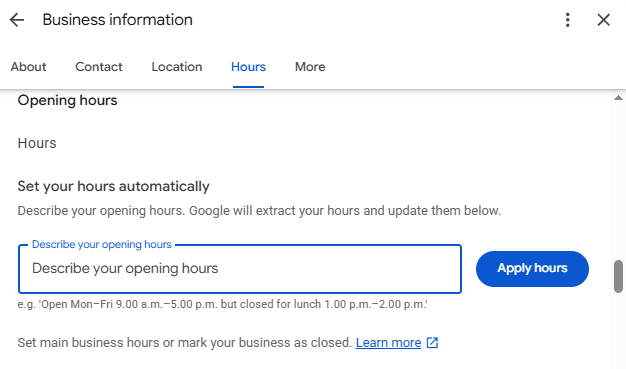
The functionality was first brought to public attention by Ayman Ali, who shared a screenshot of the feature on X (formerly Twitter). Ali noted, "This feature is really cool and it will help merchant set accurate business hours and they do not have to set opening hours of each day manually so user experience will be much better now." The screenshot depicts a prompt stating, "Set your hours automatically – Describe your opening hours. Google will extract your hours and update them below." This intuitive interface promises to alleviate the common burden of manually inputting daily schedules, a task that can be particularly time-consuming for businesses with complex or fluctuating operating hours. Once the description is provided, Google’s AI is designed to automatically apply these hours to the business’s listing, subject to a likely review and confirmation step by the business owner.
The Chronic Challenge of Accurate Business Hours and the Need for Automation
For years, maintaining accurate and up-to-date business information on platforms like Google Business Profiles has been a persistent challenge for merchants and a frequent source of frustration for consumers. Traditional methods require businesses to navigate a dashboard and manually input specific opening and closing times for each day of the week. This process becomes even more cumbersome when factoring in special hours for holidays, seasonal changes, or temporary closures due to unforeseen circumstances.
The repercussions of inaccurate hours are significant. A study by BrightLocal in 2023 indicated that 86% of consumers use Google to find local businesses, and incorrect information, especially regarding operating hours, is a primary reason for customer dissatisfaction and lost business. A consumer arriving at a closed establishment due to outdated online information is not only inconvenienced but also likely to form a negative impression of the business and the platform that provided the erroneous data. This can lead to missed sales opportunities, negative reviews, and a damaged brand reputation. According to Google’s own data, businesses with complete and accurate GBP listings are 70% more likely to attract local visits and 50% more likely to lead to a purchase. The sheer volume of businesses listed on Google—estimated to be over 200 million globally—underscores the magnitude of the data accuracy problem and the potential impact of a feature that streamlines this crucial aspect of business management.
A Chronological Perspective: Google’s Evolution in Local Search and AI Integration
The introduction of this AI-powered hours setting feature is not an isolated development but rather a logical progression in Google’s long-standing commitment to enhancing its local search offerings and integrating artificial intelligence across its ecosystem. Google’s journey in local business listings began with "Google Local Business Center," evolving into "Google Places," then "Google My Business," and finally, the current "Google Business Profiles." Each iteration has aimed to empower businesses with more control over their online presence and provide consumers with more relevant and reliable local information.
Early versions of these platforms focused on basic listing details, photos, and reviews. Over time, features like appointment booking, messaging, Q&A sections, and post creation were added, transforming GBP into a comprehensive digital storefront. The underlying theme has always been to reduce friction for both businesses and consumers.
Concurrently, Google has been at the forefront of AI and machine learning research and application. Its advancements in Natural Language Processing (NLP) are evident in everything from Google Search results to Google Assistant and Gmail’s Smart Reply. Applying NLP to interpret free-form text descriptions of business hours is a natural extension of this expertise. This move aligns with a broader industry trend where AI is increasingly being deployed to automate repetitive tasks, interpret complex data patterns, and enhance user interactions across various digital platforms. The ability to parse human language and translate it into structured data points is a core AI capability that is now being directly applied to a critical business function.
How the AI Feature is Expected to Operate
The core mechanism of the new feature revolves around the sophisticated capabilities of AI, specifically Natural Language Processing (NLP). When a business owner inputs a descriptive text—such as "We’re open Monday to Friday, 9 AM to 6 PM, Saturdays from 10 AM to 4 PM, and closed on Sundays and major holidays"—the AI system processes this unstructured information. It identifies key temporal entities, days of the week, and time ranges, then translates them into the precise, structured data format required by Google’s systems.
This process involves several layers of AI interpretation:
- Entity Recognition: Identifying "Monday," "Friday," "9 AM," "6 PM," "Saturdays," "10 AM," "4 PM," "Sundays," "major holidays" as distinct entities.
- Relationship Extraction: Understanding the relationships between these entities, such as "Monday to Friday" indicating a range, and specific times applying to specific days.
- Contextual Understanding: Differentiating between standard operating hours and specific conditions like "closed on Sundays."
- Formatting: Converting the interpreted information into a standardized, machine-readable format that can populate the daily slots in the GBP dashboard (e.g., Monday: 09:00-18:00, Tuesday: 09:00-18:00, etc.).
Crucially, the system is expected to offer a preview of the interpreted hours, allowing the business owner to review and confirm the AI’s output before it goes live. This human-in-the-loop approach ensures accuracy and provides a safeguard against potential misinterpretations by the AI, especially for highly nuanced or irregular schedules. For instance, a business might specify "open late on Thursdays until 9 PM" or "closed for lunch between 1 PM and 2 PM daily," which the AI would need to accurately parse and apply.
Broader Implications for Small Businesses and the Local Search Ecosystem
The implications of this feature extend far beyond mere convenience. For small business owners, who often juggle multiple responsibilities from operations to marketing, any tool that saves time is invaluable. This AI-powered automation can significantly reduce the administrative overhead associated with managing their online presence. Instead of painstakingly entering data for each day, owners can provide a single, natural language description, freeing up valuable time that can be redirected to core business activities like customer service, product development, or staff training.
- Enhanced Accuracy and Reliability: By simplifying the input process, businesses are more likely to keep their hours updated, leading to a higher degree of accuracy across Google’s platform. This fosters greater trust among consumers and reinforces Google’s position as a reliable source of local information.
- Reduced Barrier to Entry: For less tech-savvy business owners, the manual process of setting hours can be intimidating. A conversational, text-based input method lowers this barrier, encouraging more businesses to fully optimize their GBP listings.
- Improved User Experience for Consumers: Consumers benefit directly from more accurate information. Fewer wasted trips to closed stores or restaurants translate into a more positive experience, reducing frustration and increasing satisfaction with local search results.
- Data Quality for Google: From Google’s perspective, this feature contributes to a richer and more reliable dataset for local businesses. High-quality data is foundational to its search algorithms and enhances the overall utility of its Maps and Search products.
- Competitive Landscape: Businesses that embrace such tools to maintain impeccable online profiles gain a competitive edge. In a saturated market, even small details like accurate opening hours can differentiate a business and drive customer traffic.
Potential Challenges and Considerations
While the benefits are substantial, the implementation of such a feature will inevitably face certain considerations and potential challenges:
- Complexity of Schedules: While effective for standard hours, the AI’s ability to accurately interpret highly complex or frequently changing schedules (e.g., event-based hours, variable staff-dependent hours, pop-up shop schedules) will be critical. Businesses will still need to verify the AI’s interpretation diligently.
- Holiday and Special Hours Integration: It remains to be seen how seamlessly this feature will integrate with existing mechanisms for setting special hours (e.g., for public holidays). Will a single natural language input be able to manage both regular and special hours, or will the latter still require manual input?
- Multilingual Support: As a global platform, Google will need to ensure the AI can accurately interpret business hour descriptions in various languages and regional nuances.
- Trust and Verification: Despite the automation, businesses must maintain vigilance in reviewing the AI-generated hours. A "set it and forget it" mentality could still lead to inaccuracies if the initial description was unclear or if the AI made an error.
Industry Reactions and Expert Perspectives
While no official statements regarding this specific test have been released by Google beyond its internal testing, industry observers and small business advocates are likely to view this development positively. Local SEO specialists, for instance, have long advocated for tools that make data management easier for their clients. This feature could free up their time from routine data entry to focus on more strategic optimization efforts.
From Google’s perspective, this initiative aligns perfectly with its stated mission to organize the world’s information and make it universally accessible and useful. By simplifying the data input process for businesses, Google strengthens the reliability of its own information ecosystem, reinforcing its dominance in local search. It also underscores Google’s ongoing commitment to supporting small businesses by providing tools that enhance their digital presence and operational efficiency.
The Future Trajectory: AI’s Role in Business Management
This AI-powered hours setting feature is indicative of a broader trend: the increasing integration of artificial intelligence into routine business operations. As AI technology matures, we can anticipate more sophisticated tools that handle complex scheduling, inventory management, customer service interactions, and even personalized marketing content generation. The goal is to create an "ambient computing" environment where AI performs mundane yet critical tasks in the background, allowing human professionals to focus on strategic thinking, creativity, and direct customer engagement.
The ability to translate natural language into structured data is a foundational AI capability that opens doors to many other applications. Imagine a future where businesses can verbally instruct an AI to update prices, modify service offerings, or even respond to common customer queries, all with minimal manual intervention. This initial step with business hours, while seemingly small, is a powerful demonstration of how AI can fundamentally reshape the administrative landscape for businesses of all sizes.
Conclusion
The pilot program for Google Business Profiles’ AI-powered automatic hours setting marks a pivotal moment in the evolution of local search and small business management. By leveraging advanced artificial intelligence to interpret natural language descriptions, Google is poised to significantly reduce the administrative burden on business owners, enhance the accuracy of critical local information, and deliver a superior experience for consumers. While challenges related to complex schedules and verification will need to be addressed, this innovation underscores Google’s commitment to empowering businesses and streamlining digital interactions. As this feature rolls out more broadly, it is expected to become a cornerstone of efficient online business presence management, setting a new standard for how local businesses interact with the digital world and how consumers discover the services they need.