Basiran
Gmail, long considered the gold standard for email deliverability with consistently superior inbox placement rates (IPRs), has experienced an unprecedented and dramatic decline in its performance, sending shockwaves through the digital marketing landscape. This abrupt shift, revealed in recent industry benchmarks, poses a significant threat to businesses, particularly as the critical Black Friday and holiday shopping season approaches. The world’s largest mailbox provider (MBP) has seen its deliverability plummet, forcing marketers and leadership alike to urgently re-evaluate their email strategies.
The Unprecedented Decline: A Deep Dive into the Data
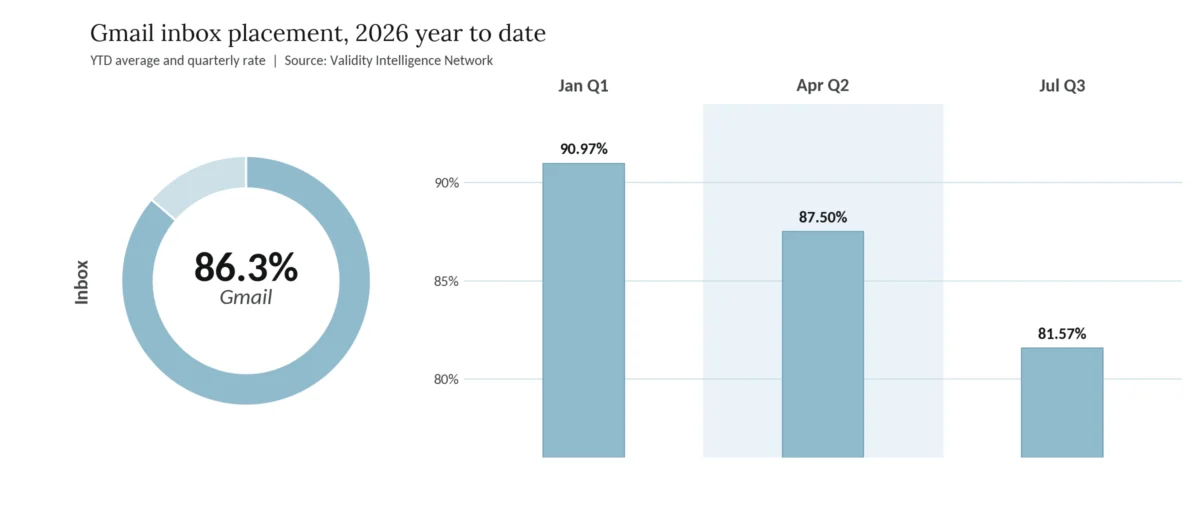
Historically, Gmail has consistently topped deliverability leaderboards. Validity’s comprehensive 2025 email deliverability benchmark report, for instance, placed Gmail at the pinnacle with an impressive 89.8 percent average inbox IPR. This performance comfortably outranked competitors, with Yahoo trailing at 87.3 percent and Microsoft at 77.4 percent. The trend of strong performance continued into the first quarter of 2026, where Gmail’s average IPR even saw a slight increase to 90.97 percent, reinforcing its seemingly unshakeable position.
However, the third quarter of 2026 painted a starkly different picture. The data indicates a precipitous fall, with Gmail’s average IPR dropping to 81.57 percent. This represents a staggering 9.4 percentage point reduction in a mere two quarters, marking the most significant and rapid decline observed for the platform in recent memory. Such a shift is not merely a statistical anomaly; it signals a fundamental change in how Gmail processes and delivers incoming email, with profound implications for senders.
Digging deeper into the underlying metrics reveals the mechanisms driving this alarming trend. Over the course of 2026, Gmail’s spam placement rates have surged by an alarming three-quarters, escalating from 5.4 percent to 9.5 percent. This means a substantially larger proportion of legitimate marketing emails are now being diverted to users’ spam folders, becoming invisible to their intended recipients. Concurrently, missing rates—encompassing emails that are either blocked outright or rejected by Gmail’s servers—have also seen a concerning rise of 2.5 points, climbing from 3.6 percent to 8.9 percent. This dual increase in spam placement and outright rejection indicates a multifaceted tightening of Gmail’s filtering mechanisms.
The situation is even more dire for Business-to-Business (B2B) senders utilizing Google Workspace. Average IPRs for Google Workspace accounts have fallen off a cliff, dropping from a healthy 88.9 percent to a mere 74.3 percent. This represents a substantial 14.6 percentage point decrease, a figure made even more unsettling by the fact that it does not account for the additional filtering layers imposed by corporate spam filters such as Proofpoint, which are common in enterprise environments. This suggests that B2B communications face an even higher hurdle in reaching their target audiences within the Gmail ecosystem.
A Timeline of Shifting Sands in Email Deliverability
The current crisis for Gmail deliverability isn’t an isolated event but rather the culmination of evolving trends and a significant tightening of email standards across the industry.
- Pre-2024: The Era of Relative Stability: For years leading up to 2024, Gmail consistently maintained its position as the most forgiving and highest-performing mailbox provider in terms of deliverability. Its sophisticated algorithms, while effective against overt spam, generally allowed a high percentage of legitimate marketing emails to reach the inbox, assuming basic sender hygiene. This fostered a sense of security among marketers, who often relied heavily on Gmail’s perceived leniency.
- Early 2024: The Authentication Mandates: A pivotal moment arrived in early 2024 when Google, alongside Yahoo, announced stringent new sender requirements. These mandates focused heavily on email authentication protocols such as SPF (Sender Policy Framework), DKIM (DomainKeys Identified Mail), and especially DMARC (Domain-based Message Authentication, Reporting & Conformance). For bulk senders (those sending over 5,000 emails per day to Gmail accounts), these protocols became non-negotiable. Additionally, a clear unsubscribe option and low spam complaint rates were emphasized.
- Q1 2025: Initial Compliance and Monitoring: Following the 2024 mandates, the industry saw an initial scramble for compliance. Many senders updated their authentication records, cleaned lists, and began more rigorous monitoring. While some initial dips were observed for non-compliant senders, overall IPRs for compliant senders remained strong, as reflected in Validity’s 2025 report (covering this period) showing Gmail still at 89.8%.
- Q1 2026: Continued High Performance for Compliant Senders: The early part of 2026 saw Gmail’s IPRs peaking at 90.97 percent. This suggests that senders who successfully adapted to the 2024 requirements continued to enjoy excellent deliverability. Google’s algorithms were likely still learning and refining their enforcement, rewarding proactive compliance.
- Q2 2026: Subtle Shifts and Increased Enforcement (Inferred): While not explicitly detailed in the provided data, it’s highly probable that Q2 2026 marked a period where Gmail’s algorithms began to mature their enforcement of the 2024 rules. Beyond mere authentication, Google likely started to place greater emphasis on user engagement signals, sender reputation over time, and the quality of content. Senders who were technically compliant but perhaps had declining engagement or inconsistent practices may have begun to see subtle shifts.
- Q3 2026: The Dramatic Plunge: The data for Q3 2026 reveals the full impact of these maturing algorithms and stricter enforcement, with IPRs plummeting to 81.57 percent. This period signifies a paradigm shift, where even previously compliant senders might be caught off guard by a more nuanced and unforgiving filtering system that prioritizes user experience above all else. The significant increase in spam placement and missing rates underscores this tightened approach.
- Late 2026: Black Friday and Beyond: With the holiday season looming, the implications of this Q3 drop are immediate and critical. Marketers now face a stark new reality, where established strategies may no longer be effective, and revenue generation from email campaigns is directly threatened.
The "Perfect Storm" of Factors Driving Gmail’s Stricter Stance
The dramatic decline in Gmail deliverability is not attributed to a single cause but rather a confluence of powerful, evolving factors—a "perfect storm" that has redefined the email landscape.
- Advanced AI and Machine Learning in Spam Detection: Google’s prowess in artificial intelligence and machine learning is unparalleled. Its spam filters are no longer reliant on simple keyword matching or blacklists. Instead, they leverage sophisticated AI models that analyze vast datasets of email interactions, sender behavior, content relevance, user complaints, and even the "intent" behind an email. This allows for real-time, adaptive filtering that can quickly identify and penalize patterns indicative of unwanted email, even from otherwise legitimate senders. The Q3 2026 data likely reflects a significant advancement and full-scale deployment of these highly intelligent filtering mechanisms.
- Heightened Focus on User Experience and Inbox Cleanliness: Google’s overarching mission is to provide the best possible experience for its users. An cluttered inbox filled with irrelevant or unsolicited marketing messages detracts from this experience. With the rise of "email fatigue" and a general societal push for digital minimalism, Gmail is actively responding by aggressively filtering out anything that doesn’t demonstrate clear value or user engagement. This means a lower tolerance for borderline content or senders with even slightly tarnished reputations.
- Rigorous Enforcement of New Email Authentication Standards: The 2024 mandates for SPF, DKIM, and DMARC were not just recommendations; they were foundational shifts. While many senders adopted these protocols, the initial enforcement might have been more lenient. By Q3 2026, it’s plausible that Gmail has moved beyond basic compliance checks to scrutinize the implementation and consistency of these protocols. Any misconfigurations, inconsistencies, or even a single failure can now have a disproportionately negative impact on deliverability.
- The Proliferation of Sophisticated Phishing and Spam Attacks: The digital threat landscape is constantly evolving. Spammers and phishers are becoming increasingly sophisticated, employing advanced techniques to bypass traditional filters. In response, Gmail must continually upgrade its defenses. This often leads to a broader tightening of filters, inadvertently catching legitimate emails in the crossfire as the system becomes more cautious and discerning.
- Sender Fatigue and Declining Engagement Metrics: Many senders, particularly in the B2C space, have adopted a "spray and pray" approach, prioritizing volume and frequency over relevance and personalization. This often leads to recipient fatigue, low open rates, high unsubscribe rates, and, critically, increased spam complaints. Gmail’s algorithms heavily factor in these engagement metrics. If a sender’s emails are consistently ignored, deleted without opening, or marked as spam by a significant portion of their audience, it signals low value, triggering stricter filtering.
- Economic Pressures and Data Privacy Concerns: In an era of increased data privacy regulations and economic uncertainties, consumers are more sensitive to how their data is used and what communications they receive. Gmail, as a major data gatekeeper, is likely responding to these broader trends by empowering users with a cleaner inbox and demanding higher standards from senders.
Statements and Reactions from Industry Experts
The industry has been quick to react to Gmail’s unprecedented shift, with experts emphasizing the urgent need for strategic re-evaluation.
"This is not just a blip; it’s a fundamental recalibration of email deliverability," stated Dr. Elena Petrova, Lead Data Scientist at Validity. "For years, Gmail was the reliable workhorse, often forgiving minor infractions. The data from Q3 2026 clearly indicates a new era where quality, relevance, and impeccable sender reputation are paramount. Senders who fail to adapt will see their email programs become increasingly ineffective, particularly in the crucial holiday season." Dr. Petrova further highlighted, "The surge in both spam placement and missing rates points to a system that is not only identifying more unwanted emails but also outright rejecting those from senders deemed unreliable. This dual-pronged attack requires a comprehensive response from marketers."
Mark Henderson, CEO of Digital Reach Consulting, a leading email marketing agency, echoed these concerns, offering a more tactical perspective. "The old playbook of pushing high volumes of email, especially during peak sales events like Black Friday, is now obsolete for Gmail. This drop, coupled with the B2B figures for Google Workspace, means that literally millions of dollars are at stake for businesses. Our clients are already seeing significant impacts on their campaign ROI. The emphasis must shift immediately from quantity to hyper-targeted quality, leveraging segmentation and personalization like never before." Henderson also speculated, "While Google rarely issues detailed explanations for algorithm changes, their consistent focus on user experience strongly suggests that senders who consistently provide value and engage their audience will be rewarded, while those who don’t will face increasingly harsh penalties."
While Google itself has not issued a specific statement addressing this particular deliverability drop, its historical public communications consistently underscore its commitment to user experience and combating spam. Any changes to its filtering algorithms are typically framed within this context, aiming to provide a safer and more relevant inbox for its vast user base.
Strategic Implications for Marketers: Adapting to the New Normal
The dramatic shift in Gmail’s deliverability demands an immediate and thorough overhaul of email marketing strategies. The core message is clear: "measurement drives management," and "less is more; quality trumps quantity."
- Intensified Monitoring and Analytics: Marketers must invest in robust deliverability monitoring tools to track inbox placement, spam placement, and missing rates in real-time, specifically for Gmail. Understanding how individual campaigns perform at the mailbox level is no longer a luxury but a necessity. Tracking sender reputation metrics, including complaint rates, bounce rates, and engagement rates, becomes even more critical.
- Hyper-Segmentation and Personalization: Generic, mass emails are now a liability. Marketers must leverage their customer data to create highly segmented and personalized campaigns. Sending relevant content to smaller, highly engaged cohorts will significantly improve engagement metrics and sender reputation with Gmail. This means moving beyond basic demographic segmentation to behavioral and preference-based targeting.
- Reinforced Email Authentication: While many senders implemented SPF, DKIM, and DMARC in 2024, it’s crucial to audit these configurations regularly. Ensure they are correctly set up, consistent across all sending domains and subdomains, and that DMARC policies are set to
p=quarantineorp=rejectto protect sender reputation. - Proactive List Hygiene: Regularly cleaning email lists to remove inactive, unengaged, or invalid addresses is more important than ever. Sending to disengaged recipients actively harms sender reputation. Implement re-engagement campaigns and sunset policies for subscribers who show no activity.
- Focus on Engagement Metrics: Gmail’s algorithms heavily weigh how recipients interact with emails. Strategies to boost open rates, click-through rates, and reply rates, while minimizing unsubscribes and spam complaints, are paramount. This includes compelling subject lines, valuable content, clear calls to action, and optimizing email frequency.
- "Discoverable to AI" Content: While nebulous, "discoverable to AI" implies clear, well-structured content that isn’t attempting to trick filters. It means avoiding spammy language, excessive capitalization, image-only emails, and broken HTML. It also suggests that the content should be genuinely relevant to the recipient, aligning with their expressed interests or past behaviors, making it easier for AI to categorize as desired communication.
Broader Economic and Industry Impact for Marketing Leadership
The scale of Gmail’s market share underscores the gravity of this deliverability crisis. Globally, Gmail commands approximately 40.4 percent of the inbox market share, a figure that surges to a dominant 53.9 percent in the United States. This means that for a majority of senders, Gmail represents half or more of their total email program’s reach.
The financial implications are stark. If an email marketing program typically generates an average of 11 cents of revenue per message, a 10 percent reduction in Gmail’s effectiveness translates directly into significant lost revenue. For every million Gmail messages sent this Black Friday, businesses stand to generate approximately $5,500 less than they did last year. When scaled across tens or hundreds of millions of emails, particularly during high-volume periods like the holiday season, these losses can quickly accumulate into millions of dollars.
For marketing leadership, this is not merely an operational challenge but a strategic imperative.
- Direct Revenue Loss and ROI Erosion: The immediate impact is on the return on investment (ROI) of email marketing. Leaders must be prepared for lower revenue forecasts from email channels and understand that budget allocations may need to shift.
- Diversification of Marketing Channels: Over-reliance on email, particularly to Gmail accounts, now carries significant risk. Marketing leaders should encourage exploration and increased investment in other customer acquisition and retention channels, such as SMS, social media marketing, paid advertising, and direct mail, to mitigate the impact of reduced email effectiveness.
- Investment in Deliverability Infrastructure and Expertise: The "perfect storm" necessitates greater investment in robust email deliverability platforms, advanced analytics, and skilled personnel. This might include dedicated deliverability specialists, better email service providers (ESPs) with strong deliverability reputations, and tools for real-time monitoring and issue resolution.
- Shift in Campaign Philosophy: Leadership must champion the "quality over quantity" mantra. This means resisting the urge to push email teams for higher sending frequency and volume, especially during peak times. Instead, the focus should be on enabling smaller, highly targeted, and exceptionally relevant sends that demonstrably drive engagement and conversions.
- Budget Reallocation for Engagement-Driven Strategies: Investment requests should be aligned with outcomes that foster engagement: advanced personalization engines, better content creation, audience segmentation tools, and A/B testing capabilities focused on deliverability improvements.
- Redefining Success Metrics: Beyond just open and click rates, leadership should emphasize metrics that Gmail values: low spam complaint rates, high read rates, and positive user interactions.
In conclusion, the dramatic decline in Gmail’s inbox placement rates marks a pivotal moment for email marketing. It signals a definitive end to an era of relative leniency and ushers in a new paradigm where precision, relevance, and impeccable sender reputation are non-negotiable. Businesses that quickly adapt their strategies, prioritize quality over volume, and invest in sophisticated deliverability practices will be best positioned to navigate this challenging new landscape and safeguard their crucial email-driven revenue streams, particularly as the high-stakes holiday season unfolds. The future of email marketing with Gmail is not about sending more, but about sending smarter.


 Asep Darmawan
 Jia Lissa