Nila Kartika Wati
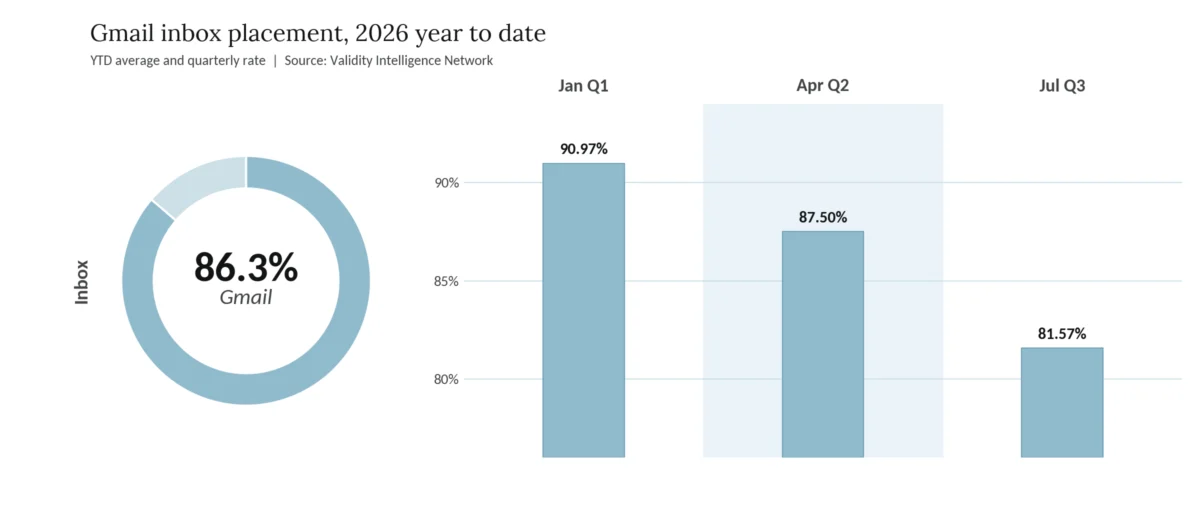
Gmail, long considered the gold standard for email deliverability with historically high inbox placement rates (IPRs) among all mailbox providers (MBPs), has experienced an unprecedented and dramatic decline in deliverability throughout 2026. This significant shift, highlighted by recent industry benchmarks, poses a critical challenge for email senders and marketing leaders, particularly as the high-stakes Black Friday and broader holiday shopping season rapidly approaches. The world’s largest MBP, accounting for a substantial portion of global email traffic, is now exhibiting a pronounced decrease in the ability of legitimate marketing messages to reach their intended recipients’ inboxes, instead shunting them to spam folders or blocking them entirely.
The Unprecedented Drop: A Deep Dive into the Data
Validity’s latest deliverability benchmark report, which comprehensively covered the year 2025, positioned Gmail at the zenith of inbox performance, boasting an impressive 89.8 percent IPR. This led its closest competitor, Yahoo, which registered an 87.3 percent IPR, and significantly outpaced Microsoft at 77.4 percent. This robust performance continued into the first quarter of 2026, with Gmail’s average IPR maintaining a strong 90.97 percent. However, this established trend took a sharp turn by the third quarter of 2026, when the average IPR for Gmail plummeted to 81.57 percent. This represents a substantial 9.4 percentage point reduction in a relatively short period, marking a profound shift in the email landscape.
The underlying metrics driving this precipitous drop reveal a concerning trend. Over the course of 2026, Gmail’s spam placement rates have surged by three-quarters, escalating from 5.4 percent in Q1 to a staggering 9.5 percent in Q3. Concurrently, missing rates—encompassing emails that are either blocked or rejected outright by Gmail—have also seen a significant uptick, increasing by 2.5 percentage points from 3.6 percent to 8.9 percent. These two factors combined indicate a tightening of Gmail’s filtering mechanisms and a more aggressive stance against what it perceives as unwanted or suspicious email traffic.
The situation is even more dire for Business-to-Business (B2B) senders utilizing Google Workspace. Average IPRs for this critical segment have fallen sharply, dropping from 88.9 percent to 74.3 percent. This constitutes a substantial 14.6 percentage point decrease, and critically, this figure represents deliverability before the additional impact of corporate-level spam filters, such as those provided by Proofpoint, are applied. This suggests that B2B messages face a double gauntlet of filtering, first at the MBP level and then at the organizational firewall, making successful inbox placement an increasingly formidable challenge.
Unpacking the Underlying Factors: A "Perfect Storm" Scenario
While the specific, granular reasons for Gmail’s abrupt shift have not been fully disclosed by Google, industry analysts and deliverability experts point to a confluence of factors creating a "perfect storm" that is likely contributing to this widespread decline. These factors are often interconnected and collectively contribute to a more stringent email ecosystem:
-
Increased Sophistication of AI and Machine Learning Algorithms: Gmail, like other major MBPs, continuously refines its spam detection algorithms, leveraging advanced artificial intelligence and machine learning. These systems are designed to learn from user engagement patterns, identify evolving spamming tactics, and block unwanted emails more effectively. A recent update or recalibration of these algorithms could be interpreting a broader range of messages as undesirable, leading to higher spam placement rates. This could include stricter scrutiny of content, sender behavior, and engagement signals.
-
Heightened Focus on User Experience and Inbox Clutter: Google’s overarching strategy often prioritizes user experience. As the volume of commercial and promotional email continues to grow, MBPs are under increasing pressure to reduce inbox clutter and protect users from irrelevant or unsolicited communications. This translates into more aggressive filtering policies aimed at ensuring that users only see emails they genuinely want. The "Promotions" tab in Gmail, while designed to organize, can still be a step away from the primary inbox, and stricter filtering may push even more messages into these secondary categories or directly to spam.
-
Sender Reputation Degradation Across the Ecosystem: A collective decline in sender reputation across a broad spectrum of senders could also be a contributing factor. If a significant number of email marketers are engaging in practices that Google deems suboptimal—such as sending to unengaged lists, purchasing lists, or having high complaint rates—it can negatively impact the overall perception of marketing email, leading to tighter controls for everyone. Google’s algorithms often consider aggregate sender behavior when making filtering decisions.
-
Evolving Spam Tactics and Counter-Measures: Spammers and malicious actors are constantly developing new ways to bypass filters. In response, MBPs like Gmail must continuously adapt and deploy new counter-measures. These defensive updates, while targeting illicit activities, can sometimes have unintended consequences, sweeping legitimate marketing emails into the net if they bear any resemblance to spam characteristics or fail to meet evolving best practices.
-
Stricter Enforcement of Email Authentication Standards: While not explicitly stated as a cause, ongoing industry pushes for stronger email authentication (like SPF, DKIM, and DMARC) mean that senders who are not fully compliant or whose authentication records are misconfigured may face harsher penalties. Gmail has been a vocal proponent of these standards, and any tightening of enforcement could disproportionately affect senders with authentication issues, leading to increased blocking or spam placement.
-
Low Engagement Rates: If a sender consistently sends emails that receive low open rates, low click-through rates, or high deletion rates without being opened, Gmail’s algorithms interpret these signals as a lack of interest from recipients. Over time, this can degrade a sender’s reputation, leading to more messages being diverted to the spam folder. Conversely, high engagement signals trust and relevance, improving deliverability.
Implications for Email Marketers: A Call to Action
The sudden downturn in Gmail deliverability necessitates an immediate and strategic response from email marketers. The traditional approach of prioritizing volume may now be counterproductive. The emphasis must unequivocally shift towards quality, relevance, and recipient engagement.
-
Enhanced Monitoring and Analytics: The era of "set it and forget it" email campaigns is over. Marketers must invest in robust deliverability monitoring tools to track their sender reputation, inbox placement rates, and complaint rates in real-time, especially with Gmail. Services that provide insight into specific domain performance and potential filtering issues are no longer a luxury but a necessity. Measurement truly drives management in this new environment.

-
Rigorous List Hygiene: Maintaining a clean and engaged email list is paramount. Regularly removing inactive subscribers, bounced addresses, and known complainers is crucial. Sending to highly engaged segments rather than broad, undifferentiated lists will signal positive intent and relevance to Gmail’s algorithms. Marketers should consider re-engagement campaigns for dormant subscribers and remove those who remain unresponsive.
-
Prioritize Engagement Metrics: Gmail’s filters are heavily influenced by how recipients interact with emails. High open rates, click-through rates, replies, and emails being moved from spam to the inbox are positive signals. Conversely, high unsubscribe rates, spam complaints, and emails being deleted without opening are negative. Marketers must design emails that encourage interaction, offer clear value, and prompt recipients to open and click. A/B testing subject lines, preheader text, and call-to-actions becomes even more critical.
-
Content Quality and Personalization: Generic, mass-produced content is more likely to be flagged. Personalized, relevant content that speaks directly to the recipient’s interests and past behaviors will foster engagement and improve deliverability. Leveraging customer data to segment audiences and tailor messaging can significantly enhance email performance.
-
Strict Adherence to MBP Requirements: Beyond general best practices, marketers must ensure consistent compliance with specific bulk sender requirements outlined by Gmail and other major MBPs. This includes proper email authentication (SPF, DKIM, DMARC), clear unsubscribe links, and avoiding known spam triggers in content. Google’s recent updates often come with explicit guidelines that must be followed.
-
Explore AI-Friendly Content: As AI plays a larger role in filtering, understanding how AI interprets content can be advantageous. This doesn’t mean "gaming" the system, but rather ensuring content is clear, well-structured, and avoids patterns that might be misinterpreted as spam.
Strategic Imperatives for Marketing Leadership: Protecting ROI
For marketing leadership, the decline in Gmail deliverability presents a significant challenge to the overall efficacy and return on investment (ROI) of email marketing programs. With Gmail commanding 40.4 percent of the global inbox market share and a dominant 53.9 percent in the US, its performance directly impacts the bottom line for a vast majority of businesses.
Consider the financial implications: if an email marketing program typically generates an average of 11 cents of revenue per message, and Gmail’s effectiveness drops by roughly 10 percent, every million Gmail messages sent during the critical Black Friday period could generate $5,500 less than the previous year. Extrapolate this across tens or hundreds of millions of emails sent by large enterprises, and the revenue loss can quickly escalate into substantial figures, directly impacting holiday sales targets and annual revenue projections.
The key takeaway for leadership is clear: in Gmail’s current environment, a paradigm shift is necessary. "Less is more," and quality decisively trumps quantity. Marketing leaders must champion strategies that prioritize getting messages in front of a smaller, highly engaged, and highly converting cohort, rather than aiming for broad but largely ineffective reach. Zero visibility to a large audience is a far worse outcome than targeted visibility to a committed segment.
Leadership must resist the temptation to push email teams to simply ramp up sending frequency and volume in an attempt to compensate for decreased deliverability. Such a strategy is likely to backfire, further degrading sender reputation and exacerbating the problem. Instead, leaders should encourage and empower teams to focus on smaller, highly targeted, and relevant sends that are designed to drive genuine engagement. This includes:
- Investing in Deliverability Expertise and Tools: Allocate budget for specialized deliverability platforms, consultants, and training for email teams.
- Data-Driven Segmentation: Support initiatives that enable more sophisticated audience segmentation and personalization based on behavioral data.
- Focus on Lifetime Value (LTV): Shift metrics beyond immediate conversion to long-term customer engagement and loyalty, which are fostered by relevant communications.
- Cross-Functional Collaboration: Foster collaboration between marketing, data science, and IT teams to ensure technical compliance and data integrity.
- Advocate for Quality over Quantity: Communicate clearly to stakeholders that email volume may decrease in the short term, but the effectiveness and ROI per message will increase, ultimately leading to better business outcomes.
The Broader Landscape: What This Means for Digital Marketing
Gmail’s deliverability challenges are not an isolated event but rather indicative of a broader trend within the digital marketing ecosystem. As consumers become more selective and MBPs more vigilant, all digital channels are facing increased scrutiny and evolving algorithms. This development reinforces the idea that customer relationships, built on trust and relevance, are the ultimate currency in digital marketing.
For other mailbox providers, Gmail’s stricter stance could set a precedent. It is plausible that other MBPs may follow suit, tightening their own filtering mechanisms in an effort to keep pace with industry leaders and protect their users. This means marketers should not view this as solely a "Gmail problem" but as a potential bellwether for the entire email marketing landscape.
This situation also underscores the importance of a diversified digital marketing strategy. While email remains a powerful channel, businesses cannot afford to be overly reliant on any single platform. Investments in SEO, paid advertising, social media marketing, content marketing, and other channels should be continually evaluated and optimized to ensure resilience against changes in any one area.
Looking Ahead: Navigating a New Deliverability Paradigm
The significant drop in Gmail’s inbox placement rates marks a pivotal moment for email marketing. It signals a new, more challenging deliverability paradigm where sender reputation, engagement, and content relevance are not just best practices, but absolute prerequisites for success. The upcoming Black Friday and holiday season will serve as a crucial test for marketers’ ability to adapt swiftly and strategically to these evolving demands. Those who prioritize precision, quality, and a deep understanding of recipient behavior will be best positioned to navigate this new landscape, safeguard their email ROI, and continue to leverage email as a powerful engine for business growth. The time for proactive measures and strategic recalibration is now.


 Evan Lee Salim
 Layla Zulfa