
The landscape of global communications is undergoing a seismic shift, moving away from traditional transactional media relations toward a model of immersive, narrative-driven brand building. At the center of this transformation is Mattel, a legacy toy manufacturer that has successfully pivoted into a powerhouse of intellectual property (IP) and entertainment. Leading the charge in articulating this evolution is Casey McDonald, Mattel’s Director of Global Communications. With a career spanning high-pressure agencies and internal corporate leadership, McDonald has become a pivotal figure in orchestrating campaigns that do more than just capture attention—they dominate the cultural conversation.
McDonald’s role at Mattel is expansive, overseeing communications for the company’s film and television slate, digital gaming division, and major entertainment partnerships. His tenure has been marked by the historic success of the "Barbie" movie campaign, a project that redefined the potential of integrated marketing. However, his work extends far beyond a single blockbuster, encompassing the strategic revitalization of legacy brands like Barney and the management of executive visibility in an increasingly complex global market.
The Professional Evolution: From Agency Scrappiness to In-House Strategy
Casey McDonald’s journey to the upper echelons of Mattel’s communications department began in the fast-paced world of PR agencies. Before joining the toy and entertainment giant, he spent a decade representing a diverse portfolio of brands, including the performance apparel company Vuori, the fashion retailer ASOS, and the social networking giant Tinder. His time at The Lead PR, where he served as Vice President, provided the foundational "scrappiness" that he cites as essential to his current success.
The transition from agency to in-house represents a fundamental shift in perspective. In the agency world, practitioners are often "parachuting" into a business, tasked with generating immediate "buzz" or securing specific media placements. This environment, according to McDonald, fosters a relentless focus on the "pitch" and a deep respect for the journalistic process. It requires a keen understanding that reporters are not obligated to provide coverage; they are searching for stories that possess inherent timeliness and relevance.
In contrast, moving in-house at a corporation like Mattel requires becoming an architect of the business itself. Communications is no longer an external service but a core function that helps shape the products and strategies it eventually announces. McDonald notes that in-house roles involve sitting at the table with creative, marketing, and product teams to ask deeper questions: "Is there a bigger story here?" and "How does this advance the company’s long-term narrative?" While agencies are designed to create buzz, in-house teams are designed to build something worth paying attention to over the long term.
The Barbie Phenomenon: A Case Study in Cultural Saturation
No discussion of modern communications is complete without an analysis of the 2023 "Barbie" campaign. Under the leadership of Mattel CEO Ynon Kreiz and the communications strategies executed by McDonald and his colleagues, the "Barbie" film became a global cultural event that transcended the cinema. The campaign was characterized by its unprecedented scale, involving more than 165 consumer product collaborations across fashion, beauty, hospitality, and gaming.
From a communications standpoint, the "Barbie" project was a masterclass in earned media. McDonald recalls how the world "quite literally turned pink" for an entire summer. The campaign successfully broke through the noise of traditional advertising, earning placements in prestigious outlets such as The New Yorker, The New York Times, and The Wall Street Journal. The strategy relied on "synergies"—the idea that every partnership and every announcement reinforced the central narrative of the film and the brand’s renewed relevance.
Data from the campaign underscores its impact. The film grossed over $1.446 billion at the global box office, but the "earned media" value—the cost of the publicity had it been purchased as advertising—reached into the hundreds of millions. For McDonald, the campaign served as a reminder of the power of integrated communications. It demonstrated that when a brand has deep cultural equity, the role of the communicator is to ensure that every announcement deserves the attention it receives, maintaining a high bar for quality and authenticity.
Navigating Global Scale and Cultural Nuance
One of the most significant challenges McDonald faced upon joining Mattel was the sheer scale of the organization. Operating a global communications strategy for iconic brands requires a delicate balance between consistency and flexibility. To manage this, McDonald utilizes a framework built on three fundamental questions:
- Who is this for?
- What are we trying to say?
- Why does it matter?
When these questions are answered clearly at the leadership level, the core message remains stable across different regions. However, McDonald emphasizes that global communications should not be "one-size-fits-all." While the strategic objective remains the same, the execution must flex to accommodate local cultures and market conditions.
This "team sport" approach allows local teams—who understand their specific markets better than a centralized headquarters—to innovate within the brand’s narrative. McDonald believes that some of the most impactful global ideas originate from these local insights, proving that a brand can be both globally consistent and locally resonant.
The Relaunch of Barney: Nostalgia as a Strategic Asset
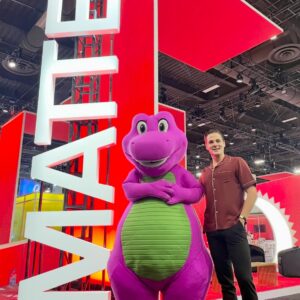
As Mattel continues to mine its deep catalog of IP, the relaunch of Barney represents a significant strategic move. For McDonald, this project is personal; he grew up as a "Barney superfan," even repurposing a Halloween costume for daily wear as a child. Professionally, however, the relaunch of the purple dinosaur is a sophisticated exercise in brand revitalization.
The Barney relaunch spans television, publishing, and consumer products. A key moment in the campaign involved a high-profile "stunt" where McDonald escorted the Barney character to Heidi Klum’s legendary annual Halloween party. This move was designed to signal Barney’s return to the cultural zeitgeist in a way that appealed to both nostalgic adults and a new generation of children.
The communications strategy for Barney focuses on the character’s core values: kindness, empathy, and emotional intelligence. In a fragmented and often polarized media environment, McDonald posits that these themes are more relevant than ever. By positioning Barney as a tool for helping young audiences navigate their emotions, Mattel is leveraging nostalgia not just for sentimentality, but as a foundation for modern social-emotional learning.
Future Outlook: Gaming, Film, and the "Specialist" Myth
The future of Mattel’s communications strategy is increasingly tied to the digital and entertainment sectors. McDonald is currently overseeing the communications for a robust slate of upcoming projects, including the "Masters of the Universe" film and expansions into the digital gaming space. This shift reflects a broader trend in the toy industry, where the physical product is increasingly seen as one component of a much larger ecosystem of storytelling.
Reflecting on his career trajectory, McDonald offers a counter-intuitive piece of advice for aspiring communicators: avoid over-specialization too early. While he once believed he needed to be "the tech PR guy" or "the fashion PR guy," he has discovered that the fundamentals of storytelling are universal. Whether the subject is an AI-driven gaming platform or an eight-foot purple dinosaur, the core tasks remain the same: understand the audience, find the unique story, and tell it with authenticity.
Analysis of Implications for the PR Industry
The success of Casey McDonald’s approach at Mattel suggests several key takeaways for the broader public relations and communications industry:
- The Death of the Silo: Effective communications now requires deep integration with product development and marketing. The "Barbie" campaign succeeded because the PR narrative was baked into the product collaborations from the beginning.
- Earned Media as the Gold Standard: In an era of ad-blockers and fragmented streaming audiences, "earned" coverage in reputable news outlets remains the most powerful way to build brand trust and cultural relevance.
- The Importance of Humanization: Despite the massive scale of global corporations, the most successful campaigns are those that feel human and authentic. McDonald’s focus on "finding the story" rather than just "pushing the message" is essential for maintaining this connection.
- IP as the New Currency: For legacy brands, the path to growth lies in the successful management and expansion of intellectual property. Communications professionals are now the guardians of these narratives, responsible for ensuring they evolve without losing their core identity.
As Mattel continues its journey from a toy maker to an IP-driven entertainment leader, the work of Casey McDonald and his team will serve as a blueprint for how legacy brands can navigate the complexities of the 21st-century media landscape. By focusing on "moments that matter," Mattel is not just selling toys; it is crafting the cultural history of the next generation.