
The landscape of online commerce for creators is continually evolving, with platforms vying to offer the most comprehensive and user-friendly solutions. Two prominent contenders in this space are Spring (formerly Teespring) and Fourthwall. While both cater to creators looking to monetize their content and audience through merchandise and digital products, their underlying philosophies and feature sets position them for distinctly different user needs. This analysis delves into the core offerings, pricing structures, store-building capabilities, product diversity, print-on-demand services, customer support, and recent developments of both platforms to provide a clear distinction for creators navigating their e-commerce journey.
Platform Philosophy: Tailored Solutions for Diverse Creator Needs
At their core, Spring and Fourthwall represent divergent approaches to creator commerce. Spring has long been recognized as a streamlined solution, particularly for creators with an established social media presence. Its primary strength lies in its simplicity, enabling users to quickly set up a storefront, select from a curated catalog of print-on-demand (POD) merchandise, customize designs, and sell directly through the platform. This model is exceptionally well-suited for creators looking to monetize audiences on platforms like YouTube or Twitch, offering an accessible entry point into the world of merchandise sales. The platform’s integrated social channel connections further enhance its appeal for this demographic.
Fourthwall, conversely, positions itself as a more robust and comprehensive e-commerce solution, designed for creators and small brands aiming to build a multifaceted business. While it also offers retail-grade print-on-demand merchandise, its capabilities extend significantly beyond this. Fourthwall empowers users to sell digital downloads, manage memberships and subscriptions, accept direct donations, and even offer gift cards. Crucially, it provides a fully customizable storefront with the option for a custom domain and acts as the Merchant of Record (MOR). This comprehensive approach allows creators to consolidate various income streams within a single, scalable platform, fostering deeper brand ownership and customer engagement. The inclusion of an AI shop assistant further underscores Fourthwall’s commitment to providing advanced tools for growth.
Quick Verdict: Identifying the Ideal Creator
For creators prioritizing a swift and straightforward method to sell print-on-demand products and digital downloads to an existing audience, Spring emerges as an excellent choice. The platform handles the entire production, payment processing, hosting, delivery, and buyer support infrastructure. This allows creators to focus on their content and design, entrusting the operational complexities to Spring.
However, for creators and small brands aspiring to build a holistic brand ecosystem with multiple revenue streams, Fourthwall presents a more compelling proposition. It offers an all-in-one brand platform where creators can integrate print-on-demand items with memberships, digital downloads, self-fulfilled products, donations, and gift cards. By acting as the Merchant of Record and offering extensive customization options, Fourthwall provides a significantly greater runway for scaling and diversification, while still maintaining crucial integrations with social channels to maximize sales reach.
Feature Comparison: A Deeper Dive into Functionality
| Feature | Fourthwall | Spring |
|---|---|---|
| Best Fit | Creators and small brands building multiple income sources. | Creators launching merch around social content. |
| Storefront | Customizable branded website with a custom domain. | Hosted social storefront with domain support. |
| Physical Products | Curated POD catalog plus the option for self-sourced stock. | POD merchandise produced and shipped by Spring. |
| Digital Products | Built-in, with seller retaining audience data. | Built-in, with Spring hosting the files. |
| Memberships | Native paid tiers, posts, video, livestreams, and member perks. | None. |
| Integrations | YouTube, TikTok Shop, Twitch, Kit, Klaviyo, Mailchimp, Zapier, and more. | YouTube, Twitch, Discord, Linktree, Store Drop, and other creator channels. |
| Tax Handling | Fourthwall acts as the Merchant of Record. | Spring acts as the Merchant of Record. |
| AI Assistant | Yes, Eli assists with catalog management, pricing, and store tweaks. | No. |
| Customer Support | Handles POD product issues, replacements/refunds for defects. Does not handle general returns. | Handles POD product issues, replacements/refunds for defects within 30 days. Does not handle general returns. |
Pricing Structures: Free to Start, Scalable Costs
A significant advantage for creators exploring both platforms is that both Spring and Fourthwall offer free entry points. This democratizes access, allowing individuals to test the waters without upfront financial commitment.
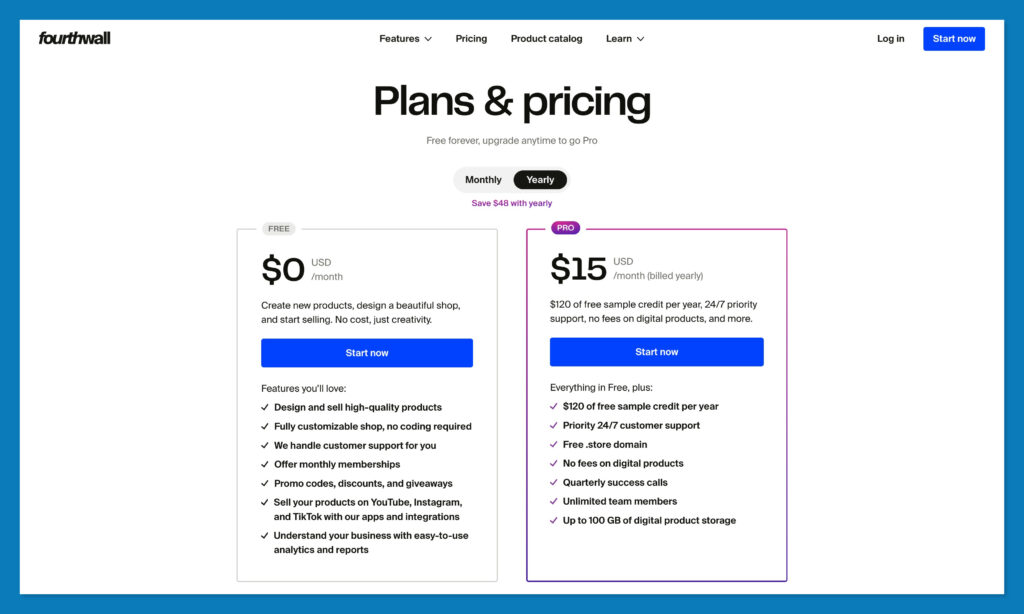
Fourthwall’s free plan is remarkably comprehensive. It includes a customizable store, the ability to sell both digital and physical products, support for one additional team member, and up to 50 product listings. While physical product sales incur only standard payment processing fees, Fourthwall charges a 5% fee on memberships and digital product sales. For creators seeking to scale beyond these initial offerings, Fourthwall offers a paid plan at $19 per month (or $180 annually). This premium tier eliminates the fee on digital product sales, increases the product listing limit to 500, provides unlimited team members, includes $10 in monthly sample credits, and offers premium support.

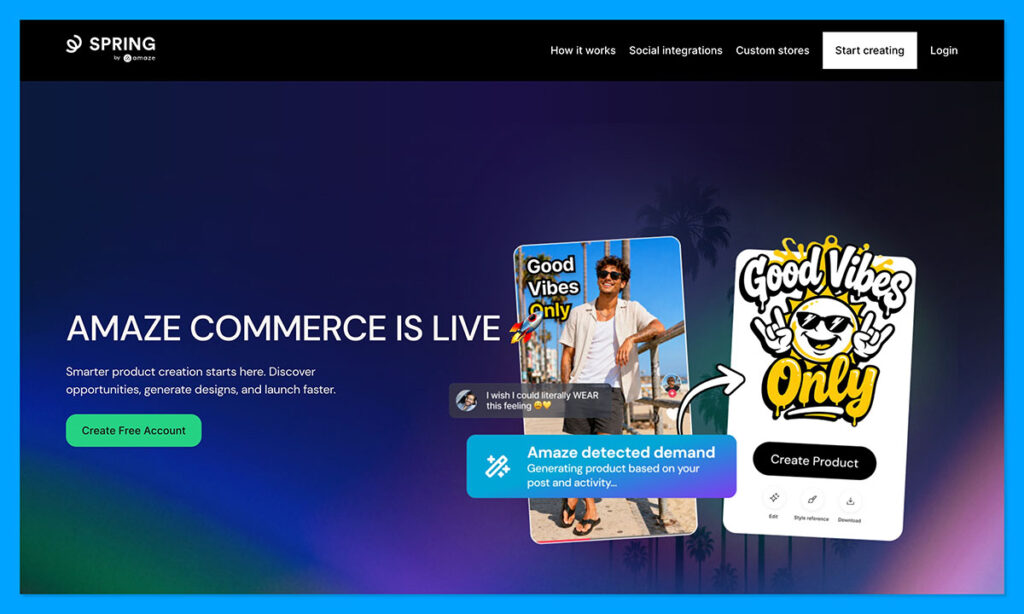
Spring operates with a single free plan, making it accessible for anyone to launch a store and list products without initial charges. The revenue model for physical products is based on a base production cost set by Spring, above which the creator sets their retail price, determining their profit margin. However, digital product sales come with a more substantial fee structure: a 20% charge plus $1.70 per sale. This means a $10 digital product sale would yield only $6.30 for the creator. While Spring’s base costs for merchandise might appear competitive, Fourthwall’s higher quality products and more favorable digital product pricing often make it a more attractive option for creators focused on mixed revenue streams.
Store Building and Integrations: Crafting Your Digital Presence
The disparity in store-building capabilities between Fourthwall and Spring is substantial, reflecting their differing strategic aims.
Spring offers a streamlined approach to storefront creation. Creators can quickly set up a branded shop by adding a logo, colors, a hero banner, social links, and featured products to a pre-designed template. Custom domain support is available. However, the extent of customization and layout options is inherently limited, focusing on rapid deployment rather than in-depth brand customization. Spring lacks built-in tools for email marketing or blogging, necessitating the use of external services for these crucial content marketing functions. On the positive side, Spring provides essential integrations with major social media platforms like YouTube and Twitch, facilitating direct sales channels.
Fourthwall, in stark contrast, provides a robust and fully customizable e-commerce store builder. Creators gain extensive control over pages, themes, layouts, domains, and even HTML and CSS for advanced customization. The platform supports product collections and offers a Storefront API for further integration possibilities. Beyond social media selling channels, Fourthwall integrates seamlessly with leading email marketing platforms such as Klaviyo and Mailchimp, enabling sophisticated audience engagement strategies. Furthermore, creators can establish blogs directly within their Fourthwall store, consolidating content marketing efforts.
A notable recent addition to Fourthwall’s integration ecosystem is Kit, a tool that synchronizes subscribers, buyers, and purchase details. This allows for automated welcome sequences and targeted offers, enhancing customer retention. This level of integrated marketing functionality is a significant differentiator for Fourthwall.
Product Diversity: Beyond the Basic T-Shirt
While both platforms offer print-on-demand services, the breadth and depth of what creators can sell differ significantly.
Spring, despite its rebranding from Teespring, has expanded its offerings beyond its initial focus on apparel. The platform now includes a "Digital Launcher" for selling digital products such as eBooks, filters, and audiobooks. Creators can also implement promotional campaigns, including percentage-based discounts, fixed-value offers, and free shipping, with analytics to track their effectiveness. However, the business model remains largely centered on individual product sales, lacking native support for recurring memberships, self-sourced inventory, or direct donations.
Fourthwall champions a more holistic approach to product offerings. Its print-on-demand catalog is meticulously curated with a focus on quality, featuring retail-grade items and exclusive "Signature Collection" products that appeal to a premium audience. Beyond POD, creators can sell their own sourced physical products, digital downloads, and manage paid memberships with various tiers, exclusive content, and perks. The platform also facilitates direct donations and offers customizable gift cards that never expire and are delivered instantly. This versatility allows for the bundling of diverse offers, such as selling an eBook and its accompanying audiobook simultaneously.
Moreover, Fourthwall’s AI assistant, Eli, plays a role in product expansion. It can assist with catalog and price updates and even replicate designs across a range of POD items, simplifying the process of diversifying a product line. This comprehensive suite of selling options and AI-powered assistance positions Fourthwall as a platform capable of supporting a creator’s entire business model, not just a single product category.
Print-on-Demand Excellence: Quality and Options
The print-on-demand (POD) aspect is a critical component for many creators, and both platforms offer distinct advantages.
Fourthwall emphasizes a curated POD catalog that prioritizes quality. Their offerings include premium apparel with options for printing and embroidery, screen prints, cut-and-sew items, and sublimation. While the base cost for some items might be slightly higher than competitors, the superior quality often justifies the investment, especially for creators targeting a discerning audience. The broader range of production techniques available through Fourthwall allows for greater creative control and a higher-end final product.
Spring also boasts a substantial catalog of approximately 200 different print-on-demand products, primarily across apparel, accessories, and home and lifestyle categories. While some individual items might be more competitively priced, the overall quality of the materials and printing can be inconsistent. Spring primarily offers direct-to-garment (DTG) printing and screen printing for apparel. A notable advantage for Spring is its "Make It Right" policy, which provides replacements or refunds for damaged or defective products reported within 30 days. Additionally, Spring offers a convenient option to order samples at base cost, enabling creators to personally assess product quality before offering them to customers.
Shipping times are a crucial factor for customer satisfaction. Fourthwall partners with fulfillment centers across the EU, UK, Canada, Mexico, Australia, Japan, and the US, typically delivering within five to ten days. Spring has partners in the EU, US, Mexico, India, and Australia, but product availability may vary by region. Spring guarantees production and tracking numbers within ten business days, followed by an additional four to seven days for delivery, potentially leading to longer customer wait times compared to Fourthwall.
Support and Merchant of Record Status: Operational Backbone
Both platforms provide essential support infrastructure, including email, community channels, and help centers. However, Fourthwall enhances its support with Eli, its 24/7 AI dashboard assistant, offering immediate assistance with common queries and tasks. The premium Pro tier on Fourthwall includes dedicated priority support and success calls, catering to creators who require a higher level of personalized guidance.
A critical shared feature is their role as Merchant of Record (MOR). This means both Spring and Fourthwall assume responsibility for tax compliance, remittance, and sales tax handling. This alleviates a significant administrative burden for creators, allowing them to avoid the complexities of navigating various tax regulations across different jurisdictions.
Customer service for print-on-demand products is also managed by both platforms. They will typically handle replacements or refunds for items with manufacturing defects or damage. However, neither platform generally accepts returns for customer errors, such as incorrect sizing or change of mind, as most items are made to order. Spring’s "Make It Right" policy specifically addresses defects within a 30-day window, while Fourthwall also manages customer service for POD issues.
Recent Platform Updates: Adapting to Creator Demands
Both Spring and Fourthwall have actively invested in platform development, reflecting their strategic visions for creator commerce.
Spring has focused on enhancing the core user experience, particularly concerning listings, account security, checkout processes, and creator support. Recent updates include the establishment of a dedicated Creator Experience team and the implementation of a checkout system that accepts a wider range of payment methods, including cryptocurrencies, PayPal, and Apple Pay. New listing controls empower creators with bulk editing capabilities, price adjustments, and the archiving of old items. Enhanced account security is provided through multi-factor authentication.
Fourthwall, on the other hand, has prioritized features aimed at fostering repeat customer engagement and brand loyalty. The integration with Kit, alongside the AI assistant, facilitates targeted follow-up campaigns and membership engagement. Fourthwall has also introduced custom gift cards, more granular team role management, self-fulfillment reminders, and advanced analytics, including tracking for Twitch gifting. Furthermore, the platform has integrated with Throne for wish lists and fundraising, partnered with Karat for financial management guidance, and expanded its Signature collection. A new designer marketplace also aims to connect creators with illustrators and merchandise partners, further solidifying its ecosystem approach.
Conclusion: Choosing Your Creator Commerce Path
In summary, Spring remains a highly effective and accessible platform for creators who need a quick and easy way to sell custom merchandise and digital products to an existing social audience. Its free-to-use model, comprehensive POD offerings, and integrated social channel connections make it an attractive entry point. However, its limitations in terms of deep customization and the lack of support for diverse revenue streams mean it may not be suitable for creators aiming to build a fully scalable brand.
Fourthwall is the clear choice for creators and small brands looking to establish and grow an owned brand. It provides a comprehensive e-commerce solution that goes beyond mere merchandise sales. With its robust store builder, diverse product offerings (including memberships and digital downloads), powerful integrations, and commitment to quality, Fourthwall empowers creators to build multifaceted businesses. The platform’s scalability means creators can expand their offerings and revenue streams without the need to migrate to a new system, making it a strategic investment for long-term brand development. Ultimately, the decision hinges on whether a creator seeks a simple merchandise outlet or a foundational platform for a holistic, scalable e-commerce brand.