


Published on April 17, 2026, the comprehensive 2026 Email Impact Report from Sinch Mailgun delivers a stark message to businesses worldwide: while email remains an indispensable communication channel, a significant and widening chasm is emerging between organizations that strategically invest in data-driven measurement, robust deliverability, and intelligent optimization, and those that continue to operate on outdated assumptions. This critical divergence, highlighted by a global survey of over 1,200 email senders and an unprecedented analysis of more than 400 billion real emails transmitted through Sinch Mailgun’s infrastructure in 2025, underscores a pivotal moment for digital marketers. The report delves into five core areas: Return on Investment (ROI), industry benchmarks, deliverability, Artificial Intelligence (AI) adoption, and future investment trends, providing crucial insights for email senders navigating the second half of 2026 and beyond.
The digital marketing landscape has become increasingly complex, characterized by escalating competition for audience attention, evolving privacy regulations, and the rapid integration of advanced technologies like artificial intelligence. In this environment, the enduring power of email as a direct, personal, and highly effective communication tool is consistently reaffirmed. Yet, despite its recognized importance, the Sinch Mailgun report reveals a significant disconnect in how organizations leverage and evaluate their email programs, suggesting that many are failing to fully capitalize on its potential.
The ROI Conundrum: Conviction Versus Concrete Evidence
Email’s perceived value within organizations remains exceptionally high, with a striking 78% of senders affirming its status as "very" or "extremely" important to their operations. This level of internal buy-in is a rare commodity for any marketing channel, testifying to email’s foundational role in customer engagement, sales, and operational communication. However, the report swiftly pivots from organizational belief to a critical examination of organizational evidence, uncovering a substantial gap. Fewer than half of all email senders actively measure the Return on Investment (ROI) of their programs, with only 46% tracking promotional email ROI and a slightly lower 43% for transactional emails. This data suggests that a majority of teams are operating on conviction and anecdotal success rather than tangible, data-backed proof of financial returns.
The consequences of this measurement deficit are profound. While many acknowledge email’s effectiveness, the inability to quantify its financial impact directly impedes strategic decision-making and resource allocation. For those who do measure ROI, the results are overwhelmingly positive, reinforcing email’s high-yield potential. A significant 60% of senders measuring promotional email ROI report returns exceeding $10 for every $1 spent, indicating a powerful and efficient channel. Even more remarkably, 13% of these senders achieve an ROI greater than $40 for every dollar invested. Similarly, for transactional emails, 62% of measuring senders report crossing the $10:1 threshold, with 13% again seeing returns above $40:1. Interestingly, Sinch Mailgun’s analysis suggests that such exceptionally high returns might, in some cases, signal underinvestment rather than peak efficiency, implying that further strategic investment could yield even greater absolute returns without necessarily diminishing the ROI ratio.
The primary obstacle cited for increasing email investment is budget constraints, with 43% of senders identifying this as their biggest barrier. This finding creates a paradoxical loop: budget is hard to secure without data, yet most teams are not collecting the necessary data to build a compelling case for increased funding. The report offers a pragmatic solution, recommending that organizations start by tracking revenue per campaign as an intermediate step towards full ROI tracking. Even an imperfect attribution model, it argues, is superior to no attribution, providing a baseline from which to demonstrate value and incrementally improve measurement sophistication. This phased approach acknowledges the challenges of comprehensive attribution modeling, especially for smaller teams, while emphasizing the critical need to move beyond mere assumptions. The implication is clear: in an era of heightened accountability for marketing spend, demonstrating email’s financial contribution is no longer optional but a prerequisite for growth.
Unveiling True Performance: Benchmarks from 400 Billion Emails
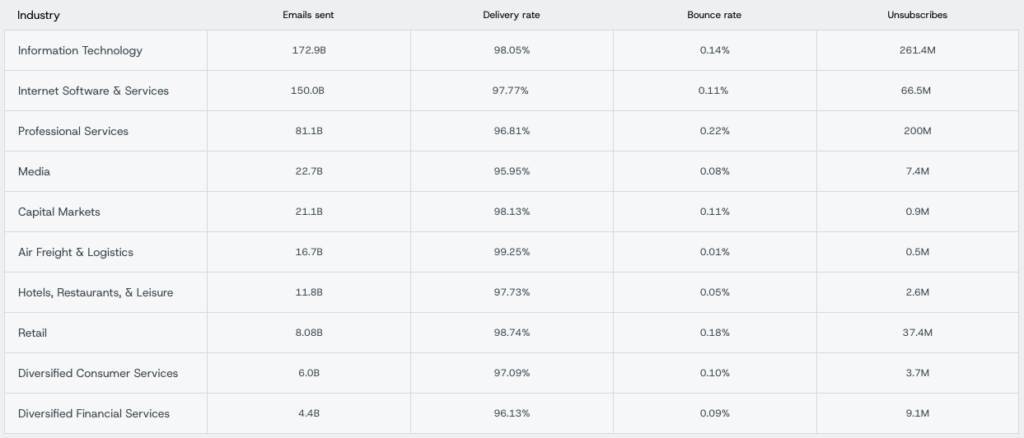
A distinguishing feature of Sinch Mailgun’s 2026 report is its departure from reliance on self-reported survey data for industry benchmarks. Instead, Chapter 2 leverages an unprecedented dataset: real sending data from Sinch Mailgun’s infrastructure, encompassing over 400 billion emails sent in 2025 across the top 10 industries by volume. This analytical rigor provides an unparalleled, factual perspective on email performance metrics, offering a more accurate yardstick against which organizations can measure their own programs.

The raw data reveals significant variations in email performance across sectors, driven by the nature of their email communications and audience expectations. For instance, the Air Freight & Logistics industry leads with an impressive 99.25% delivery rate and a remarkably low 0.01% bounce rate. These stellar figures are largely attributable to the transactional nature of their emails—shipping confirmations, tracking updates, and delivery notifications—which are highly anticipated and desired by recipients. In stark contrast, the Media industry sits at the lower end of the top 10 with a 95.95% delivery rate. This difference is understandable given the high volumes of promotional content and broader, less targeted audiences characteristic of media outlets, which naturally exert downward pressure on delivery metrics.
However, the report issues a crucial caveat: delivery rate alone can be misleading. An email "delivered" to a spam folder still counts towards a high delivery rate, obscuring the true effectiveness of a campaign. Sinch Mailgun makes a compelling case for senders to pair delivery rate tracking with consistent inbox placement testing. This dual approach provides a more accurate understanding of where emails are actually landing—whether in the primary inbox, promotions tab, or spam folder—and not merely whether they were accepted by the recipient server. This distinction is vital for optimizing content, sender reputation, and overall campaign performance.
Further analysis of unsubscribe rates underscores the necessity of contextualized data. The Information Technology sector recorded the highest raw number of unsubscribes at 261 million. Yet, when viewed against its colossal send volume of 172.9 billion emails, this translates to an unsubscribe rate of approximately 0.15%. Conversely, the Retail industry generated 37.4 million unsubscribes from a much smaller base of 8.08 billion sends, resulting in a significantly higher rate per email. This comparison unequivocally demonstrates that raw unsubscribe volume, without the essential context of send volume, is meaningless for performance evaluation. Understanding these industry-specific benchmarks, derived from real-world sending patterns, empowers businesses to set more realistic goals and identify areas for improvement based on objective data rather than generalized estimates.
Deliverability: Progress in Infrastructure, Stagnation in Understanding
The technical infrastructure supporting email deliverability has made considerable strides, yet a persistent knowledge gap among senders threatens to undermine these advancements. The report highlights that 89% of senders acknowledge the importance of deliverability to their organization, and a promising 43% report an improvement in their inbox placement over the past 12 months. This progress is largely attributed to significant developments in email authentication standards, particularly the widespread adoption of DMARC (Domain-based Message Authentication, Reporting, and Conformance).
The growth in DMARC adoption has been substantial and consistent: 43% in 2023, 54% in 2024, and reaching 61% in 2025. This surge has been primarily driven by stricter enforcement requirements from major email service providers (ESPs) such as Gmail, Yahoo, and Microsoft, which have increasingly mandated robust authentication protocols to combat spam and phishing. For the first time in Sinch Mailgun’s research history, the report notes that DMARC enforcement policies are outpacing passive monitoring, with over half of DMARC adopters now implementing "quarantine" or "reject" policies. These policies instruct recipient mail servers to either move unauthenticated emails to the spam folder or reject them outright, significantly enhancing email security and sender reputation.
Despite these critical infrastructure improvements, the understanding of key deliverability metrics among senders has not kept pace. A concerning 36% of senders claim to monitor an "email deliverability rate," a metric that, according to the report, does not accurately exist in the way they perceive it. As previously discussed, the delivery rate measures whether an email was accepted by the recipient server, including those filtered to spam. The true measure of success, inbox placement, quantifies what actually reached the intended inbox. Alarmingly, only 25% of senders consistently run inbox placement tests to ascertain this crucial metric. Furthermore, a significant 27% of DMARC users are unaware of the specific policy (monitor, quarantine, or reject) they have in place. These findings underscore a critical disconnect: while the tools and protocols for superior deliverability are evolving and becoming more robust, the foundational literacy and practical application among many email professionals are lagging. This knowledge deficit can lead to misinterpretations of performance data, misguided optimization efforts, and ultimately, missed opportunities for genuine inbox success.
AI in Email: Widespread Adoption, Uneven Impact
Artificial Intelligence is rapidly reshaping industries, and email marketing is no exception. Sinch Mailgun’s report reveals that AI adoption in email programs is widespread, with 79% of senders either currently using or planning to use AI. However, the depth and effectiveness of this integration vary significantly, leading to an uneven impact on program performance. Regular, systematic use of AI currently stands at just 27%, indicating that a substantial portion of adopters are still in experimental phases rather than fully embedding AI into their routine workflows.
The most common applications of AI in email marketing include copy generation (41%), content personalization (36%), dynamic content creation (29%), send time optimization (27%), and data analysis (27%). This pattern highlights a clear trend: AI delivers its most substantial value when integrated into core decision-making processes rather than being confined to superficial content production tasks. Teams that leverage AI for sophisticated applications such as personalization, optimizing send times, and A/B testing report compounding returns on their investment. In contrast, those who use AI primarily for more basic tasks, like drafting subject lines or simple content variations, tend to see a more limited impact on their overall email program performance.
The report provides compelling data to illustrate this disparity: 54% of senders who have actively implemented AI report that their email programs improved moderately or significantly year-over-year. In stark contrast, only 37% of senders who are not using AI observed similar improvements during the same period. This 17-point performance gap serves as the clearest signal yet that AI is beginning to stratify email programs into different performance tiers. While the report cautiously notes that this does not definitively prove causation, the consistent direction of the data strongly suggests a correlational link between AI integration and enhanced email program effectiveness. Crucially, 23% of AI users indicate that the technology has not helped them at all, reinforcing the report’s central argument that the difference between seeing value and not seeing value lies not in the tool itself, but in the depth and strategic nature of its integration within existing workflows.
The Future of Email Investment: Priorities and Projections
Looking ahead to 2026, the Sinch Mailgun report identifies the top priorities for email senders. "Taking advantage of AI" and "increasing email engagement" are tied for the leading position, each cited by 40% of senders. These priorities reflect a dual focus: leveraging emerging technologies to drive efficiency and personalization, while simultaneously enhancing the quality and relevance of interactions with recipients.
Regarding investment plans, the data shows a cautious but generally positive outlook. A significant 31% of senders plan to increase their email investment, indicating a belief in the channel’s continued potential for growth and ROI. The largest segment, 48%, intends to maintain current spending levels, suggesting stability in the email marketing budgets for nearly half of the organizations surveyed. Only a small minority, 7%, plan to decrease their email investment, reinforcing email’s established role as a core marketing channel.
The report concludes with a straightforward, yet profound, affirmation: email works. The extensive data collected across ROI metrics, industry benchmarks, and deliverability trends consistently supports this assertion. However, the future success of email programs will increasingly depend on a concerted and simultaneous investment in three critical areas: measurement, deliverability, and optimization.
- Measurement: Moving beyond assumptions to prove ROI with real, quantifiable data is paramount. This involves establishing clear metrics, implementing robust tracking mechanisms, and continuously refining attribution models, even if starting with intermediate steps like revenue per campaign.
- Deliverability: Consistently reaching the inbox, not just the server, requires meticulous attention to authentication protocols (like DMARC), list hygiene, sender reputation management, and ongoing inbox placement testing. The technical progress in this area must be met with an equivalent increase in understanding and proactive management by email teams.
- Optimization: Harnessing the power of AI and systematic testing to continuously improve performance at scale is no longer optional. This means moving beyond basic AI applications to embed artificial intelligence into personalization, send-time optimization, dynamic content generation, and sophisticated data analysis.
The encouraging news is that none of these strategic imperatives necessitate a massive upfront budget to initiate. Each area offers opportunities for incremental improvements that, when compounded over time, lead to significant and sustainable gains in email program effectiveness and ROI. The 2026 Email Impact Report serves as a comprehensive roadmap for organizations seeking to navigate the evolving digital landscape, urging them to embrace data, technology, and strategic foresight to ensure their email programs not only survive but thrive in an increasingly competitive environment. The message is clear: the future belongs to those who measure, deliver, and optimize.








