

In the intensely competitive digital marketing arena, email remains a cornerstone for customer engagement and revenue generation, yet what constitutes "good" performance is a constantly shifting benchmark. The latest DMA (Data & Marketing Association) UK Email Benchmarking Report, meticulously sponsored by Validity, offers an indispensable, granular analysis of the current state of email marketing, illuminating the critical differentiators between merely adequate programs and those that drive substantial revenue uplift. This comprehensive report, drawing on anonymized data from six prominent email service providers, represents the most authoritative and complete overview of email performance across the United Kingdom today. Its findings are crucial for marketers and business leaders striving to optimize their strategies and harness the full potential of this enduring channel.
Background and Methodology: A Robust Foundation for Insight
The Data & Marketing Association (DMA) stands as the leading trade association for the UK’s data and marketing industry, advocating for best practices, ethical data use, and innovation. Its annual benchmarking reports are eagerly anticipated resources, providing vital industry standards and actionable insights. Validity, a global leader in email deliverability and data quality, serves as a fitting sponsor, lending its deep expertise to the report’s focus on technical performance and strategic optimization. The collaboration underscores the increasing complexity of email marketing, where technical infrastructure, data hygiene, and sophisticated content strategies must converge for success.
The 2026 report distinguishes itself through its robust methodology, aggregating performance metrics from a diverse set of email service providers (ESPs). This broad data pool mitigates the biases inherent in single-source reports, offering a truly holistic view of the UK market. The data encompasses millions of emails sent across various sectors, allowing for a detailed examination of trends, challenges, and opportunities that define modern email campaigns. This extensive data set enables marketers to benchmark their own performance against industry averages and identify areas for strategic improvement, moving beyond anecdotal evidence to data-driven decision-making.
The Evolving Landscape of Email Performance: Key Takeaways
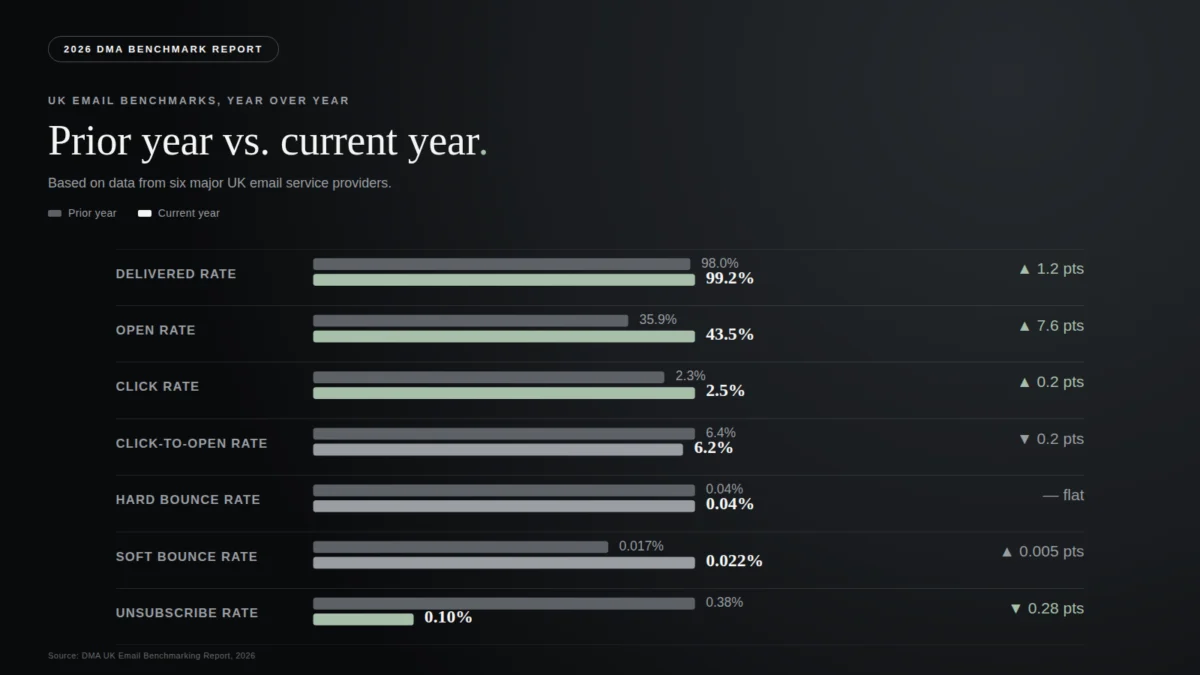
The overarching narrative presented by the report is one of positive, albeit complex, growth for the email channel year-over-year. While specific figures from the accompanying visual asset are not provided in the text, the report indicates a general upward trend in key engagement metrics, signaling email’s continued efficacy as a direct marketing tool. This positive trajectory comes despite an increasingly crowded inbox and heightened consumer scrutiny, underscoring the resilience and adaptability of email as a communication medium. However, a deeper dive into the numbers reveals significant variances and nuanced challenges that demand a re-evaluation of traditional metrics and strategies.
Across different sectors, performance metrics exhibit considerable divergence, highlighting the unique dynamics at play within various industries. Retail and travel sectors, for instance, registered among the lowest click-through rates, at 1.0% and 1.2% respectively. This seemingly low performance warrants closer examination, as the report suggests it may not solely indicate diminished engagement but rather a shift in how engagement is tracked, particularly with the advent of AI-driven inbox features. In contrast, the Business-to-Business (B2B) sector demonstrated a remarkable improvement in delivered rates, climbing from 90.7% to 95.6%. This substantial increase signals a concerted effort by B2B marketers to refine their acquisition strategies, enhance list hygiene, and comply more rigorously with data protection regulations, leading to cleaner and more effective email lists.
Delivery is Not Deliverability: The Inbox Placement Imperative
One of the most critical distinctions illuminated by the report is the often-confused difference between "delivery rate" and "inbox placement rate" (IPR). While a 99.2% delivered rate might appear robust on the surface, it merely indicates that an email was accepted by the recipient’s mail server. It offers no guarantee that the email actually landed in the primary inbox, rather than being relegated to a spam folder, a promotions tab, or blocked entirely. The true measure of an email’s reach and potential impact is its inbox placement rate (IPR).
Globally, IPRs currently hover around 87%, implying that approximately one in every eight legitimate, permission-based marketing emails never reaches its intended destination. The UK average IPR, while slightly higher at around 91%, has seen a concerning decline of more than two percentage points. This downward trend is primarily attributed to mailbox providers (MBPs) intensifying their enforcement of bulk sender requirements and employing more sophisticated spam filtering algorithms. Notably, Microsoft’s email services (including Outlook and Hotmail), which account for roughly 30% of UK inboxes, remain particularly challenging for senders to consistently place emails with. Microsoft’s stricter filtering policies often prioritize sender reputation, engagement signals, and adherence to technical standards like SPF, DKIM, and DMARC, making it a critical benchmark for overall deliverability success.
For revenue leaders and marketing professionals, this discrepancy between delivery and deliverability represents a significant, often invisible, drain on ROI. An email program with a seemingly high delivery rate but a suboptimal IPR is fundamentally undermining its own efforts. A typical sender achieving a 90% inbox placement rate could realize an immediate, double-digit revenue lift by improving their IPR by just a few percentage points, without needing to invest further in content creation, creative design, or additional advertising spend. This underscores the foundational importance of deliverability management as the first and most crucial step in any successful email strategy. Investing in tools and practices that monitor and optimize IPR, such as sender reputation management, list hygiene, and adherence to evolving ISP guidelines, offers one of the most direct pathways to improved email ROI.
The Complexities of Clicks: AI’s Impact and the Attribution Challenge
While overall click-through rates have seen only a modest increase, the report highlights a profound, underlying shift in how clicks are generated and attributed. The emergence of AI-generated email summaries and intelligent assistants within email clients is fundamentally altering the user journey. These AI tools are increasingly capable of extracting and surfacing key call-to-action links directly within the inbox preview, allowing subscribers to click through to a website or landing page without ever formally "opening" the email.
This innovation, while potentially driving traffic, introduces a significant challenge for traditional attribution models. Senders are effectively ceding the initial click decision to an AI’s interpretation of which link is most relevant or important. This phenomenon likely contributes to the observed "weak" sector numbers for retail and travel. It is highly improbable that these sectors genuinely experienced a halving of their click performance year-over-year. A more accurate interpretation is that AI summaries and assistants are facilitating fewer, but potentially higher-intent, clicks that are difficult to track with conventional open-and-click metrics. The real story here is not a decline in performance but an urgent need for more sophisticated, multi-touch attribution models that can account for these AI-mediated interactions. Marketers must now consider how their email content and link structure are interpreted by AI, optimizing for direct link visibility and ensuring that even "pre-open" clicks are accurately recorded and attributed to the email channel.
The Brand Billboard Effect: The Unseen Value of Inactive Subscribers
A particularly insightful finding of the report challenges conventional wisdom regarding inactive email subscribers. Many email programs maintain a significant segment of inactive users, often comprising as much as 50% of the total mailing list. The prevailing sentiment among marketers is often one of reluctance to mail these segments, driven by concerns about negatively impacting deliverability metrics through low engagement rates or increased spam complaints. However, the report reveals that this reluctance overlooks email’s powerful, albeit passive, role as a "brand billboard" within the inbox.

Even when subscribers do not actively open or click on an email, the mere presence of the sender name and subject line in their inbox can have a tangible impact. This passive exposure contributes to brand recall, awareness, and trust. Subscribers may see an email from a familiar brand and, without opening it, subsequently take alternative actions: visiting the brand’s physical store, searching for a product review online, or navigating directly to the brand’s website through other channels. When these indirect responses are factored into the equation, inactive subscribers can account for a substantial portion—roughly 25%—of a program’s total revenue. This revenue is primarily driven by accumulated brand reputation and recall, rather than direct, trackable engagement within the email itself.
This significant finding necessitates a re-evaluation of aggressive list suppression strategies. Instead of simply removing inactive subscribers, marketers should consider segmenting them for re-engagement campaigns or for less frequent, brand-focused communications designed to maintain brand presence and leverage the billboard effect. The implication is clear: even seemingly disengaged subscribers hold considerable latent value, and a nuanced approach to list management can unlock this hidden revenue potential. This insight demands that email program valuation extends beyond immediate transaction-based metrics to encompass the broader, long-term impact of brand exposure and relationship building.
The Diminishing Reliability of Open Rates as a Success Metric
The report unequivocally states that open rates, while historically a cornerstone metric, are no longer as useful as they once were, though they are not entirely useless either. This shift is primarily due to technological advancements and privacy-focused changes implemented by mailbox providers. Zeta Global, a contributor to the report, recently published data illustrating a stark contrast between unique opens (around 40%) and a "true open" rate (a mere 11%) after stripping out mailbox provider inflation. This suggests that as much as three-quarters of recorded opens may not represent genuine human engagement.
Validity has observed this phenomenon firsthand. In the first quarter of the year, many of its customers reported significant drops in Gmail open rates. These declines were largely attributable to changes in Gmail’s image-fetching behavior and general inbox updates, rather than a genuine collapse in subscriber engagement. Crucially, click rates for these same customers remained steady over the same period, confirming that subscribers had not disengaged from the content.
The primary culprits behind inflated open rates include:
- Mail Privacy Protection (MPP): Features like Apple Mail Privacy Protection automatically load images in emails, registering an "open" even if the user never actually views the message.
- Pre-fetching: Some email clients pre-load images to speed up viewing, inadvertently triggering open pixels.
- Security Scanners: Corporate security systems often scan emails for malicious content, which can trigger open pixels.
- Bots: Automated bots can open emails, further skewing metrics.
Despite these challenges, open rates still retain some directional value. They remain useful for relative comparisons in A/B testing, where an 80% open rate is still demonstrably better than a 60% open rate for the same segment. Furthermore, for Apple-based traffic specifically, an open is only generated when a message has genuinely achieved inbox placement, offering a specific signal of deliverability for that segment. However, marketing leaders must cease treating open rate as a standalone, absolute success metric. It should be contextualized with other engagement signals and understood within the framework of evolving privacy and technology landscapes.
From Static Testing to Continuous Optimization: The Future of Email Strategy
The traditional model of A/B testing, which typically involves isolating and testing one variable at a time, is increasingly becoming obsolete in the face of rapid technological advancements. The report advocates for a paradigm shift towards continuous optimization, enabled by enhanced processing power and artificial intelligence. Modern platforms can now treat an entire email program as a dynamic, continuous testing environment, where improvements are identified, tested, and implemented automatically, rather than being confined to scheduled, often time-consuming, test cycles.
This evolution demands a focus on different measurement signals to truly understand campaign effectiveness. Beyond traditional opens and clicks, new key performance indicators (KPIs) must emerge:
- Inbox Placement Rate (IPR): As established, this is the foundational metric for ensuring messages even have a chance to be seen.
- Reply Signals: Tracking direct responses, even informal ones, can indicate deeper engagement and relationship building.
- Website Visits/Conversions (Post-Email, Indirect): Measuring traffic and conversions originating from email exposure, even without a direct click, acknowledges the brand billboard effect.
- Customer Lifetime Value (CLV): A long-term metric that reflects the sustained impact of email on customer loyalty and spending.
- Churn Rates: Monitoring how email engagement influences customer retention.
- Sentiment Analysis: Analyzing text responses or social media mentions related to email campaigns for deeper qualitative insights.
- Time on Page/Engagement Depth: For clicks that do occur, evaluating the quality of engagement on the landing page.
These diverse signals support a newer, more holistic KPI that is increasingly gaining traction among C-suite executives: Return on Relationship (RoR). Unlike last-touch attribution models, which narrowly credit the final touchpoint before a conversion, RoR captures the cumulative impact of all engagement over time. It measures whether a history of consistent, relevant email engagement is effectively building enough trust and affinity to make the next message worth opening, the next offer worth considering, and the customer worth retaining. RoR encompasses opens, clicks, repeat purchases, retention rates, and even brand advocacy, providing a comprehensive view of the long-term value generated by email marketing efforts.
The Bottom Line for Email ROI: Strategic Priorities for Leaders
Translating these profound insights into actionable strategies, the report highlights three critical priorities for marketing leaders aiming to maximize email ROI and secure their position as industry frontrunners:
-
Prioritize and Optimize Inbox Placement Rate (IPR): IPR must become the foundational metric for all email programs. Without consistent inbox delivery, all other optimization efforts are severely hampered. This requires rigorous list hygiene, adherence to sender best practices, robust authentication protocols (SPF, DKIM, DMARC), and proactive monitoring of sender reputation and deliverability metrics. Investing in tools and expertise dedicated to deliverability is no longer optional but essential.
-
Embrace Advanced Attribution Models for a Holistic View: The traditional reliance on last-touch attribution is insufficient in an era influenced by AI summaries and the brand billboard effect. Marketers must adopt multi-touch attribution models that can track and credit indirect engagement, pre-open clicks, and the long-term impact of passive brand exposure. This necessitates integrating email data with broader customer journey analytics and potentially leveraging AI-driven attribution tools to accurately assess the channel’s true value.
-
Shift to Continuous, AI-Assisted Optimization and Relationship-Centric KPIs: The future of email marketing lies in dynamic, real-time optimization rather than static, periodic testing. By leveraging AI and advanced analytics, teams can continuously refine campaigns based on evolving user behavior and platform changes. Concurrently, the focus of measurement must shift towards holistic, long-term metrics like Return on Relationship (RoR), which capture the cumulative impact of engagement, trust-building, and customer loyalty over time.
Email remains an unparalleled channel for direct, personalized communication and revenue generation. However, its success in the coming years will hinge on an organization’s willingness to adapt its measurement frameworks, embrace technological advancements like AI-driven optimization, and prioritize genuine customer relationships over fleeting vanity metrics. Programs built to measure the right things—inbox placement, reply signals, and relationship strength, rather than just superficial opens and clicks—are the ones poised to emerge as the new leaders in next year’s benchmarking report. Teams already utilizing platforms like Validity Engage are actively embedding this continuous, AI-assisted optimization into their daily operations, transforming these benchmarks from an annual report card into an ongoing practice of strategic excellence. The journey to superior email ROI is now defined by a commitment to sophisticated measurement, intelligent automation, and a deep understanding of the evolving digital consumer.








