Domino’s has ignited a conversation in the fast-food landscape with the launch of its audacious "Pizza Can’t. The Domino Can." campaign, designed to champion its latest product innovation: the Domino, a personal-sized, rectangular Detroit-style pizza. This strategic move by the pizza giant aims to redefine consumer perceptions of pizza, positioning it as a versatile meal solution for a broader spectrum of occasions beyond traditional dinner times, and catering to the burgeoning demand for personalization.
The campaign’s flagship is a daring 60-second commercial that unflinchingly portrays scenarios where conventional pizzas prove impractical, even disastrous. These vignettes include the perils of attempting to eat a round pizza while navigating the confines of a car, the challenges of enjoying a slice during adventurous activities like rock climbing, the inherent difficulties of sharing during intense gaming sessions, and the chaotic inadequacy of a single pizza to satisfy diverse family topping preferences. Each scenario escalates to darkly comedic, albeit hyperbolic, conclusions: a car careening off a cliff, and a family pizza night devolving into a comical melee. This bold, attention-grabbing approach, characterized by its edgy, darkly humorous tone, is a calculated risk by Domino’s, signaling a willingness to embrace controversy to achieve cut-through in a saturated media environment.
Kate Trumbull, Domino’s Executive Vice President and Chief Marketing Officer, articulated the brand’s philosophy behind this provocative strategy. "I’m a firm believer that great advertising is polarizing, and if you’re doing advertising that is safe and expected, it certainly won’t break through today with how fragmented media is," Trumbull stated. She expressed confidence that the campaign’s distinctive nature will resonate with consumers, predicting, "I think these ads are going to break through and drive a tremendous awareness and trial and hopefully conversation." This sentiment underscores a strategic imperative to eschew predictable marketing in favor of impactful, memorable messaging.
The high-profile campaign is slated for significant media placements, including the highly anticipated 2026 NFL international season opener on Netflix on September 10th and the prestigious Emmy Awards on September 14th. Complementing the hero spot are three 30-second commercials that delve deeper into specific scenarios depicted in the initial ad, alongside a focused 15-second spot highlighting the Domino product itself. This multi-faceted media approach will span linear television, Netflix live broadcasts, online video platforms, connected TV, and extensive digital and social media channels, ensuring broad audience reach.
Beyond digital and broadcast media, Domino’s is executing a robust out-of-home strategy, with high-impact placements planned for New York City, including prominent locations like the Nasdaq market site, The Trident, and Everest. Adding a touch of exclusivity and fashion-forward integration, a limited-edition collection of tote bags featuring the Domino product will be distributed during New York Fashion Week in September.
Matt Talbot, co-founder and Chief Creative Officer at WorkInProgress, Domino’s agency of record, elaborated on the creative rationale. "It’s easy to talk ad nauseam about the positives and not disrupt consumers in ads," Talbot commented. "What better way to stop people in their tracks and reconsider what role pizza can play in their lives than to say there’s some things pizza can’t do?" This perspective highlights the campaign’s objective to challenge ingrained perceptions and encourage consumers to view pizza, and specifically the Domino, in a new light.
Empowering Consumers Through Direct Comparison and Generous Offers
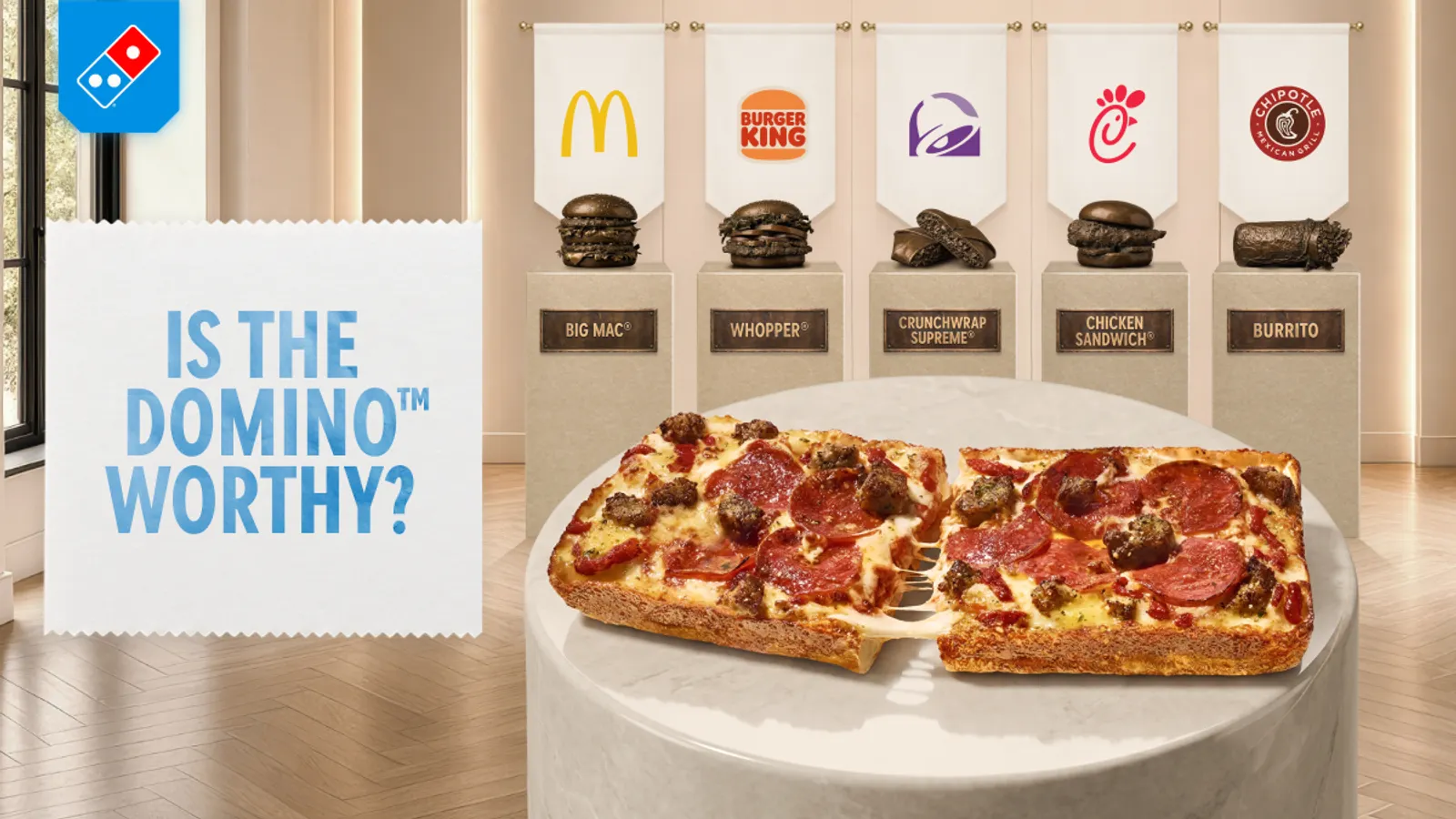
Central to the "Pizza Can’t. The Domino Can." campaign is an innovative promotion titled "Is the Domino Worthy?". This initiative directly engages with iconic fast-food staples, positioning the Domino as a formidable competitor. A dedicated social video explicitly challenges leading fast-food chains, prompting consumers to evaluate the Domino’s place among beloved, craveable, portable, and memorable menu items.
Trumbull elaborated on this competitive positioning: "In fast food, there are items that are just beloved, known and iconic, and they tend to be super craveable, portable and memorable. We’re going to leave it up to customers to decide if our Domino deserves to sit alongside fast-food greats." This approach places the power of decision directly in the hands of the consumer, fostering engagement and encouraging active participation.
To incentivize this evaluation, Domino’s is offering a compelling incentive. Consumers who purchase a qualifying item from a competitor—specifically, a McDonald’s Big Mac, Burger King Whopper, Taco Bell Crunchwrap Supreme, Chick-fil-A chicken sandwich, or Chipotle burrito—and upload their receipt to a dedicated microsite, isthedominoworthy.com, will receive a promotional code for a free Domino, while supplies last. This ambitious giveaway underscores Domino’s commitment to driving trial and is part of a broader plan to distribute $1 million worth of Domino pizzas.
This direct comparison strategy echoes Domino’s previous marketing efforts. Last year, the company launched a campaign that juxtaposed an eight-slice pizza against a comparably priced, sliced cheeseburger from fast-food competitors, aiming to highlight value. With competitors in the pizza sector, such as Pizza Hut and Papa John’s, experiencing sales declines, and Domino’s own U.S. sales momentum showing signs of slowing, the company views this aggressive stance against the broader fast-food market as a strategic opportunity to capture market share across different dayparts and on third-party delivery platforms.
Talbot further emphasized the strategic intent: "We finally have something that is for one [person] and customizable in this way, so we have to make people think about pizza differently, and putting it alongside these other items for the first time [demonstrates] traditional pizza could never be head to head against them, but the Domino can." This highlights the Domino’s unique selling proposition: a personal, customizable pizza designed for modern, on-the-go consumption, a niche that traditional large-format pizzas may not effectively serve.
A History of Consumer-Centric Innovation and Feedback
The "Is the Domino Worthy?" promotion follows a series of consumer-focused initiatives by Domino’s. Most recently, the company engaged consumers as beta testers for its relaunched digital ordering system. Between August 3rd and August 30th, customers who placed a qualifying online order were eligible for a $5 discount coupon, with feedback encouraged but not mandatory for the discount.
Trumbull drew a direct line from these initiatives to a core brand principle: "I learned at [Procter & Gamble], ‘consumer is boss,’ and that’s been a consistent thing from Domino’s as a brand," she remarked. "It’s meaningful when we can actually resolve attention and pay people for giving us that feedback, so we’ve been learning a lot through the process. The campaign has been really successful." This consistent emphasis on consumer feedback and direct engagement underscores Domino’s commitment to evolving its products and services based on real-world user experience.
The Domino: A Strategic Play for a Evolving Market
The introduction of the Domino product and its accompanying "Pizza Can’t. The Domino Can." campaign represents a multifaceted strategy for Domino’s. Firstly, the product itself addresses a growing consumer desire for individual, customizable meal options. In an era where personalization is a key driver of consumer choice, the Domino’s rectangular, personal size and Detroit-style crust offer a distinct alternative to traditional round pizzas. This format is inherently more portable and manageable for single servings, making it suitable for a wider range of consumption occasions, from solo lunches to late-night snacks.
Secondly, the campaign’s bold, even provocative, approach is designed to cut through the noise of a highly competitive market. By acknowledging pizza’s limitations in certain scenarios, Domino’s paradoxically highlights the Domino’s strengths and adaptability. This self-aware, humorous, and slightly irreverent tone is likely to resonate with younger demographics who often respond positively to brands that don’t take themselves too seriously. The strategic use of humor, even dark humor, can foster emotional connections and increase brand recall.
Thirdly, the "Is the Domino Worthy?" promotion is a sophisticated marketing tactic that leverages the appeal of established fast-food icons. By inviting consumers to compare the Domino directly with industry giants like McDonald’s, Burger King, and Taco Bell, Domino’s is implicitly elevating its product to that same tier of desirability and convenience. The offer of a free Domino in exchange for engaging with competitors’ products is a clever way to drive immediate trial and generate buzz. The allocation of $1 million worth of free pizzas signifies a substantial investment in market penetration and consumer acquisition.
The timing of this campaign is also noteworthy. As other pizza chains grapple with declining sales, Domino’s is proactively seeking to expand its market presence beyond its traditional dinner-time stronghold. By targeting new dayparts and occasions, and by positioning the Domino as a viable alternative to other fast-food staples, Domino’s aims to diversify its revenue streams and capture a larger share of the overall quick-service restaurant market.
The underlying implication of this strategy is that Domino’s is not content to rest on its laurels. The company is actively innovating, both in its product development and its marketing approach, to stay ahead of evolving consumer preferences and competitive pressures. The "Pizza Can’t. The Domino Can." campaign is more than just an advertisement; it’s a declaration of intent to redefine the role of pizza in consumers’ lives and to solidify its position as a leader in the dynamic fast-food landscape. The success of this campaign will likely be measured not only by immediate sales figures but also by its ability to shift consumer perceptions and foster long-term brand loyalty in a rapidly changing marketplace.