

Dropshipping continues to be a robust and dynamic sector within e-commerce in 2026, with projections indicating a market valuation of approximately $543.53 billion. This sustained growth, however, inevitably fuels increased competition, making strategic partnerships more critical than ever for businesses aiming to differentiate themselves. Among the leading platforms catering to this demand, Spocket and Doba emerge as prominent contenders, particularly for entrepreneurs building their presence on platforms like Shopify. While both offer solutions for streamlining dropshipping operations, they cater to distinct business needs and growth stages. Spocket distinguishes itself through a curated catalog, emphasizing trending products sourced primarily from suppliers in the United States and Europe, fostering a sense of selectivity and quality. In contrast, Doba boasts a considerably larger inventory, with a pronounced emphasis on U.S.-based suppliers and products housed in U.S. warehouses, making it a strong choice for sellers targeting the American market. Furthermore, Doba offers a wider array of marketplace integration options and features an advanced AI agent, Doba Pilot, which has significantly expanded its capabilities in automating day-to-day operational tasks.
Doba vs. Spocket: A Strategic Overview for 2026
The choice between Doba and Spocket hinges on a business’s current scale, market focus, and operational ambitions. Doba presents itself as the superior option for established or rapidly growing dropshipping enterprises aiming for broad market reach across diverse sales channels, including Amazon, TikTok Shop, and beyond. Its robust automation tools are designed to significantly reduce administrative burdens by ensuring real-time synchronization of pricing and inventory, facilitating seamless product listing migration between channels, and enabling the application of dynamic pricing rules. This makes Doba particularly adept at managing extensive product catalogs and complex operational workflows.
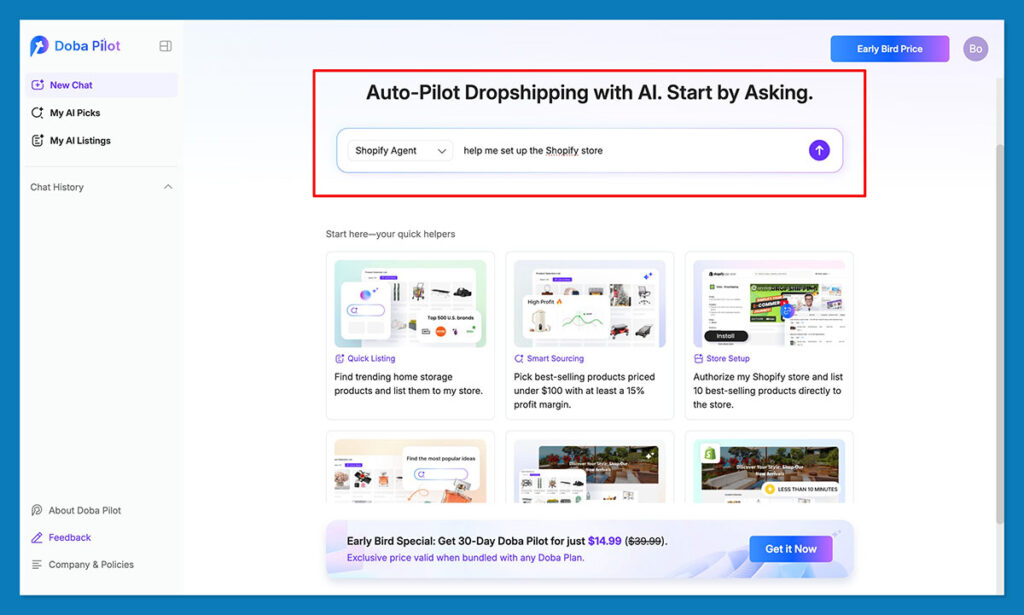
The recent enhancements to Doba Pilot underscore this operational focus. The AI agent now provides end-to-end support, encompassing market research, product sourcing, listing creation, order fulfillment, and post-sales management—a substantial leap from its previous functionalities. For businesses focused on the U.S. market, Doba’s integration of warehouse-based products and domestic shipping support offers a tangible advantage in delivering faster shipping times, a crucial factor in customer satisfaction.
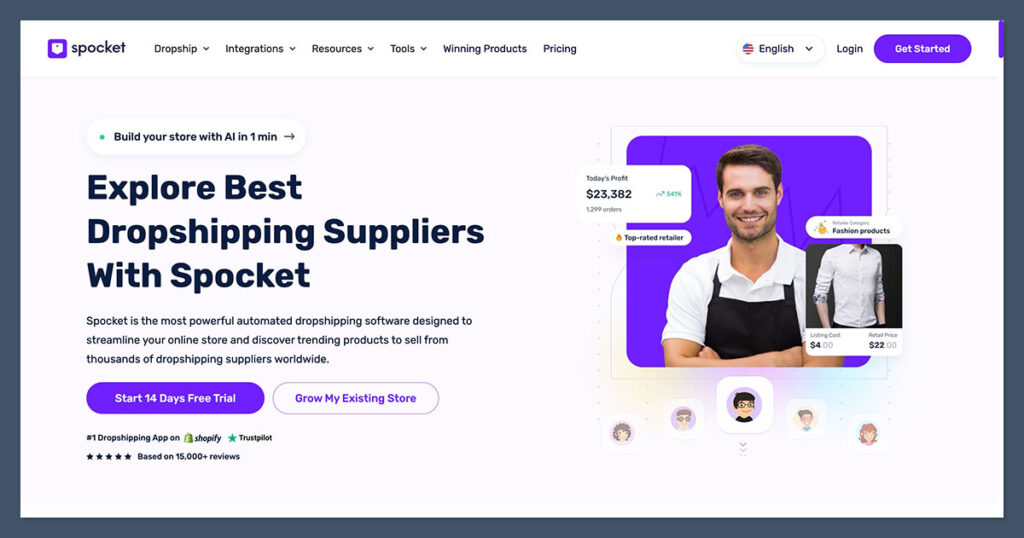
Spocket, on the other hand, is positioned as a more accessible and straightforward solution for dropshippers seeking a curated selection of products and direct access to local suppliers. Its user interface is designed for ease of adoption, allowing users to quickly browse, select, and list products. While it offers control over pricing and listings, and even branded invoices, its most significant drawback lies in its subscription model: each newly connected store necessitates a separate subscription, which can quickly escalate costs for businesses operating multiple storefronts.
Operational Hub vs. Curated Selection: Core Differentiators
At their core, both platforms provide the essential infrastructure for dropshipping. Doba, however, has evolved beyond a mere supplier directory to become a comprehensive operational hub. Its expansive catalog, featuring over a million SKUs, is complemented by advanced management features for product imports, inventory fluctuations, order processing, shipment tracking, and cross-channel product synchronization. This integrated approach aims to streamline the entire post-sourcing operational lifecycle. The platform’s strong alignment with the U.S. market, evidenced by its extensive network of U.S. warehouse options, can be a significant asset for businesses prioritizing swift domestic delivery.
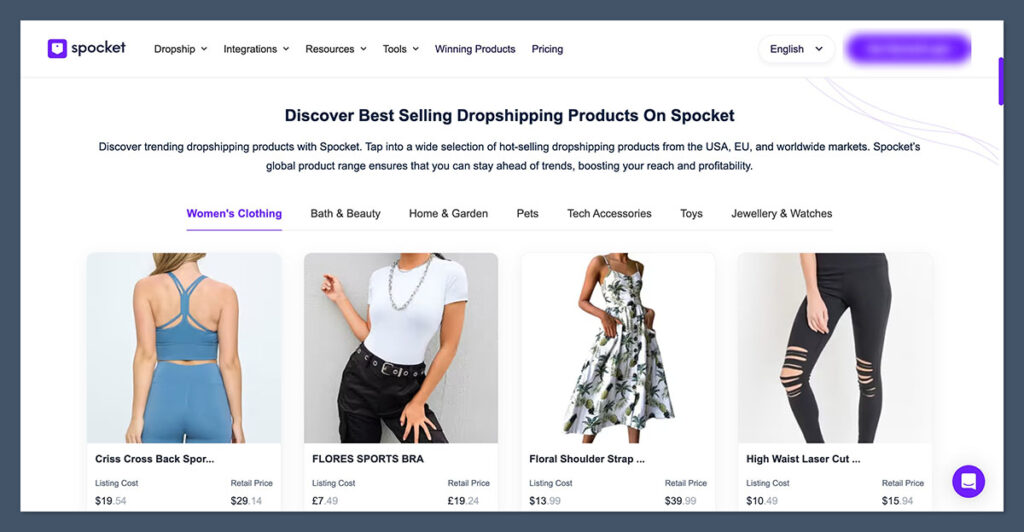
Spocket’s philosophy centers on empowering sellers to make informed sourcing decisions from the outset. Its carefully vetted network of U.S. and EU suppliers offers a more focused product selection. The process of importing products is designed to be simple: select products, edit as needed, and publish. This approach makes Spocket an attractive option for smaller businesses and those new to dropshipping who prioritize a less complex onboarding experience.
Pricing and Total Cost of Ownership
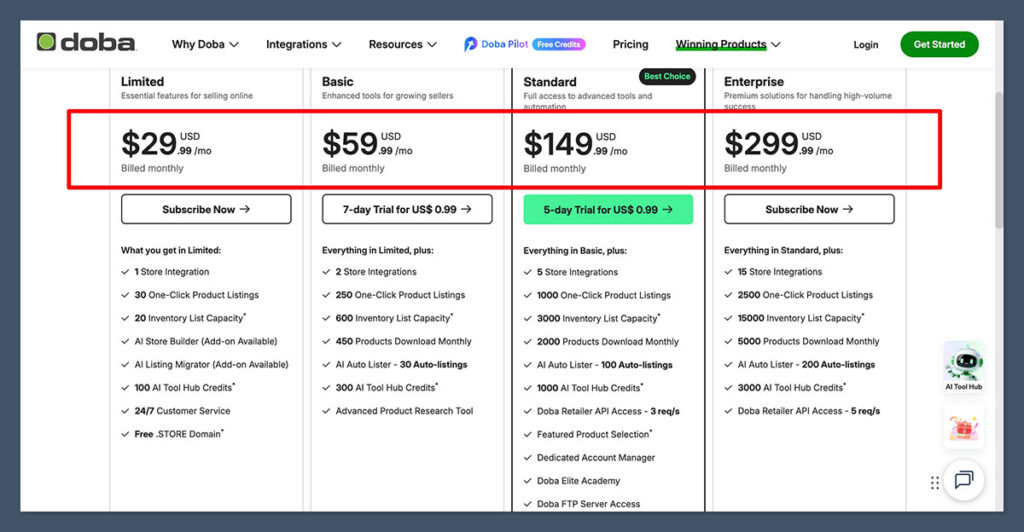
When evaluating the financial commitment, Doba generally presents a more economical entry point, particularly for its foundational plans. The Limited plan starts at $29.99 per month, offering one store integration, a limited number of one-click product listings, and a modest allocation of AI Tool Hub credits. Higher-tier plans, such as the Basic ($59.99/month) and Standard ($149.99/month), progressively increase capacity, features, and access to advanced tools like API access and dedicated account management.
Spocket’s entry-level plan begins at $39.99 per month. While an annual subscription offers significant savings, the fundamental cost structure means that each individual store requires its own paid subscription. This can lead to a substantially higher total cost for businesses managing multiple e-commerce ventures. It is important to note that neither platform’s subscription fees cover the cost of the actual products sold; these are incurred separately as inventory is purchased from suppliers.
Ease of Use and Onboarding: A Tale of Two Approaches
For newcomers to dropshipping, Spocket often provides a gentler learning curve. Its interface is intuitive, guiding users through a streamlined process of browsing its curated catalog, adding desired products to an import list, making necessary edits, and publishing them to their store. While this simplicity is a clear advantage for beginners, it’s worth noting that products typically need to be imported individually, although bulk publishing of the import list is possible.
Doba, conversely, offers a more feature-rich environment, which can initially appear more complex. However, the platform has made significant strides in improving its onboarding experience, largely due to the evolution of Doba Pilot. This AI agent can now guide users through the initial stages of product research, store connection, and listing setup in a conversational manner, significantly lowering the barrier to entry. While the overall platform still presents a broader feature set compared to Spocket, the enhanced AI assistance ensures that users can achieve functional operational status more rapidly. Doba also provides extensive online resources, including a dedicated "Academy" for higher-tier subscribers, which is invaluable for businesses seeking to scale and refine their dropshipping strategies.
AI, Automation, and Product Research Capabilities
Doba has significantly invested in its AI capabilities with the recent comprehensive upgrade of Doba Pilot. This AI agent has transformed from a conversational catalog search tool into a full-fledged dropshipping assistant. It now manages the entire lifecycle from market research to post-sales support.

- Market Research (Market Scout): Doba’s AI analyzes demand, competition, pricing trends, and seasonality, providing valuable insights for category assessment before a seller commits resources.
- Product Sourcing (Smart Sourcing): Sellers can provide basic product descriptions, category preferences, price ranges, and shipping locations, and the AI will identify relevant products, streamlining the discovery process.
- Listing and Management: Doba Pilot extends its capabilities to store setup, including theme and banner assistance for Shopify. Its workflows now support major platforms like Shopify, BigCommerce, Wix, eBay, Walmart, and TikTok Shop. The latest enhancements for Walmart and TikTok include AI-assisted product attribute management, UPC uploads, listing previews, and bulk publishing, further bolstering multi-channel listing efficiency. The AI can also assist with pricing strategies, title and description optimization, and direct publishing.
- Order and Fulfillment Automation: Pilot integrates order and fulfillment management within the same interface, allowing sellers to monitor logistics, address exceptions, track shipments, and initiate refund processes without navigating separate tools. Proactive monitoring for logistics exceptions and the ability to intercept unshipped purchase orders when store orders are canceled are notable advancements.
- Recurring Tasks and Information Retrieval: Users can schedule recurring jobs for sourcing, auto-listing, or market reports. Pilot can also be queried for information regarding Doba’s policies and supplier details.
Beyond Pilot, Doba offers a suite of AI-powered tools, including an AI Pickr, image creation and background removal, auto-listing, and an AI store builder. While AI credit allowances vary by plan, new Doba users receive 30 free Doba Pilot Credits upon signup.
Spocket, while not as heavily focused on broad AI functionalities, incorporates intelligent features for product filtering. Users can sort items by origin, destination, price, supplier, premium status, or best-seller metrics. Specific features like shipping time and cost estimations are currently exclusive to U.S. sellers. Both platforms automate core order workflows, with Doba additionally offering inventory and pricing updates and AI-assisted operational tasks contingent on channel capabilities.
Product Range, Quality, and Supplier Vetting
Both platforms offer substantial product catalogs, with Doba arguably presenting a slightly broader variety across categories such as homeware, beauty, and automotive goods, among others. Doba’s network extends to over a million SKUs, which is advantageous for sellers exploring multiple product niches. However, due to the sheer volume of suppliers Doba works with, product quality can exhibit variability, despite Doba’s vetting processes.
Spocket maintains a more stringent approach to supplier onboarding. Suppliers must either manufacture their own inventory or physically hold it, and they are required to offer retailers a minimum discount of 25% off public pricing. This selectivity contributes to a generally higher perceived quality and reliability within Spocket’s nearly one million-product catalog. While Spocket primarily features U.S. and EU suppliers, Doba also provides the capability to filter suppliers by location.
Shipping, Fulfillment, and Returns: Navigating Logistics
Spocket’s emphasis on U.S. and EU suppliers facilitates relatively swift local delivery. Doba mirrors this with a strong U.S. shipping infrastructure, reporting that approximately 90% of its products ship from within the U.S. This can result in comparable delivery times for U.S.-focused retailers, though actual transit times remain dependent on specific products, suppliers, destinations, and chosen shipping methods. Doba prominently highlights products shipping from U.S. warehouses, a crucial factor for businesses prioritizing fast domestic fulfillment. These U.S. warehouse options can mitigate common fulfillment challenges such as extended transit times, stockouts, and late delivery complaints. It is important to note that neither platform guarantees specific delivery windows, and international shipping remains a significant component of both catalogs.
Both platforms have established clear operational guidelines for their suppliers. Doba mandates that suppliers refund any order not dispatched within their stated processing times. Damaged items are eligible for a prepaid return label upon submission of evidence, and invalid tracking information can trigger a refund if the supplier cannot rectify the issue. Doba also offers optional After-Sales Protection Services to help mitigate losses from common post-purchase issues, including returns for non-defective items and lost packages.
Spocket requires its suppliers to maintain a 95% order success rate, provide tracking details, and adhere to stated delivery windows. Suppliers are also obligated to respond to inquiries within 24-47 hours. However, individual suppliers retain the autonomy to set their own return policies, with some potentially refusing returns altogether. Both companies provide automation to expedite fulfillment tasks, but managing complexities like split-basket orders may still require direct seller intervention.
Integrations, Stores, and Scalability
Doba and Spocket integrate with a wide range of popular e-commerce platforms, including Shopify, WooCommerce, Wix, BigCommerce, and Square. Doba distinguishes itself further with its robust marketplace integration capabilities, offering more structured support for multi-channel listings across platforms like Temu, TikTok Shop, Amazon, eBay, and Walmart. This extensive reach makes it easier for businesses to diversify their sales channels.
A key advantage of Doba for multi-channel sellers is its centralized management dashboard. Product, inventory, store, and order data are consolidated, with automatic synchronization of inventory levels and orders across connected channels. This automation is crucial for preventing outdated stock counts and minimizing errors associated with manual order processing. While Doba Pilot’s integrated workflows currently support a select group of platforms (Shopify, BigCommerce, Wix, Walmart, TikTok Shop, and eBay), the platform’s broader integration capabilities remain a significant asset.
Both platforms offer API integrations. Spocket’s API is primarily geared towards streamlining storefront integration, including automated checkout processing and inventory tracking. Doba’s API, on the other hand, is more focused on bulk data streaming, multi-channel marketplace synchronization, fulfillment routing, and comprehensive inventory updates, catering to more complex operational needs.
Samples, Branding, and Packaging
Ordering product samples is a recommended practice for any e-commerce venture. Both Doba and Spocket facilitate this process. Spocket features a straightforward "order samples" option on each listing, allowing for the purchase of up to five units per item, though bulk sampling is not available. Doba’s sample ordering process is slightly more involved, often requiring coordination through individual supplier listings or direct communication.
Spocket offers branded invoicing on its higher-tier plans. Doba enforces blind shipping for marketplace orders, with specific branding or packaging options contingent on individual supplier capabilities. Spocket generally holds an advantage in this area due to its more streamlined sample ordering and branded invoicing features, which require less direct seller effort.
Conclusion: Choosing the Right Partner for Growth
Both Doba and Spocket offer compelling solutions for dropshippers, each with distinct strengths. Spocket is an excellent choice for beginners seeking local suppliers, a user-friendly interface, straightforward sample ordering, and branded invoicing, particularly for businesses operating a single store.
However, Doba emerges as the more comprehensive and scalable solution for a broader range of e-commerce businesses. Its competitive starting pricing, coupled with its extensive control over listings, orders, inventory, and multi-channel marketplace integrations, positions it as a superior platform for growth. The significant enhancements to Doba Pilot, particularly its AI-driven operational support, address previous usability concerns and empower businesses to manage complex workflows efficiently. While Doba may offer more functionality than some nascent businesses initially require, its capacity for seamless scaling makes it the preferred choice for entrepreneurs looking to expand their dropshipping operations. As the dropshipping market continues its upward trajectory, strategic platform selection, informed by an understanding of operational needs and growth aspirations, will remain paramount to success.








