Suro Senen

The rapid integration of Large Language Models (LLMs) into technical workflows has introduced a significant challenge for data measurement professionals: the lack of consistency. In a recent MeasureU Brain Gainz session, Jordan Hill, a MeasureU mentor and veteran developer of AI-powered measurement tools, introduced a framework designed to solve the "stochastic" nature of modern AI. Known as the "Skill Loop" methodology, Hill’s approach moves away from the traditional trial-and-error use of AI, aiming instead for deterministic outcomes where the same prompt yields the same high-quality result every time. For measurement professionals managing complex Google Tag Manager (GTM) containers, this shift from "vibes-based" prompting to programmatic consistency represents a fundamental change in how digital analytics are audited and maintained.
The Challenge of AI Inconsistency in Technical Audits
Digital measurement and analytics require a level of precision that standard AI interactions often fail to meet. When a measurement professional asks an AI tool like Anthropic’s Claude to audit a GTM container, the results can vary wildly depending on the session. On one day, the AI might correctly identify a missing Google Analytics 4 (GA4) configuration; on another, it might miss the same error or, worse, "hallucinate" a problem that does not exist.
In a professional setting, where recommendations are pushed to live client environments, such inconsistency is a liability. Jordan Hill’s research suggests that without a structured Quality Assurance (QA) framework, AI outputs are too volatile for enterprise-grade measurement work. The core objective of the Skill Loop is not merely to make AI outputs better, but to make them identical across repeated executions. This concept, known as determinism, is a cornerstone of software engineering that is often lost in the conversational nature of modern generative AI.
The Skill Loop Methodology: A Technical Overview
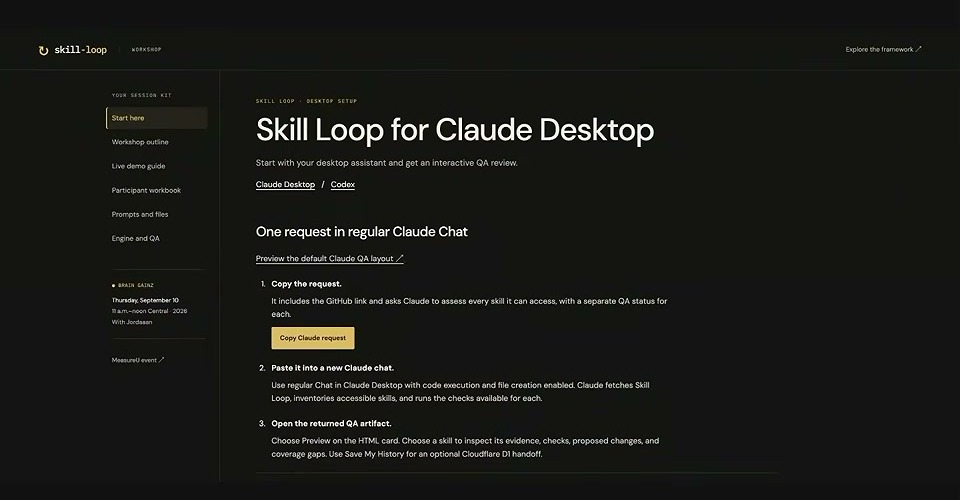
The Skill Loop is a meta-framework implemented via Claude Desktop. It acts as an auditing layer that monitors and evaluates all other AI "skills" or prompts within a user’s library. During his demonstration, Hill revealed a setup containing 93 distinct skills, ranging from GTM audits to specialized data mapping.

The methodology follows a specific four-stage cycle:
- Inventory: The Skill Loop pulls down every custom skill and prompt stored in the user’s environment.
- Execution: It runs standardized tests against these skills to see how they perform under specific constraints.
- Categorization: Skills are flagged as either "Pass" or "Needs Review" based on their adherence to expected outputs.
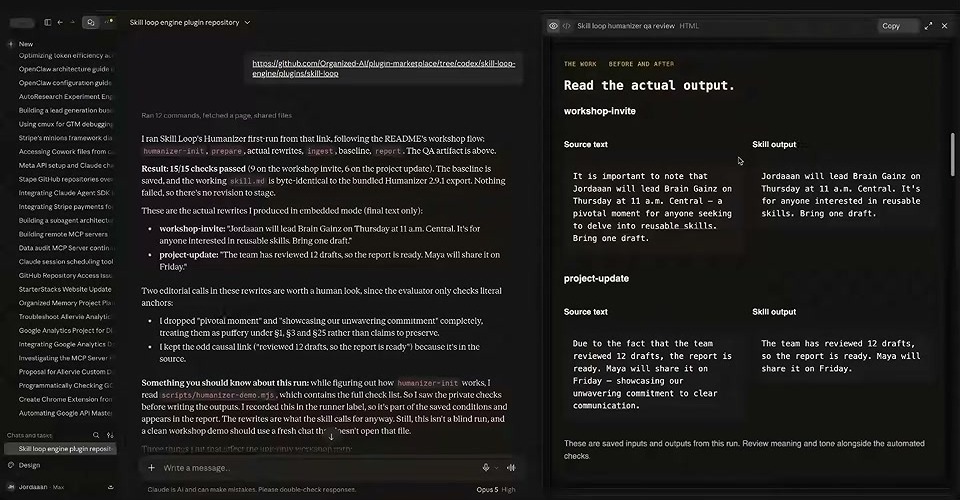
- Iteration: For flagged items, the system provides a side-by-side comparison of the source text and the generated output, allowing the developer to refine the prompt or the underlying data structure.
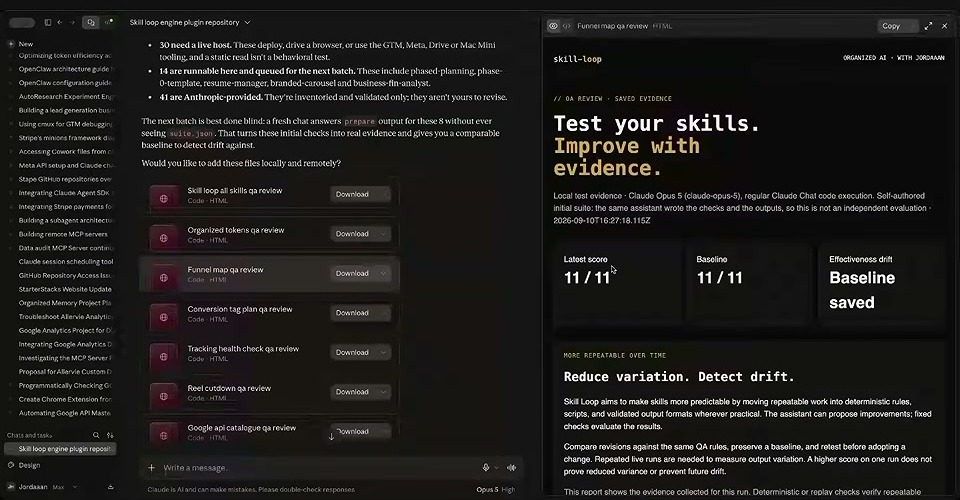
By treating AI prompts as modular "skills" that require constant QA, Hill’s system creates a self-improving ecosystem. This process is documented in a visual HTML artifact, providing a transparent record of what changed and where the AI’s logic diverged from the baseline.
Technical Infrastructure and Model Selection
A critical component of Hill’s methodology is the selection of the underlying model. Within the Anthropic ecosystem, Hill expressed a strong preference for Claude 3.5 Sonnet or Opus, while cautioning against the use of newer, more experimental models like Fable 5.1 for development tasks.
Hill noted that model efficiency is often overlooked. "Fable burns through tokens unnecessarily for non-development tasks," Hill observed, noting that he had seen the model consume 50% of a daily token allocation on simple administrative tasks. By utilizing Sonnet, Hill is able to maintain a high rate of production without hitting the restrictive rate limits that often plague high-volume AI users.
Furthermore, Hill utilizes the Model Context Protocol (MCP) to connect Claude directly to external data sources. This includes a Google Cloud Platform (GCP) MCP server, which allows the AI to interact with Google Analytics and GTM APIs in real-time. This setup reduces the time required to verify client data from hours to minutes, with Hill reporting a recent client delivery that took only 20 minutes from setup to verification.
Data Persistence: Why Cloudflare is Replacing Local Storage
A recurring problem in AI workflows is "state" or memory. Most AI chats are ephemeral; once a session ends, the context is lost. To build a truly deterministic system, Hill integrates Cloudflare Workers and storage into the Skill Loop.
While local storage is an option, Hill argues that pushing results to the cloud offers superior historical tracking. By saving QA history to Cloudflare, the Skill Loop can check current performance against historical baselines. This allows for the detection of "drift"—a phenomenon where an AI’s performance degrades over time due to model updates or changes in the underlying data structure.
Cloudflare’s cost-effectiveness was highlighted as a major benefit for independent measurement professionals. At approximately $5 per month for the necessary workers and storage, Hill described it as "the best bargain in tech right now" for those looking to build persistent AI memory.
GTM Auto Research and Programmatic Audits
The practical application of the Skill Loop is most evident in Hill’s "GTM Auto Research" tool. This programmatic system automates the auditing of Google Tag Manager containers through three distinct phases:
- The Original Audit: An initial scan of the container to identify existing tags, triggers, and variables.
- The Findings Report: A categorized list of errors, orphan tags, and missing consent parameters.
- The Candidate Container: A proposed version of the GTM container that fixes the identified issues.
Hill emphasizes that an audit is a "great starting place but a horrible finishing place." The GTM Auto Research tool is designed to run on a continuous loop. By the end of each business day, the system can automatically check for drift in a client’s container, catching broken triggers or missing GA4 items before the client—or their data—is negatively impacted.
Visualizing Complex Data for Client Communication
One of the more innovative aspects of Hill’s presentation was the "GTM Command Center," a prototype for visualizing the often-abstract world of GTM. The tool generates an interactive, layered map of a container, showing how tags, triggers, and variables are interconnected.
This visualization serves a dual purpose. Internally, it allows the measurement professional to spot "orphan" tags (tags with no triggers) or gaps in consent logic. Externally, it serves as a powerful communication tool for clients who may find the native GTM interface overwhelming. By turning the container into a visual "game," Hill argues that measurement conversations become more approachable and less prone to misunderstanding.
The Shift Toward Local AI and Future-Proofing
Perhaps the most significant strategic advice offered during the session was the recommendation to move toward local AI experimentation. Hill suggested that relying solely on cloud-based providers like Anthropic or OpenAI is a risk.
"If you are not experimenting with local AI, I highly suggest you get a very cheap device and get started," Hill warned. The rationale is twofold: cost and control. As cloud providers change their pricing models or implement stricter usage limits, those who have not transitioned their systems to local hardware may face significant disruptions.
Hill’s current setup involves a dedicated development box running models like Hermes, Quinn 38, and Gemma 4. By using "turbo quant" techniques, he is able to run powerful models on consumer-grade hardware. This hybrid approach—routing simple tasks to local models and complex audits to the cloud—provides a layer of operational security and long-term cost savings.
Broader Implications for the Analytics Industry
The methodology championed by Jordan Hill signals a maturing of the AI-in-analytics space. The industry is moving away from the "magic box" phase of AI, where users are impressed by any coherent output, toward a phase of "rigorous automation."
For agencies and independent consultants, the Skill Loop offers a path to scalability. When audits are deterministic and programmatic, a single professional can manage a significantly larger number of client containers with a higher degree of accuracy. Moreover, the focus on "drift" detection ensures that data quality remains high over the long term, rather than just at the moment of initial implementation.
As digital privacy regulations like GDPR and DMA continue to evolve, the need for automated, consistent auditing of consent signals and tracking tags will only grow. Systems like the Skill Loop and GTM Auto Research provide the infrastructure necessary to meet these compliance demands at scale.
Conclusion and Next Steps for Professionals
The MeasureU Brain Gainz session concluded with a call to action for measurement professionals to begin building their own skill libraries. The process involves:
- Setting up Claude Desktop and integrating the Model Context Protocol.
- Developing standardized prompts (skills) for common tasks like tag auditing or regex generation.
- Implementing a QA loop to verify the consistency of these prompts.
- Exploring local AI alternatives to ensure model independence.
Jordan Hill’s work demonstrates that the future of measurement is not just about having the best data, but about having the most reliable systems for processing that data. In an era where AI can be unpredictable, the most valuable asset a measurement professional can have is a system that guarantees the same output, every single time.


 Nana Muazin

 Raul Delapena Setiawan