
 rifanmuazin
The global media landscape is currently navigating a period of profound instability, characterized by a dual crisis of credibility and resources. According to the newly released Cision 2026 State of the Media Report, which surveyed more than 1,800 journalists across the globe, the industry is grappling with a volatile mix of technological disruption and economic pressure. For public relations (PR) professionals, these findings represent both a challenge and a significant opportunity to redefine their roles as essential partners in the news-gathering process.
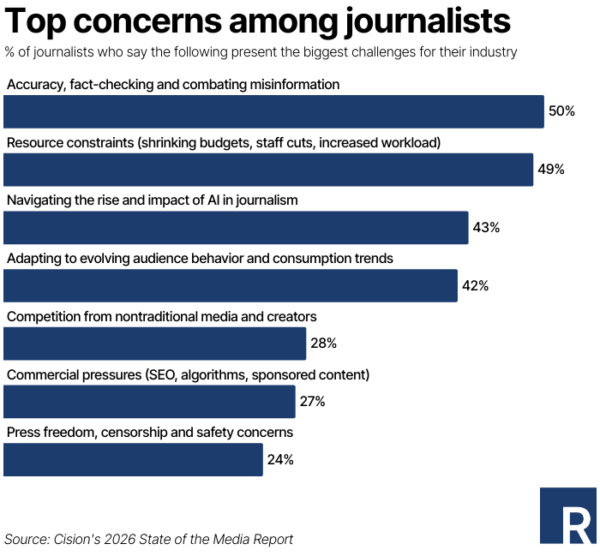
The report highlights a stark reality: 50% of journalists identify the struggle for accuracy and the ongoing battle against misinformation as their primary challenge over the past year. This represents a notable escalation from the 2025 report, where 40% of respondents cited the need to maintain credibility and combat "fake news" accusations as their chief concern. As digital ecosystems become increasingly saturated with unverified content, the burden of verification has become a central, often exhausting, component of the journalistic workflow.
The Evolution of Newsroom Challenges: A Three-Year Chronology
To understand the current state of the media, it is necessary to examine the trajectory of these challenges over the last several cycles. The data reveals a consistent upward trend in pressure points that were once considered manageable but have now reached critical levels.
In 2024, the primary concerns centered on the transition to digital-first models and the optimization of social media algorithms. By 2025, the focus shifted toward the defense of journalistic integrity, with 20% of reporters specifically noting that finding credible sources was becoming a bottleneck in their daily operations. During that same period, 29% of journalists expressed concern over shrinking budgets and staff reductions.
Entering 2026, these pressures have intensified significantly. The percentage of journalists citing shrinking budgets, staff cuts, and increased workloads as a major challenge has surged to 49%, nearly doubling the sentiment from just twelve months prior. This indicates a period of rapid consolidation and resource depletion within newsrooms, leaving fewer reporters to cover a broader range of topics with less institutional support.

Simultaneously, the rise of Artificial Intelligence (AI) has moved from a peripheral curiosity to a central source of professional anxiety. In 2025, 30% of journalists expressed unease regarding the impact of AI on their profession. In the 2026 report, that figure has climbed to 43%. This anxiety is rooted in two main areas: the potential for AI to automate journalistic tasks and the role of AI in generating sophisticated misinformation that is increasingly difficult to detect.
Supporting Data: The PR-Journalist Symbiosis
Despite the internal turmoil within newsrooms, or perhaps because of it, the reliance on PR professionals has reached a high watermark. The Cision report finds that 66% of journalists now rely on PR-provided content—including pitches, media kits, and press releases—to generate story ideas. This positions PR as the single most influential source for news inspiration, outperforming social media trends, rival publications, and industry-specific events.
However, this reliance is contingent upon the quality and relevance of the material provided. The data suggests a significant disconnect between what PR pros send and what journalists actually need:
- Pitch Relevance: Journalists report that 75% or more of the pitches they receive are irrelevant to their specific beat or audience.
- Rejection Criteria: 82% of journalists state that a lack of alignment with their coverage area is the primary reason they reject a pitch.
- Communication Barriers: While PR teams often experiment with new outreach platforms, 97% of reporters maintain a strict preference for email communication, viewing it as the least intrusive and most professional channel for managing information flow.
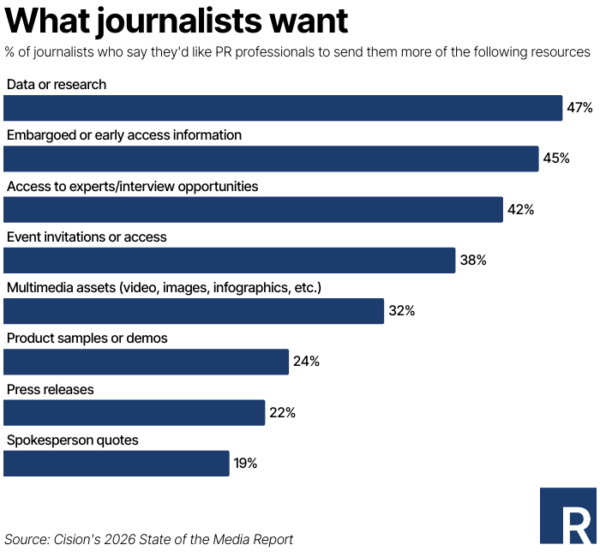
The report identifies a "Gold Standard" for content that journalists are most likely to utilize. Topping the list are original data sets, embargoed stories that offer a competitive "first-look" advantage, and direct access to subject matter experts. In an era where newsrooms lack the budget for deep investigative research, PR teams that provide vetted, data-backed insights are effectively filling a critical gap in the news production cycle.
Official Responses and Strategic Perspectives
The findings of the 2026 report have prompted industry leaders to call for a return to "human-centric" PR. Amy Jones, Cision’s Chief Marketing Officer, emphasized that the current environment leaves no room for the "spray-and-pray" tactics that have historically cluttered journalists’ inboxes.
"PR teams, much like newsrooms, are under immense pressure to deliver results with fewer resources," Jones noted in the report. "However, adopting an automated, high-volume strategy is counterproductive. It erodes the very credibility that PR pros need to build. In 2026, the competitive differentiator is thoughtfully tailored, human-to-human outreach."
Jones further advised that PR professionals must invest time in building "curated lists" of journalists. This involves a deep dive into a reporter’s previous work, their audience demographics, and the specific nuances of their beat. By doing so, PR pros can ensure that every interaction provides value rather than noise.
From the newsroom perspective, the sentiment is one of cautious collaboration. Many editors have indicated that they no longer have the luxury of "discovery" phases for stories. They require "turnkey" information—materials that are ready to be verified and integrated into a narrative. This includes high-quality multimedia assets, such as high-resolution images and video clips, which help meet the visual demands of digital platforms without requiring the newsroom to dispatch its own creative teams.
The AI Hurdle: Balancing Efficiency with Authenticity
One of the most contentious areas identified in the report is the use of AI in PR outreach. While AI tools are becoming ubiquitous for drafting content, journalists remain highly skeptical of their use in the PR-journalist relationship.
The 2026 data shows that 53% of reporters "strongly or somewhat object" to receiving pitches or press releases that appear to be AI-generated. While this is a slight decrease from the 56% who felt this way in 2025—suggesting a slow normalization of the technology—it remains a significant barrier. The objection is not necessarily to the technology itself, but to the perceived lack of effort and the potential for factual errors.
The report warns that as AI becomes more integrated into PR workflows, the risk of "dehumanizing" the pitch increases. Journalists value the "nuanced insight and authentic storytelling" that only a human professional can provide. The consensus among the 1,800 surveyed reporters is that AI should be used for background research and data organization, but the final outreach and the relationship-building must remain human.
Broader Impact and Implications for the Future of Media
The implications of the Cision 2026 State of the Media Report extend beyond the immediate PR-journalist interaction. They point to a broader shift in how information is synthesized and consumed in a fragmented media environment.
First, the "Resource Gap" suggests that specialized trade publications and niche media outlets may become even more dependent on corporate and institutional PR. As mainstream newsrooms cut back on specialized beats like science, technology, and deep-sector finance, the role of the PR professional evolves from a "promoter" to an "information officer" who sustains the flow of news in these sectors.
Second, the "Misinformation Crisis" creates a premium on "Trusted Sources." For brands and organizations, this means that their PR departments must act as rigorous fact-checkers. A single instance of providing inaccurate data to a resource-strapped journalist can lead to a permanent blacklisting, as reporters simply do not have the time to double-check every figure provided by a source they no longer trust.
Finally, the report underscores the enduring power of "Earned Media." Despite the rise of influencer marketing and paid content, the validation provided by a traditional news outlet remains the most coveted asset for brands. However, securing that earned media in 2026 requires a more sophisticated approach than ever before. It requires a blend of data literacy, emotional intelligence, and a deep respect for the shrinking bandwidth of the modern journalist.
As the media industry continues to navigate these turbulent waters, the 2026 State of the Media Report serves as a roadmap. It suggests that while the tools of the trade are changing, the fundamental requirements of journalism—accuracy, relevance, and human connection—remain unchanged. For PR professionals, the path forward is clear: provide the data, provide the experts, and above all, provide the human touch that AI cannot replicate.










