rifanmuazin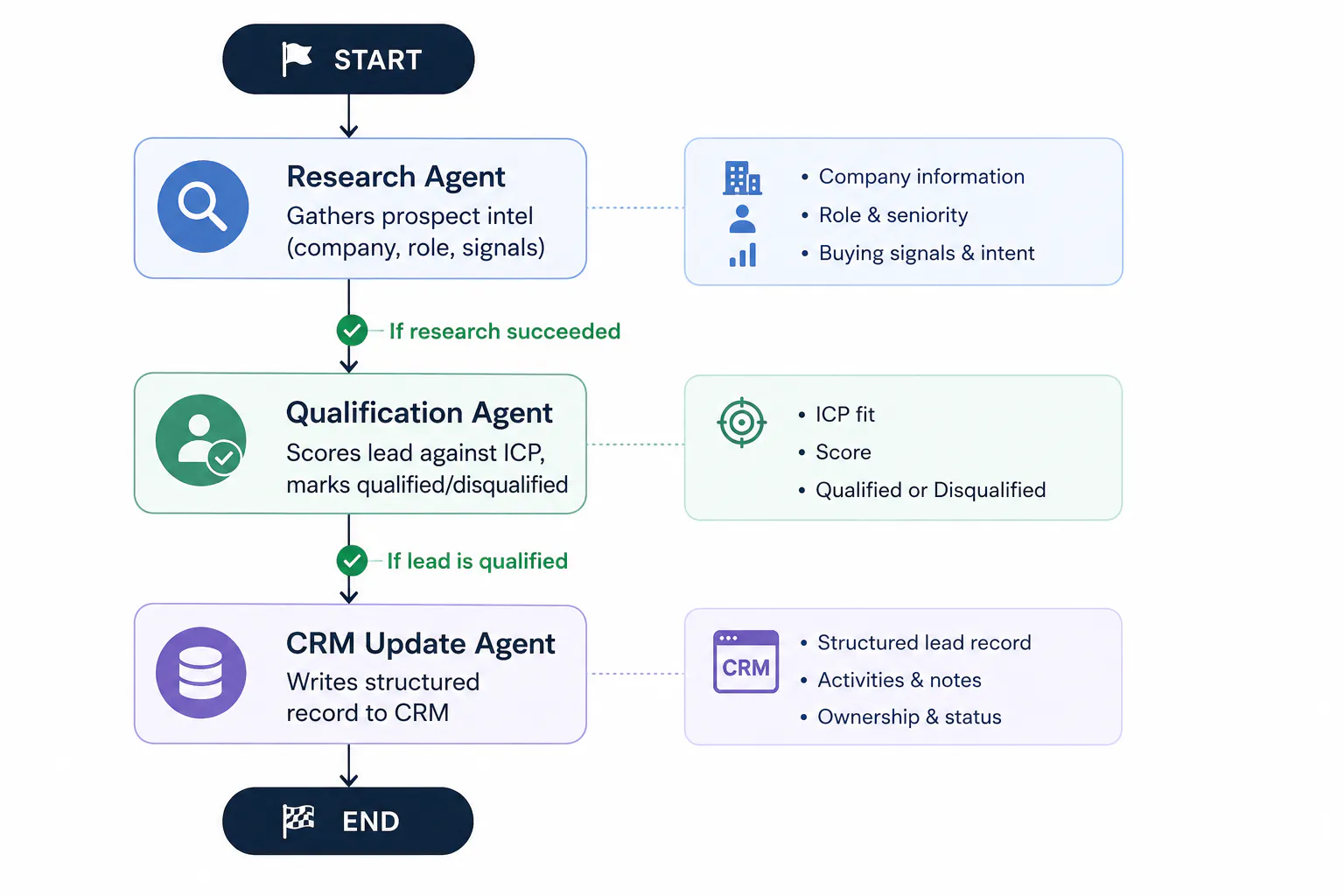
The modernization of B2B sales operations is increasingly defined by the transition from manual lead management to automated, AI-driven workflows. Historically, sales representatives and Sales Development Representatives (SDRs) have found themselves bogged down by “administrative drag”—the repetitive tasks of researching prospects, scoring lead fit, and manually updating Customer Relationship Management (CRM) platforms like Salesforce or HubSpot. Industry data from Salesforce’s “State of Sales” report suggests that sales reps spend only about 28% of their week actually selling, with the remainder consumed by manual data entry and lead research. To combat this inefficiency, a new architectural paradigm has emerged: multi-agent AI systems orchestrated by frameworks like LangGraph.
This evolution represents a shift from simple, linear automation to complex, stateful workflows where specialized AI agents collaborate to manage the sales funnel. By leveraging OpenAI’s large language models (LLMs) and the LangGraph orchestration layer, organizations can now build pipelines that take raw prospect data and transform it into fully enriched, qualified, and updated CRM entries with zero human intervention.
The Sales Productivity Gap and the Rise of Agentic AI
The current B2B sales cycle is more data-intensive than ever. A typical prospect research phase involves cross-referencing LinkedIn profiles, company funding news, industry reports, and technographic data. When performed by humans, this process is not only slow but prone to inconsistency. An SDR might spend 30 to 40 minutes researching a single lead, only to find they do not meet the Ideal Customer Profile (ICP).
AI automation addresses these bottlenecks through three primary mechanisms: speed, consistency, and scale. Unlike a human team, an AI system can process hundreds of leads simultaneously, applying the exact same rubric to every prospect. This does not imply the replacement of salespeople; rather, it facilitates a “human-in-the-loop” model where AI handles the data-heavy preparation, allowing human reps to focus on high-value relationship building and closing.
The multi-agent approach is central to this efficiency. In a single-prompt LLM system, the model often struggles to handle diverse logic, such as switching between data retrieval, analytical scoring, and database formatting. By contrast, a multi-agent system assigns dedicated roles to different “nodes”:
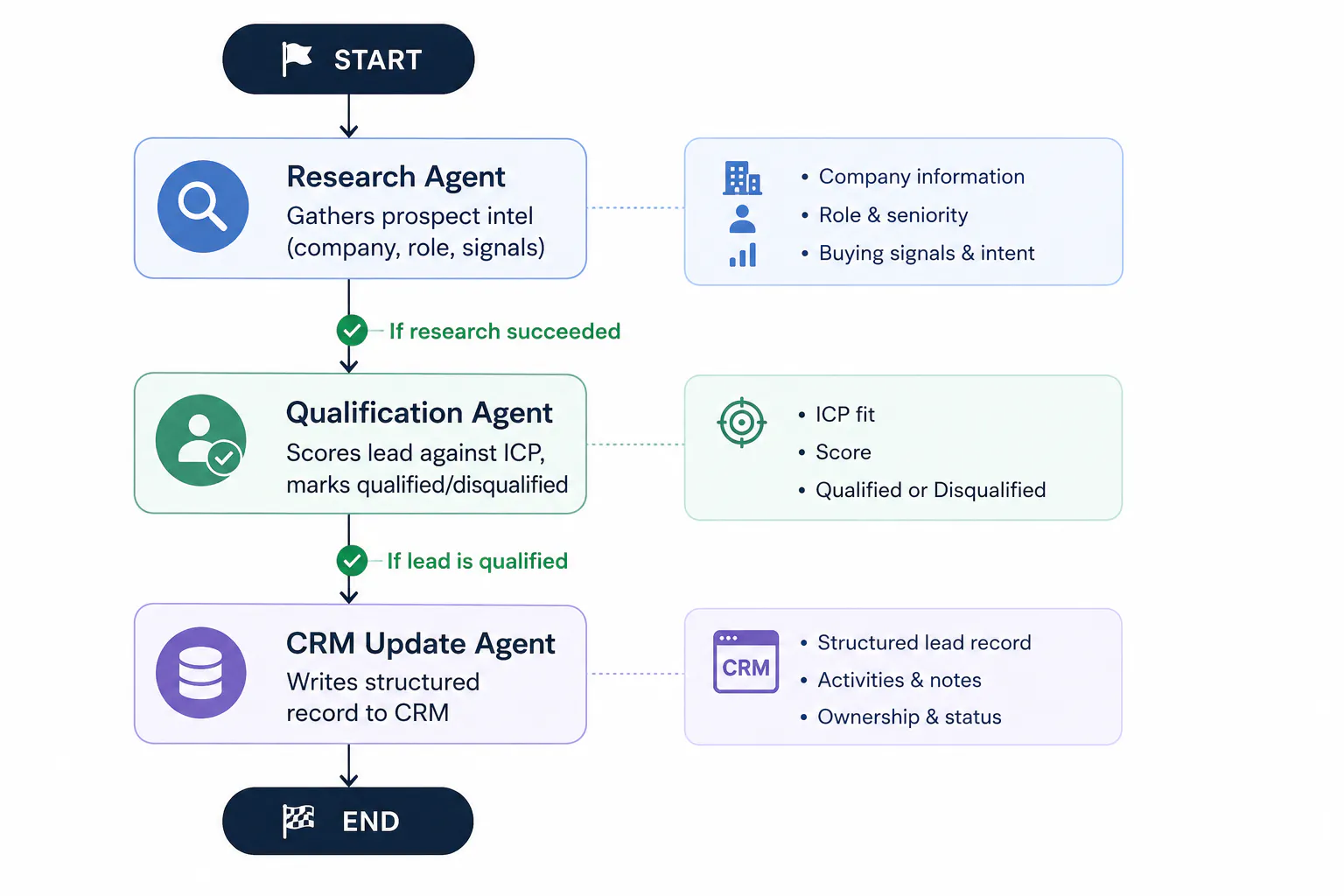
- The Research Agent: Focused on data enrichment and buying signals.
- The Qualification Agent: Focused on analytical scoring against an ICP.
- The CRM Agent: Focused on data integrity and outreach drafting.
Understanding the Orchestration: Why LangGraph?
For complex sales workflows, traditional linear chains are often insufficient. Sales processes are rarely a straight line; they involve conditional logic—for instance, if a prospect is disqualified, the system should stop immediately to avoid polluting the CRM with bad data.
LangGraph, a framework built on top of LangChain, is specifically designed for these stateful, multi-step applications. It models workflows as a directed graph where nodes represent functions (agents) and edges represent the flow of data. LangGraph provides several critical advantages for sales automation:
- Cycles and Branching: It allows for “if-this-then-that” logic, such as re-routing a lead for further research if initial data is sparse.
- Persistence: The “state” of the prospect is maintained throughout the journey, ensuring that the CRM agent knows exactly what the Research agent found.
- Controllability: Developers can define exact exit points, ensuring the AI does not perform unnecessary or expensive API calls.
Architecting the Multi-Agent Sales Pipeline
The architecture of a modern automated sales system relies on a shared state object. This object acts as the “source of truth” that travels through the pipeline. As each agent completes its task, it appends its findings to this state.
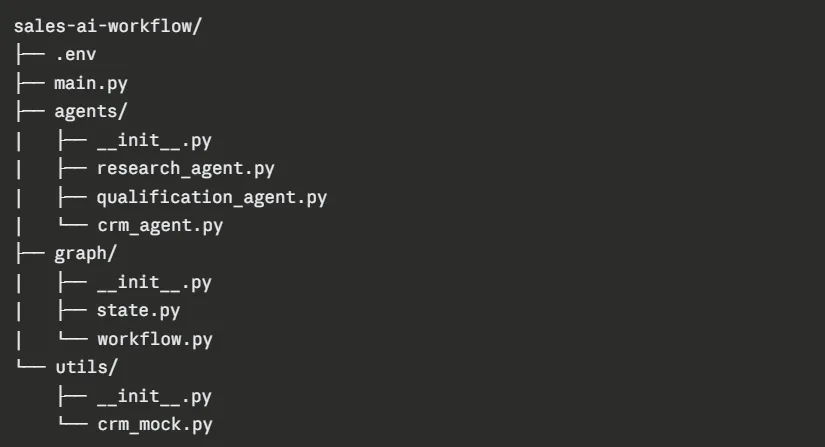
The Lifecycle of a Prospect State
A robust system tracks a variety of fields throughout the lifecycle:
- Inputs: Name, company, role, email, and LinkedIn URL.
- Research Outputs: Structured JSON containing company overview, size, industry, funding stage, and tech stack signals.
- Qualification Outputs: A numerical score (0-100), a plain-text reason for the score, and a boolean “is_qualified” flag.
- CRM Outputs: A final formatted record, a confirmation of the update, and a personalized outreach email draft.
Implementation Milestone 1: Defining the Schema
The first step in building this system is establishing the SalesState using Python’s TypedDict. This ensures that every agent in the graph understands the data structure it is receiving and returning. This schema acts as the contract for the entire workflow, preventing data format errors between the Research and CRM stages.
Implementation Milestone 2: The Prospect Research Agent
The Research Agent serves as the “eyes” of the system. In a production environment, this agent would be connected to external APIs like Apollo.io or Clearbit. For development, it utilizes high-reasoning models like GPT-4o-mini to simulate intelligent research. Its primary objective is to return a structured JSON object that details the prospect’s buying power, potential pain points, and recent company news. This structured data is vital for the next stage: qualification.
Implementation Milestone 3: The Lead Qualification Agent
The Qualification Agent acts as the “gatekeeper.” It compares the research data against a pre-defined Ideal Customer Profile (ICP). For example, a SaaS company might target firms with 50-500 employees in the B2B tech sector. The agent evaluates the research and assigns a score.
A critical feature of this agent is its ability to set a “disqualified” flag. If a lead scores below a certain threshold (e.g., 60/100), the system triggers a conditional edge in LangGraph that terminates the process. This prevents the “CRM bloat” that occurs when sales teams fill their databases with low-quality leads.
Implementation Milestone 4: The CRM Update Agent
The final agent in the sequence only activates if the lead is qualified. It performs two roles: it formats the data for the CRM and generates a personalized “first-touch” email. By referencing specific data points found by the Research Agent—such as a recent funding round or a specific tech stack—the AI can draft an email that feels human and relevant, significantly increasing response rates.
Connectivity and Workflow Integration
Once the agents are built, they are wired together using the LangGraph StateGraph. The graph defines the “Entry Point” (Research) and the “Conditional Edges” (Qualification).
The routing logic is simple but powerful:
- After Research: If data is found, move to Qualification; otherwise, End.
- After Qualification: If
is_qualifiedis True, move to CRM Update; otherwise, End.
This modularity allows for easy debugging. If the outreach emails are not performing well, developers can tweak the CRM Agent’s prompt without affecting the Research or Qualification logic.
Supporting Data: The Impact of Automated Enrichment
The transition to automated sales workflows is supported by significant performance metrics. According to research by LeadGenius, enriched leads see a 25% higher conversion rate compared to non-enriched leads. Furthermore, organizations using AI for lead qualification report a 50% increase in leads passed to the sales team and a 33% decrease in the cost per lead.
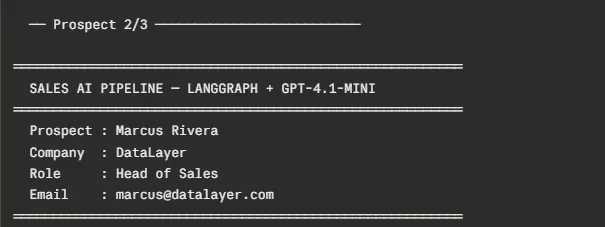
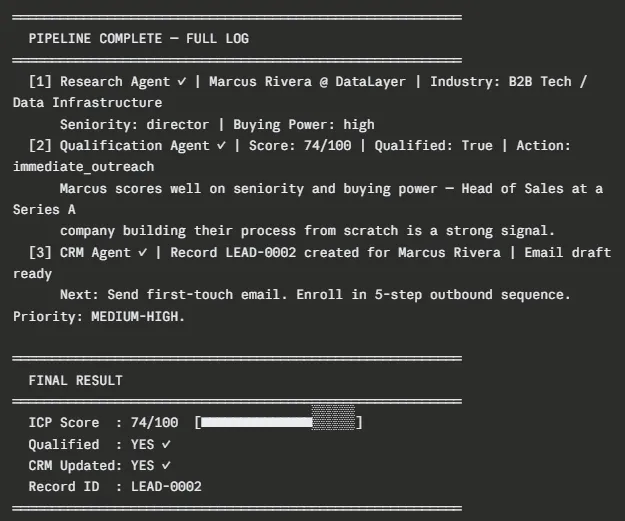
In a practical test of the LangGraph system, three different prospect types often yield distinct results:
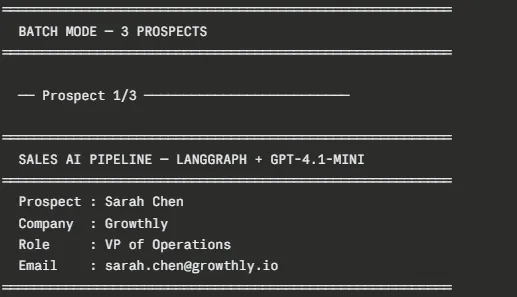
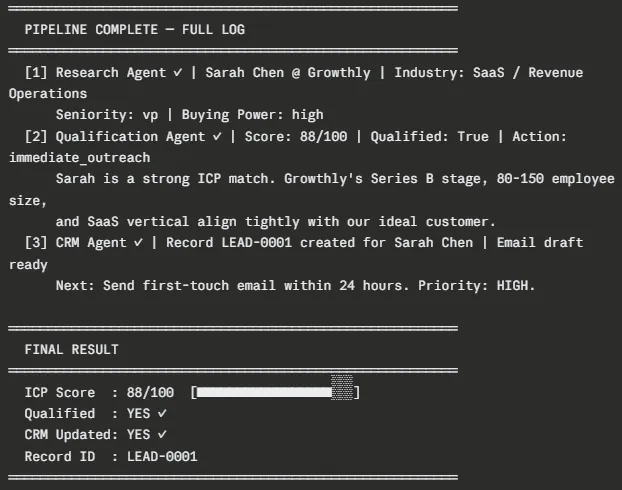
- The High-Fit Lead: A VP of Operations at a Series B tech company might score an 88/100. The system automatically creates a CRM record and drafts an email mentioning their recent growth.
- The Marginal Lead: A Head of Sales at a smaller firm might score a 74/100. They qualify, but the outreach draft focuses on foundational infrastructure rather than scaling.
- The Poor-Fit Lead: A founder of a micro-agency might score a 52/100. The LangGraph router identifies this score and exits the pipeline before a CRM entry is created, saving the company from unnecessary outreach.
Production Considerations and Future Implications
Transitioning a prototype into a production-ready system requires addressing several technical hurdles.
Real-World Tool Integration
While LLMs have vast knowledge, they cannot see real-time data without tools. Production systems must use “Tool Calling” to connect agents to live databases. Using the @tool decorator in LangChain, developers can allow the Research Agent to query live APIs like Apollo.io or LinkedIn directly.
Error Handling and Observability
In a high-volume environment, API hiccups are inevitable. Implementing retry logic and exponential backoff ensures that a temporary network error doesn’t break the entire batch process. Furthermore, platforms like LangSmith provide essential observability, allowing teams to trace every agent’s input and output to refine prompts and identify where leads might be getting mischaracterized.
The Human Element
The emergence of these systems is fundamentally changing the role of the SDR. Rather than being data entry specialists, SDRs are becoming “AI Orchestrators” who supervise the pipeline and focus their energy on the final 10% of the sales process: the human conversation.
Conclusion
The integration of LangGraph and multi-agent AI systems represents a significant leap forward in sales productivity. By automating the repeatable, rule-based processes of research and qualification, companies can eliminate the administrative burden that currently stifles sales teams. The modular architecture of these systems allows for continuous improvement—adding new tools, refining qualification criteria, and scaling to handle thousands of prospects with the same level of care as a manual search. As AI continues to evolve, the organizations that thrive will be those that successfully marry the efficiency of agentic workflows with the irreplaceable nuance of human relationship management.