


The struggle for organizational synergy within small and medium-sized businesses (SMBs) has reached a critical inflection point, as evidenced by the release of the 2026 Anatomy of Aligned Go-To-Market Teams report. While the theoretical benefits of sales and marketing alignment are nearly universally accepted, the practical execution remains elusive for nearly half of the industry. According to data compiled from a survey of over 500 go-to-market (GTM) professionals, a staggering 87% of teams expect improved alignment to provide a significant lift to overall business performance. However, a much smaller cohort—only 56%—describe their current internal operations as "highly aligned."
This discrepancy highlights a persistent "alignment gap" that transcends simple communication failures. Rather than presenting as a singular strategic error, misalignment manifests as a series of operational frictions: "qualified" leads that sales departments refuse to touch, marketing campaigns launched without the knowledge of frontline representatives, and a revenue pipeline that appears robust until the final stages of the sales cycle fail to materialize into closed deals. As SMBs navigate a volatile economic landscape in 2026, the cost of this friction is no longer a mere inconvenience; it is a primary driver of wasted capital and stalled growth.
The Disconnect Between Executive Vision and Operational Reality
One of the most striking revelations in the 2026 report is the profound perception gap existing between different levels of corporate hierarchy. The data indicates that 69% of executives believe their sales and marketing teams are strongly aligned. In contrast, only 47% of non-executive staff—those responsible for the day-to-day execution of campaigns and sales calls—agree with that assessment.
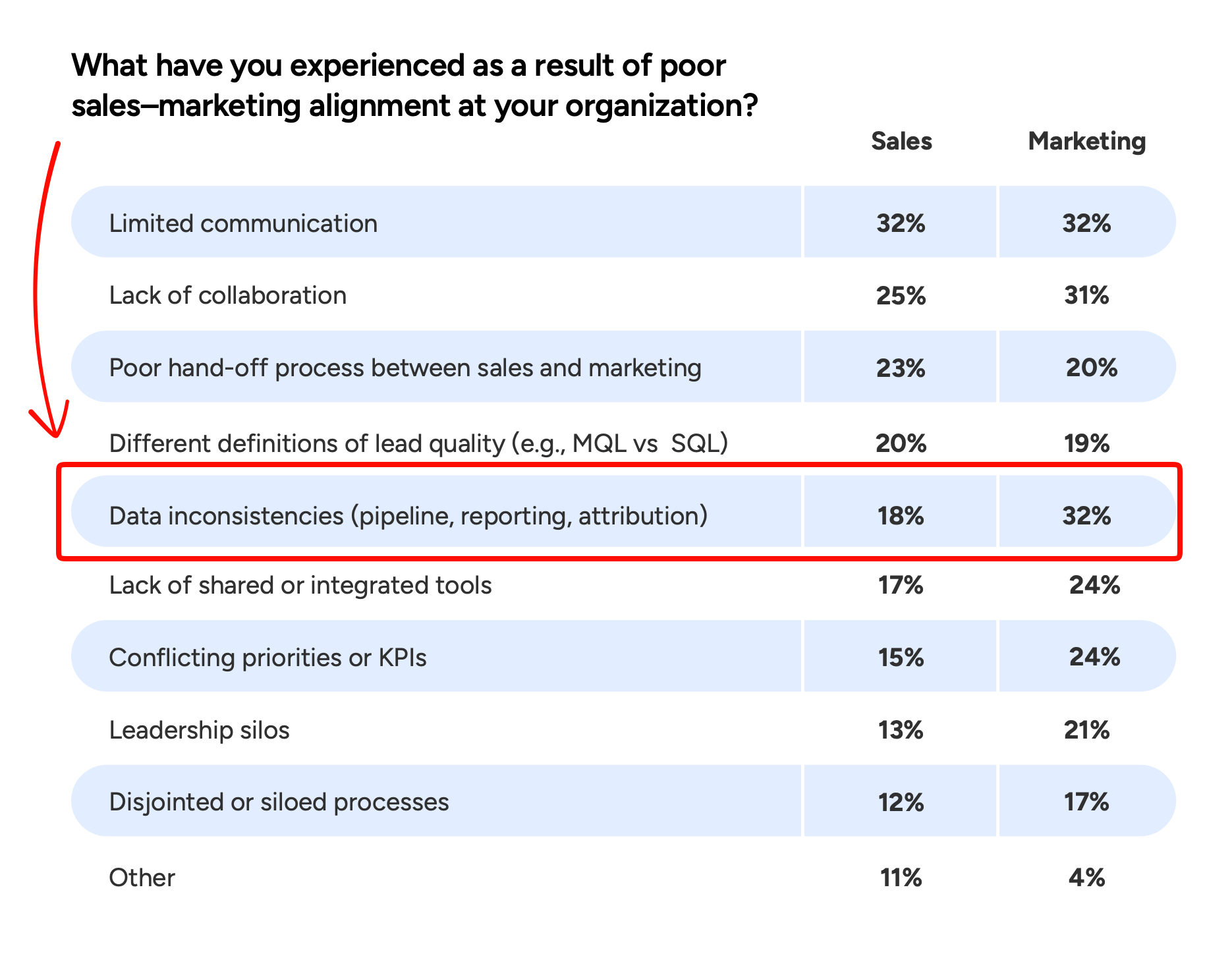
This "ivory tower" effect suggests that leadership often mistakes the existence of a meeting cadence for true operational integration. While executives may see a recurring sync call on the calendar and a shared slide deck, the staff on the ground are grappling with the structural information lags that occur when the organizational chart widens. Specifically, non-executives are significantly more likely to report barriers such as data inconsistencies (28% vs. 22%), limited communication (33% vs. 28%), and leadership silos (19% vs. 14%).

The functional split is equally telling. Sales professionals tend to feel more optimistic, with 62% reporting high alignment, compared to just 53% of marketing professionals. This suggests that marketing teams often feel the burden of proof more heavily, as they are frequently tasked with justifying lead quality to a sales force that may have different criteria for "readiness."
The Compounding Costs of Operational Friction
Misalignment is frequently categorized as a "culture problem," but the 2026 data reframes it as a direct operational cost. The first symptom of poor GTM alignment is often employee frustration, cited by 29% of respondents. However, the downstream effects on the balance sheet are even more concerning.
The report identifies three primary consequences that surface when teams fail to synchronize:
- Delayed Lead Follow-up: Marketers feel this most acutely, with 32% flagging it as a primary concern compared to 22% of sales. When a lead is generated but sits in a CRM without action, its value depreciates by the hour.
- Duplicated Work: Without a shared roadmap, teams often find themselves creating redundant content or overlapping outreach strategies, draining budgets that could otherwise be used to improve conversion rates.
- Unclear Target Customers: 29% of marketers report a lack of clarity regarding the "ideal customer profile" (ICP), leading to top-of-funnel waste.
These issues compound into significant pipeline problems. When marketing and sales operate on different definitions of lead quality—specifically the distinction between a Marketing Qualified Lead (MQL) and a Sales Qualified Lead (SQL)—the resulting friction creates a "lose-lose" scenario. Marketing may celebrate high lead volumes, while sales views those same leads as a distraction from their revenue targets. Currently, 20% of sales and 19% of marketing professionals cite these conflicting definitions as a major blocker to success.
The Paradox of Tool Bloat and Fragmented Technology
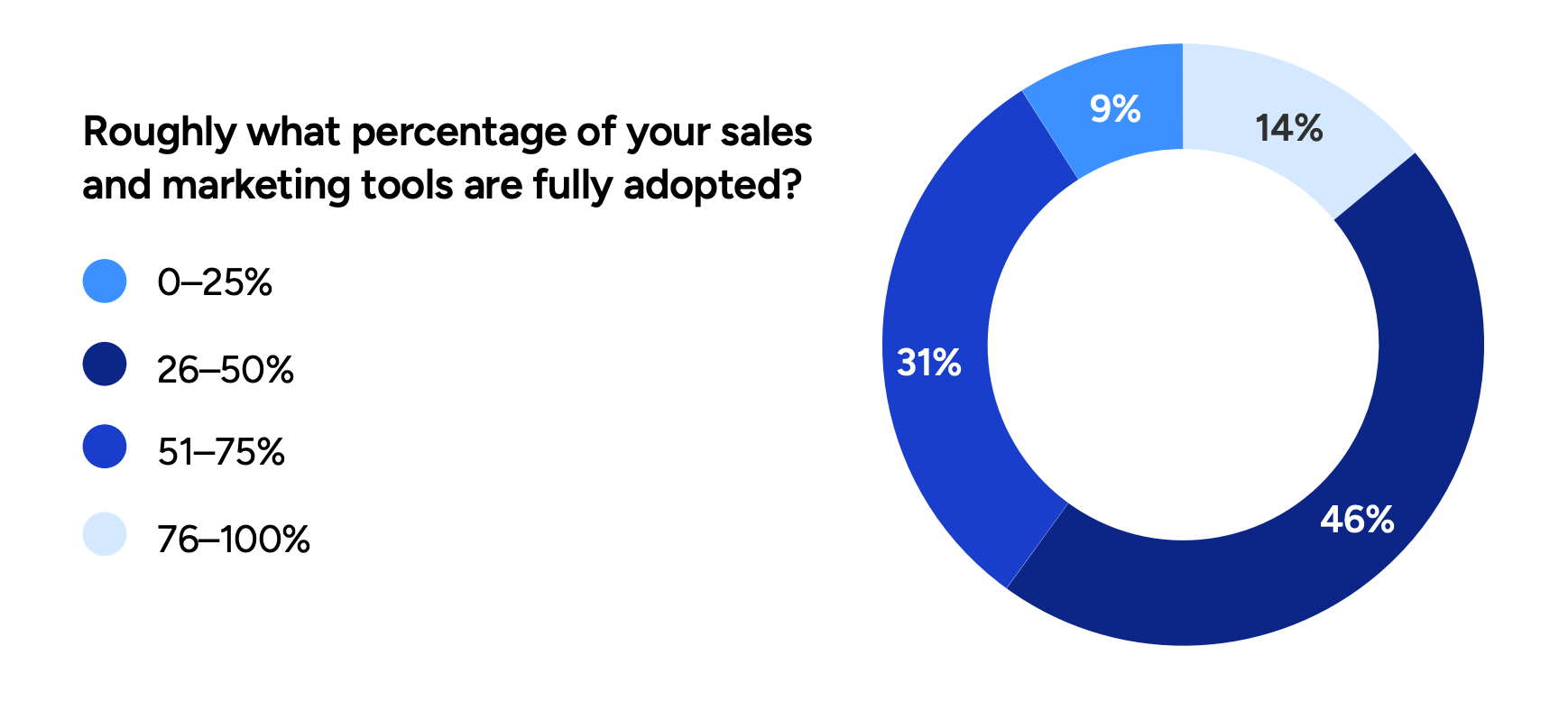
In an attempt to "buy" their way into alignment, many SMBs have over-invested in technology, leading to what analysts call "tool bloat." The 2026 report finds that 56% of GTM professionals consider tool bloat a significant issue within their organizations. Paradoxically, 60% of these professionals report using less than half of the tools currently available in their tech stacks.

The adoption rates paint a bleak picture of technological efficiency:
- 14% of teams utilize only 0% to 25% of their software stack.
- 46% of teams utilize between 26% and 50% of their stack.
This fragmentation does more than just waste subscription fees; it creates data silos. When marketing automation platforms are not fully integrated with the CRM or are only used by a fraction of the team, the "source of truth" for customer data becomes fractured. Marketing teams are nearly twice as likely as sales teams to cite data inconsistencies as a barrier (32% vs. 18%), largely because they rely on these systems for attribution and performance measurement.
The data suggests that the most successful teams are moving toward "leaner" tech stacks. Organizations that consolidated their technology are twice as likely to rate their lead quality as "excellent" (55% vs. 20%). This indicates that high-performing teams prioritize adoption and integration over the sheer number of features.
Chronology of Alignment: From Meetings to Integrated Operating Models
The evolution of GTM strategy over the last five years shows a shift from "communication-first" to "process-first" alignment. In the early 2020s, the standard response to misalignment was to increase the frequency of meetings. However, the 2026 data proves that communication alone is insufficient. While 54% of teams still prioritize communication frequency, the "highly aligned" cohort has moved toward structural changes.
Phase 1: The Communication Layer (2020–2022)
Teams focused on recurring syncs and shared Slack channels. While this reduced immediate friction, it did not solve the underlying data discrepancies.
Phase 2: The Definition Layer (2023–2024)
Organizations began focusing on Service Level Agreements (SLAs) and shared definitions of MQLs and SQLs. This period saw the rise of RevOps (Revenue Operations) as a bridge between functions.
Phase 3: The Integrated Operating Model (2025–Present)
The current "gold standard" involves integrated workflows, shared KPIs, and unified data sources. Aligned teams are now 3.5x more likely to have strong cross-functional data sharing (59% vs. 16%). In this phase, the meeting is no longer the place where alignment is created, but rather the place where an already-aligned system is monitored.
Strategic Implications and the Path Forward
The 2026 report identifies lead qualification and handoff processes as the single most impactful lever for improving performance, with 36% of GTM professionals citing it as their top priority. To achieve this, industry leaders recommend a three-pronged approach to operationalize alignment:
1. Unified Persona Development
Alignment must begin at the top of the funnel. When buyer personas are treated as a "marketing deliverable" rather than a joint artifact, they often lack the practical insights that sales reps gather from daily calls. High-performing teams are increasingly using shared customer interview notes and call recordings to build personas that reflect real-world objections and motivations.
2. Standardized Lead Qualification
A functional handoff requires an agreed-upon SLA that dictates what information marketing must provide, the timeline for sales follow-up, and a feedback loop for rejected leads. Without this, the sales cycle inevitably drags, and revenue targets remain out of reach.
3. Data Consolidation and AI Integration
Looking toward the next 12 months, 44% of GTM teams are prioritizing data integration and AI-driven insights. The goal is to move toward a "single pane of glass" where both sales and marketing see the same conversion signals and pipeline health. The report identifies CRMs, marketing automation platforms, and landing page builders as the three most critical tools for maintaining this unity.
Broader Impact on the SMB Ecosystem
The implications of this report extend beyond individual company performance. As the cost of customer acquisition (CAC) continues to rise across digital channels, the ability to efficiently convert leads into revenue has become a primary competitive advantage. SMBs that fail to bridge the sales-marketing gap risk being out-maneuvered by leaner, more integrated competitors who can act on data in real-time.
Furthermore, the 2026 data suggests a shift in how talent is managed within GTM teams. With employee frustration being a leading consequence of misalignment, companies that solve these structural issues are likely to see higher retention rates and more productive staff.
In summary, the 2026 Anatomy of Aligned Go-To-Market Teams report serves as a wake-up call for leadership. The transition from "talking about alignment" to "operating with alignment" requires a fundamental shift in how tools are bought, how data is shared, and how success is measured. For the 87% of teams expecting a performance lift, the path forward is clear: stop fixing the meetings and start fixing the operating model.







