The evolving landscape of search is presenting significant challenges for digital marketers and content creators. As generative artificial intelligence (AI) integrates into search engines, traditional methods of optimizing for visibility are becoming increasingly difficult. A primary hurdle is the persistent lack of granular performance data directly attributable to AI-generated answers, often referred to as AI Overviews or AI-powered summaries. This opacity leaves professionals struggling to accurately assess the impact of their content within these new AI-driven search results.
For instance, Google’s Search Console, a vital tool for understanding website performance in organic search, currently combines data from AI Overviews and traditional organic listings. This integration makes it challenging for optimizers to discern which channel is driving traffic and visibility, forcing them to rely on educated guesses rather than concrete data. The situation is further complicated by the fact that platforms like ChatGPT are selective about the data they share, often restricting access to performance metrics to only those publishers who have licensed their content to OpenAI. This creates a significant information asymmetry and hinders broad-based optimization efforts.
In this environment, Bing has emerged as a pioneer in offering greater transparency. Earlier this year, following the publication of its comprehensive “Guide to AEO and GEO” (AI-Enhanced Optimization and Generative Experience Optimization), Bing introduced an “AI Performance Report” within its Webmaster Tools. This report was designed to provide insights into how content performs within Bing’s AI-powered search features. Recognizing the need for more actionable data, Bing has recently undertaken a significant enhancement of this report, aiming to make it more useful and impactful for publishers seeking to understand and leverage AI-driven search.
Unpacking Bing’s AI Performance Report: A Deeper Dive
The updated AI Performance Report from Bing aims to track the presence of a website’s content within Microsoft Copilot, AI-generated summaries within Bing search results, and select AI partner integrations. While the report offers a significant step forward in providing visibility into AI-driven search, some limitations persist. Notably, there is currently no direct option to filter the data by a single channel within the AI ecosystem, nor is there a clear method to identify specific AI partners that may be leveraging a publisher’s content.

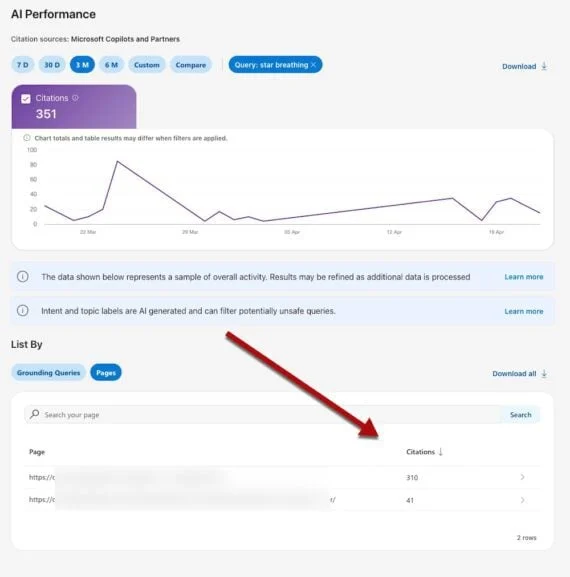
The report is structured into two primary sections: “Grounding Queries” and “Pages.” The “Grounding Queries” section focuses on the search queries that trigger AI-generated responses and cite specific web pages. The “Pages” section provides an overview of how individual pages are being cited within these AI outputs.
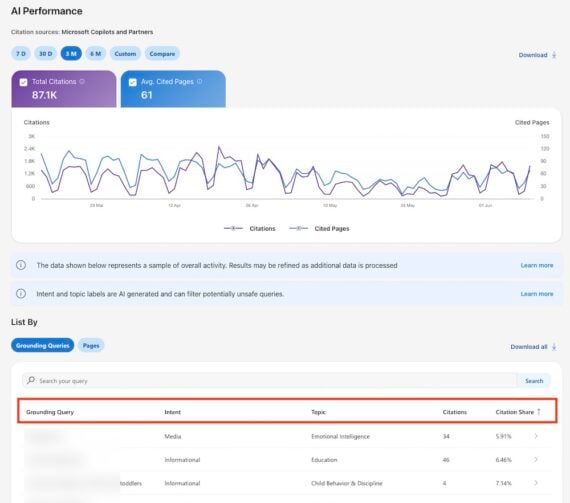
Upon a closer examination of the “Grounding Queries” section, the enhanced AI Performance Report now offers a richer set of metrics for each query that results in an AI citation. These improvements are designed to give publishers a more nuanced understanding of their content’s role in AI-generated answers. The report now includes:
- Query Text: The exact search query entered by the user that led to an AI-generated response and cited the publisher’s content.
- Intent: An inferred classification of the user’s underlying goal behind the query, such as informational, navigational, or transactional. Understanding intent helps publishers align their content with user needs.
- Topic: A categorization of the subject matter of the query, providing context for the relevance of the cited content.
- Citations: The total number of times a specific grounding query resulted in a citation of the publisher’s website. This indicates the frequency with which the content is being leveraged by the AI.
- Citation Share: The percentage of times the publisher’s content was cited for a particular grounding query compared to all other sources. This metric is crucial for understanding competitive positioning within AI-generated answers.
These metrics allow publishers to sort their grounding queries based on intent, topic, the total number of citations, or their citation share. This granular sorting capability is a significant improvement, enabling optimizers to identify high-impact queries and understand the competitive landscape for specific topics.
Furthermore, the report empowers users to export the entire dataset into a spreadsheet format. This offline access provides a greater degree of flexibility for advanced sorting, filtering, and in-depth analysis, allowing for custom reporting and integration with other analytical tools.
A key feature within the “Grounding Queries” section is the ability to drill down into specific queries. By clicking on any given grounding query, users can access a detailed list of their own pages that were cited in relation to that specific query during the selected period. This direct link between a query and the cited pages offers invaluable insight into which content pieces are most relevant and frequently utilized by the AI.
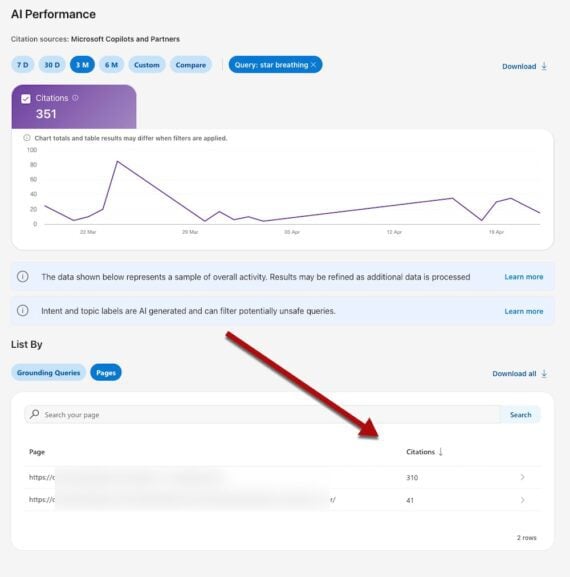
The report also indicates the frequency with which each cited page (URL) appears for a particular grounding query. However, it is important to note that the current version of the report does not provide metrics such as the number of views or clicks directly generated by these AI citations. While the frequency of citation is informative, the absence of direct traffic data means that inferring direct user engagement solely from this report remains a challenge. Nevertheless, clicking on any individual URL within this view will reveal all the grounding queries for which that specific page has been cited over a given period, offering a comprehensive understanding of its AI-driven reach.
Leveraging the Enhanced Data for Strategic Optimization
The enhancements to Bing’s AI Performance Report introduce a suite of expanded metrics designed to provide publishers with a more robust framework for tracking their visibility within AI-generated search results. These new metrics aim to bridge the gap in understanding the performance of content in this rapidly evolving search paradigm. The updated report includes:
- Total Citations: This metric quantifies the overall number of times a website’s content has been cited across all AI-generated summaries and Copilot responses within Bing. It serves as a foundational indicator of a site’s presence in AI search.
- Unique Grounding Queries: This metric highlights the number of distinct search queries for which a website’s content was cited. A higher number of unique grounding queries suggests broader relevance and applicability of the content across a diverse range of user intents.
- Pages Cited: This indicates the total count of unique pages from a website that have been featured in AI-generated summaries or Copilot responses. It helps assess the breadth of content being recognized by the AI.
- Average Citation Position: While not a direct measure of ranking in traditional search, this metric provides an indication of where on average a website’s content appears within the AI-generated answer or summary when it is cited. This can offer clues about the perceived authority or relevance of the content by the AI.
- Citation Click-Through Rate (CTR) – Potential Future Metric: Although not explicitly detailed in the current update, the industry’s demand for such a metric is high. A hypothetical “Citation CTR” would measure the percentage of users who interact with a cited link within an AI summary. The inclusion of such a metric in future updates would significantly enhance the report’s utility.
- AI Traffic Estimate – Potential Future Metric: Similar to CTR, a future iteration might offer an estimated volume of traffic driven by AI citations, moving beyond just the frequency of appearances.
- Competitor Citation Analysis – Potential Future Feature: The ability to compare one’s citation performance against direct competitors within the AI landscape would be a game-changer for strategic planning.
These expanded metrics, even with the current limitations, provide a valuable foundation for understanding content performance in the context of generative AI. Publishers can now more effectively:
- Identify Content Gaps: By analyzing which grounding queries are not yielding citations, publishers can identify areas where their content might be lacking or less relevant to AI models.
- Optimize for Specific Intents and Topics: The ability to sort by intent and topic allows for a more targeted approach to content creation and optimization, ensuring that content directly addresses user needs within specific AI-driven contexts.
- Benchmark Performance: The citation data provides a baseline for measuring improvement over time and understanding how content is being utilized as AI search evolves.
- Inform Content Strategy: Insights from the report can guide content creation efforts, focusing on topics and formats that are more likely to be recognized and cited by AI models.
Getting Started with Bing Webmaster Tools and the AI Performance Report
For publishers looking to leverage these new insights, setting up Bing Webmaster Tools is a straightforward process, particularly for those already utilizing Google Search Console. The integration is designed for ease of use, allowing for a quick transition.
To begin, users can log in to Bing Webmaster Tools using their Microsoft account credentials. The platform offers a convenient feature to “Import your sites from GSC,” which streamlines the setup process by automatically transferring existing site data and verification from Google Search Console. This significantly reduces the manual effort required for initial configuration.
Once the site is added and verified, Bing will begin collecting and processing data. It is important to allow approximately 24 hours for the AI Performance Report to populate with initial data. During this period, Bing’s systems will analyze search queries, identify AI-generated summaries, and track content citations to build the report.
The availability of this AI Performance Report on Bing represents a significant step towards greater transparency in the burgeoning field of AI-powered search. While challenges remain, particularly concerning granular traffic data and competitive benchmarking, Bing’s proactive approach in providing publishers with actionable insights is a welcome development. As generative AI continues to reshape the search engine landscape, tools like Bing’s AI Performance Report will become increasingly indispensable for content creators and digital marketers striving to maintain and enhance their online visibility. The ongoing evolution of these reports will be closely watched by the industry, with a keen eye on further enhancements that could provide even deeper insights into the complex dynamics of AI-driven search. The data, while not yet providing a complete picture of direct user engagement, offers a crucial starting point for understanding how content is being surfaced and utilized by the next generation of search technologies.

 Raul Delapena Setiawan
 Ammar Sabilarrohman