Lina Hope
A recently enhanced workshop designed to move beyond the buzz surrounding artificial intelligence is gaining traction among Go-to-Market (GTM) leaders, offering a structured approach to identifying and addressing the fundamental operational friction points that impede business growth. The revamped methodology, which was piloted at the 6sense Breakthrough conference in Las Vegas, prioritizes uncovering core constraints before diving into technology solutions, a departure from the typical AI-centric discussions that often dominate industry conversations.
The workshop, developed by Matt Heinz, has been expanded from a one-hour session to a more comprehensive two-hour experience. This extended format includes a detailed four-page worksheet for individual reflection and group collaboration, culminating in a concrete 30-day commitment with defined SMART goals and milestones. The design encourages cross-company learning, with participants from various organizations sharing diverse perspectives on common GTM challenges. However, the facilitator emphasizes its applicability and potential impact when implemented internally within a company’s own marketing or GTM leadership teams.
"Most of us have these critical conversations between meetings, in frantic email threads and Slack sessions, and we never get the oxygen to find the real constraints that matter," Heinz explained, underscoring the value of a structured approach. "Taking a couple of hours with a proven structure to figure out what can really be changed to drive impact in the next 30-90 days is real value, whether you do it at a conference or in your own conference room."
The AI Directive vs. Operational Friction
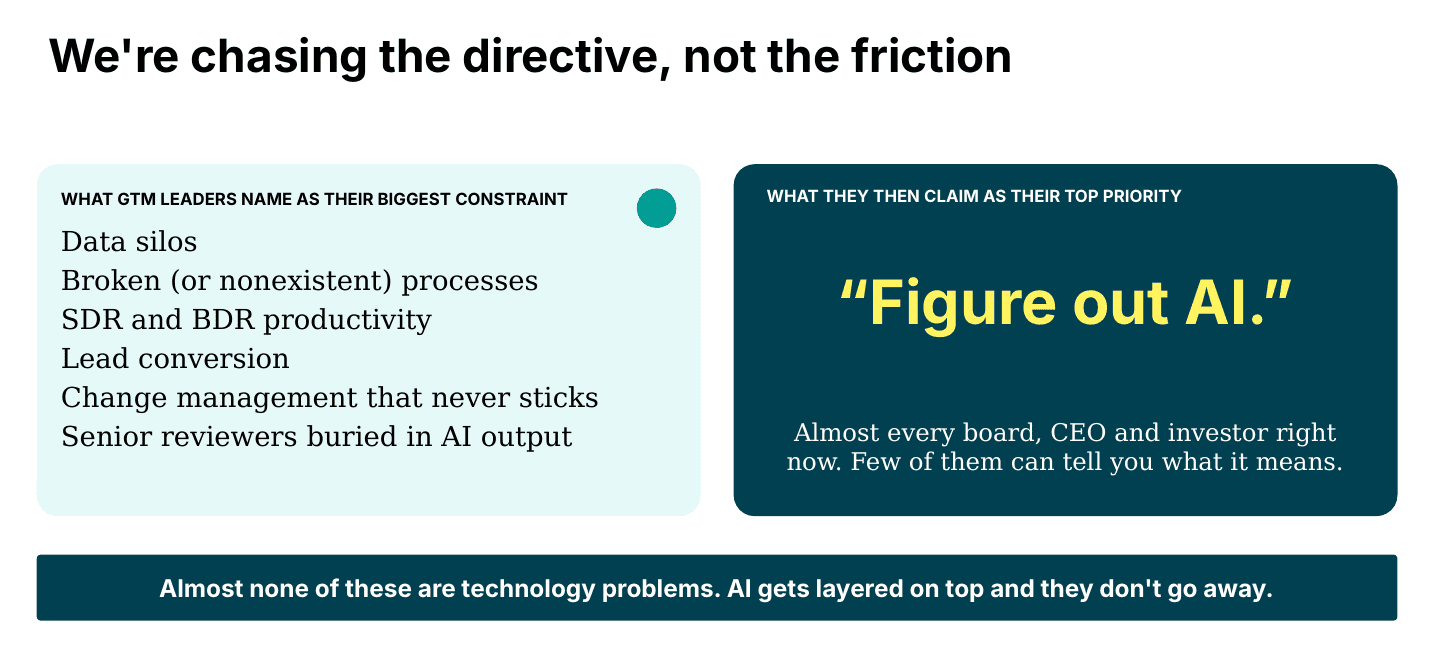
The workshop’s core premise rests on a critical observation: GTM leaders often find themselves chasing the directive to "figure out AI" without first addressing the underlying operational inefficiencies that are actually hindering their performance. When asked to identify their biggest GTM constraints, common themes emerge: data silos, broken processes, issues with Sales Development Representative (SDR) and Business Development Representative (BDR) productivity, lead conversion challenges, and persistent change management failures. Yet, when pressed for their top priority for the next quarters, the overwhelming response is AI.
This disconnect, Heinz argues, leads teams to invest time and resources into AI pilots and licenses without a clear understanding of how these tools will directly impact their most significant roadblocks. The workshop’s initial phase, spanning the first 25 minutes, is dedicated to surfacing these fundamental GTM challenges.
"We’re addressing priorities two through five and leaving number one, arguably the most important and impactful of them, alone," Heinz stated, referencing a slide that illustrates the phenomenon of chasing the directive rather than the friction.
Shifting the AI Conversation: Capability, Governance, and Work Design
Historically, the argument for AI’s limited impact often centered on the immaturity of the technology. However, recent data suggests this excuse is no longer valid. A McKinsey State of AI survey indicated that while 80% of AI users report improved productivity, only 37% can attribute bottom-line impact, with a mere 6% classified as high performers. Similarly, research by Jim Lecinski with Kellogg highlights that only 28% of organizations are actively rethinking workflows to accommodate AI, and just 10% of marketing leaders report significant value realization.
These findings point to a significant shift: the primary constraints are no longer solely technological capabilities but have moved to encompass organizational permission structures, governance policies, and the fundamental design of work processes. The workshop’s revamped structure reflects this evolution by prioritizing objectives, then constraints, followed by strategy and process, and finally, technology.
"If a process isn’t documented, I can just about guarantee it isn’t followed by everyone, and now it isn’t followed by the agent either," Heinz noted, emphasizing the importance of codifying workflows.
The business case for AI implementation is also re-examined. Many AI business cases focus on cost reduction, a strategy that yields a one-time benefit. Heinz advocates for focusing AI initiatives on constraints that directly limit revenue growth, necessitating a deep understanding of the actual, measurable business bottleneck.
Deconstructing Constraints: The Three-Pronged Approach
The expanded worksheet guides participants to identify up to three constraints. The initial constraint is often the most outwardly discussed and perhaps the safest. However, by the third entry, participants are encouraged to delve into more challenging, potentially avoided issues. A crucial rule is to articulate these constraints in a single sentence, explicitly excluding the word "AI" to prevent a relapse into the directive-driven mindset.
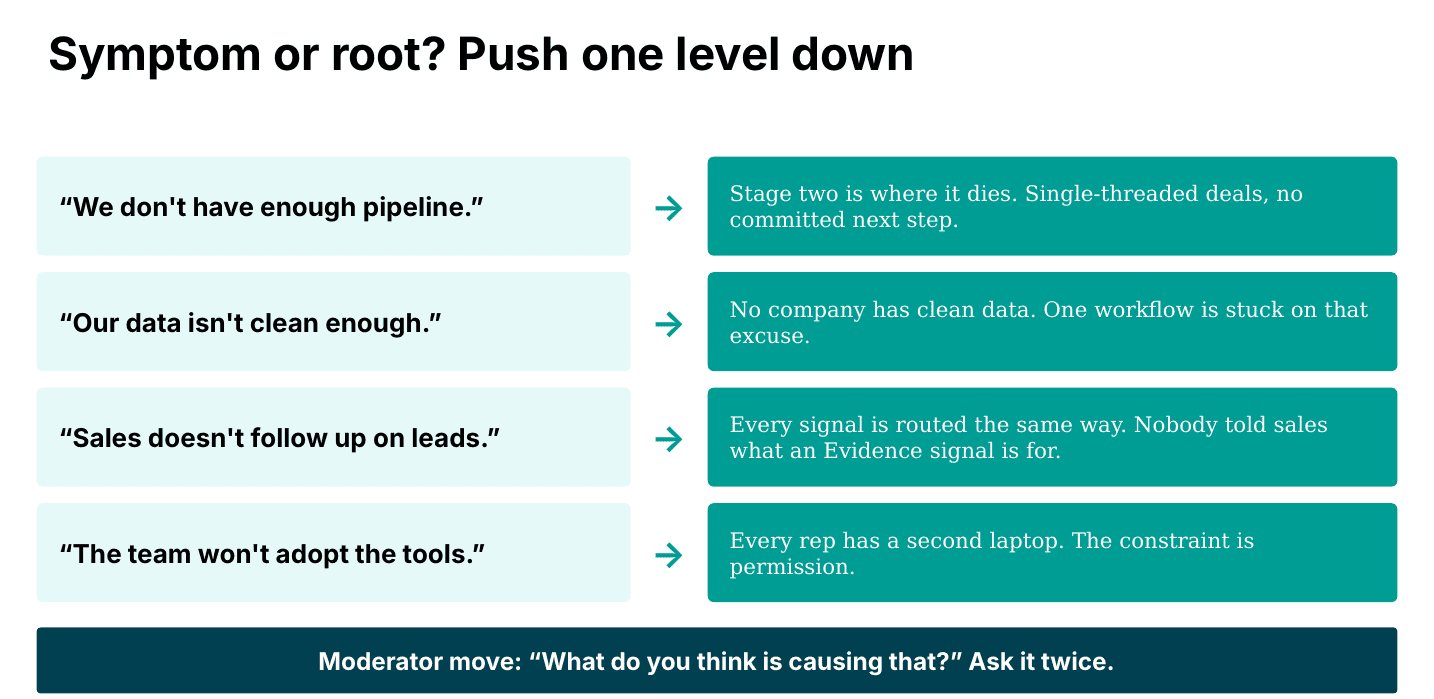
Under each identified constraint, participants are prompted to answer "what’s causing that?" twice, pushing beyond superficial symptoms to uncover root causes. For instance, "not enough pipeline" might lead to "conversion rate dropped," and further probing could reveal "every deal is single-threaded and nothing has a committed next step." This iterative questioning aims to unearth actionable insights.
A common challenge encountered during the workshop is the vagueness of initial constraint statements, such as "fix our data silos." The facilitator prompts participants to articulate the purpose of resolving such issues: what decisions or actions will be enabled by integrated data? This leads to more specific, workflow-amenable objectives like "get call data into the CRM so reps can see which deals have gone quiet." This specificity is key to identifying the right workflows and AI implementations for tangible business impact.
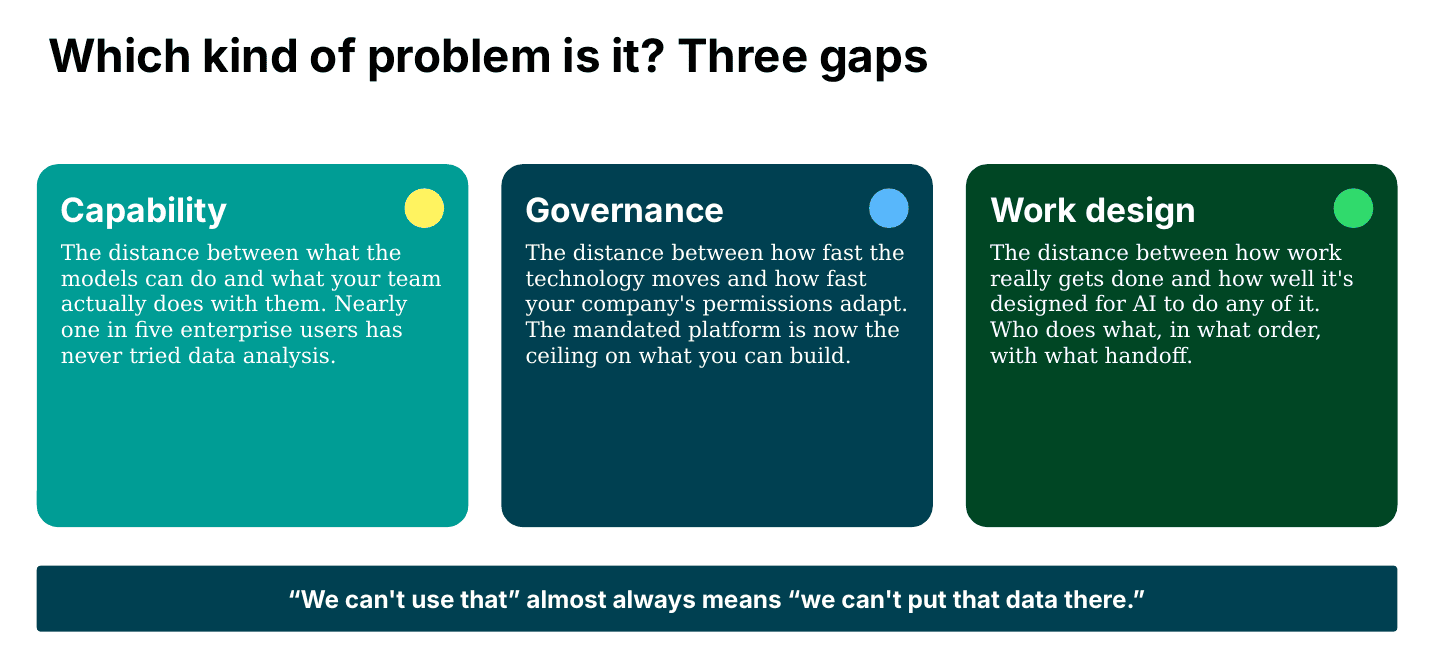
The workshop then categorizes each constraint under one of three core gaps:
- Capability: The disparity between what AI models can do and what teams are equipped to do with them. Data from OpenAI indicates that a significant portion of active users have not explored certain functionalities, even within paid licenses.
- Governance: The lag between technological advancement and organizational permission structures. Enterprise licenses, chosen years ago, can now inadvertently cap innovation. Instances of employees using personal devices for AI work due to restrictive company policies highlight this challenge.
- Work Design: The disconnect between how work is actually performed and how well it is structured to incorporate AI. This gap pertains to the clarity of roles, sequences, and handoffs in current workflows, much of which remains undocumented.
Heinz stresses that many teams mistakenly attribute AI leverage issues solely to capability gaps, overlooking the more significant hurdles of governance or work design, which training alone cannot resolve. The phrase "we can’t use that tool" often translates to "we can’t put our data there," signifying a governance or data integration problem, not a technological limitation.
Focusing Efforts: Selecting and Justifying a Key Constraint
Participants then select one of their identified constraints for a deeper dive, determining which one would yield the most significant positive change if addressed within the next 90 days. This selection process is followed by articulating the rationale, a step that helps prevent participants from revisiting less impactful issues later.
The Strategic Integration of AI
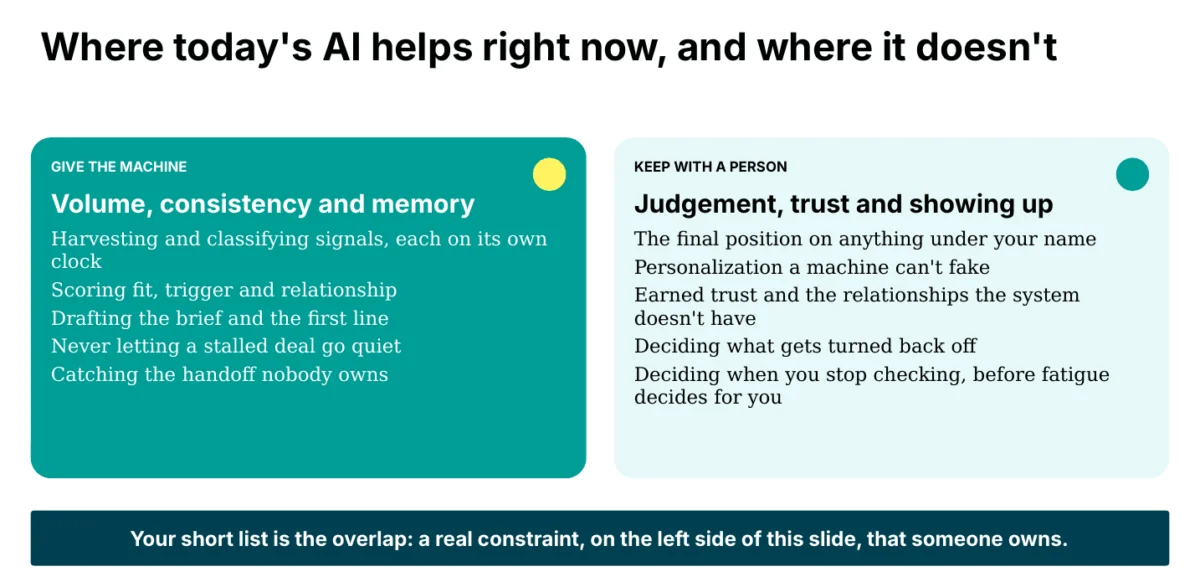
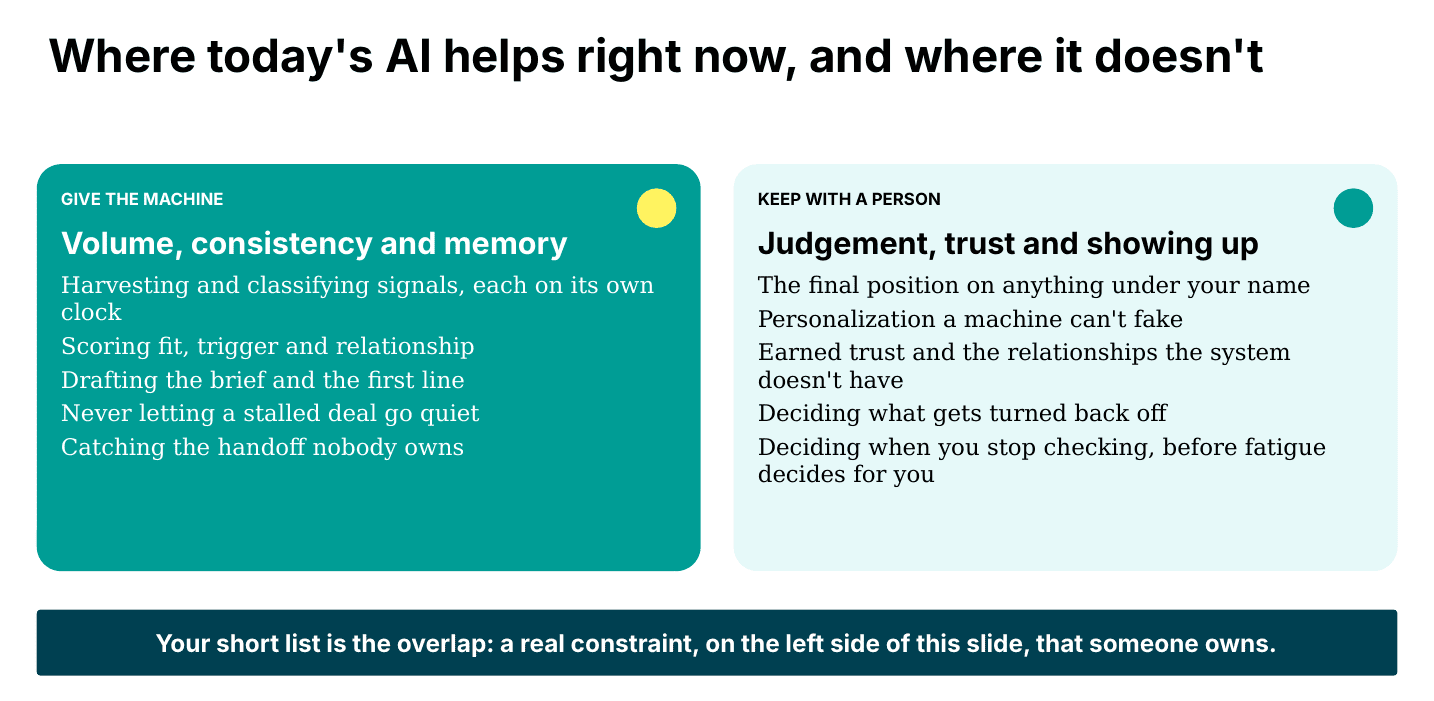
With a clearly defined and justified constraint, the AI conversation becomes meaningful. The workshop prompts participants to identify three ways AI could assist with their chosen constraint, ranked by potential leverage. The facilitator offers a framework for this, suggesting that AI excels at tasks involving volume, consistency, and memory, such as harvesting signals, scoring leads, drafting initial content, and ensuring no deal goes unnoticed. Human strengths remain in judgment, trust, personalization that AI cannot replicate, relationship building, and the critical decision of when to rely on machine output.
The chosen AI applications are then pressure-tested against five critical questions, designed to identify potential pitfalls that have stalled previous AI initiatives. These questions are not new, but AI has made the cost of skipping them increasingly apparent.
From Commitment to Action: The 30-Day Plan
The final section of the worksheet focuses on creating a concrete commitment. Participants outline one constraint, a specific workflow to be built internally (not bought), a measurable milestone with a deadline within 30 days, and the individual responsible for its execution. This structured approach transforms abstract intentions into tangible actions.
An optional, but notable, element of the workshop is an offer for participants to submit their completed worksheets. The facilitator provides written feedback and a 30-day check-in, creating a post-workshop accountability mechanism without further sales pitches.
Empowering Internal Adoption
The complete workshop materials, including slides, the four-page worksheet, and facilitator notes, are available for download. The facilitator provides guidance for internal implementation, emphasizing key principles: prioritizing problem identification over tool selection, allowing for individual reflection before group discussion, and ensuring commitments are vocalized. The goal is for participants to leave with a written plan that did not exist prior to the session, fostering tangible progress within a two-hour timeframe.
The expanded workshop signifies a crucial evolution in how organizations approach AI adoption. By grounding AI discussions in the reality of existing operational friction and clearly defined business objectives, leaders can move beyond the hype and unlock genuine, measurable impact within their Go-to-Market strategies. The framework provides a clear roadmap for teams to identify their most pressing challenges, strategically leverage technology, and commit to actionable steps that drive sustainable growth.

 Reynand Wu
 Layla Zulfa