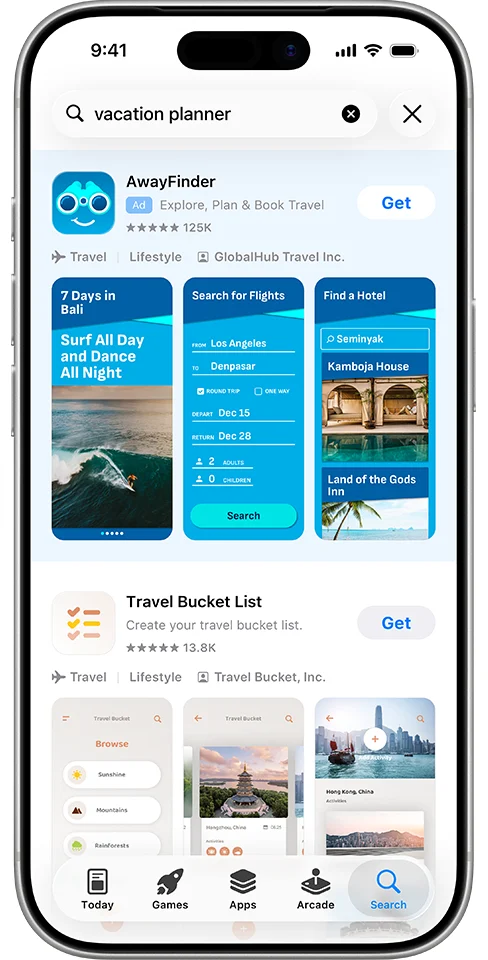
On March 3, 2026, Apple Search Ads, the pivotal advertising platform within the App Store, fundamentally altered its long-standing “one query, one ad” paradigm. This strategic shift, initiated with a phased rollout beginning in the United Kingdom and Japan, before expanding globally within the month, now allows for two sponsored app placements to appear on a single search results page. Previously, a user’s query would surface a single advertisement at the top of the results, with advertisers vying for that sole prime position. The introduction of a second paid slot, strategically positioned within the organic results at approximately the third position, signifies a significant expansion of advertising inventory and presents a complex new landscape for app developers and marketers.
This evolution marks a departure from a foundational rule that has governed Apple Search Ads since its inception. For years, the platform operated on a straightforward auction system: the highest bidder secured the top ad spot, and all other advertisers competed for subsequent, less prominent opportunities. The introduction of a second paid placement means that a single search query can now yield two sponsored app listings, a change that, while seemingly an opportunity for increased visibility, introduces nuanced challenges and strategic considerations for advertisers. The implications extend beyond mere inventory expansion, fundamentally altering how advertisers approach keyword strategy, budget allocation, and overall App Store optimization.
The Unfolding of a Dual-Placement Auction
The implementation of the second paid placement was not an opt-in feature for existing advertisers. Instead, Apple automatically broadened the auction parameters. Any campaign that was already actively bidding on a particular keyword became immediately eligible for consideration in the second placement slot upon the format’s live deployment. This automatic integration means that advertisers did not need to actively adjust their campaign settings or initiate new bids to participate. Apple’s approach was to expand the available inventory and seamlessly incorporate existing participants into this new, dual-slot auction environment.
Crucially, this enhancement does not grant advertisers the ability to directly select their desired placement. There is no separate bidding mechanism for the top slot versus the second slot, nor is there a way to specifically target one position over the other. Apple’s proprietary system autonomously assigns placements, with a significant emphasis placed on relevance above all else. An app that is not deemed a strong match for a user’s search query will not be displayed, regardless of the advertiser’s budget. This strict adherence to relevance is a defining characteristic of Apple Search Ads and distinguishes this inventory expansion from a simple increase in ad volume.
Relevance: The Decisive Factor in Placement
Apple has consistently maintained a more stringent relevance threshold for its advertising compared to platforms like Google. On Google’s advertising network, a sufficiently high bid can sometimes lead to an advertisement appearing for keywords that are only loosely related to the advertised product or service. In contrast, Apple’s system proactively excludes apps that it determines to be a poor fit for a specific search query, irrespective of the financial commitment behind the ad.

In the era of a single paid placement, this relevance bar primarily dictated whether an advertiser appeared on the search results page at all. With the introduction of two paid slots, the relevance criterion now plays a dual role. It not only determines initial eligibility but also influences who benefits from spillover opportunities when a competitor is unable to secure both positions. This dynamic elevates the importance of keyword quality and strategic alignment more than ever before. Advertisers who have historically relied on broad, loosely themed keyword lists that only marginally met relevance criteria are likely to experience greater volatility in their ad placements from one search to the next. Conversely, campaigns where keywords, app categories, and creative assets are tightly aligned with user intent are expected to maintain more stable positions.
Prior to this significant rollout, a proactive approach to keyword management became paramount for many marketing agencies and in-house teams. Auditing client accounts for any instances of thin keyword coverage or weak relevance signals was a critical preparatory step. Conducting these assessments while the auction was relatively calmer allowed for strategic adjustments to be made before entering a more competitive and dynamic environment. Entering a busier auction with poorly defined or loosely associated keywords was recognized as an inefficient strategy, likely to result in wasted ad spend on placements that were never realistically attainable.
Deconstructing the Cost Dynamics
The intuitive assumption might be that an increase in advertising inventory would naturally lead to a decrease in costs. A larger supply of ad slots could logically translate into more impressions and a reduced cost per tap. Indeed, initial observations from the early stages of the rollout have suggested that the second placement tends to clear at a lower cost than the top position. However, a longer-term perspective reveals a more complex cost picture.
Average cost per tap on Apple Search Ads has been on an upward trajectory. Data from 2025 indicated an average cost per tap of $2.25, a notable increase from $1.59 just two years prior. While the addition of an extra slot may offer some immediate relief, it does little to counteract the sustained rise in the number of advertisers competing for the same high-intent audience. The fundamental challenge remains the intense competition for valuable App Store search real estate.
Therefore, the more pertinent question for advertisers is not solely whether individual taps become cheaper, but rather whether the same advertising budget can now yield a greater number of app installs. For campaigns that are meticulously structured with a strong emphasis on relevance, the answer is likely to be yes, at least during the initial adjustment period as the market adapts to the new format. However, for advertisers whose campaigns were already struggling to win auctions, the availability of a second placement that they are unable to secure will offer little to no tangible benefit.
The Ripple Effect on Organic Discovery
The introduction of a second paid ad slot also has a discernible impact on organic search results. The new paid placement occupies space that was previously reserved for organic app listings. This means that genuine, non-sponsored results are pushed further down the search results page. For any app that relies significantly on organic search traffic to supplement its paid advertising efforts, this shift can lead to a softening of organic volume as paid placements consume more of the visible screen real estate. Consequently, the gains achieved through paid advertising might be partially offset by a decline in organic discoverability, creating a complex interplay between the two channels.

Identifying True Advantage in the New Landscape
The advertisers poised to gain the most from this significant change are those who had already established robust foundational strategies before the rollout. The advantage is not with those who simply increased their bids on day one, but rather with those who had their fundamentals in order. Three key areas consistently emerge as determinants of success in this evolving environment.
1. Unwavering Keyword Discipline: The cornerstone of success lies in rigorous keyword management. App Store keywords must be meticulously reviewed and aligned with the app’s specific category, metadata, and creative assets. Any keywords that only loosely align with these core elements should be either tightened to be more specific or removed entirely. This foundational work must precede any adjustments to bidding strategies. The second placement, in particular, acts as a strong filter for relevance, often prioritizing it over bidding spend.
2. Strategic Audience Segmentation: Apple has long provided advertisers with the capability to differentiate between new and returning users. With the expansion of available impressions, the cost of treating these user groups as a monolithic entity has become increasingly apparent. In campaigns analyzed across various markets, returning users, while contributing to overall spend, often account for a disproportionately small share of primary in-app actions that carry significant commercial value. By segmenting returning users into separate campaigns, advertisers can effectively reduce bids for this group and reallocate that budget towards driving genuine new user acquisition and growth.
3. Proactive Competitor Targeting: The availability of two paid positions creates new opportunities for competitors to appear on an advertiser’s branded search terms. Conversely, this also presents a strategic opening for advertisers to target their rivals. Competitor campaigns that might have seemed unfeasible when only a single, highly contested top position was available, now become viable strategies. This is particularly true provided that clear cost-per-tap ceilings are established and adhered to before scaling these campaigns. Understanding and leveraging competitor strategies is now more critical than ever.
The Enduring Strength of Apple Search Ads
Apple Search Ads has historically excelled in driving high-intent, bottom-of-funnel user acquisition. The introduction of the second paid slot extends this inherent strength to a broader range of advertisers simultaneously. However, the platform’s design continues to reward thorough preparation and strategic execution rather than sheer bidding volume. Because relevance remains the primary determinant of eligibility for these coveted positions, advertisers who meticulously manage their keyword quality, optimize their audience segmentation, and strategically address competitor targeting are best positioned to capture a larger share of this newly expanded inventory. Even several months post-rollout, the competitive advantage still resides with those who master these fundamental aspects of App Store advertising, as the broader market continues to adapt and close the gap. The landscape of app discovery within the App Store has irrevocably shifted, demanding a more sophisticated and data-driven approach from all stakeholders.