The digital marketing landscape is undergoing a profound transformation, driven by the rapid ascent of generative artificial intelligence (AI) and its integration into search mechanisms. At the forefront of this shift is the emergence of Answer Engine Optimization (AEO) checkers, sophisticated tools designed to ascertain whether AI-generated answers, which increasingly influence consumer decisions, accurately reference and cite a specific brand. As platforms like ChatGPT, Perplexity, and Gemini become primary conduits for information, users are increasingly obtaining direct answers without the need to click through to external websites. This "zero-click" phenomenon means that brand visibility, once measured predominantly by search engine rankings, can now vanish into an AI-synthesized response, often unseen by the brand itself.
The Paradigm Shift: From Traditional SEO to AEO
For decades, Search Engine Optimization (SEO) focused on optimizing content to rank high in a list of links returned by traditional search engines. The goal was to drive traffic by securing a prominent position on the Search Engine Results Page (SERP). However, the advent of large language models (LLMs) and their integration into search has fundamentally altered this dynamic. Generative AI tools function as "answer engines," synthesizing information from vast datasets and presenting it as a single, coherent response. This often resolves a user’s query directly, eliminating the need to click on any provided links.
Google’s strategic pivot in May 2024, with the rollout of AI Overviews, cemented this shift. These AI-generated summaries appear prominently at the top of Google’s search results, providing concise answers and often reducing the necessity for users to scroll or click. This move by the dominant search engine underscores the imperative for brands to adapt their digital strategies. Data from various analytics firms suggests a significant increase in zero-click searches, with some reports indicating that over 65% of Google searches result in no clicks to websites, a figure projected to rise with the proliferation of AI Overviews. The rapid adoption of generative AI tools further illustrates this trend; ChatGPT, for instance, reached 100 million active users faster than any consumer application in history, highlighting the scale of this behavioral change.
![AEO checker tools that measure answer engine visibility [2026]](https://53.fs1.hubspotusercontent-na1.net/hubfs/53/aeo-checker-1-20260903-3858273.webp)
AEO, therefore, is not a replacement for SEO but rather a complementary discipline. While SEO continues to ensure content is crawlable, indexable, and authoritative—signals that AI engines still rely on for source selection—AEO specifically targets the accuracy and frequency of brand mentions and citations within the AI-generated answers themselves. The goal is to ensure that when an AI provides information relevant to a brand’s products, services, or expertise, that brand is acknowledged and properly attributed.
Understanding Answer Engine Optimization (AEO)
Answer Engine Optimization is defined as the strategic practice of enhancing how often and how precisely a brand, its products, or its content appears within the AI-generated responses provided by tools like ChatGPT, Perplexity, Gemini, and Google’s AI Overviews. This optimization goes beyond merely ranking for keywords; it focuses on influencing the AI’s "understanding" and articulation of information. For AI engines to parse and trust content, it must be clearly structured, provide direct and authoritative answers to common questions, and back claims with verifiable primary sources. This often involves adopting advanced content strategies, including the use of structured data (schema markup), entity optimization, and the creation of highly focused, informative content that directly addresses user queries.
The Role of an AEO Checker: Core Functionality and Workflow
An AEO checker serves as a vital diagnostic and monitoring tool in this new environment. Its primary function is to measure a brand’s visibility across various answer engines and then translate that data into actionable recommendations for improvement. Typically, an AEO checker performs several key tasks:
![AEO checker tools that measure answer engine visibility [2026]](https://no-cache.hubspot.com/cta/default/53/9dd5e54b-fbef-4dd0-bc44-1689feb1ea18.png)
- Measurement: It continuously monitors target queries across selected AI platforms (e.g., ChatGPT, Perplexity, Gemini, Google AI Overviews) to identify instances where a brand is cited or mentioned.
- Diagnosis: It analyzes the nature of these citations and mentions, noting accuracy, context, and whether competitors are being favored. It also identifies "content gaps" where a brand should be mentioned but isn’t.
- Prioritization: Based on the diagnosis, it ranks potential fixes, highlighting content updates, schema corrections, or entity enhancements most likely to improve citation rates and brand visibility.
- Optimization Guidance: It provides specific recommendations for optimizing existing content or creating new content that aligns with AI parsing requirements.
- Reporting: It tracks visibility scores, citation coverage, and other key metrics over time, enabling brands to assess the effectiveness of their AEO strategies.
This workflow often operates as a continuous loop, allowing brands to adapt rapidly to the dynamic nature of AI responses and evolving algorithms.
Manual AEO Checks: An Initial, Limited Approach
For businesses just beginning to explore AEO, manual checks can offer initial insights, though their scalability and reliability are inherently limited.
Checking Google AI Overviews (AIOs):
Performing manual checks for Google’s AI Overviews involves running priority queries in live search sessions. It’s crucial to note that AIOs do not trigger for every query; Google’s systems display them only when they determine a summary adds value beyond standard links. Furthermore, AIO results can vary between sessions, necessitating multiple lookups for a more representative sample. When an AIO appears, it typically cites the pages it drew from, placing source links inline with the text and often providing a desktop hover preview of the site.
- Step 1: Define Important Queries. Businesses should compile a list of critical queries, including their brand name, branded product terms, and common informational questions posed by their target audience.
- Step 2: Execute and Record. Each query should be run in a signed-out or incognito session. For each run, record whether an AI Overview appeared, if the brand’s domain was among the inline source links, and the exact claim made about the brand or topic.
- Step 3: Interpret Results. Compare queries that successfully triggered an AIO citing the brand against those where competitors were cited instead. This helps identify content gaps. Given the variability of AIOs, a single absence should prompt re-checking rather than being taken as definitive proof of lost placement.
- Step 4: Build Reporting. Screenshotting each result with the query, date, and location is essential for a defensible record. While Google announced a dedicated generative AI performance report rolled out to a subset of sites in June 2026, it primarily reports impressions and may not fully isolate AI Overview activity from overall "Web" search performance in standard Search Console reports.
The inherent volatility of AIOs and the volume of queries make manual sampling unreliable and impractical for continuous monitoring. This highlights the indispensable role of automated AEO checkers.
![AEO checker tools that measure answer engine visibility [2026]](https://53.fs1.hubspotusercontent-na1.net/hubfs/53/aeo-checker-2-20260903-852936.webp)
Checking ChatGPT and Perplexity Citations:
These platforms also cite sources, but their mechanisms differ. Perplexity, by default, attaches citations to every answer, linking to its sources and often displaying a dedicated sources panel. ChatGPT provides inline citations when using web search and lists them in a Sources panel beneath the reply.
- Step 1: Practical Citation Checks. Using the same branded and informational queries, check for two outcomes: whether the brand’s domain appears among the cited sources, and whether the brand is explicitly named in the answer text. Both a citation and a direct mention represent distinct wins.
- Step 2: Prompt for Retrieval. ChatGPT only searches the web when a question benefits from current information or when explicitly prompted. Phrasing direct, current questions (e.g., "best [category] tools for [use case]") encourages the engine to access live sources.
- Step 3: Log and Action. Due to source variability, each prompt should be run multiple times across fresh sessions. Recording the engine, prompt, date, citation/mention status, and competitor appearance helps surface inconsistencies. Absences become actionable tasks, prompting content refinement and subsequent re-checking.
Key Criteria for Selecting AEO Checking Software
While manual checks offer a starting point, scaling AEO efforts necessitates specialized software. When evaluating AEO checking tools, several critical factors come into play:
- Multi-Engine Monitoring: The ability to track visibility across a comprehensive range of answer engines, including Google AI Overviews, ChatGPT, Perplexity, and Gemini, is paramount.
- Citation and Mention Detection: Beyond simply linking, the tool should identify direct brand mentions within the AI’s synthesized answer text.
- Competitive Analysis: Understanding how competitors are performing in AI answers provides crucial strategic insights, identifying gaps and opportunities.
- Actionable Recommendations: The software should not just report data but also translate it into clear, prioritized recommendations for content optimization, schema markup, and entity management.
- Data Accuracy and Freshness: Given the dynamic nature of AI responses, continuous monitoring and frequent data refreshes are essential for reliable insights.
- Scalability: The ability to manage and analyze a large volume of queries and content pieces efficiently.
- Integration Capabilities: Seamless integration with existing marketing tech stacks, such as Content Management Systems (CMS) and Customer Relationship Management (CRM) systems, enhances workflow efficiency and attribution.
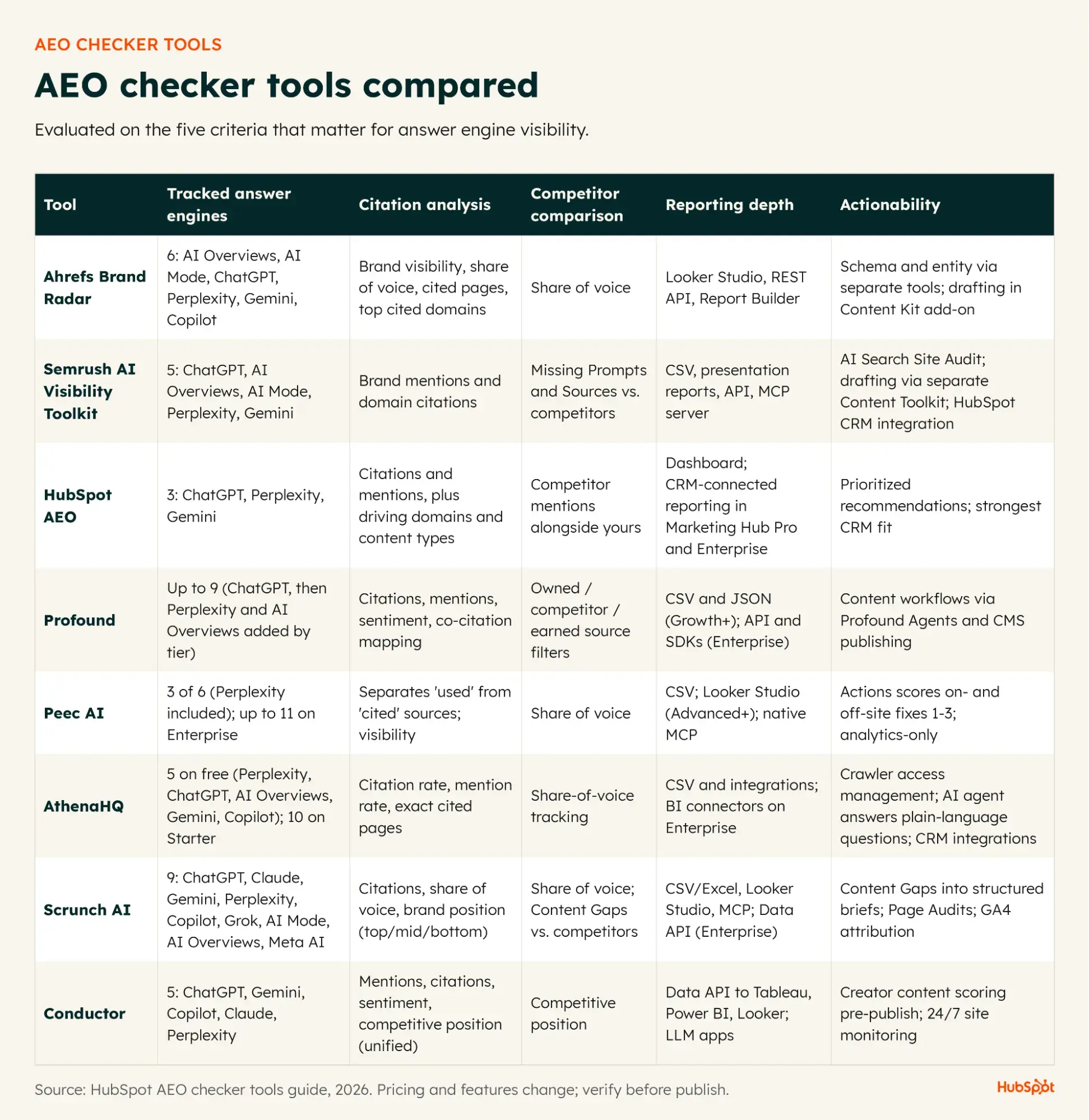
Leading AEO Checker Tools: A Comparative Analysis
The market for AEO tools is rapidly evolving, with various platforms offering specialized functionalities to address different aspects of AI visibility.
![AEO checker tools that measure answer engine visibility [2026]](https://53.fs1.hubspotusercontent-na1.net/hubfs/53/aeo-checker-3-20260903-8904553.webp)
Tools with AI Overviews Tracking:
These tools are crucial for brands navigating Google’s new AI-powered search results.
- Ahrefs Brand Radar: Leveraging real search queries rather than synthetic prompts, Ahrefs Brand Radar boasts a substantial index for AI Overviews. It provides insights into brand mentions and citations within these summaries, allowing marketers to understand their presence in Google’s generative AI results. Its strength lies in its extensive data collection, making it a robust option for competitive analysis within the AIO context.
- Semrush AI Visibility Toolkit: Integrated within its broader SEO suite, Semrush’s toolkit helps identify which of a brand’s ranking keywords already trigger AI Overviews. This functionality is invaluable for prioritizing existing content pages that are "near-inclusion" and require targeted optimization to secure a spot in the AI summary. Semrush’s existing strength in keyword research and competitive intelligence provides a strong foundation for its AEO offerings.
Tools with ChatGPT Citation Detection:
These tools focus on the most widely recognized generative AI platform.
- HubSpot AEO: HubSpot’s dedicated AEO tool tracks both citations (AI answers linking back to a brand’s domain) and direct mentions (answers naming the brand without a link). It also analyzes the domains and content types driving visibility for both the brand and its competitors, offering prioritized recommendations based on this analysis. Its deep integration capabilities within the HubSpot ecosystem are a significant advantage for existing users.
- Profound: Profound goes beyond basic citation detection, delving into the context of citations. It offers sentiment scoring for brand mentions, flags uncited prompts (where a brand should have been mentioned but wasn’t), and provides a breakdown of citations by source type (owned content, competitor content, earned media). This granular analysis offers a more nuanced understanding of brand perception within AI responses.
Tools with Perplexity Monitoring:
Perplexity is gaining traction for its strong citation practices, making dedicated monitoring valuable.
- Peec AI: As a pure-play analytics tool, Peec AI focuses specifically on reporting clean, comprehensive data from Perplexity. Its specialization ensures a deep dive into how Perplexity sources and presents information, which can be critical for brands that see significant user engagement on this platform.
- AthenaHQ: AthenaHQ offers Perplexity tracking across all its plans, including a free tier, making it accessible for smaller businesses or those exploring AEO. Its conversational assistant interface can simplify the process of querying and interpreting results.
Tools for Schema and Entity Readiness:
Underpinning successful AEO is content that AI can easily understand and trust.
- Scrunch AI: This tool specifically addresses the technical foundations of AEO by checking whether AI crawlers can effectively reach and render a brand’s web pages. Ensuring crawlability and proper rendering is fundamental for any AI engine to process and cite content accurately.
- Conductor: Conductor combines 24/7 technical monitoring with a content scorer. This dual approach helps brands not only ensure their technical infrastructure supports AI parsing but also that their content is strategically optimized for relevance and authority, which are key signals for AI engines.
Essential AEO Metrics for Strategic Insight
![AEO checker tools that measure answer engine visibility [2026]](https://53.fs1.hubspotusercontent-na1.net/hubfs/53/aeo-checker-4-20260903-6212698.webp)
Once an AEO checker is operational, monitoring specific metrics is crucial for evaluating strategy effectiveness and making informed adjustments. These metrics should be viewed as trends rather than isolated snapshots.
- Visibility Score: An aggregate measure of a brand’s overall presence across monitored answer engines, often represented as a percentage or index.
- Citation Coverage: The percentage of AI-generated answers for relevant queries that cite the brand’s content or domain. This indicates the AI’s trust and reliance on the brand as an authoritative source.
- Brand Mentions: The frequency with which the brand name is directly referenced within AI answers, even if a direct link (citation) is not provided. This reflects brand recognition and mindshare.
- Competitive Share of Voice: A comparative metric showing a brand’s visibility against its primary competitors in AI answers. This helps identify competitive strengths and weaknesses.
- AI-Referred Sessions: Direct traffic attributed to clicks originating from AI Overviews or cited links within other answer engines. While challenging due to zero-click trends, this still provides a measurable impact.
- Qualified Traffic Proxies: Metrics like branded search lift or engagement with content that is known to be frequently cited by AI, offering indirect insights into the value of AI visibility.
Tracking these metrics over weeks and months provides a clear direction for AEO efforts, enabling marketers to refine content strategies and technical optimizations.
HubSpot’s Ecosystem Approach: Bridging Measurement and Action
Many AEO checkers excel at diagnosis but often leave the implementation of fixes to external processes. HubSpot aims to streamline this by integrating AEO capabilities directly within its marketing and CRM platform. Available as a standalone product or within Marketing Hub Professional and Enterprise, HubSpot AEO translates visibility data into prioritized recommendations—what content to create, update, or promote.
For users of Marketing Hub Professional and Enterprise, the integration is particularly powerful. Here, AEO’s recommendations are enriched by CRM data, allowing for suggestions that align with customer journeys and sales pipeline needs. The platform’s "Content Agent" feature can even convert a blog recommendation into a research-backed first draft, tailored to the brand’s voice, with a single click. This draft lands directly in HubSpot’s content editor, facilitating rapid review, refinement, and publication through Content Hub and Marketing Hub. This generation capability, currently in public beta, operates on HubSpot Credits, offering an efficient bridge from insight to execution.
![AEO checker tools that measure answer engine visibility [2026]](https://53.fs1.hubspotusercontent-na1.net/hubfs/53/aeo-checker-5-20260903-8938354.webp)
Furthermore, HubSpot’s Smart CRM attributes traffic referred from AI tools as a distinct source, linking it to contacts and deals. While acknowledging the inherent challenge of attributing value to zero-click visibility, HubSpot provides measurable insights into the AI traffic that does click through, integrating AEO reporting into the broader marketing and sales funnel. This holistic approach makes HubSpot AEO a practical next step for organizations whose manual checks are no longer sustainable.
The Future of Search: Challenges and Opportunities in the AEO Landscape
The rise of AEO marks a permanent shift in digital strategy, presenting both significant challenges and unparalleled opportunities for brands. The dynamic nature of AI responses, coupled with the ongoing "attribution dilemma" of measuring the value of zero-click interactions, will continue to be central concerns for marketers. As AI models evolve, becoming more sophisticated and potentially more autonomous in their content generation, the methods for optimizing and monitoring brand presence will also need to adapt.
Ethical considerations, such as the potential for AI hallucination, bias, or the spread of misinformation, also underscore the importance of accurate brand representation. For businesses, this necessitates a proactive approach: investing in robust structured data, creating highly authoritative and transparent content, and continuously monitoring their brand’s portrayal across AI platforms. The ability to quickly identify and correct misrepresentations or missed opportunities will be a critical competitive advantage.
Ultimately, AEO is not a passing trend but a fundamental discipline for maintaining brand visibility and influence in an increasingly AI-driven information ecosystem. Businesses that embrace and invest in AEO strategies, leveraging both manual insights and advanced automated tools, will be best positioned to thrive in this new era of search.