
 rifanmuazin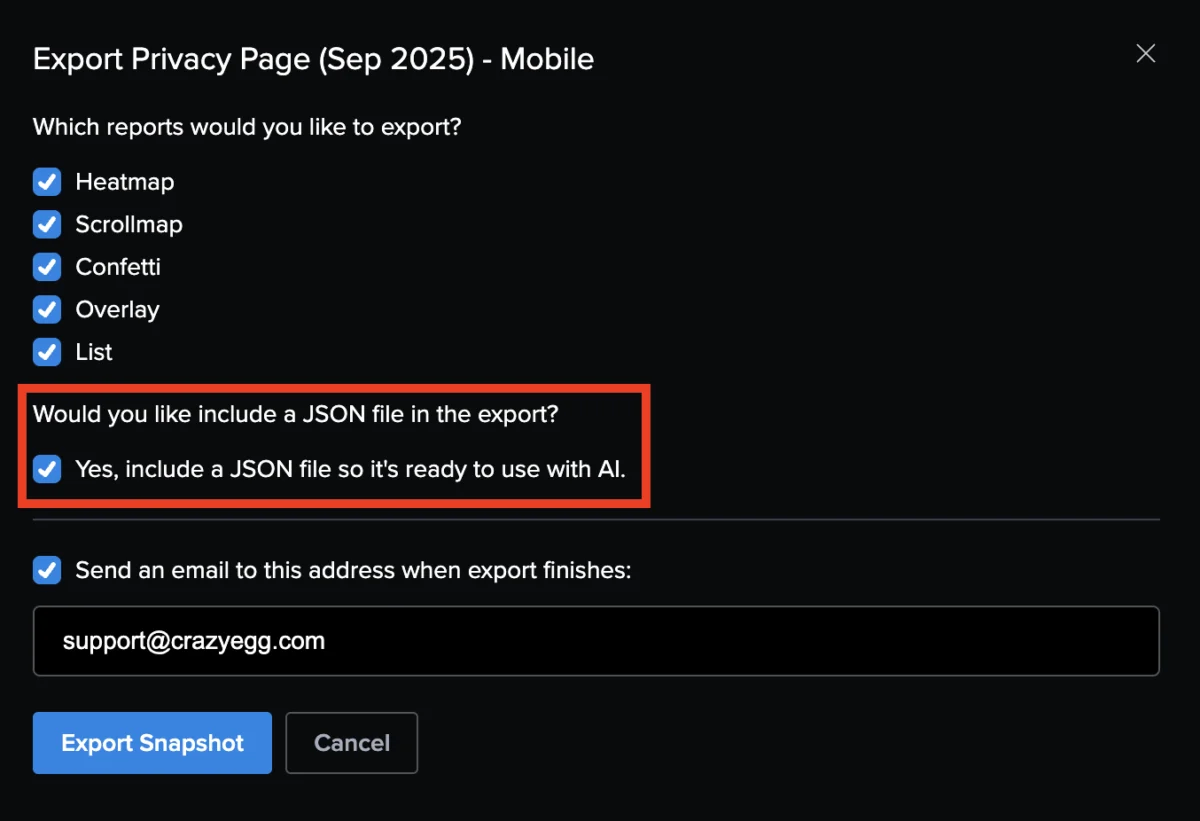
The Evolution of Behavioral Analytics and AI Integration
The introduction of AI-ready exports for heatmaps marks a pivotal moment in the timeline of web analytics. Historically, heatmaps served as a visual representation of where users clicked, scrolled, or moved their cursors. While these "blobs" of color provided intuitive insights for human analysts, they remained largely inaccessible to automated data processing tools without significant manual translation.
The latest update from Crazy Egg transforms these visual data points into structured JSON (JavaScript Object Notation) files. This format is the native language of modern AI, allowing tools such as ChatGPT, Claude, and Gemini to ingest thousands of data points regarding user interaction. By including conversion data in these exports, Crazy Egg is moving beyond "vanity metrics"—such as where a user accidentally clicked—and toward "value metrics," which highlight the specific behaviors that lead to a completed purchase, a newsletter sign-up, or a lead generation form submission.
Technical Specifications of the AI Export Feature
The new functionality is specifically designed to streamline the workflow between data collection and actionable insight. According to the technical documentation, the AI Export includes data from any events currently being tracked within the Crazy Egg Conversions suite. This means that if a business is tracking a "Thank You" page load or a "Submit" button click as a conversion, that specific data point is cross-referenced with the user’s navigational path in the exported file.
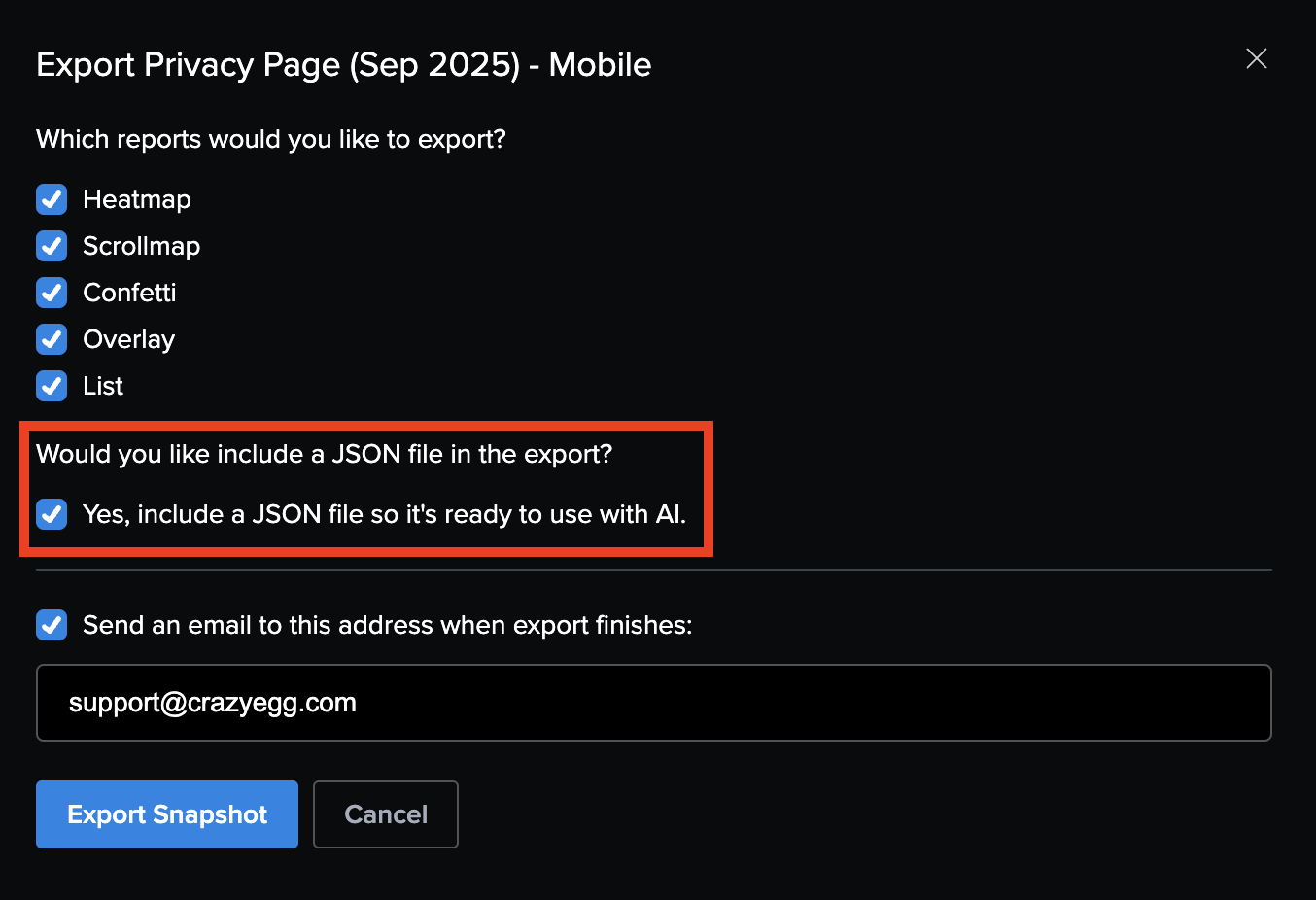
To access this feature, users navigate to any Heatmap report within the Crazy Egg dashboard. By selecting the "Export" option under the primary menu, users can toggle a specific setting: “Yes, include a JSON file so it’s ready to use with AI.” Once the file is generated, it can be uploaded directly into an AI interface. The AI then acts as a virtual data scientist, capable of identifying patterns that might be invisible to the naked eye, such as a high-intent user segment that consistently drops off at a specific scroll depth despite clicking on key value propositions.
The Strategic Importance of Conversion Data in CRO
Conversion Rate Optimization is a multi-billion dollar industry, with companies spending significant portions of their marketing budgets to move the needle by even a fraction of a percentage point. According to industry benchmarks, the average e-commerce conversion rate hovers between 2% and 3%. For high-volume enterprises, an increase of just 0.5% in conversion can result in millions of dollars in additional annual revenue.
By integrating conversion data into AI exports, Crazy Egg is addressing the "context gap" in traditional heatmap analysis. In the past, a heatmap might show heavy clicking on a specific image. A human analyst might assume that image is a point of interest. However, without conversion data linked to those clicks, it was impossible to know if those clicks were "productive" (leading to a sale) or "frustrated" (users clicking an image they mistakenly thought was a link). AI analysis can now correlate these behaviors instantly, informing the user whether a specific site element is a driver of revenue or a source of friction.
Chronology of Development in AI-Driven Marketing Tools
The trajectory of Crazy Egg’s product development reflects a broader trend within the MarTech (Marketing Technology) ecosystem.
- Phase 1: Visual Mapping (2006–2015): The early years focused on basic click and scroll maps. Analysis was purely visual and qualitative.
- Phase 2: Quantitative Integration (2016–2021): Platforms began integrating A/B testing and direct conversion tracking, allowing users to see the statistical significance of layout changes.
- Phase 3: Automated Insights (2022–2023): The rise of generative AI prompted tools to offer "AI summaries" or basic automated suggestions based on site data.
- Phase 4: Structured Data Portability (2024–Present): The current era, defined by the "Analyze conversion data from Heatmaps in any AI tool" update, focuses on data portability. Rather than forcing users to use a proprietary, "black box" AI, companies are providing structured data that can be used in the user’s AI tool of choice.
This shift recognizes that many enterprise companies have already developed custom AI prompts and internal workflows within platforms like OpenAI or Anthropic. By providing a JSON export, Crazy Egg allows these companies to integrate behavioral data into their existing sophisticated AI stacks.
Industry Implications and Expert Perspectives
The ability to process heatmap and conversion data through AI has profound implications for digital agencies and in-house marketing teams. Stephen Ngo, Director of Growth Marketing at Crazy Egg and a veteran of B2B startups like Paddle and ProfitWell, emphasizes that this feature allows tools to go "beyond surface-level activity."
Market analysts suggest that this move will likely force competitors—such as Hotjar, FullStory, and Microsoft Clarity—to enhance their own data portability features. The democratization of data analysis means that smaller teams, which may not have the budget for a full-time data scientist, can now leverage AI to perform high-level CRO audits.
"The bottleneck in CRO has never been a lack of data; it has been the time required to interpret that data," says one independent UX consultant. "With JSON exports that include conversion events, we can essentially ask an AI, ‘Show me the top three reasons why users who clicked the pricing page didn’t sign up,’ and get a data-backed hypothesis in seconds rather than hours."

Broader Impact on A/B Testing Workflows
One of the most practical applications of this new feature is its role in the A/B testing lifecycle. Traditionally, a marketer would look at a heatmap, form a subjective hypothesis, and then design a test. This process is prone to human bias.
With AI-analyzed heatmap data, the hypothesis generation phase becomes significantly more objective. An AI tool can analyze the JSON file and suggest specific variations for an A/B test based on the exact coordinates of where conversions are failing. For example, if the data shows that users who convert tend to hover over a specific testimonial for more than five seconds, the AI might suggest moving that testimonial higher on the page or making it more prominent.
This creates a "virtuous cycle" of optimization:
- Data Collection: Crazy Egg captures clicks, scrolls, and conversions.
- Export: The user generates an AI-ready JSON file.
- AI Analysis: The AI identifies hidden patterns and friction points.
- Hypothesis: The AI suggests 3–5 specific CRO ideas.
- Testing: The user runs an A/B test in Crazy Egg to validate the AI’s suggestions.
Availability and Future Outlook
Crazy Egg has confirmed that the AI Export for Heatmaps, including the new conversion data integration, is currently available for all customers on Pro and Enterprise plans. This positioning suggests that the feature is aimed at power users and organizations with high-traffic sites where data density is high enough to provide meaningful insights for AI models.
Looking forward, the industry expects to see even tighter integrations between behavioral tracking and AI. This might include "live" API connections where AI can analyze user behavior in real-time to trigger personalized site adjustments. For now, the move to provide structured, conversion-linked data in a portable format represents a significant step toward the "autonomous marketing" future, where data analysis is no longer a manual chore but an automated, continuous process of discovery.
As businesses continue to navigate an increasingly competitive digital landscape, the ability to rapidly turn raw visitor data into conversion-driving strategies will be a key differentiator. The integration of AI into the standard CRO toolkit is no longer a luxury but a necessity for those looking to maximize the return on their digital investments.








