

The fiercely competitive landscape of email marketing demands a constant re-evaluation of what constitutes "good" performance. This year’s highly anticipated DMA (Data & Marketing Association) UK Email Benchmarking Report, sponsored by Validity, offers an unparalleled insight into the current state of email efficacy, delineating the critical differences between merely adequate and truly exceptional programs. The report underscores email’s immense potential for revenue generation, provided marketers adapt to a rapidly evolving digital environment. Drawing on an extensive dataset from six prominent email service providers, this comprehensive analysis provides the most complete overview of UK email performance available today, serving as an indispensable guide for marketing professionals aiming to optimize their strategies.
The Foundational Importance of Benchmarking in a Dynamic Channel
The Data & Marketing Association (DMA) stands as the leading trade body for the UK marketing industry, championing responsible data use and effective marketing practices. Its annual Email Benchmarking Report is a cornerstone publication, offering critical industry standards against which businesses can measure their own performance. In an era where email remains a primary driver of customer engagement and sales, understanding these benchmarks is not merely an academic exercise but a strategic imperative. Validity, a global leader in email deliverability and sender reputation, sponsors this report, lending its deep expertise in ensuring emails reach their intended inboxes. The collaboration between DMA and Validity highlights the growing recognition that technical infrastructure and strategic execution are inextricably linked to email marketing success.
The report’s release comes at a pivotal time, as marketers grapple with a confluence of technological advancements, evolving consumer behaviors, and heightened privacy regulations. From the advent of sophisticated AI tools that influence how emails are perceived and interacted with, to stricter enforcement of bulk sender requirements by mailbox providers, the dynamics of email marketing are in constant flux. The 2026 report, therefore, serves as a crucial compass, guiding brands through these complexities and illuminating pathways to sustained growth and improved ROI.
Overall Positive Trends Mask Deeper Nuances
On the surface, the 2026 DMA UK Email Benchmarking Report paints a broadly positive picture for the email channel, reflecting its enduring strength and adaptability. Year-over-year data indicates a general upward trend in key metrics, suggesting that email continues to be a robust and reliable marketing tool. However, a deeper dive into the numbers reveals significant variances across different sectors, highlighting specific challenges and opportunities that demand nuanced strategic responses.
While overall engagement metrics show resilience, sectors like retail and travel find themselves at the lower end for click-through rates, registering 1.0 percent and 1.2 percent respectively. This performance divergence warrants closer scrutiny, as these sectors typically rely heavily on direct response from their email campaigns. Conversely, the Business-to-Business (B2B) segment showcased a remarkable improvement in delivered rates, climbing from 90.7 percent to an impressive 95.6 percent. This sharp uptick signals a concerted effort within the B2B landscape to refine acquisition strategies, maintain rigorous list hygiene, and adhere to best practices for sender reputation. Such improvements are often driven by a greater emphasis on data quality, compliance with regulations like GDPR, and a strategic understanding of the long-term value of a clean, engaged subscriber list.
For revenue leaders, simply observing these aggregate numbers is insufficient. The more pertinent inquiry lies in dissecting the underlying drivers of these trends and identifying where the most significant opportunities for growth truly reside. Understanding the ‘why’ behind the ‘what’ is essential for translating benchmarking insights into actionable strategies that deliver tangible revenue uplift.
Beyond Delivery: The Criticality of Inbox Placement Rate (IPR)
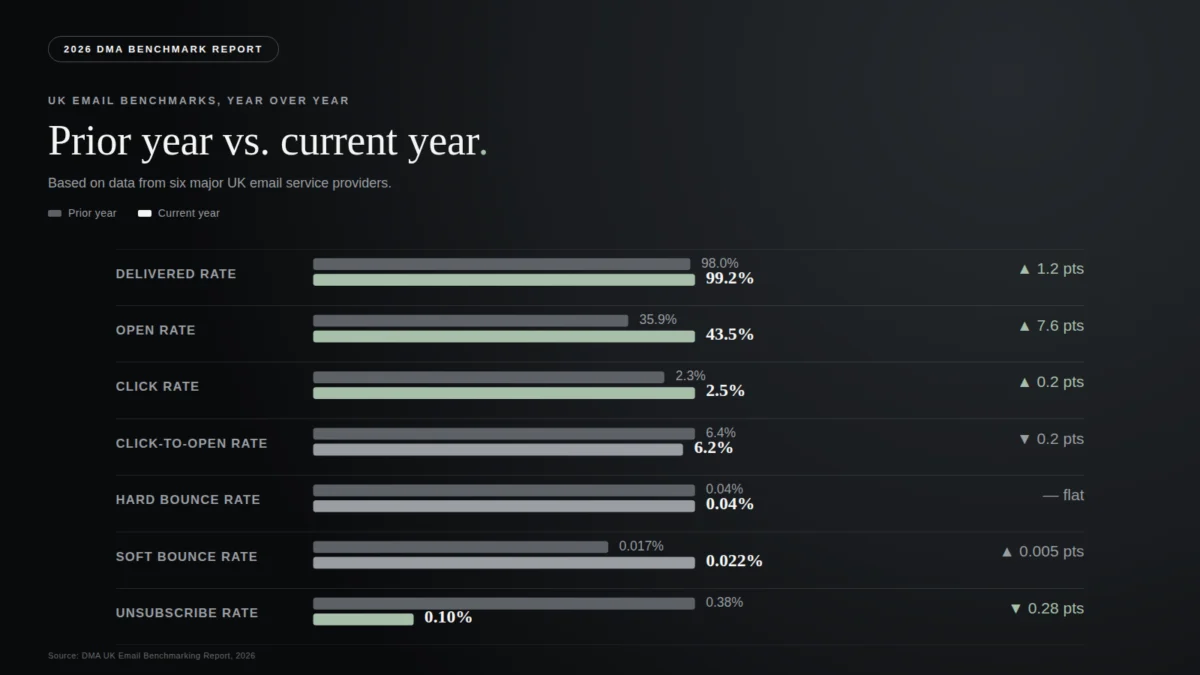
A high delivered rate, often proudly touted by email marketers, can be misleading. While the report highlights a strong overall delivered rate of 99.2 percent, this figure merely indicates that an email successfully reached the recipient’s server. It provides no guarantee that the email actually landed in the recipient’s primary inbox, rather than being shunted into a spam folder, promotions tab, or rejected outright. This crucial distinction introduces the concept of Inbox Placement Rate (IPR), the true measure of whether an email investment will convert into revenue.
Globally, average IPRs hover around 87 percent, implying that approximately one in eight legitimate, permission-based marketing emails never reaches its intended destination. This represents a significant loss of potential engagement and revenue for businesses worldwide. The UK average IPR, while slightly higher at around 91 percent, has experienced a concerning decline of more than two points. This downward trend is largely attributed to mailbox providers, such as Microsoft (which commands roughly 30 percent of UK inboxes), increasingly tightening their enforcement of bulk sender requirements. These providers are implementing more sophisticated algorithms and stricter policies to combat spam and protect user experience, inadvertently making it harder for even legitimate senders to consistently reach the inbox.
For any marketing leader focused on maximizing email ROI, IPR should be the foremost metric to monitor. A typical sender operating at a 90 percent inbox placement rate faces an immediate and substantial opportunity for double-digit revenue uplift, without needing to spend a single additional penny on content creation, design, or promotional offers. By improving IPR from 90% to 95%, for example, a company sending 1 million emails could suddenly see an additional 50,000 emails reaching the inbox, translating directly into increased visibility, engagement, and ultimately, sales. This emphasizes that effective email marketing begins not with compelling creative, but with ensuring reliable delivery to the primary inbox. As a Validity expert highlighted, "Inbox placement is the foundation. Without it, even the most brilliant campaign is just shouting into the void. It’s the invisible hand that dictates the real potential of your email efforts."
AI’s Influence on Clicks: A More Complex Attribution Challenge
While overall click-through rates have shown only a modest increase, the report uncovers a more intriguing and complex shift occurring beneath the surface: the growing influence of Artificial Intelligence (AI) on how subscribers interact with emails. AI-generated email summaries, now a feature in several prominent email clients, are increasingly surfacing call-to-action (CTA) links directly within the inbox interface, often before a subscriber even opens the message.
This technological advancement has a dual impact. On one hand, it can potentially drive traffic by reducing the friction of opening an email to find a relevant link. On the other hand, it fundamentally alters the traditional click decision-making process. Marketers are, in essence, ceding control over which link is prioritized to an AI’s judgment. The AI might highlight a "Shop Now" link, while the marketer intended to drive engagement with a blog post first. This paradigm shift demands a re-evaluation of how CTAs are structured and presented within email content, ensuring they are optimized for both human readability and AI interpretation.
This shift likely contributes to the seemingly "weak" sector click numbers observed in retail and travel. It is improbable that these programs genuinely experienced a halving of their click performance year-over-year. A more plausible explanation is that AI summaries and assistants are facilitating fewer, but higher-intent, clicks. Subscribers who click directly from an AI summary are often more pre-qualified and decisive in their intent. The real story here is not a decline in performance but an urgent and pressing need for more sophisticated attribution models. Traditional last-click attribution, which has long been the standard, fails to capture the full customer journey in an AI-intermediated environment. Marketers must now embrace multi-touch attribution, view-through metrics, and even predictive analytics to accurately gauge the influence of email at various stages of the customer lifecycle. An industry analyst noted, "AI isn’t just changing how emails are opened; it’s redefining the entire conversion funnel. Brands need to invest in smart attribution tools that can track these fragmented journeys."

The Brand Billboard Effect: Unlocking the Hidden Value of Inactive Subscribers
Almost every email marketing program carries an "inactive" segment, often constituting as much as 50 percent of the total subscriber list. This segment typically includes subscribers who haven’t opened or clicked an email in a significant period (e.g., 90, 180, or 365 days). Many senders are understandably reluctant to continue mailing to this segment, fearing that low engagement rates could negatively impact their sender reputation and overall deliverability. However, this reluctance often overlooks email’s powerful, albeit indirect, role as a "brand billboard" within the inbox.
Subscribers, even those who do not actively open or click, still see the sender name and subject line as messages arrive in their inbox. This consistent brand exposure, even if passive, reinforces brand recognition, recall, and trust. These "inactive" subscribers may not engage directly with the email itself, but they still respond in other measurable ways: visiting a brand’s physical store, searching for product reviews online, navigating directly to the company website, or even making purchases without ever opening the promotional email that subtly nudged them.
When these alternative, indirect responses are factored into the equation, the report reveals a compelling insight: inactive subscribers can account for roughly 25 percent of an email program’s total revenue. This significant contribution is driven largely by the cumulative effect of brand reputation and awareness, rather than direct, trackable engagement metrics. This finding introduces a critical dimension to any conversation about list suppression strategies or the overall valuation of an email program. It suggests that a blanket suppression of inactive segments might inadvertently cut off a valuable, albeit hidden, revenue stream. Instead, marketers should consider segmenting inactive subscribers more granularly and developing re-engagement strategies that acknowledge this "billboard effect," perhaps by sending less frequent, high-value brand-building content that maintains awareness without risking sender reputation. A DMA spokesperson emphasized, "The perceived ‘dead weight’ of inactive subscribers is often a miscalculation. Their mere presence in the inbox contributes to brand equity and can drive offline or direct web traffic that current attribution models frequently miss."
The Shifting Relevance of Open Rates
The traditional open rate, once a cornerstone metric for email campaign success, is increasingly losing its utility as a standalone indicator of engagement. While not entirely useless, its reliability has been significantly eroded by changes in technology and privacy features. Zeta Global, a key contributor to this year’s report, recently published data illustrating this discrepancy: a reported unique open rate of 40 percent contrasted with a "true open" rate – one stripped of mailbox provider inflation – of just 11 percent. This stark difference suggests that approximately three-quarters of recorded opens may not reflect a genuine, human interaction with the email.
This phenomenon is largely attributable to factors like email security scanners that "pre-fetch" images (and thus trigger open pixels) to scan for malicious content, as well as Apple’s Mail Privacy Protection (MPP) feature. Introduced in 2021, MPP pre-loads email content in the background, making it appear as if an email has been opened, regardless of whether the recipient actually viewed it.
Validity has observed these changes firsthand. In Q1, many of its customers reported significant drops in Gmail open rates. These declines were largely explained by alterations to Gmail’s image-fetching behavior and various inbox updates, rather than a genuine collapse in subscriber engagement. Crucially, click rates for the same customers remained steady over the same period, confirming that subscribers had not disengaged but rather that the open rate metric itself had become less reliable.
While open rates still carry some directional value (e.g., an 80 percent open rate still outperforms a 60 percent open rate in an A/B test), and for Apple-based traffic specifically, an open is only generated when a message has truly achieved inbox placement, marketing leaders should cease treating it as a primary, standalone success metric. Its inflated nature means it no longer accurately reflects true subscriber interest or campaign performance. Instead, marketers should pivot to more robust metrics like click-through rates, conversion rates, and the aforementioned inbox placement rate to gain a more accurate understanding of campaign effectiveness.
From Testing to Continuous Optimization: Embracing AI for Iterative Improvement
The traditional model of A/B testing, where marketers meticulously test one variable at a time (e.g., subject line A vs. B, CTA color X vs. Y), is gradually losing its relevance in the face of advanced computing power and Artificial Intelligence. The capabilities of AI have ushered in an era where an entire email program can be treated as a continuous testing environment. In this new paradigm, improvements are not identified through scheduled, isolated test cycles, but rather through automatic, real-time identification and implementation of optimal strategies. AI algorithms can analyze vast amounts of data, identify subtle patterns, and make instantaneous adjustments to subject lines, send times, content personalization, and even segmentation, maximizing engagement and conversion rates on an ongoing basis.
This shift does not eliminate the need for measurement; rather, it refocuses it on different, more holistic signals that reflect genuine customer interaction and long-term value. These crucial signals include:
- Reply Signals: Tracking responses to emails, especially in B2B contexts, indicates a deeper level of engagement than a mere click.
- Forwarding: When subscribers forward an email, it signifies strong advocacy and content value, extending reach organically.
- Complaint Rates: While negative, monitoring these helps maintain sender reputation and identify problematic content or segments.
- Time Spent in Inbox: More sophisticated analytics can estimate how long an email is viewed, indicating true interest.
- Conversion Data Beyond the Click: Integrating email data with CRM and sales data to track actual purchases, sign-ups, or leads generated, regardless of the direct click path.
These signals collectively support a newer, more comprehensive Key Performance Indicator (KPI) that deserves to be presented to the C-suite: Return on Relationship (RoR). Unlike last-touch attribution models, which credit only the final interaction before a conversion, RoR tracks the cumulative impact of opens, clicks, repeat purchases, and retention over an extended period. It provides a nuanced understanding of whether a consistent history of email engagement is building sufficient trust and brand affinity to make the next message worthwhile to the subscriber. RoR acknowledges that email marketing is not merely about transactional exchanges but about cultivating lasting customer relationships that drive long-term value. It recognizes that every email, even if not directly clicked, contributes to the overall brand narrative and strengthens the bond with the customer, ultimately influencing their lifetime value.
The Bottom Line for Email ROI: Three Strategic Priorities
For marketing leaders aiming to translate the insights from the DMA UK Email Benchmarking Report into tangible revenue growth, three strategic priorities emerge as paramount:
- Prioritize Inbox Placement Above All Else: Before any focus on creative content, compelling offers, or sophisticated segmentation, ensuring emails consistently reach the primary inbox is non-negotiable. This requires a proactive approach to sender reputation management, robust email authentication protocols (such as DMARC, SPF, and DKIM), vigilant list hygiene to remove invalid or disengaged addresses, and continuous monitoring of deliverability metrics. Investing in tools and expertise that provide real-time insights into inbox placement rates and sender reputation is no longer a luxury but a necessity.
- Rethink and Expand Engagement Metrics Beyond Traditional Opens and Clicks: Given the diminishing reliability of open rates and the evolving nature of clicks due to AI, marketers must adopt a broader, more sophisticated suite of metrics. Focus should shift to true engagement indicators like reply rates, forwarding, conversion rates (on-site purchases, form fills), and the overarching Return on Relationship (RoR). Developing advanced attribution models that account for multi-touch journeys and the "brand billboard effect" of passive engagement is crucial for accurately valuing the email channel’s contribution.
- Embrace Continuous, AI-Assisted Optimization: The era of static, periodic A/B testing is waning. Marketers must leverage AI and machine learning to transform their email programs into dynamic, continuously optimizing systems. This involves adopting platforms that can analyze performance data in real-time, identify optimal strategies for various segments, and automatically implement adjustments to content, send times, and personalization. This shift allows for unprecedented agility and responsiveness, ensuring campaigns are always performing at their peak potential.
Email remains an incredibly powerful channel, capable of driving substantial revenue and fostering deep customer relationships. However, its continued success hinges on a willingness to adapt, innovate, and embrace new measurement paradigms. Programs built to measure the right things—inbox placement, reply signals, relationship strength, and holistic conversions—rather than solely relying on outdated metrics like opens and clicks, are the ones that will emerge as the new leaders in next year’s benchmarks. Teams utilizing advanced platforms like Validity Engage are already integrating this kind of continuous, AI-assisted optimization into their daily program management, transforming these annual benchmarks from a mere report card into an ongoing practice of excellence. By prioritizing deliverability, adopting smarter metrics, and harnessing the power of AI, marketers can unlock the full, untapped potential of their email strategies, securing its position as a cornerstone of digital marketing success for years to come.








