
 rifanmuazin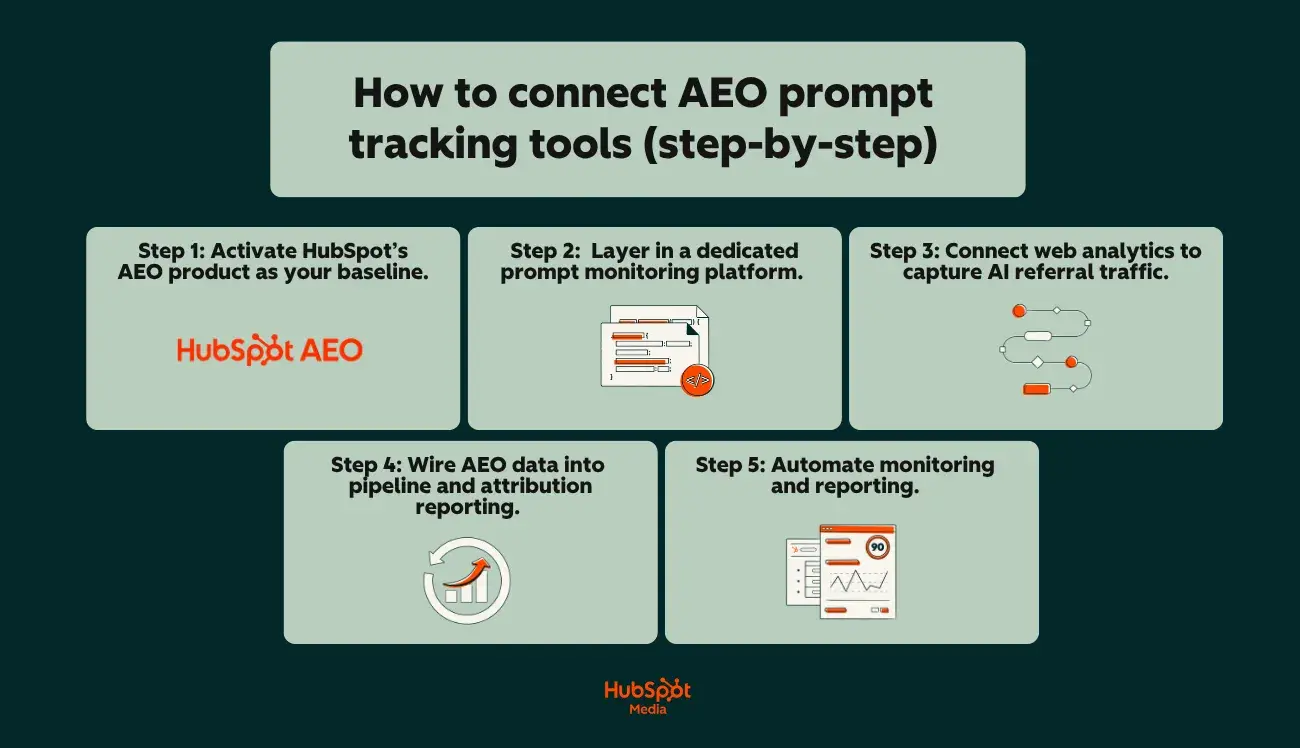
The emergence of artificial intelligence (AI) in search and information retrieval has ushered in a new era for digital marketing, fundamentally altering how brands achieve visibility and connect with their target audiences. Traditional SEO strategies, while still vital, are increasingly complemented by a nascent discipline known as AEO prompt tracking. This innovative approach moves beyond measuring keyword rankings and organic traffic on search engine results pages (SERPs) to evaluate a brand’s presence and influence within AI-generated answers from platforms like ChatGPT, Perplexity, and Google AI Overviews. For marketing leaders, SEO managers, and demand generation teams, AEO prompt tracking represents the critical measurement layer that bridges the gap between content creation and demonstrable pipeline impact, providing a data-driven framework to prove AI search drives tangible business results.
The Paradigm Shift: From SERPs to AI Answers
The digital landscape is experiencing a profound transformation as users increasingly turn to AI-powered "answer engines" for rapid, synthesized information. Unlike conventional search engines that present a list of links for users to sift through, AI answer engines directly provide a comprehensive response, often citing sources within the answer itself. This shift from a link-based economy to a citation-based one demands a recalibration of how brands measure their digital footprint. When a prospective customer poses a buying question to an AI assistant, and a brand fails to appear in the generated answer, traditional rank tracking metrics become insufficient to detect this critical loss of visibility. The challenge lies in the limited prompt-level visibility, the disconnection of AI search data from web analytics and CRM systems, and the subsequent ambiguity in attributing leads and revenue to AI search efforts. Many organizations attempting to operationalize AEO are currently grappling with inconsistent reporting, governance gaps, and stalled initiatives due to the lack of clear measurement and attribution. This necessitates a structured framework to systematically monitor, analyze, and optimize brand presence in this evolving environment.
Defining AEO Prompt Tracking: A New Metric for Visibility
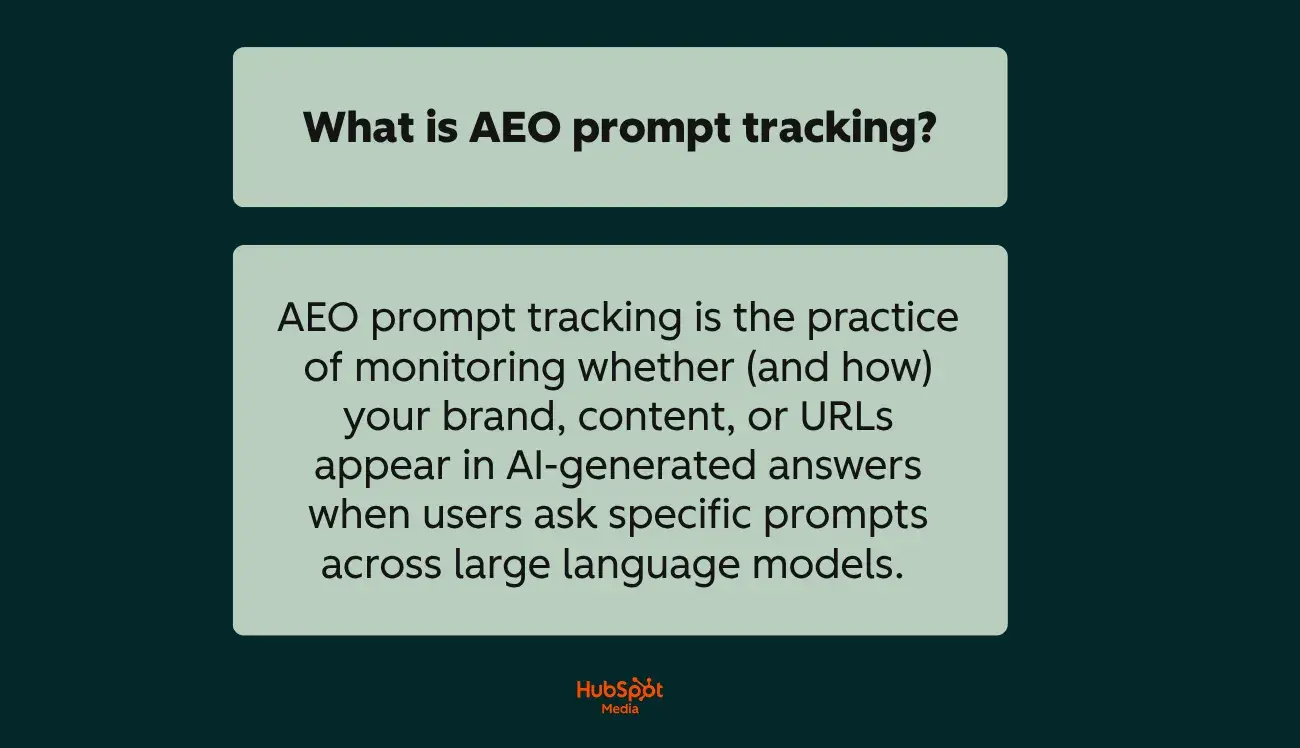
AEO prompt tracking is the systematic practice of monitoring if and how a brand, its content, or specific URLs are referenced or appear in AI-generated responses when users submit specific prompts to large language models (LLMs). This differs significantly from traditional SEO rank tracking, which focuses on a page’s position on a SERP for a given keyword. AEO, conversely, assesses a brand’s inclusion within the AI’s answer itself – whether as a direct citation, a mention, or a recommendation. For instance, while SEO might track a website’s ranking for "best CRM for small businesses," AEO prompt tracking would determine if that brand is cited when an AI is asked, "What’s the best CRM for small businesses?"
This distinction is more critical than it initially appears. SEO rank tracking answers the question, "Where do I rank on a list?" AEO prompt tracking, however, addresses a more fundamental query: "Am I even part of the AI’s conversation?" The underlying shift is from measuring stable URL positions on a search results page to quantifying non-deterministic brand presence within dynamic, AI-generated answers. This means that successful AEO strategies require monitoring across multiple answer engines, as their outputs can vary significantly. Such monitoring involves running a defined library of prompts across platforms like ChatGPT, Perplexity, and Gemini, then tracking the frequency, sentiment, and competitive positioning of brand citations over time.
.png)
Challenges in Operationalizing AI Search Measurement
The rapid evolution of AI search presents significant operational hurdles for marketing teams. The dynamic and often non-deterministic nature of AI outputs makes consistent tracking challenging. Unlike stable SERP rankings, AI answers can vary even for the same prompt, influenced by model updates, real-time data integration, and user context. Furthermore, data fragmentation is a major issue; AI search data often remains siloed, disconnected from broader web analytics and CRM systems, making it difficult to establish clear attribution to leads and revenue. This lack of integrated data impedes a comprehensive understanding of AI search’s true business impact. The nascent state of specialized AEO tools also adds to the complexity, leaving many teams overwhelmed by the choice of platforms and the integration challenges involved in building a cohesive measurement stack. Without a clear framework, AEO efforts often remain experimental, failing to secure sustained budget and executive buy-in.
Key AEO Metrics for Strategic Marketing
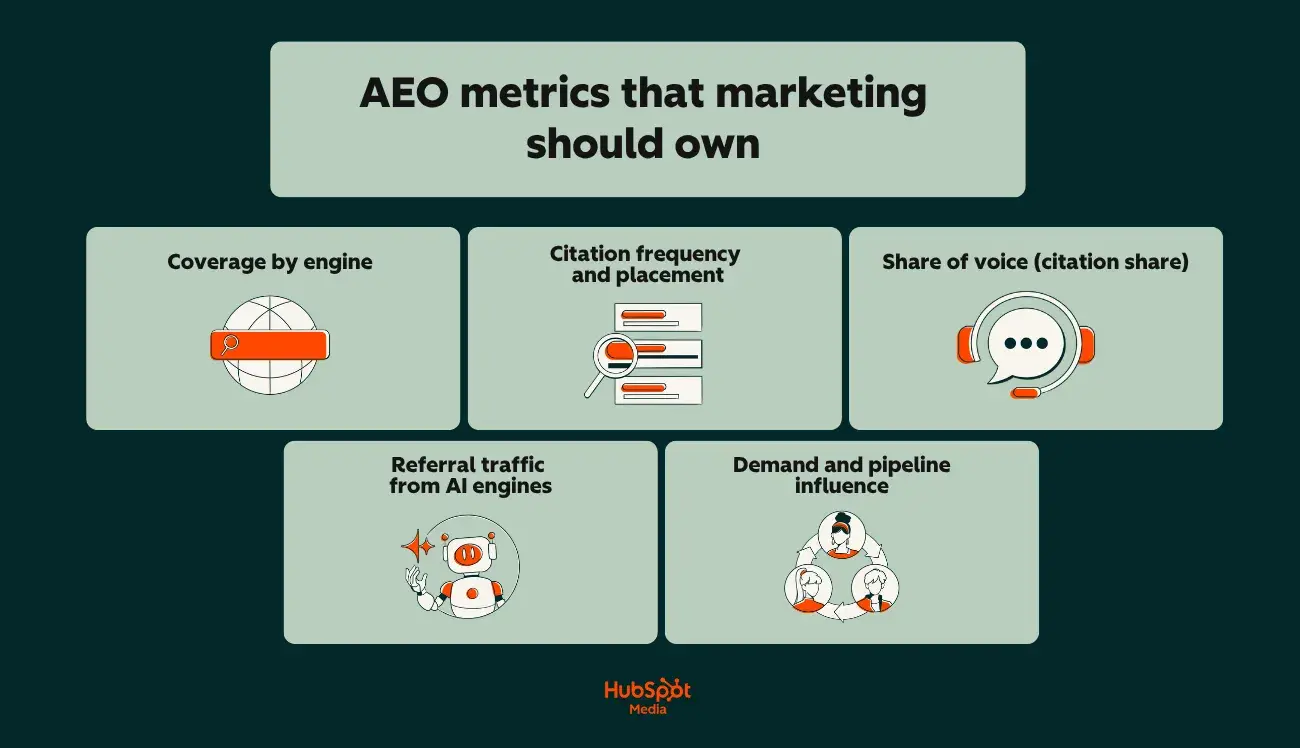
To transform AI search visibility into a measurable and actionable discipline, marketing teams must embrace a new set of key performance indicators (KPIs). These metrics make AI search visibility quantifiable, comparable to competitors, and directly linkable to pipeline and revenue. Every time an answer engine generates a response, it either includes a brand or it doesn’t, and this inclusion can now be systematically tracked and analyzed. The five core AEO metrics marketing should own are:
-
Coverage by Engine: This metric quantifies whether a brand appears in AI answers on each platform independently. Given that answer engines operate differently—e.g., Perplexity’s heavy reliance on web retrieval and source attribution versus Gemini’s potentially more synthesized responses—engine-level breakdowns are crucial. Measuring coverage involves running a prompt library across each engine and logging a binary "yes/no" for brand presence per prompt, per engine. The coverage rate is then the percentage of prompts where the brand appears, calculated for each engine. This prevents critical visibility gaps from being obscured by an average across all platforms.
-
Citation Frequency and Placement: Citation frequency measures the total number of times a brand, domain, or specific URLs are cited across a defined set of prompts. Citation placement, on the other hand, tracks where within the AI answer the citation appears (e.g., first source, supporting mention, or footnote). Both metrics are vital: high frequency indicates broad presence, while prominent placement often correlates with stronger impact and perceived authority. A brand with moderate frequency but consistent first-position placement might have more effective visibility than a competitor cited more often but always buried deep within the response.

-
Share of Voice (Citation Share): As the AEO equivalent of organic share of voice, citation share benchmarks a brand’s appearance in AI answers against its competitors for the same set of prompts. It provides a clear competitive positioning metric. If a brand appears in 35% of tracked responses while a top competitor appears in 52%, this gap becomes a direct strategic input for content investment and competitive differentiation. This metric moves AEO from an internal performance indicator to a competitive intelligence tool.
-
Referral Traffic from Answer Engines: This metric measures the actual clicks and visits directed to a brand’s website from AI-generated answers, linking AEO prompt tracking to traditional web analytics. Attribution remains a challenge as not all answer engines provide clean referral data. While some platforms (like Google AI Overviews and Perplexity) are beginning to pass clearer referral information, others (like ChatGPT) may generate more direct traffic spikes without explicit attribution. Marketing teams are advised to set up dedicated segments in their analytics platforms for known AI referral sources and correlate these with AEO citation changes. A sudden increase in direct visits coinciding with higher AI citation frequency serves as a strong directional signal of influence.
-
Demand and Pipeline Influence: The ultimate goal of AEO prompt tracking is to demonstrate whether AI visibility translates into tangible business outcomes: leads, opportunities, and revenue. This requires a robust connection between AEO data and CRM systems. By integrating prompt visibility data with contact records, lifecycle stages, and deal pipelines, marketing teams can trace the conversion path of AI-sourced traffic. This ensures that AEO impact reports utilize the same attribution logic that informs broader budget decisions, transforming visibility into a revenue conversation. HubSpot’s own marketing team, for example, validated this approach by using AEO methodology to achieve an impressive 1,850% increase in leads before building tools for other businesses.
Building a Robust AEO Prompt Library: The Foundation of Measurement
The efficacy of AEO prompt tracking hinges on the quality and structure of its prompt library. A well-constructed library ensures that the tracking system yields actionable insights, directly linking AI search visibility to content strategy, campaign planning, and pipeline generation. This process involves three critical steps:
-
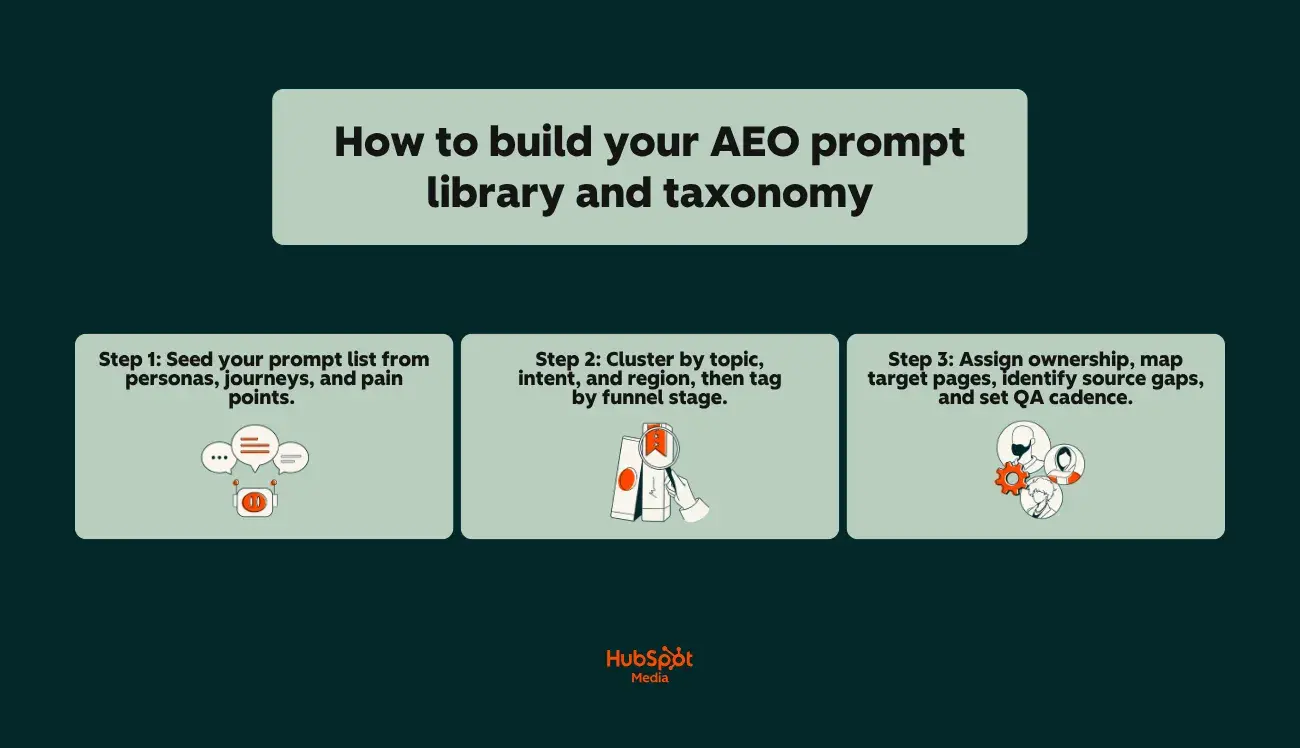
Seed your prompt list from personas, journeys, and pain points: The initial prompts should genuinely reflect how the target audience interacts with answer engines, rather than internal product-centric language. This seeding process draws from buyer personas (e.g., "What does a marketing manager need to know about CRM?"), customer journey stages (e.g., "Best CRM for small business comparison"), and documented pain points (e.g., "CRM integration challenges with email marketing"). Layering in core category terms (e.g., "marketing automation software") ensures comprehensive coverage. A starting library of 100 to 200 prompts is often ideal; fewer may lack statistical significance, while more than 300 can become unwieldy without automation. CRM data can be leveraged to automatically suggest business-context-driven prompts, bypassing the challenge of starting from a blank slate.
-
Cluster by topic, intent, and region, then tag by funnel stage: To transform a flat list of prompts into a structured, queryable system, clustering is essential. Prompts should be grouped by topic (e.g., "CRM features," "Marketing Automation"), user intent (e.g., informational, navigational, commercial, transactional), and region (for geo-specific queries). Subsequently, each prompt must be tagged by its respective funnel stage: awareness (broad questions), consideration (comparison queries), and decision (specific buying questions). This granular tagging enables reporting on AEO visibility by funnel position, allowing marketing teams to quickly answer critical questions like, "Are we visible in AI answers for bottom-of-funnel buying prompts?"
-
Assign ownership, map target pages, identify source gaps, and set QA cadence: To make the prompt library actionable, each entry requires specific metadata: an owner (e.g., content manager), a target page (the optimal URL for citation), documented source gaps (content needed to improve citation), and a status (e.g., active, review, retired). Assigning ownership ensures accountability for improving citations. Identifying source gaps highlights specific content creation or optimization opportunities. A regular QA cadence (e.g., quarterly, with monthly lighter reviews) is the operational heartbeat, involving checks for prompt relevance, new competitor activity, and citation trends. This structured approach prevents the library from becoming static, ensuring it remains a dynamic asset for driving growth.
Integrating AEO Tools for Comprehensive Insight
The expanding landscape of AEO tools necessitates a strategic approach to integration, with a CRM-integrated platform serving as the operational hub. This layered stack ensures each tool plays a defined role, anchoring attribution and reporting.
-
Activate HubSpot AEO as your baseline: Platforms like HubSpot AEO provide prompt-level visibility tracking across major answer engines (e.g., ChatGPT, Gemini, Perplexity) with native CRM integration. This integration eliminates data-stitching overhead, a common pitfall in early AEO programs, by connecting visibility data directly to contact records, lifecycle stages, and deal pipelines. Starting with such a platform allows teams to quickly establish a baseline, understand current citation share, and identify critical content gaps without manual data reconciliation.
-
Layer in a dedicated prompt monitoring platform: For broader engine coverage (e.g., Microsoft Copilot, Google AI Overviews) and high-volume, scheduled prompt monitoring, dedicated AEO monitoring platforms can complement the baseline. These tools often provide deeper analytical capabilities, such as tracking nuanced citation sentiment, identifying emerging prompt trends, and offering more extensive competitive benchmarking. The key is to select platforms that offer structured data exports (CSV or API) with per-prompt, per-engine granularity, allowing for seamless integration with the CRM-integrated hub for comprehensive analysis and reporting.
-
Connect web analytics to capture AI referral traffic: Integrating web analytics platforms (e.g., Google Analytics, HubSpot Analytics) is crucial for translating brand citations into actual website visits. This involves setting up dedicated segments for known AI referral sources and configuring URL parameters to track clicks originating from AI answers. While attribution remains imperfect across all AI engines, correlating spikes in direct traffic with increased AI citation frequency provides valuable directional signals.
-
Wire AEO data into pipeline and attribution reporting: This step transforms AEO from a content performance metric into a revenue conversation. It requires deliberate CRM configuration to link AI search visibility data to leads, opportunities, and ultimately, revenue. This involves creating custom properties in the CRM to log AI citation data, implementing attribution models that account for AI touchpoints, and building custom reports and dashboards that correlate AEO metrics with pipeline movement. This ensures AEO impact reports use the same attribution logic that drives broader marketing budget decisions.
-
Automate monitoring and alerting: Automation is vital for scaling AEO prompt tracking, eliminating the need for manual weekly check-ins. This includes setting up automated alerts for significant changes in citation share (e.g., a competitor gaining ground), citation loss (e.g., a brand disappearing from critical prompts), and traffic threshold triggers (e.g., a surge in AI-attributed traffic). Automated reports summarizing key AEO metrics can be scheduled for marketing leaders, ensuring consistent visibility without operational burden. While automation handles data collection and flagging, human judgment remains essential for strategic decision-making based on these signals.
Strategic Content Optimization: Closing Gaps and Boosting Citations
Translating AEO prompt tracking insights into improved brand visibility requires a strategic approach to content optimization and creation. The gaps identified between target prompt coverage and actual citations represent the highest-leverage content opportunities.
-
Run a trusted-source analysis: Before creating or updating content, conduct an analysis of the URLs, domains, and content types that answer engines consistently cite for a given prompt set. This reveals which sources are currently "winning" citations and why, informing a content strategy that targets formats and characteristics that AI models already trust. This involves manually reviewing AI answers for top prompts, categorizing cited sources by type (e.g., long-form guides, FAQs, industry reports), and identifying common patterns in their structure, authority, and freshness.
-
Build a sourcing plan for high-trust content: Based on the trusted-source analysis, prioritize the creation or optimization of content formats that consistently earn AI citations. This includes comprehensive, long-form guides (often cited for deep expertise), well-structured FAQ sections (directly answering common queries), and definition blocks (providing concise explanations). Prioritization should be based on impact (potential for high citation share and pipeline influence) and feasibility (resources required for creation/optimization). Stack-ranking content gaps by these criteria creates a prioritized editorial backlog directly driven by AEO data.
-
Optimize on-page patterns for answer engine retrieval: Answer engines retrieve and synthesize content differently from traditional search crawlers. Therefore, optimizing on-page patterns specifically for AI retrieval is crucial. This includes structuring content with clear headings (H1, H2, H3), using concise definition blocks at the top of pages, developing comprehensive FAQ sections that directly answer common questions, employing consistent internal linking structures to signal content authority, and implementing schema markup (e.g., FAQ schema, HowTo schema) to explicitly highlight key information for AI extraction. Platforms like HubSpot’s Content Hub provide a centralized system for managing these optimizations at scale, ensuring consistency across a brand’s digital assets.
Overcoming Implementation Hurdles: A Structured Approach
The path to successful AEO prompt tracking is not without its challenges. The dynamic nature of AI, coupled with evolving attribution models and tool fragmentation, can create significant hurdles. However, these can be overcome with a structured and disciplined approach. The key lies in treating AEO not as an experimental sideline but as a core, measurable marketing discipline. This means establishing clear ownership within the marketing team, committing to a consistent monitoring cadence, defining specific target pages for citations, meticulously documenting source gaps, and integrating AEO data directly into existing CRM and attribution frameworks. The brands that are currently gaining citation share are those that have embraced this structured approach, recognizing that early investment in building a robust system will yield compounding data and insights over time.
The Future of AI Search and Brand Visibility
AEO prompt tracking is not merely a fleeting trend; it is a fundamental shift in how brands must approach digital visibility. As AI models become more sophisticated and deeply integrated into daily information consumption, a brand’s presence within AI-generated answers will increasingly dictate its market relevance and competitive advantage. The ability to systematically measure, analyze, and optimize this presence is becoming a non-negotiable requirement for marketing success. While the landscape will continue to evolve, the foundational principles of understanding user prompts, tracking citations across diverse engines, and linking these insights to business outcomes will remain paramount. The organizations that commit to building this structure and discipline now will be best positioned to leverage AI search as a powerful driver of pipeline and revenue, transforming the conversation from speculative interest to quantifiable impact.









