rifanmuazin
Online retailers, who have invested considerable effort in meticulously crafting their product catalogs, now face an emergent challenge: ensuring that artificial intelligence (AI) tools like ChatGPT and Google Gemini accurately represent their offerings to potential customers. The rapid proliferation of large language models (LLMs) has transformed how consumers discover information and products, yet these AI systems often struggle with the dynamic and extensive nature of e-commerce inventories, frequently leading to inaccurate, incomplete, or outdated product descriptions. Addressing this critical gap, Yoast SEO for Shopify has announced the launch of its new llms.txt feature, designed to provide AI tools with a structured and authoritative guide to an online store’s most vital content.
The Emergence of AI in Product Discovery and Its Challenges
The digital landscape has undergone a seismic shift with the widespread adoption of generative AI. Tools capable of understanding and generating human-like text have quickly moved from niche applications to mainstream platforms, impacting everything from customer service to search queries. A significant proportion of online searches now involve natural language questions, where users expect direct, concise answers, often synthesized by AI. For e-commerce, this means that an increasing number of potential customers are encountering product information not directly from a website, but through an AI’s interpretation.
However, the current modus operandi of many AI tools presents inherent limitations for online merchants. Unlike traditional search engine crawlers that systematically index entire websites, LLMs often "graze" for information, quickly extracting data points to formulate responses. This method, while efficient for general information retrieval, is inherently problematic for comprehensive and accurate product representation. When confronted with large, frequently updated catalogs, AI systems can struggle to distinguish critical product details from ancillary content, leading to several detrimental outcomes:
- Inaccurate Descriptions: AI might misinterpret product specifications, features, or benefits, presenting incorrect information to users. A recent study by Gartner indicated that by 2025, 30% of outbound marketing messages from large organizations will be synthetically generated, underscoring the urgency for brands to ensure these generations are accurate.
- Incomplete Information: Important details about a product, its variations, or its availability might be omitted, leaving potential customers with an insufficient understanding. The average e-commerce site can have thousands of SKUs, making it difficult for AI to parse every detail without explicit guidance.
- Outdated Data: Product prices, stock levels, or promotional offers can change rapidly. If an AI tool references outdated cached information, it can lead to customer frustration and missed sales opportunities.
- Misdirected Traffic: In some cases, an AI might inadvertently reference a competitor’s product or an irrelevant page if it cannot definitively identify the authoritative source within a store.
These challenges are particularly acute for Shopify merchants, many of whom manage extensive inventories and rely heavily on precise product information to drive conversions. The ability of AI to "fill in the gaps" often results in a generic or even erroneous narrative that fails to capture the unique selling propositions of a brand’s products, undermining the significant effort put into crafting compelling product pages.
Introducing llms.txt: A Directed Guide for AI
The llms.txt feature developed by Yoast SEO for Shopify serves as a crucial bridge between the complex, dynamic nature of an e-commerce catalog and the information-gathering mechanisms of AI tools. Conceptually similar to the well-established robots.txt file, which guides search engine crawlers on what to index and what to ignore, llms.txt provides explicit instructions to AI systems on which parts of a Shopify store are most relevant and authoritative. It acts as a curated store guide, ensuring that AI prioritizes the most important content rather than making educated guesses.
This innovative file essentially tells AI tools: "Here are our top products, our key collections, our official policies, and our essential brand information. Focus on these." This directive approach is vital for maintaining brand integrity and accuracy in an AI-driven information ecosystem. By providing a clear roadmap, Yoast SEO aims to minimize the risk of AI-generated inaccuracies, incomplete answers, or the unfortunate scenario of misdirecting potential customers.
The implementation of llms.txt is designed for simplicity, requiring minimal technical intervention from merchants. Once activated within the Yoast SEO for Shopify settings, the system handles the automatic creation and regular updating of this critical file. This "set it and forget it" approach is particularly beneficial for small to medium-sized businesses (SMBs) that may lack dedicated SEO or development teams.
Two Operational Modes for Merchant Control
Understanding that different merchants have varying needs for control and customization, Yoast SEO for Shopify offers two distinct ways to manage the llms.txt file:
-
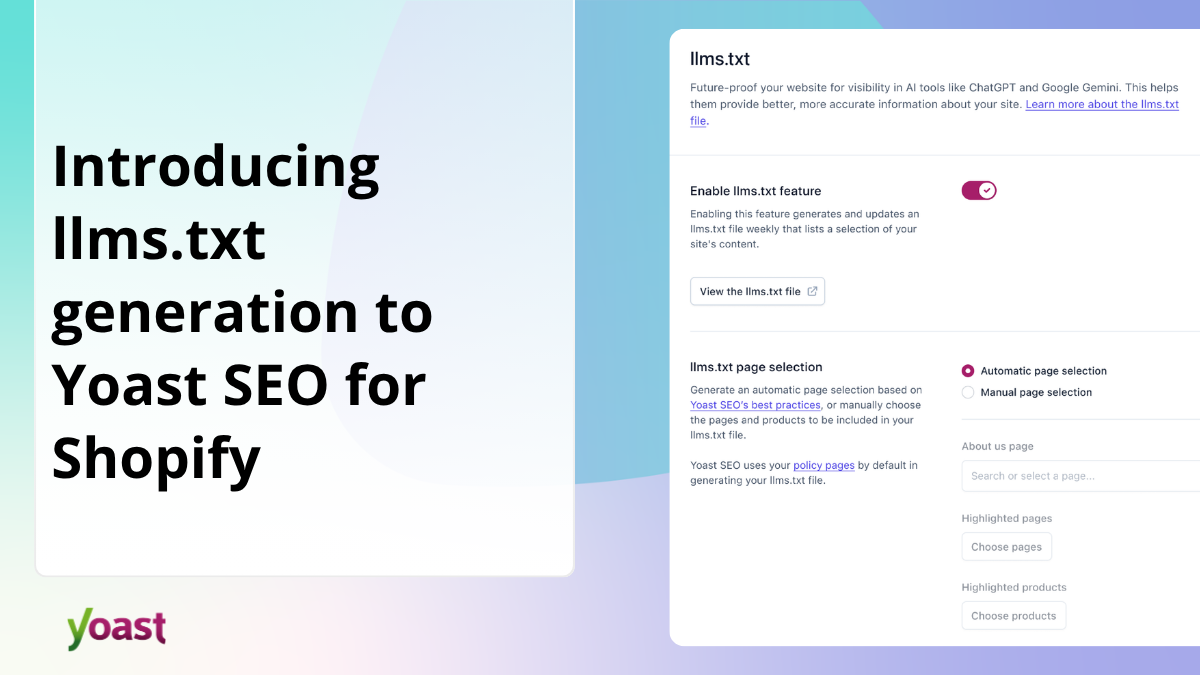
Automatic Management: This is the default and most straightforward option. Upon activation, Yoast SEO automatically builds and updates the llms.txt file on a weekly basis, leveraging the existing Shopify data. This automated process intelligently highlights:
- Best-selling products: Ensuring that high-performing items receive prominent and accurate AI representation. Data from Shopify’s own analytics often shows that a significant portion of revenue comes from a relatively small percentage of top-selling products.
- New arrivals: Quickly bringing fresh inventory to the attention of AI tools, maintaining currency.
- Key collections: Directing AI to important product groupings that define the store’s offerings.
- Policy pages: Providing AI with authoritative information on shipping, returns, privacy, and other crucial customer service aspects, which are increasingly important for consumer trust.
- Top-performing blog posts or guides: If applicable, directing AI to valuable content that supports product understanding or brand narrative.
- Other vital store pages: Ensuring foundational elements of the store are correctly understood.
This automatic mode removes the burden of manual selection, making it an ideal choice for merchants who prefer a hands-off approach while still benefiting from enhanced AI accuracy. The weekly updates ensure that the information provided to AI remains current, reflecting changes in inventory, popularity, and store structure.
-
Manual Selection for Granular Control: For merchants who require more precise control over the information presented to AI, Yoast SEO provides a manual selection option. This mode empowers users to hand-pick specific products, collections, and pages they wish to feature prominently in the llms.txt file. This level of granularity is particularly useful for:
- Highlighting specific campaigns or promotions: Merchants can ensure that AI prioritizes products central to current marketing efforts.
- Showcasing niche or high-margin items: Drawing AI attention to specific items that may not be best-sellers but are strategically important.
- Curating brand narrative: Explicitly including pages that tell the brand’s story, values, or unique manufacturing processes. A dedicated spot is provided for the "About Us" page, allowing merchants to control how their brand’s ethos is communicated to AI and subsequently to potential customers.
Regardless of the chosen method, the llms.txt file is updated weekly, and importantly, it automatically removes deleted products, preventing AI from referencing non-existent items. This dynamic updating mechanism is crucial for maintaining data integrity in fast-paced retail environments.
Seamless Integration and Accessibility
A significant barrier to adopting new SEO or technical features for many e-commerce businesses is the perceived complexity and the need for specialized technical knowledge. Yoast SEO has explicitly addressed this by embedding the llms.txt feature directly into the Yoast SEO for Shopify settings. This means that setting up and managing the feature does not require any code editing, command-line interfaces, or deep understanding of server configurations. Any member of a merchant’s team with access to the Shopify admin panel and Yoast SEO settings can activate and configure it in a matter of seconds.
Furthermore, Yoast SEO has implemented safeguards to ensure compatibility with existing store configurations. If a merchant already has a redirect set up for /llms.txt, the system will respect it and notify the user, preventing any conflicts or breakage. This attention to detail underscores Yoast’s commitment to providing robust, user-friendly solutions that integrate smoothly into established e-commerce operations.
Strategic Implications for E-commerce SEO and Brand Control
The introduction of llms.txt signifies a pivotal shift in the realm of e-commerce SEO, moving beyond traditional keyword optimization to embrace the nuances of AI-driven content discovery. Its implications are far-reaching:
- Enhanced Accuracy and Trust: By guiding AI to authoritative content, merchants can significantly improve the accuracy of product information presented to potential customers. This fosters greater trust and reduces the likelihood of customer dissatisfaction stemming from incorrect expectations. A study by Salesforce indicated that 88% of customers say trust is more important than ever in these changing times.
- Improved Brand Storytelling: The ability to explicitly include "About Us" pages and other brand-centric content allows merchants to control the narrative that AI presents, ensuring that the brand’s unique identity and values are accurately conveyed. This is crucial in a competitive market where brand differentiation is key.
- Optimized Product Discovery: As AI plays a larger role in how people find products online, ensuring that AI tools have access to the most relevant and up-to-date product information becomes a competitive advantage. This can lead to more qualified leads and higher conversion rates. According to Adobe Analytics, e-commerce sales continue to grow globally, making optimized discovery more vital than ever.
- Future-Proofing SEO Strategies: The digital marketing landscape is constantly evolving. Tools like llms.txt help merchants adapt their SEO strategies to the emerging realities of AI-powered search and product recommendations, ensuring their online presence remains robust and effective. It represents a proactive step in what many are calling "AI SEO," where optimizing for LLMs becomes as important as optimizing for traditional search engines.
- Empowering Merchants: Yoast’s decision to make this feature opt-in underscores its philosophy of empowering merchants with control over their digital presence. In an era where data usage by AI is a significant concern, giving businesses the choice to dictate how their content is consumed by LLMs is a welcome development. This aligns with broader industry trends towards greater data privacy and user control.
The timeline for the emergence of such a feature is directly tied to the rapid ascent of generative AI. While LLMs began making significant public inroads in late 2022 and early 2023, the subsequent year has seen their integration into various platforms, including search engines. The challenges posed by AI’s "hallucinations" and information inaccuracies quickly became apparent, prompting SEO and e-commerce solution providers like Yoast to innovate. The development of llms.txt is a direct response to this evolving digital ecosystem, providing a necessary layer of control for businesses navigating the new complexities of AI-driven information dissemination.
Yoast’s Stance and the Path Forward
Beth Parker, Product Marketing Manager at Yoast, emphasizes the company’s commitment to empowering merchants: "We believe every merchant should have a say in how their content is seen and used as AI plays a bigger role in how people discover products online. That’s why this feature is opt-in." This statement highlights Yoast’s understanding of the importance of merchant autonomy in the age of AI. The company positions llms.txt not just as a technical solution, but as a strategic tool for maintaining brand integrity and optimizing online visibility in a dynamically changing digital environment.
For Shopify merchants, activating the llms.txt toggle in Yoast SEO for Shopify represents a straightforward yet powerful step towards future-proofing their online presence. By taking control of how AI interprets and presents their product catalogs, businesses can ensure that their hard-earned efforts in product development and content creation are accurately reflected in the burgeoning world of AI-driven product discovery. As consumers increasingly rely on AI for information, tools like llms.txt will become indispensable for maintaining a competitive edge and fostering trust in the digital marketplace.