
Commercial email marketing stands as an unparalleled digital marketing channel, consistently delivering a remarkable return on investment, often ranging from $10 to $36 for every dollar spent. This impressive figure, highlighted by industry analyses from sources like Litmus and the Data & Marketing Association (DMA), underscores email’s enduring power as a direct line to consumers. However, achieving this coveted ROI is not a given; it hinges on navigating a complex landscape fraught with challenges, from the ever-present threat of spam folders to the technical intricacies of ensuring emails render perfectly across diverse devices and dark mode environments.
This article delves into the core tenets of commercial email, clarifying its definition, distinguishing it from transactional communications, and exploring the various types that drive specific business outcomes. Crucially, it outlines the critical technical and strategic best practices that separate high-performing campaigns from those that falter, ensuring messages not only reach the inbox but also engage and convert.
Defining Commercial Email: A Legal and Strategic Imperative
At its heart, commercial email refers to any electronic message whose primary purpose is to advertise or promote a product, service, or commercial content. This definition is not merely marketing jargon but a fundamental legal distinction, particularly under the Federal Trade Commission’s (FTC) CAN-SPAM Act in the United States, which serves as the foundational regulatory framework for commercial email. Adherence to this legal standard is paramount for maintaining sender reputation and avoiding hefty penalties.
The CAN-SPAM Act: Foundation of Compliance
Enacted in 2003, the CAN-SPAM Act establishes national standards for the sending of commercial email, granting recipients the right to have businesses stop emailing them. Its core requirements include:
- No false or misleading header information: The “From,” “To,” “Reply-To,” and routing information must be accurate.
- No deceptive subject lines: The subject line must accurately reflect the content of the message.
- Identify the message as an advertisement: While not always required to explicitly state “advertisement,” it must be clear it is commercial content.
- Include a physical postal address: Senders must include their valid physical postal address.
- Provide a clear and conspicuous way to opt out: An unsubscribe link must be present and easy to use.
- Honor opt-out requests promptly: Businesses must process unsubscribe requests within 10 business days.
Failure to comply can result in significant fines, underscoring the necessity of understanding and strictly adhering to these regulations.
Commercial vs. Transactional: Clarifying the Crucial Distinction
A common point of confusion arises between commercial and transactional emails. While both are sent by businesses, their primary purposes differ significantly, impacting legal obligations and deliverability.
- Commercial Emails: As discussed, these messages are promotional in nature, designed to market products, services, or content to drive sales or engagement. Examples include newsletters, promotional offers, new product announcements, and sales event invitations.
- Transactional Emails: These communications facilitate an agreed-upon transaction or update an existing customer relationship. They are typically triggered by a user action and contain essential information directly related to that action. Examples include order confirmations, shipping notifications, password reset requests, account statements, support ticket updates, and legal notices.
The distinction is critical because transactional emails often have different legal requirements (e.g., they might be exempt from certain unsubscribe rules under CAN-SPAM if they contain only transactional information) and generally enjoy higher deliverability rates due to their expected nature and direct relevance to the recipient. Mailbox providers are less likely to flag transactional emails as spam because they are typically anticipated and contain crucial user-requested information.
Navigating the Hybrid Zone: The Primary Purpose Test
Some emails inherently blend commercial and transactional elements. Consider a receipt email that also includes a promotional coupon for a future purchase. In such “hybrid” scenarios, the FTC applies the “primary purpose test.” If the main goal of the email is to confirm a purchase or provide essential information about an ongoing transaction, it is classified as transactional, even if it contains a minor promotional element. However, if the promotional aspect becomes dominant, clearly aiming to drive another sale or upsell, the email falls under the commercial category and must adhere to all associated regulations. Marketers must exercise caution and clarity in such cases to avoid misclassification and potential compliance issues.
The Evolution of Email Marketing: A Brief Chronology
The journey of commercial email is a testament to its adaptability and enduring relevance in a rapidly changing digital landscape.

- 1978: The “birth” of email marketing is often attributed to Gary Thuerk, a marketing manager at Digital Equipment Corp., who sent the first mass unsolicited commercial email (spam) to about 400 ARPANET users, resulting in $13 million in sales.
- Early 1990s: As the internet became more public, email lists and rudimentary email software emerged, allowing businesses to send messages to subscribers.
- 2000s: The proliferation of spam led to the development of anti-spam technologies and, crucially, legislative action. The CAN-SPAM Act (2003) in the U.S. and similar regulations globally aimed to curb unsolicited email and protect consumer rights. This era also saw the rise of Email Service Providers (ESPs) offering more sophisticated tools for list management, segmentation, and analytics.
- 22010s: The mobile revolution profoundly impacted email. Responsive design became imperative as more users accessed emails on smartphones. Personalization capabilities advanced significantly, moving beyond simple name insertions to behavioral targeting. Dark mode, initially a niche feature, began gaining traction, posing new design challenges.
- Late 2010s – Present: Data privacy became a global concern, leading to landmark legislation like the General Data Protection Regulation (GDPR) in Europe (2018) and the California Consumer Privacy Act (CCPA) in the U.S. (2020). These laws imposed stricter requirements on consent, data handling, and transparency, further shaping email marketing practices. Mailbox providers (MBPs) like Gmail and Yahoo continually refine their filtering algorithms, emphasizing sender reputation, authentication, and engagement metrics, making deliverability an increasingly complex technical challenge. Artificial intelligence (AI) and machine learning (ML) began to influence personalization, automation, and predictive analytics in email marketing.
Types of Commercial Emails: Driving Diverse Business Outcomes
Effective commercial email marketing isn’t a one-size-fits-all endeavor. Savvy marketers leverage different types of emails to achieve specific strategic goals, each requiring a tailored approach to content, design, and timing.
-
Promotional Blasts: The Instant Impact: These emails are designed for immediate action, often featuring sales, discounts, new product announcements, or seasonal offers. They are the “sprint runners” of email marketing, built for speed and direct conversion.
- Examples: Flash sales, holiday promotions (e.g., Black Friday), limited-time offers, product launch announcements with immediate purchase options.
- Strategic Purpose: Drive quick sales, clear inventory, generate excitement around new offerings, boost engagement during peak shopping periods.
- Key Considerations: Clear call-to-action (CTA), strong sense of urgency, compelling visuals, A/B testing subject lines and offers.
-
Newsletters: Cultivating Long-Term Relationships: Unlike the rapid pace of promotional blasts, newsletters are the “marathon runners.” They focus on building sustained engagement and brand loyalty by delivering valuable content over time.
- Examples: Industry news roundups, blog post summaries, expert tips, company updates, curated content relevant to subscriber interests.
- Strategic Purpose: Establish thought leadership, nurture leads, drive traffic to owned content (blog, website), foster community, keep the brand top-of-mind.
- Key Considerations: Consistent publishing schedule, diverse content mix, balance between informational and soft-promotional elements, clear value proposition.
-
Retention and Re-engagement Campaigns: Winning Back Valued Subscribers: These emails are the “comeback specialists,” designed to reconnect with subscribers who have become inactive or to strengthen relationships with existing customers.
- Examples: Win-back series for lapsed subscribers, loyalty program updates, exclusive offers for long-term customers, personalized recommendations based on past purchases, feedback requests.
- Strategic Purpose: Reduce churn, increase customer lifetime value (CLTV), reactivate dormant accounts, gather insights for product/service improvement.
- Key Considerations: Segmentation based on inactivity levels, compelling incentives, clear value proposition for returning, empathy in messaging.
-
Product Launches and Updates: Announcing Innovation: These emails serve as the “starting pistol” for new offerings or significant enhancements, generating anticipation and driving initial adoption.
- Examples: Pre-order announcements, beta program invitations, detailed feature breakdowns for new software versions, event invitations for product reveals.
- Strategic Purpose: Build hype, educate the audience about new features/benefits, drive early adoption, collect feedback, differentiate from competitors.
- Key Considerations: Staggered communication (teaser, announcement, follow-up), rich media (videos, GIFs), clear explanation of value, strong call to action for learning more or purchasing.
The Pillars of High-Performance Commercial Email: Five Essential Best Practices
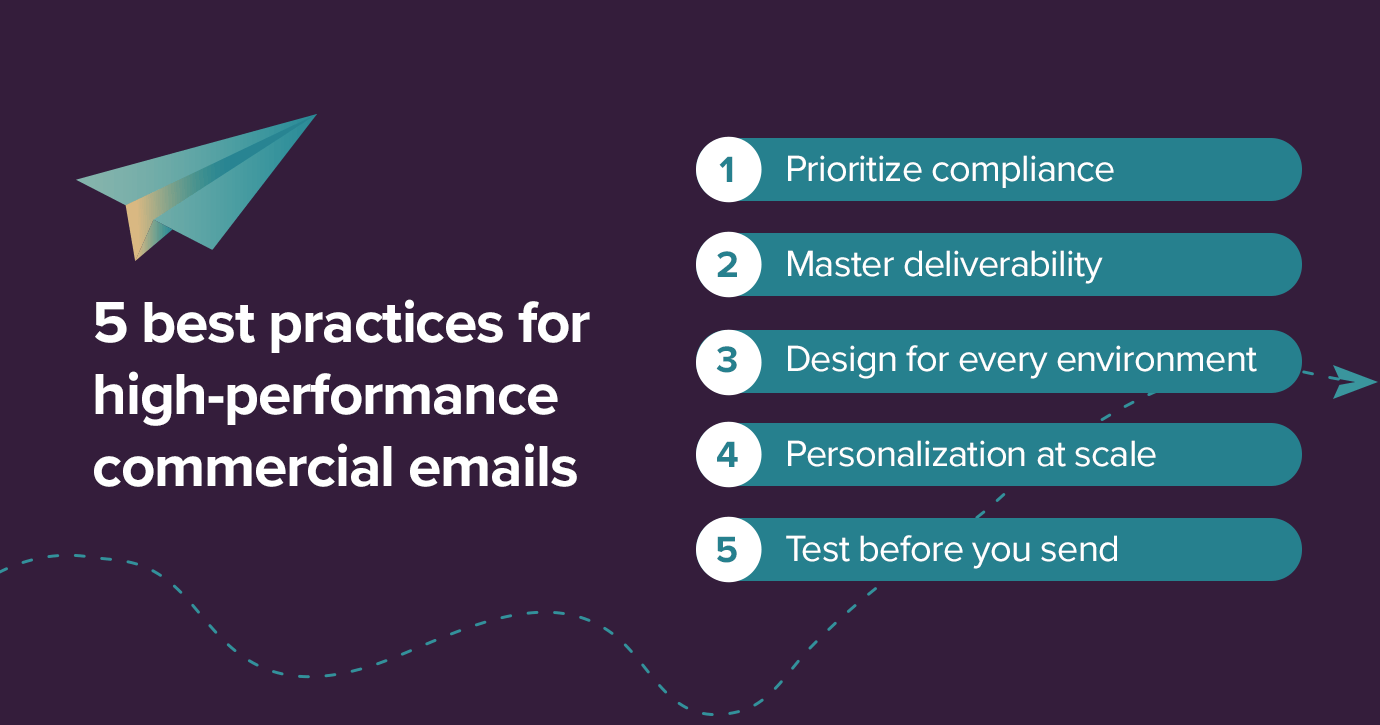
Strategy sets the stage, but meticulous execution determines success. These five best practices are non-negotiable for maximizing the impact of commercial email campaigns.
1. Prioritizing Regulatory Compliance: Beyond CAN-SPAM
While CAN-SPAM forms the bedrock, a truly compliant email strategy extends globally. Regulations like Europe’s GDPR and California’s CCPA introduce even more stringent requirements regarding consent, data processing, and individual rights.
- Explicit Consent: Under GDPR, obtaining explicit, affirmative consent from subscribers before sending commercial emails is crucial. This means no pre-checked boxes or inferred consent.
- Data Privacy: Compliance also mandates transparent data handling, informing subscribers how their data is collected, used, and protected, and providing mechanisms for them to access, rectify, or erase their personal information.
- Global Reach: For businesses operating internationally, understanding and adhering to the strictest applicable regulations across all target markets is vital.
- Unsubscribe Mechanisms: Every commercial email must feature a prominent, easy-to-use, one-click unsubscribe link, and opt-out requests must be processed swiftly, typically within 10 business days as per CAN-SPAM, but often immediately by best practice.
- Transparent Identity: The “from” name and subject line must accurately reflect the sender and content, preventing deceptive practices that erode trust and invite spam complaints.
Non-compliance can lead to severe financial penalties (e.g., millions under GDPR), irreparable damage to sender reputation, and blacklisting by internet service providers (ISPs), effectively shutting down email marketing efforts. Compliance isn’t just a legal obligation; it’s a fundamental trust-building exercise with subscribers and a signal to MBPs that you are a legitimate sender.
2. Mastering Email Deliverability: The Gateway to the Inbox
Deliverability refers to the ability of an email to successfully reach a subscriber’s inbox, bypassing spam folders and blocks. It is influenced by a sender’s reputation, a dynamic score assigned by MBPs based on various signals.
- Technical Authentication: This is table stakes. Implementing SPF (Sender Policy Framework), DKIM (DomainKeys Identified Mail), and DMARC (Domain-based Message Authentication, Reporting & Conformance) is essential. These protocols verify that an email originates from the claimed sender, protecting against spoofing and phishing. Recent mandates from major providers like Gmail and Yahoo now require DMARC enforcement for bulk senders, making this non-negotiable. BIMI (Brand Indicators for Message Identification) can further enhance trust by displaying a brand logo next to the sender’s name in supporting inboxes.
- Sender Reputation: MBPs constantly monitor a sender’s reputation based on:
- Engagement Metrics: High open rates, click-through rates, and replies signal that recipients value your content. Conversely, low engagement, combined with high delete rates without opening, can damage reputation.
- Complaint Rates: Every spam complaint is a significant negative signal. Keeping complaint rates below 0.1% is crucial. High complaint rates often point to issues with list acquisition (e.g., buying lists), irrelevant content, or excessive sending frequency.
- Bounce Rates: Hard bounces (permanent delivery failures) indicate invalid email addresses. High bounce rates suggest poor list hygiene.
- Spam Trap Hits: Emails sent to spam traps (addresses used by ISPs to identify spammers) are catastrophic for sender reputation.
- List Hygiene: Regularly cleaning email lists to remove inactive subscribers, hard bounces, and known spam traps is paramount. Validating email addresses at the point of signup and periodically thereafter helps maintain a healthy list. Suppressing unengaged subscribers (those who haven’t opened or clicked in 6-12 months) rather than continually mailing them prevents negative engagement signals.
- Sending Consistency and IP Warming: Sudden, drastic increases in email volume from a new or dormant IP address can trigger spam filters. Gradual “IP warming” by sending increasing volumes over time allows MBPs to build a positive reputation for the sender. Consistent sending patterns are also preferred.
- Dedicated IPs/Subdomains: For organizations sending both commercial and transactional emails, using separate subdomains or dedicated IP addresses for each type is a critical best practice. This compartmentalizes sender reputation, ensuring that a dip in commercial email deliverability (e.g., due to a poorly received promotional campaign) does not impact the critical delivery of transactional messages like order confirmations or password resets.
3. Designing for Universal Access: Dark Mode and Mobile First
The modern email environment demands a versatile design approach. Emails must render flawlessly across an ever-growing array of devices, screen sizes, and user preferences, including the widespread adoption of dark mode.
- Dark Mode Optimization: Dark mode presents unique challenges, as email clients invert colors, which can make dark text on dark backgrounds invisible, or cause transparent logos to disappear. Implementing specific CSS techniques (e.g.,
@media (prefers-color-scheme: dark)) and providing separate assets for dark mode ensures brand consistency and readability. Thorough testing is vital to verify that all elements, from text to images and logos, are visible and aesthetically pleasing in both light and dark environments. - Mobile Responsiveness: With a significant portion of emails opened on mobile devices (often exceeding 50%), a mobile-first design philosophy is non-negotiable. This involves:
- Single-column layouts: Simplifies reading on small screens.
- Large, readable fonts: Ensuring text is legible without pinching or zooming.
- Thumb-friendly CTAs: Buttons should be at least 44×44 pixels to be easily tappable.
- Optimized images: Resized and compressed for fast loading on mobile data connections.
- Accessibility: Designing for accessibility benefits all users. This includes using sufficient color contrast, providing alt text for images, and structuring content logically for screen readers.
The ultimate goal is a consistent and positive user experience, regardless of how or where an email is viewed. An email that looks perfect on a desktop in light mode but is broken on a mobile device in dark mode is a missed opportunity and a potential source of subscriber frustration.
4. Personalization at Scale: Beyond Just a Name
Basic “Hi [Name]” personalization is a relic of the past. Modern commercial email thrives on dynamic, hyper-relevant content that anticipates subscriber needs and preferences.
- Advanced Segmentation: Move beyond demographic data to segment audiences based on behavioral triggers, purchase history, browsing patterns, engagement levels, lifecycle stage, and expressed preferences. For example, segmenting by “high-value recent purchasers” versus “browsers of specific product categories.”
- Dynamic Content Blocks: Leverage email platforms to swap out entire content blocks—product recommendations, images, calls-to-action—based on individual subscriber data. A customer who recently bought running shoes could receive content about running accessories, while another who viewed hiking gear sees related promotions.
- Behavioral Triggers: Implement automated email flows based on specific user actions or inactions. Examples include cart abandonment emails, post-purchase follow-ups, welcome series for new subscribers, and re-engagement campaigns for inactive users.
- AI-Driven Recommendations: Increasingly, AI and machine learning are used to analyze vast amounts of data to provide highly accurate, individualized product or content recommendations, optimizing send times, and even suggesting subject lines.
- Lifecycle Marketing: Tailor content to where the customer is in their journey with your brand, moving them from awareness to consideration, purchase, and loyalty through a series of relevant emails.
The key is to start simple—perhaps with behavioral triggers like cart abandonment—and gradually scale up to more sophisticated, data-driven personalization. Even modest improvements in relevance can significantly boost open rates, click-through rates, and conversion rates, as subscribers are more likely to engage with content that feels directly relevant to them.
5. Rigorous Pre-Send Testing: Eliminating Critical Errors
The complexity of modern email clients, devices, and operating systems means that what looks perfect in an email builder can be disastrous in a subscriber’s inbox. The risk of broken links, rendering inconsistencies, and formatting errors across dozens of email environments is high.
- Client Compatibility: Emails must be tested across a wide array of email clients (Gmail, Outlook, Apple Mail, Yahoo Mail), webmail interfaces, and mobile devices (iOS, Android). Each client interprets HTML and CSS differently, leading to potential rendering issues.
- Dark Mode Validation: As previously mentioned, specific testing for dark mode is essential to ensure readability and visual integrity.
- Link Validation: All hyperlinks must be functional and point to the correct destinations. Broken links are a major source of frustration and distrust.
- Subject Line and Preheader Text Optimization: Test how subject lines and preheader text appear across different clients, ensuring they are compelling and not truncated, and also checking for potential spam filter triggers within the text.
- Spam Filter Checks: Utilize tools that analyze email content against common spam filter criteria to identify and rectify issues before sending.
- Call-to-Action (CTA) Functionality: Verify that CTAs are clickable and clearly visible on all devices and within various email clients.
- A/B Testing: Beyond error checking, A/B testing different subject lines, content blocks, CTAs, and even send times can provide invaluable insights into what resonates best with your audience, leading to continuous optimization.
Specialized email testing platforms, such as Litmus, provide invaluable capabilities to preview emails across 90+ clients and devices, catch dark mode failures, validate links, and check against spam filters, turning a potential nightmare into a systematic quality assurance process. This proactive approach safeguards brand credibility and ensures that every carefully crafted commercial email delivers its intended impact.
The Broader Implications: Brand Trust, Revenue, and the Future of Email
The effective execution of commercial email campaigns has far-reaching implications beyond immediate sales.
- Impact on Customer Lifetime Value (CLTV): Well-executed, personalized, and compliant email marketing fosters loyalty and repeat business, significantly increasing the long-term value of each customer. Conversely, spammy or irrelevant emails erode trust and drive customers away.
- Brand Reputation: Consistent delivery of valuable, well-designed, and relevant emails enhances brand perception. It positions the brand as professional, attentive, and reliable.
- Data Privacy as a Competitive Advantage: In an era of heightened privacy concerns, brands that visibly prioritize data protection and transparency through their email practices can build deeper trust and differentiate themselves from competitors.
- Emerging Trends: AI and Interactive Emails: The future of commercial email is likely to see even greater integration of AI for hyper-personalization, predictive analytics, and automated content generation. Interactive emails, allowing users to take actions directly within the inbox (e.g., browse products, fill out forms), are also gaining traction, promising even richer engagement experiences.
Conclusion: Championing the Inbox for Sustainable Growth
Commercial email remains a titan in the digital marketing arena, offering an unparalleled ROI when wielded with precision and expertise. The journey from campaign conception to inbox success is multifaceted, demanding a keen understanding of legal compliance, a relentless pursuit of deliverability, an unwavering commitment to universal design, the strategic application of personalization, and an absolute dedication to rigorous pre-send testing.
The distinction between commercial and transactional emails is not merely academic; it is a critical differentiator for legal compliance and deliverability. The various types of commercial emails, from promotional sprints to relationship-building marathons, each serve a unique purpose in a holistic marketing strategy.
In a crowded digital landscape, where attention is a precious commodity, mastering the art and science of commercial email is no longer optional—it is essential for sustainable business growth. By embracing these best practices, marketers can transform their email programs from potential spam-folder casualties into inbox champions, consistently driving that coveted high ROI and building lasting customer relationships. It’s time to lace up those campaign shoes and sprint toward inbox success, ensuring every message not only arrives but thrives.