rifanmuazin
The digital marketing landscape has reached a significant milestone with the integration of generative artificial intelligence and behavioral analytics. Crazy Egg, a pioneer in heatmapping technology, has announced a substantial update to its platform, allowing users to export heatmap data in an AI-optimized format that now includes comprehensive conversion metrics. This development enables marketers and data analysts to bridge the gap between visual user behavior and bottom-line business results by leveraging the processing power of Large Language Models (LLMs) such as ChatGPT, Claude, and Gemini.
The Technological Shift in User Experience Analytics
For over a decade, heatmaps have served as a cornerstone of user experience (UX) design and conversion rate optimization (CRO). By providing a visual representation of where users click, scroll, and hover, these tools have allowed businesses to move beyond the abstract numbers found in traditional analytics suites. However, the interpretation of these visual maps has historically remained a manual task. Analysts would spend hours cross-referencing heatmap snapshots with conversion reports to hypothesize why certain elements were failing to perform.
The introduction of AI-ready JSON exports represents a fundamental shift in this workflow. By converting visual interactions into structured data, Crazy Egg is facilitating a transition from manual observation to automated insight. The inclusion of conversion data within these exports allows AI tools to perform multi-variable analysis, identifying correlations between specific mouse movements and successful transaction completions that might be invisible to the human eye.
Chronology of Analytical Innovation
To understand the significance of this update, it is necessary to view the evolution of web analytics through several distinct eras:
- The Log File Era (Late 1990s): Analytics were limited to server-side logs, showing hits and page views with little context regarding user intent.
- The Tagging and Visual Era (2000s – 2010s): Tools like Crazy Egg introduced the "Confetti" and "Heatmap" views, allowing marketers to see the "why" behind the "what." This period focused on visual intuition.
- The Big Data Era (2010s – 2020s): Organizations began collecting massive amounts of event-based data, but the sheer volume often led to "analysis paralysis."
- The Augmented Analytics Era (2023 – Present): The current era is defined by the use of AI to process structured data. Crazy Egg’s latest update fits squarely within this trend, transforming raw behavioral data into a narrative that AI can interpret.
The decision to include conversion data in AI exports follows a series of incremental updates aimed at making behavioral data more actionable. Earlier iterations of the export tool focused primarily on click coordinates; the latest version integrates the "Conversions" feature, which tracks specific goals such as form submissions, button clicks for "Add to Cart," and completed purchases.
Technical Specifications of AI-Ready Exports
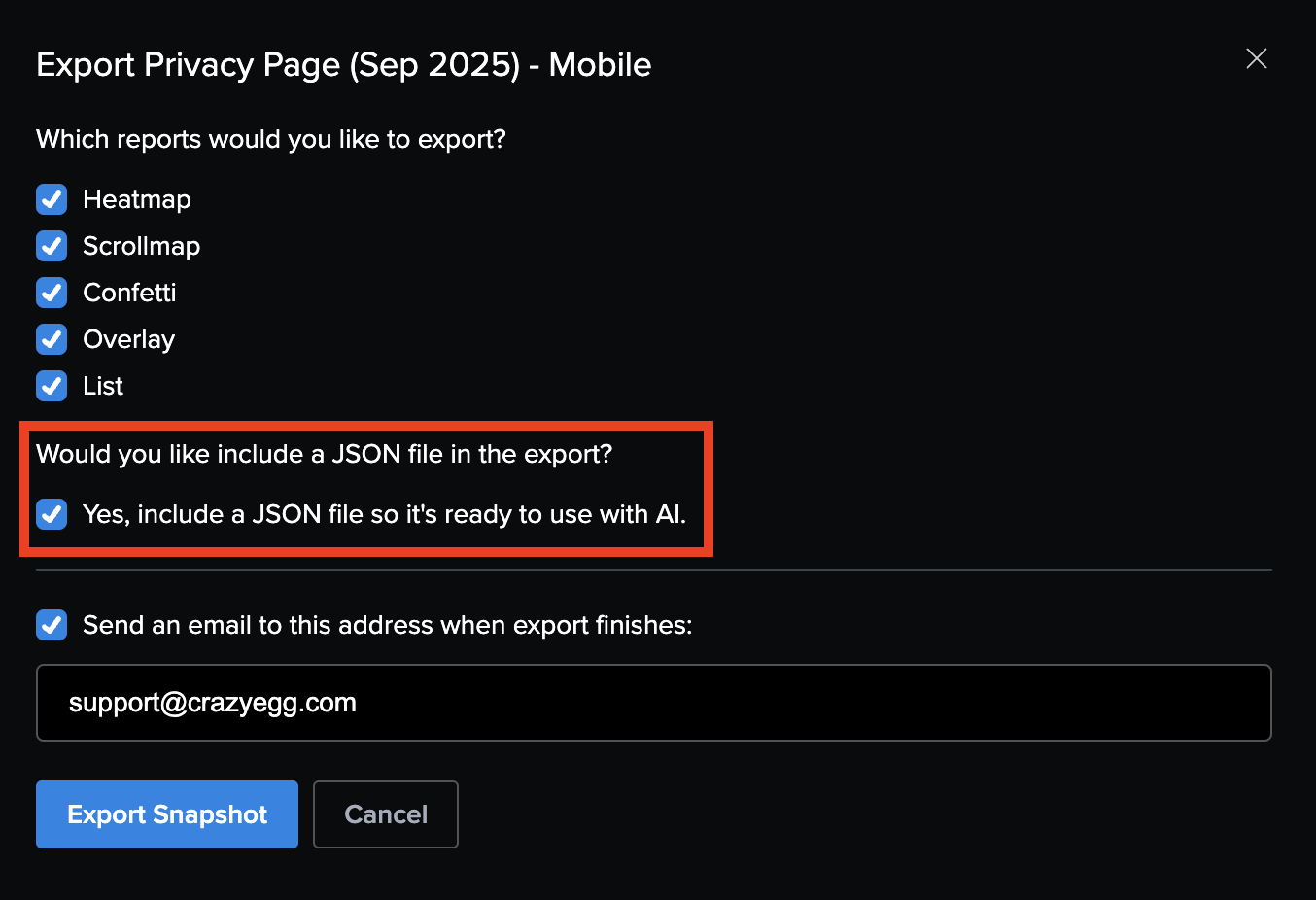
The mechanism for this new feature involves the generation of a JSON (JavaScript Object Notation) file. Unlike standard CSV files or static image exports, JSON provides a nested structure that is highly legible for machine learning algorithms. When a user selects the "Export to AI" option within the Crazy Egg interface, the system packages several layers of data:
- Interaction Coordinates: Precise locations of clicks and hovers relative to page elements.
- Scroll Depth Metrics: Data points indicating where the majority of users lose interest.
- Conversion Event Markers: Metadata identifying which specific interactions led to a predefined conversion goal.
- Element Identification: Information about the HTML elements being interacted with, allowing the AI to understand if a user is clicking a text link, an image, or a CTA button.
By uploading this file to an AI tool, users can bypass the need for custom data engineering. The AI can then be prompted to "Identify the top three friction points preventing mobile users from reaching the checkout button" or "Compare the behavior of converting users versus non-converting users on the landing page."
Implications for Conversion Rate Optimization (CRO)
The integration of AI into the CRO process addresses one of the most significant bottlenecks in digital marketing: the hypothesis generation phase. In a traditional CRO cycle, an analyst must first identify a problem, then research potential causes, and finally design a test. This research phase is often the most time-consuming.
With AI-enhanced heatmap data, the "Research" and "Hypothesis" phases are dramatically accelerated. Industry data suggests that companies using AI in their marketing stacks see a significant reduction in the time required to launch A/B tests. By providing the AI with conversion-linked heatmap data, marketers can receive suggestions for page variations that are grounded in actual user behavior patterns.
For instance, an AI might notice that users who eventually convert tend to hover over a specific testimonial for several seconds, while those who bounce never scroll far enough to see it. The AI can then recommend moving that testimonial higher on the page—a data-driven hypothesis ready for A/B testing.
Industry Reactions and Market Context
While Crazy Egg has not released specific internal statements regarding the competitive landscape, industry analysts note that this move places the company at the forefront of the "Low-Code/No-Code" AI movement. By making data "AI-ready" out of the box, the platform lowers the barrier to entry for small to medium-sized enterprises (SMEs) that may not have dedicated data science teams.
Growth marketing experts have reacted positively to the development. Stephen Ngo, Director of Growth Marketing at Crazy Egg, highlighted that the tool allows users to go beyond "surface-level activity." The consensus among digital strategists is that as privacy regulations like GDPR and CCPA make third-party tracking more difficult, first-party behavioral data (like that collected by heatmaps) becomes increasingly valuable. The ability to analyze this first-party data with AI provides a competitive advantage in understanding the customer journey.
Strategic Implementation for Organizations
To effectively utilize this new capability, organizations are encouraged to follow a structured workflow. The process begins with the definition of clear conversion goals within the Crazy Egg dashboard. Once these goals are established and data has been collected, the export can be performed via the "Export" menu located under the three-dot icon in any Heatmap report.

The requirement for a Pro or Enterprise plan suggests that Crazy Egg is targeting professional marketing teams and agencies that manage high-traffic sites where manual analysis is no longer feasible. For these users, the AI export serves as a force multiplier, allowing a single analyst to oversee dozens of pages with the same level of depth previously reserved for a single high-priority landing page.
Broader Impact on the Analytics Ecosystem
The shift toward AI-compatible data formats is likely to trigger a ripple effect across the MarTech (Marketing Technology) industry. As more tools adopt "AI-ready" standards, the interoperability between different software suites will improve. We are moving toward an ecosystem where the value of a tool is measured not just by the data it collects, but by how easily that data can be consumed by external intelligence tools.
Furthermore, this development touches upon the growing field of "Predictive UX." By analyzing past conversion data through AI, companies can begin to predict which design changes will have the highest probability of success before a single line of code is changed. This reduces the "waste" associated with failed A/B tests and allows for a more efficient allocation of design and development resources.
Conclusion and Future Outlook
The ability to analyze conversion data from heatmaps in any AI tool is more than a simple feature update; it is a redefinition of the relationship between marketers and their data. By providing the "missing link" between behavior and conversion in a format designed for machine intelligence, Crazy Egg is enabling a more scientific and automated approach to website optimization.
As AI models continue to evolve in their ability to process complex data structures, the depth of insights derived from these exports will only increase. For now, the focus remains on empowering marketers to identify CRO opportunities with unprecedented speed and accuracy. The future of web analytics is no longer just about seeing what users do; it is about using artificial intelligence to understand why they do it and how to influence their journey toward a conversion.