rifanmuazin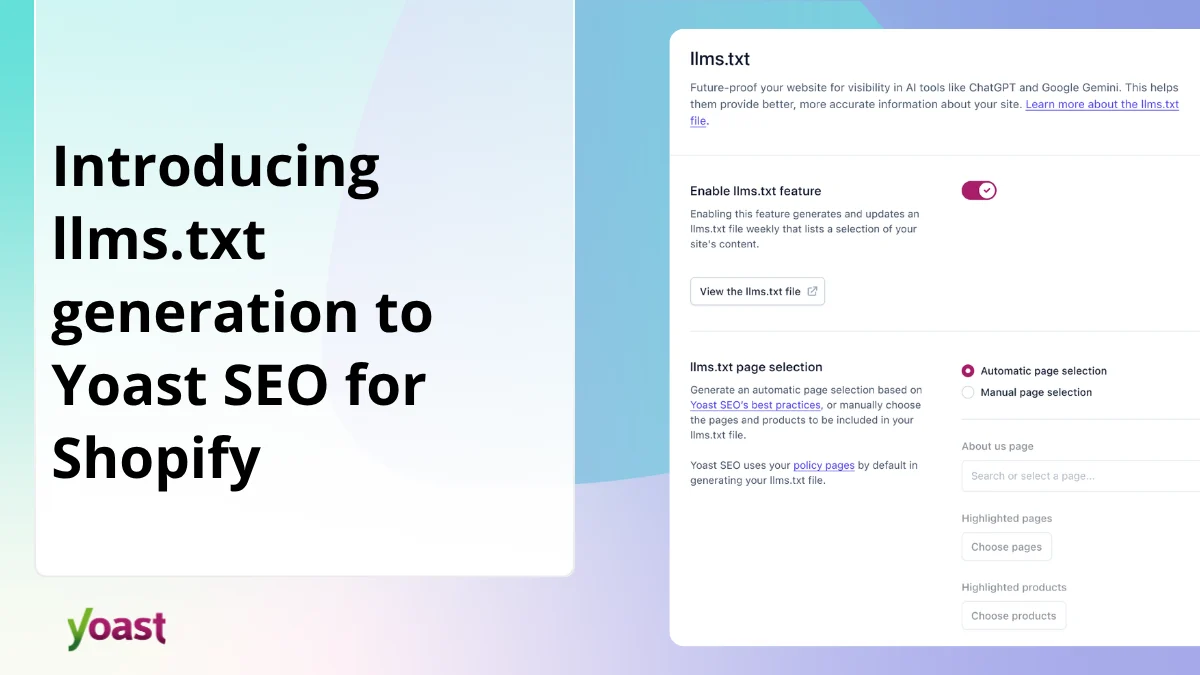
In a significant development for the e-commerce sector, Yoast SEO for Shopify has unveiled its new llms.txt feature, designed to give online store owners unprecedented control over how Large Language Models (LLMs) like ChatGPT and Google Gemini interact with and describe their product catalogs and brand information. This innovation directly addresses a growing concern among digital merchants: the potential for AI tools to misrepresent products, provide outdated information, or even inadvertently direct customers to competitors, thereby undermining hard-earned brand equity and sales efforts.
The introduction of llms.txt marks a crucial evolution in digital content management, extending the concept of web crawler directives beyond traditional search engines to the rapidly expanding realm of generative artificial intelligence. Unlike conventional search engine bots that crawl and index entire websites for ranking purposes, LLMs often operate differently, synthesizing information from various sources to generate responses. This method, while powerful, can lead to inaccuracies when dealing with dynamic e-commerce catalogs, where product details, availability, and pricing change frequently. The llms.txt feature aims to bridge this gap by providing a structured, prioritized guide to AI tools, ensuring they access and articulate the most relevant and accurate information about a store’s offerings.
The Rise of AI and E-commerce: A Double-Edged Sword
The global e-commerce market continues its robust expansion, projected to reach over $7 trillion by 2025, with platforms like Shopify empowering millions of merchants worldwide. Concurrently, generative AI has rapidly transitioned from a niche technological concept to a mainstream phenomenon, profoundly influencing how consumers discover, research, and interact with products online. Tools capable of generating natural language descriptions, answering complex queries, and even recommending products have become increasingly integrated into search experiences, chatbots, and personal digital assistants.
While AI offers immense potential for enhancing customer experience and streamlining operations, its unguided application presents unique challenges for e-commerce. A recent study by Gartner predicted that by 2025, 30% of outbound marketing messages from large organizations will be synthetically generated, blurring the lines between human and AI-created content. However, the accuracy of this content remains a critical concern. LLMs, by their nature, are prone to "hallucinations"—generating plausible but factually incorrect information—or may simply retrieve outdated data. For an e-commerce business, such inaccuracies can be devastating, leading to customer frustration, increased return rates, and significant damage to brand reputation. Imagine an AI chatbot describing a product with features it doesn’t possess, or listing a price that is no longer valid, or even worse, misinterpreting a brand’s unique selling proposition. These scenarios underscore the urgent need for mechanisms that allow businesses to curate the information AI consumes and disseminates.
Addressing the Information Gap: From robots.txt to llms.txt
The concept of instructing web crawlers is not new. For decades, websites have utilized robots.txt files to communicate with search engine bots, dictating which parts of a site should or should not be crawled and indexed. This protocol is fundamental to SEO, allowing webmasters to manage their site’s visibility and prevent indexing of sensitive or redundant content. However, robots.txt was designed for traditional search engine indexing, not for the generative capabilities and synthesis processes of modern LLMs.
LLMs do not merely index pages; they absorb vast quantities of text data, learn patterns, and then generate new content based on that learning. Their "browsing" behavior is often less systematic than a search engine crawler. They may grab snippets, fill in gaps with inferred information, or prioritize readily available data without understanding the full context of a dynamic e-commerce store. This can result in AI descriptions that are:
- Incomplete: Missing crucial product specifications or variations.
- Outdated: Citing old prices, discontinued items, or expired promotions.
- Inaccurate: Misrepresenting product benefits, materials, or usage.
- Misleading: Potentially sending shoppers to a competitor if the AI synthesizes information poorly or incorrectly attributes offerings.
Yoast SEO’s llms.txt feature directly tackles these problems by creating a dedicated file that acts as a precise directive for AI tools. This file tells LLMs exactly which parts of a Shopify store are most important: top-selling products, new arrivals, specific collections, crucial policy pages, and essential brand information. It transforms the AI’s interaction from an undirected wander through a vast catalog into a guided tour of the store’s most critical and up-to-date content.
How the llms.txt Feature Functions: Automatic and Manual Control
The implementation of llms.txt within Yoast SEO for Shopify is designed for simplicity and maximum merchant control, requiring no technical coding knowledge. This accessibility is paramount, recognizing that many Shopify store owners may not have extensive web development expertise.
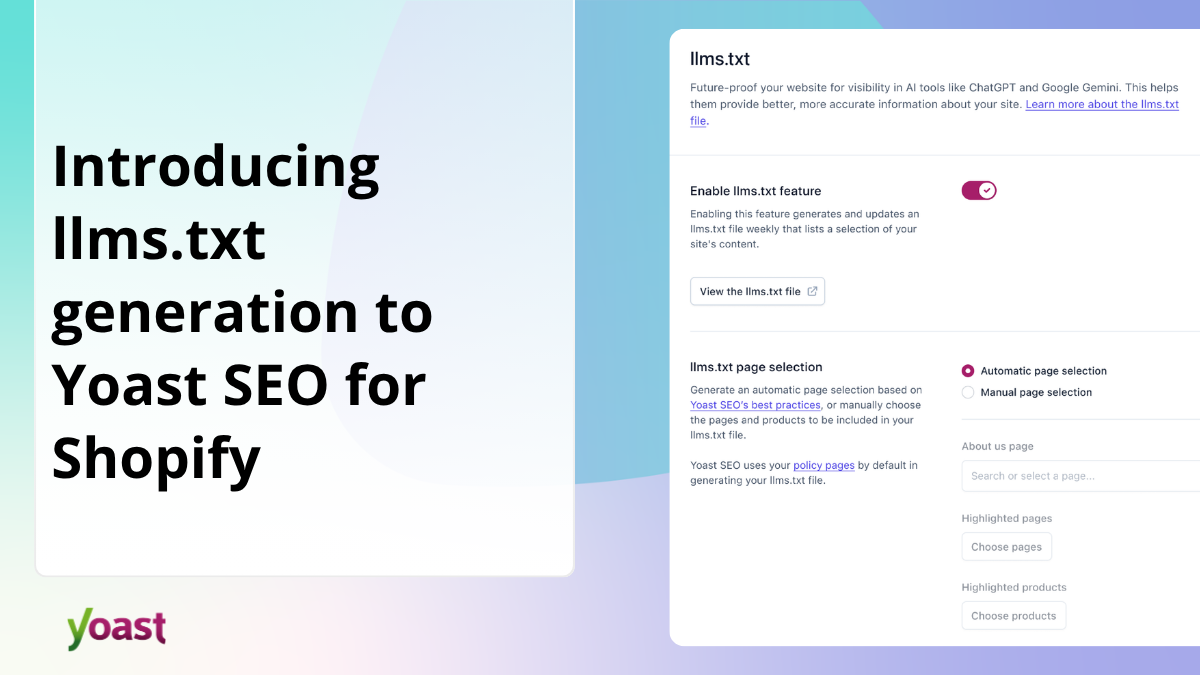
Merchants have two primary ways to utilize the feature:
-
Automatic Management: This is the simplest and most recommended option for many businesses. Upon activation, Yoast SEO automatically builds and updates the
llms.txtfile on a weekly basis, drawing directly from the Shopify store’s data. This automated process intelligently highlights:- Best-selling products: Ensuring AI tools prioritize items proven to be popular.
- New arrivals: Keeping AI descriptions fresh with the latest inventory.
- Product collections: Providing AI with organized categories of products.
- Store policies: Crucial for accurate information regarding shipping, returns, and privacy.
- Key pages: Such as contact information, FAQs, and essential service pages.
- This automated approach eliminates the need for manual intervention, making it ideal for stores with large, constantly evolving catalogs. The system also automatically removes references to deleted products, preventing AI from generating information about unavailable items.
-
Manual Selection for Granular Control: For merchants who require more precise curation, the
llms.txtfeature offers a manual selection option. This allows store owners to hand-pick specific products and pages they want to feature prominently for AI tools. This level of control is particularly valuable for:- Promoting specific campaigns: Highlighting products related to seasonal sales or marketing initiatives.
- Emphasizing high-margin items: Directing AI to focus on products with better profitability.
- Showcasing unique or signature products: Ensuring AI accurately conveys the distinctiveness of core offerings.
- A dedicated section is also provided for adding the "About Us" page, allowing merchants to ensure AI accurately understands and communicates their brand’s story, mission, and values—a critical component of brand identity that often gets lost in generic AI summaries.
Regardless of the chosen method, thellms.txtfile updates weekly, maintaining currency and automatically pruning any deleted products, thus ensuring AI tools always have access to the most accurate and relevant information.
Seamless Integration and Opt-In Philosophy
A core principle behind the llms.txt feature is its seamless integration into the existing Yoast SEO for Shopify settings. This "no technical knowledge needed" approach means that any team member, regardless of their coding background, can activate and configure the feature in seconds. This user-friendly design reduces barriers to adoption and empowers a broader range of personnel to manage their store’s AI footprint. Furthermore, Yoast has built in safeguards: if a merchant already has a redirect set up for /llms.txt, the system respects it and provides a notification, preventing any conflicts or broken functionalities.
Crucially, the llms.txt feature is opt-in. This reflects Yoast’s philosophy that every merchant should have agency over how their content is perceived and utilized, especially as AI plays an increasingly central role in product discovery. In an era where data privacy and content ownership are paramount, giving merchants the explicit choice to participate aligns with growing demands for ethical AI practices and user control. As Beth Parker, Product Marketing Manager at Yoast, stated, "We believe every merchant should have a say in how their content is seen and used as AI plays a bigger role in how people discover products online. That’s why this feature is opt-in." This commitment to merchant autonomy underscores Yoast’s understanding of the evolving digital landscape and the need for tools that empower, rather than dictate.
Broader Implications for E-commerce, SEO, and Brand Management
The introduction of llms.txt has far-reaching implications across several critical domains:
- Enhanced Accuracy and Customer Trust: By providing AI with a curated source of truth,
llms.txtdirectly contributes to more accurate product descriptions and answers. This, in turn, builds greater customer trust, reduces misinformation, and improves the overall shopping experience. Consumers are more likely to complete purchases and return to stores they trust to provide reliable information. - Strategic Brand Narrative Control: In an increasingly competitive market, a consistent and accurate brand narrative is vital.
llms.txtallows merchants to proactively shape how AI understands and communicates their brand’s unique story, values, and offerings. This is a powerful tool for brand reputation management, ensuring that AI-driven interactions reinforce desired brand perceptions rather than dilute them. - The Evolving Landscape of SEO and Discovery: While
llms.txtis not traditional SEO in the sense of influencing search engine rankings, it is a crucial step in "AI-driven discovery optimization." As more consumers rely on conversational AI and generative search interfaces to find products, ensuring AI has accurate and prioritized information becomes a new frontier for visibility and discoverability. It represents a proactive approach to future-proofing a store’s online presence in an AI-first world. - Operational Efficiency: Accurate AI-generated information can significantly reduce the burden on customer service teams. Fewer inquiries related to product specifications, availability, or policy details mean staff can focus on more complex issues, leading to improved operational efficiency and reduced costs.
- Competitive Advantage: Merchants who proactively adopt
llms.txtwill gain a distinct advantage. They will be able to offer a superior, more reliable AI-driven customer experience compared to competitors whose products might be inaccurately or incompletely described by general-purpose LLMs. - Pioneering AI Governance for E-commerce:
llms.txtsets a precedent for how e-commerce platforms and tools can facilitate responsible AI integration. It’s a practical step towards addressing the broader ethical questions surrounding AI’s use of proprietary content and the need for creators and businesses to control their digital assets.
Challenges and the Future Outlook
Despite its promise, the success of llms.txt will depend on several factors. Widespread adoption by merchants is crucial, requiring effective communication and education from Yoast. Furthermore, the effectiveness of the protocol relies on LLM providers respecting and integrating llms.txt directives into their data ingestion and generation processes, much like how search engines adhere to robots.txt. While major LLM developers are increasingly sensitive to content ownership and accuracy, universal compliance remains an ongoing challenge for the industry.
Looking ahead, llms.txt represents more than just a feature; it’s a strategic response to the evolving digital ecosystem. As AI capabilities continue to advance and become even more deeply embedded in consumer journeys, the need for tools that empower businesses to manage their digital identity and content interactions with AI will only intensify. Yoast SEO, traditionally a leader in search engine optimization, is positioning itself at the forefront of this new wave of "AI optimization," providing practical solutions that empower merchants to thrive in an increasingly AI-mediated commerce landscape.
By turning on the llms.txt toggle in Yoast SEO for Shopify, merchants are not just tweaking a setting; they are actively participating in shaping the future of how their products are discovered, understood, and presented to the next generation of online shoppers. This initiative underscores a critical shift: from simply optimizing for algorithms to actively guiding the intelligence that will define future digital interactions.