rifanmuazin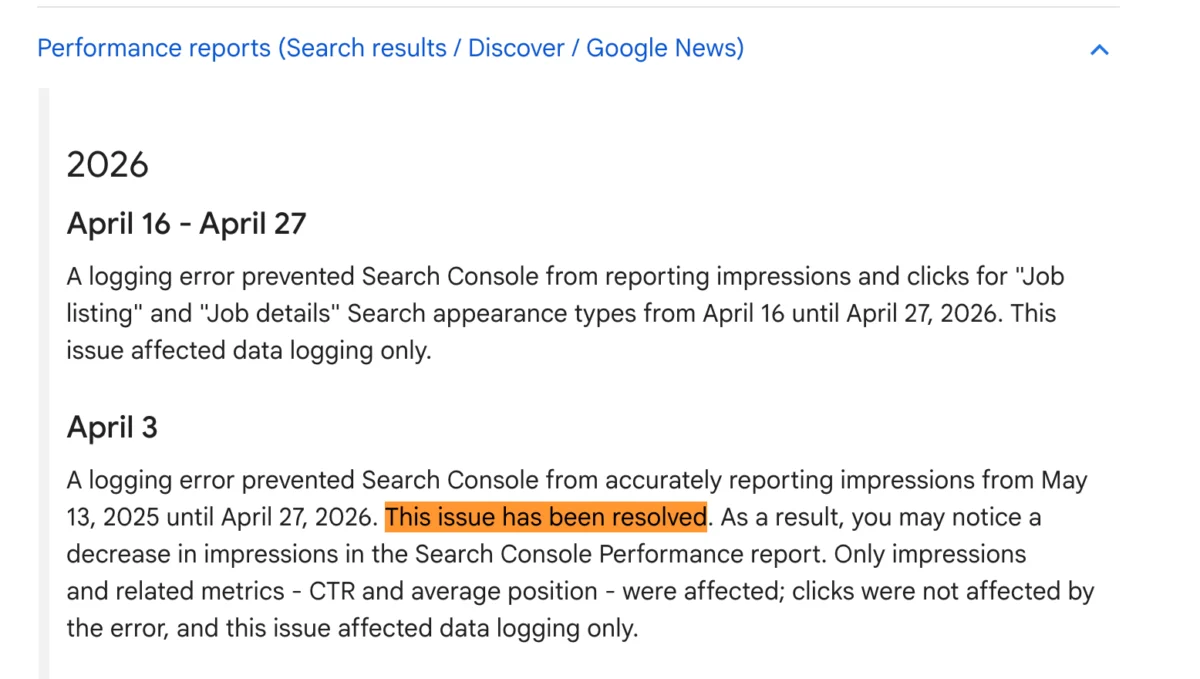
Google has officially resolved a significant data logging error within its Search Console platform, which had affected the accurate reporting of impressions and related metrics for nearly a year. The issue, which spanned from May 13, 2025, to April 27, 2026, has been rectified, but critically, the historical data for this period will not be retroactively corrected. This resolution means webmasters and SEO professionals may now observe a notable decrease in impression figures within their Search Console Performance reports, reflecting a return to accurate data after a period of potentially inflated statistics.
Understanding Google Search Console and Its Indispensable Role
Google Search Console (GSC) stands as a cornerstone tool for webmasters, SEO professionals, and digital marketers worldwide. It provides crucial insights into how a website performs in Google Search, identifying indexing issues, security problems, and, most importantly, offering detailed performance data. This data includes vital metrics such as impressions, clicks, click-through rate (CTR), and average position in search results. For businesses and individuals heavily reliant on organic search traffic, GSC is more than just an analytical tool; it’s a strategic compass, guiding decisions on content optimization, technical SEO improvements, and overall digital marketing strategy.
The integrity of the data provided by GSC is paramount. Accurate information enables webmasters to understand user behavior, evaluate the effectiveness of their SEO campaigns, identify trends, and make informed decisions that directly impact their online visibility and revenue. Any discrepancy or error in this data can lead to misinterpretations, flawed strategies, and potentially wasted resources, making the recent logging error a matter of significant concern for the entire digital community.
The Genesis of the Issue: A 50-Week Anomaly
The data logging error first came to light approximately a month prior to its resolution, when Google initially acknowledged an issue impacting Search Console’s ability to accurately report impressions. The identified period of inaccuracy was extensive, covering nearly 50 weeks, specifically from May 13, 2025, through April 27, 2026. During this timeframe, a "logging error prevented Search Console from accurately reporting impressions," according to Google’s official communication. While the exact technical root cause of this logging error was not publicly detailed, its impact was clear: the data displayed for impressions and related metrics during this period was not a true reflection of actual performance.
The announcement of such a prolonged data anomaly immediately raised alarms within the SEO community. Professionals routinely track performance month-over-month and year-over-year, and a 50-week gap of inaccurate data creates substantial challenges for long-term trend analysis and performance benchmarking. The initial notification from Google served as a warning, prompting webmasters to exercise caution when interpreting their GSC performance reports for the affected period.
Google’s Official Resolution and Critical Clarifications
Google has since updated its official support documentation, confirming that "This issue has been resolved." The full statement provided by Google elucidates the nature of the fix and its immediate consequences:
"A logging error prevented Search Console from accurately reporting impressions from May 13, 2025 until April 27, 2026. This issue has been resolved. As a result, you may notice a decrease in impressions in the Search Console Performance report. Only impressions and related metrics – CTR and average position – were affected; clicks were not affected by the error, and this issue affected data logging only."
This statement offers several critical pieces of information. Firstly, it reiterates the specific metrics impacted: impressions, click-through rate (CTR), and average position. It explicitly states that clicks were not affected, which is a relief for many, as clicks often serve as a more direct indicator of user engagement and traffic generation. Secondly, the mention of a potential "decrease in impressions" post-resolution strongly suggests that the previous reporting during the error period was likely overstating actual impressions. This implies that many websites might have been operating under the assumption of higher visibility than they genuinely had, making the correction a significant recalibration.

Crucially, the resolution is forward-looking. This means that while Search Console will now accurately report data from the point of the fix onwards, the data logged between May 13, 2025, and April 27, 2026, remains uncorrected. This distinction is vital for webmasters planning to review past performance.
Community Reaction and Expert Insights
The resolution and its implications quickly resonated across the digital marketing community. The fix was initially spotted by Kenichi Suzuki, a respected figure in the SEO world, who shared his observations on LinkedIn. Following this, prominent SEO expert Glenn Gabe reshared the update on X (formerly Twitter), adding a nuanced observation: "But, when I’m checking impressions across accounts, I’m not seeing any changes." Gabe’s comment highlights the varied nature of data discrepancies and the importance of individual website analysis, as the impact might not be universally immediate or uniformly noticeable across all properties.
Perhaps the most definitive clarification came from John Mueller, a Search Advocate at Google. Responding to queries on Bluesky, Mueller explicitly confirmed that the fix applies only to future data logging. He stated that the historical data for the affected 50-week period would not be corrected retroactively. This confirmation from a direct Google representative underscores the permanent nature of the data gap for that specific timeframe, solidifying the challenge for historical analysis. Mueller’s intervention is often crucial in providing clear, actionable insights directly from Google, especially when technical issues arise.
The collective response from the SEO community reflects a mix of relief that the issue is resolved, coupled with a degree of frustration regarding the uncorrectable historical data. Many professionals rely heavily on year-over-year comparisons to demonstrate growth and evaluate long-term strategies, and this 50-week gap will undoubtedly complicate such analyses for the foreseeable future.
Understanding the Impact: Impressions, CTR, and Average Position
To fully grasp the ramifications of this logging error, it’s essential to understand the metrics involved:
- Impressions: An impression is counted each time a link to your site appears in a search result for a user, even if the link is not clicked. It’s a fundamental measure of visibility. Inaccurate impression data means webmasters might have overestimated their visibility in search results, potentially leading to incorrect assumptions about keyword performance or content reach.
- Click-Through Rate (CTR): CTR is calculated by dividing the number of clicks your link receives by the number of times it was shown (impressions). If impressions were inflated, then the reported CTR would have been artificially lowered for the affected period. A falsely low CTR could lead to misdiagnosing content or title tag effectiveness, prompting unnecessary or counterproductive optimization efforts.
- Average Position: This metric indicates the average ranking of your website’s snippets for a given query. While not directly affected by the logging error in its raw calculation, the reporting context within GSC often ties average position closely with impressions. If impressions were skewed, the interpretation of average position in relation to user visibility might have been distorted.
The fact that clicks were unaffected is a silver lining. Clicks are a more direct measure of user engagement and traffic acquisition. However, the interplay between impressions, clicks, and CTR means that even with accurate click data, the overall narrative of a website’s performance during the affected period could be significantly skewed due to the impression anomaly. For example, a website might have observed steady clicks but an unusually low CTR, which, if attributed to poor content rather than inflated impressions, could have led to misguided strategic changes.
Implications for SEO Professionals and Webmasters
The resolution of this GSC data logging error carries several significant implications for SEO professionals and webmasters:
Challenges for Historical Analysis and Trend Spotting
The most immediate challenge is the inability to perform accurate year-over-year comparisons or long-term trend analysis for the 50-week period. SEO is an iterative process, and understanding historical performance is crucial for identifying seasonal patterns, assessing the impact of algorithm updates, and measuring the success of ongoing campaigns. The uncorrected data gap will create a "blind spot" in historical records, making it difficult to confidently attribute changes in performance during that time.
Recalibration of Performance Expectations
For websites whose impressions were significantly overstated, there will be a necessary recalibration of performance expectations. What was perceived as strong visibility might now be revealed as less robust, necessitating a re-evaluation of current SEO strategies and goals. This might lead to difficult conversations with clients or stakeholders who were presented with higher impression figures.

Data Discrepancies Across Reporting Tools
Webmasters using multiple analytics platforms (e.g., Google Analytics, third-party SEO tools) alongside Search Console might observe discrepancies. While Google Analytics typically reports user behavior post-click, the initial visibility metrics often draw heavily from GSC. These discrepancies could complicate consolidated reporting and require careful explanation.
Focus on Future Data Integrity
The resolution emphasizes the importance of continually monitoring data integrity. While GSC is generally reliable, this incident serves as a reminder that technical issues can arise, and cross-referencing data points when possible, along with staying informed through official channels, is prudent.
Strategic Adjustments
SEO professionals will need to adapt their reporting and analysis methodologies for the coming year. This might involve:
- Segmenting Data: Focusing on clicks and other unaffected metrics for historical analysis during the problematic period.
- Contextual Reporting: Clearly communicating the GSC data logging issue to clients and stakeholders, explaining why certain impression-based metrics might appear lower or inconsistent for the affected timeframe.
- Baseline Re-establishment: Establishing a new baseline for impression and CTR performance from the date of the fix, rather than relying solely on potentially inaccurate historical data.
- Qualitative Analysis: Leaning more heavily on qualitative insights and other unaffected data sources to understand performance trends during the impacted period.
Navigating the Post-Resolution Landscape
Moving forward, webmasters should take proactive steps to navigate this post-resolution environment. Firstly, it is crucial to communicate transparently with any stakeholders about the nature of the data correction and its implications. Explaining that the reported "decrease" in impressions is a correction to accurate reporting, rather than an actual drop in visibility, is vital.
Secondly, focusing on data from the resolution date onwards will be key for establishing new, reliable performance benchmarks. While the past 50 weeks will remain a challenge for impression-based analysis, the future data will provide a clearer picture. Webmasters should pay close attention to the newly reported impression, CTR, and average position figures to understand their true performance and adjust their strategies accordingly.
Consider leveraging other data points for the affected period where possible. While GSC impressions are unique, correlating clicks from GSC with traffic data from Google Analytics for the same period can provide a more holistic view of actual user engagement and website performance, even if the initial visibility metrics were flawed.
Broader Context of Data Reliability in Digital Marketing
This incident underscores a broader truth in the digital marketing landscape: data reliability is paramount, and vigilance is always necessary. As search algorithms evolve and analytics platforms become more complex, occasional technical glitches are almost inevitable. What truly matters is the transparency with which these issues are communicated and the commitment to resolving them.
The 50-week Google Search Console data logging error serves as a powerful reminder of the intricate dependencies within the digital ecosystem. While Google has successfully resolved the technical glitch, the uncorrected historical data will leave a lasting mark on the analytics of countless websites. SEO professionals and webmasters must now adapt their reporting, analysis, and strategic planning to account for this significant data anomaly, reinforcing the need for continuous education, critical thinking, and a diversified approach to performance measurement in the ever-evolving world of online search. The digital landscape demands not just data, but accurate data, and the community’s response to this fix highlights the enduring importance of trust and integrity in our digital tools.