
 rifanmuazin
In the hyper-competitive landscape of digital commerce, the difference between a thriving enterprise and a stagnant brand often rests on the efficiency of its conversion rate optimization (CRO) program. Recent industry data suggests that while the global conversion rate optimization software market is projected to reach billions in valuation by 2030, many organizations continue to squander resources on low-impact testing. To address this inefficiency, industry leaders have moved toward a structured methodology known as the SHIP model—Scrutinize, Hypothesize, Implement, and Propagate—to ensure that every adjustment to a digital platform is rooted in empirical evidence and strategic priority.
The optimization process is no longer viewed as a series of isolated A/B tests but as a continuous, compound-interest-bearing loop. When executed correctly, CRO functions as a sales conversation refinement tool, identifying where digital dialogue breaks down and repairing the friction points that prevent a visitor from becoming a customer. The SHIP model provides the structural integrity required to move beyond guesswork and toward a predictable growth engine.
The Chronology of Optimization: The SHIP Model
A sophisticated CRO program operates through a cyclical four-phase rhythm. This ensures that learnings from one test directly inform the next, creating a repository of institutional knowledge regarding user behavior.
- Scrutinize: This initial phase focuses on the gathering of both quantitative and qualitative data. It is the diagnostic stage where practitioners identify not just where users are dropping off, but the psychological and technical reasons behind that abandonment.
- Hypothesize: Once data is gathered, the team develops a predictive statement. This involves transforming a "problem" into a "testable solution" with a projected outcome.
- Implement: This is the technical execution phase where designs are created, code is written, and A/B or multivariate tests are launched to a segment of the live traffic.
- Propagate: After a test reaches statistical significance, the results are analyzed. Winning variations are fully integrated into the site, while losing tests provide insights that feed back into the Scrutinize phase.
Phase One: The Scrutinize Methodology
The Scrutinize phase is arguably the most critical, yet frequently the most rushed. Modern digital marketing teams often suffer from "implementation bias," jumping to solutions before fully diagnosing the ailment. A rigorous scrutiny phase involves a two-pronged approach: quantitative analysis (the "what") and qualitative analysis (the "why").
Quantitative data is derived from analytics platforms like Google Analytics 4 or Adobe Analytics. Practitioners look for high-exit pages, anomalous bounce rates on specific devices, and funnel bottlenecks. However, numbers only tell half the story. To understand the "why," CRO specialists employ qualitative tools such as heatmaps, session recordings, and on-site surveys. This empathy-driven data allows the team to see the website through the eyes of the user, uncovering frustrations that a spreadsheet cannot capture.
Distinguishing Usability from Conversion Blockers
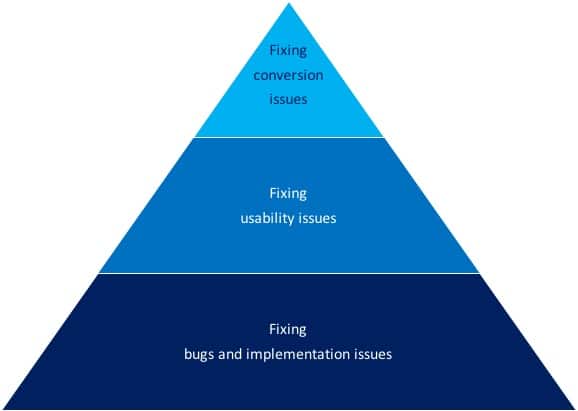
A common pitfall in digital optimization is the conflation of usability and conversion optimization. While they are related, they serve different masters. A website can be perfectly usable—fast, accessible, and intuitive—yet fail to convert because it lacks a compelling value proposition or fails to address user fears.
Usability issues are technical or navigational hurdles. Examples include broken links, non-responsive buttons, or a confusing checkout flow where the "Next" button is hidden. Fixing these is the baseline for any functional site.
Conversion issues, conversely, are psychological. These involve "FUDs"—Fears, Uncertainties, and Doubts. A user might find the checkout button easily (high usability) but hesitate to click it because they don’t trust the brand’s return policy or feel the price is too high (low conversion). Every usability issue is technically a conversion issue, as it stops the process, but not every conversion issue is a usability problem. A highly usable site that fails to persuade is simply a streamlined path to a "no."
The Anatomy of a Scientific Hypothesis
To move from observation to action, a team must develop a hypothesis. In professional CRO circles, there is a distinction between an "initial hypothesis" and a "concrete hypothesis."

An initial hypothesis is a broad observation. For example: "Adding social proof will increase trust." While a good starting point, it is too vague for rigorous testing.
A concrete hypothesis is a data-backed prediction. A robust version would state: "Based on qualitative data from user surveys indicating a lack of brand familiarity, adding three verified customer testimonials and a ‘trusted by’ logo bar to the homepage will increase the click-through rate to product pages by 8% and overall conversions by 5%."
This level of specificity ensures that the team knows exactly what is being measured and why, allowing for a clear "pass/fail" grade at the end of the test cycle.
Comparative Analysis of Prioritization Frameworks
With potentially hundreds of ideas generated during the Scrutinize phase, prioritization becomes the linchpin of a successful program. Several frameworks have emerged as industry standards, each offering different levels of granularity.
The PIE Framework
Developed by Chris Goward and the team at Widerfunnel, PIE stands for Potential, Importance, and Ease.
- Potential: How much improvement can be made on this page?
- Importance: How valuable is the traffic to this page? (High-volume or high-cost traffic pages are prioritized).
- Ease: How difficult is it to implement this test technically or politically?
While PIE is highly accessible, critics argue it is overly subjective. One team member’s "8" for potential might be another’s "4."
The Hotwire Framework
Introduced by Pauline Marol, this model adds layers of business strategy. It evaluates ideas based on the source of the problem, the complexity of the fix, and how well the test aligns with overarching business objectives. This framework is favored by product managers who need to justify testing resources to C-suite executives.
The PXL Framework
Peep Laja and the CXL team developed PXL to bring more objectivity to the process. Instead of subjective 1-10 scales, PXL uses binary "Yes/No" questions. Is the change "above the fold"? Is it a change to motivation? Is it addressing a friction point identified in research? By forcing these objective answers, the framework minimizes the "Highest Paid Person’s Opinion" (HiPPO) effect.
The Invesp Prioritization Framework: A New Weighted Standard
Building upon the foundations of PIE and PXL, the Invesp framework introduces a weighted scoring system designed to maximize ROI. This model recognizes that a single research opportunity can be addressed in multiple ways, each with different implementation costs and expected impacts.
The Invesp model scores research opportunities based on 11 distinct criteria, including:

- Data Source Weighting: A problem identified through four different methods (e.g., analytics, heatmaps, surveys, and expert review) receives a significantly higher score than an idea based on a single observation.
- Nature of the Change: Adding or removing an element is weighted more heavily than simply changing the location or emphasis of an existing element.
- Location: Changes "above the fold" or on high-intent pages like the cart page receive priority.
- Strategic Alignment: Tests that align with the brand’s core quarterly goals receive a "strategic bonus."
This multi-dimensional approach ensures that the "low-hanging fruit" is identified alongside the "high-impact strategic bets," allowing for a balanced testing roadmap.
Business Implications and Long-Term Strategic Impact
The shift toward data-driven CRO has profound implications for the broader economy. In an era where customer acquisition costs (CAC) are skyrocketing across platforms like Meta and Google, the ability to convert a higher percentage of existing traffic is the only sustainable way to maintain margins.
Industry analysts note that companies utilizing structured CRO frameworks see an average conversion lift that is 2x to 3x higher than those using ad-hoc testing methods. Furthermore, the "Propagation" phase of the SHIP model ensures that these wins are not just temporary spikes but permanent elevations of the baseline revenue.
Beyond immediate revenue, a robust CRO program fosters a culture of experimentation within an organization. It moves decision-making away from subjective debates and toward a meritocracy of data. This cultural shift often spills over into product development, customer service, and traditional marketing, as the entire organization begins to ask: "What does the data say?"
Conclusion: The Future of Optimization
As artificial intelligence and machine learning become more integrated into CRO tools, the speed of the SHIP model is expected to accelerate. Predictive analytics will likely automate much of the Scrutinize phase, identifying patterns in user behavior before a human analyst notices them. However, the need for strategic prioritization will remain.

There is no "perfect" framework that fits every business. As Chris Goward famously noted, every website lives in a unique target market with specific competitive and seasonal factors. The goal of using models like SHIP, PIE, or PXL is not to find a universal truth, but to create a consistent, repeatable, and transparent process for growth. By prioritizing the right ideas, organizations stop guessing and start growing, turning their digital platforms into highly tuned engines of conversion.








