rifanmuazin
Temu, a global e-commerce platform, is significantly expanding its horizons for businesses through its innovative Local Seller Program. Initially conceived to empower local businesses to serve their immediate customer base, the program has evolved to offer eligible sellers access to broader regional markets. This strategic expansion aims to unlock new sales channels, foster substantial growth, and simplify market-by-market operational expansion for businesses of all sizes. The program is actively recruiting eligible local businesses to leverage Temu’s extensive network, facilitating their journey into online commerce and enhancing their competitive edge in an increasingly digital marketplace.
The Genesis and Evolution of Temu’s Local Seller Program
Launched in early 2024, Temu’s Local Seller Program was meticulously designed with the local entrepreneur in mind. Its core mission was to bridge the gap between small and medium-sized businesses (SMBs) and the burgeoning online retail landscape. By providing a streamlined pathway to sell through localized warehousing and delivery infrastructure, Temu aimed to remove the significant barriers to entry that often deter smaller enterprises from venturing into e-commerce. This included minimizing upfront costs, simplifying technical complexities, and overcoming the challenge of acquiring initial customer traffic.
The program’s success and rapid adoption across 37 initial markets quickly highlighted its potential beyond serving strictly local consumers. Recognizing this unmet demand and the inherent scalability of the platform, Temu began a phased rollout to include nearby and regional markets. This evolution represents a pivotal shift, transforming the program from a localized solution to a powerful engine for cross-border e-commerce growth. For sellers, this means a dramatically expanded customer base without the need to replicate operational infrastructure in each new territory.
Unlocking Regional Markets: A New Era for Sellers
A key innovation of Temu’s Local Seller Program is its capability to facilitate cross-border sales within defined regional blocs. This is particularly impactful within the European Union, where eligible sellers are no longer confined to their home country. For instance, a German-based business can now seamlessly offer its products to customers in Belgium, even if it lacks a physical presence or dedicated warehousing in that nation. Temu supports these transactions either through its integrated logistics partners or by allowing sellers to utilize their own established shipping arrangements.

The program’s expansion has been strategically timed to coincide with peak e-commerce seasons and market demands. Since early 2026, for example, sellers in key European markets such as Germany, Italy, the Netherlands, Portugal, Spain, Romania, Belgium, Poland, and France have gained access to markets including the United Kingdom, Iceland, and Switzerland. This coordinated expansion demonstrates Temu’s commitment to creating cohesive regional selling ecosystems.
In North America, a similar expansion has been in effect since December 2025, enabling US-based sellers to tap into the Canadian market. This strategic approach to market access allows businesses to scale their operations exponentially by leveraging existing capabilities and reaching new customer demographics without the prohibitive costs and complexities typically associated with establishing an international e-commerce presence. The overarching benefit is a significant increase in potential sales volume and market penetration, driven by Temu’s commitment to facilitating seller growth.
Catalyzing Business Growth: The Temu Advantage
Temu’s Local Seller Program is engineered to be a potent catalyst for business growth, particularly for SMBs that often struggle with the intricacies of online retail. The program’s onboarding process is deliberately designed for speed and simplicity, with a focus on enabling sellers to go live quickly and begin generating revenue.
Key Growth Drivers:
- No-Cost Onboarding and Simple Setup: Temu eliminates the financial barriers to entry by offering free onboarding and a straightforward setup process. This allows businesses to focus their resources on product development and customer service rather than on platform integration costs.
- Rapid Time-to-Market: Seller applications are typically processed in approximately 10 minutes, with approvals often issued within a single business day. Many businesses find themselves actively selling on the platform within 72 hours of approval. Furthermore, anecdotal evidence suggests that a significant portion of new sellers achieve their first sale within 20 days, highlighting the program’s efficacy in driving immediate customer engagement.
- Access to a Vast Customer Base: Temu’s discovery-based sales model, which emphasizes product visibility and customer browsing, provides sellers with access to a massive and diverse audience. This model contrasts with traditional search-heavy marketplaces, offering a unique opportunity for businesses to reach customers who may not be actively searching for their specific products but are open to discovery.
- New Revenue Streams and Market Expansion: Sellers participating in the program frequently report reaching entirely new customer segments and expanding their market reach beyond their traditional customer base. This has led to the creation of significant new revenue streams, enabling businesses to reinvest profits back into their offline operations. This reinvestment often manifests as local job creation, warehouse expansions, and enhancements to customer support services, creating a virtuous cycle of growth and community impact.
Is Temu’s Local Seller Program the Right Fit for Your Small Business?
For many small and medium-sized businesses, the Temu Local Seller Program presents a compelling and accessible growth opportunity. The inherent challenges faced by smaller enterprises—high upfront investment, operational complexities, and the arduous task of customer acquisition—are precisely what the program aims to mitigate. Temu’s approach is to act as a facilitator, connecting merchants with essential traffic, infrastructure, and third-party services that are critical for scaling.
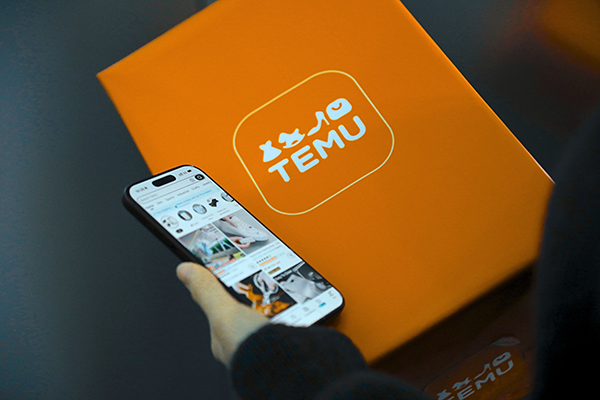
Instead of requiring sellers to build every aspect of their e-commerce operation from scratch, Temu provides a robust ecosystem. This includes access to a substantial customer base, efficient logistics and payment processing, and user-friendly tools for managing inventory and orders. For businesses that may lack the resources or expertise to navigate the complexities of global e-commerce independently, Temu offers a clear and achievable pathway to expand their reach and boost sales.
Navigating the Global Marketplace: Available Selling Regions
Temu’s Local Seller Program is currently operational in a substantial and growing number of markets worldwide, providing businesses with a diverse range of opportunities. As of the latest updates, the program is accessible in:
- North America: United States, Canada, Mexico
- Europe: United Kingdom, Germany, France, Italy, Netherlands, Spain, Belgium, Austria, Poland, Czech Republic, Hungary, Romania, Sweden, Portugal, Greece, Denmark, Finland, Bulgaria, Slovakia, Slovenia, Ireland, Lithuania, Croatia, Estonia, Switzerland, Norway
- Asia: Japan, Republic of Korea
- Oceania: Australia
- Middle East: United Arab Emirates
- South America: Brazil
- Africa/Eurasia: Türkiye
Interested sellers are encouraged to register through the dedicated Temu Seller Center portal at https://seller.temu.com/login.html?redirectUrl=https%3A%2F%2Fseller.temu.com%2F.
A Diverse Product Landscape: What Can You Sell?
The Temu Local Seller Program welcomes a vast array of products, catering to over 700 distinct categories. This broad scope ensures that a wide spectrum of businesses, from niche artisans to large-scale distributors, can find a place on the platform. Eligible sellers can list items across popular verticals such as:
- Apparel and Fashion: Clothing, footwear, accessories.
- Home Goods and Decor: Kitchenware, bedding, decorative items, furniture.
- Electronics and Gadgets: Mobile accessories, small electronic devices, smart home tech.
- Health and Beauty: Skincare, cosmetics, personal care items.
- Toys and Hobbies: Children’s toys, craft supplies, collectibles.
- Sporting Goods and Outdoor Equipment: Fitness accessories, camping gear.
- Everyday Essentials: Pet supplies, stationery, cleaning products.
Temu actively supports a diverse merchant base, including established family-run brands, traditional manufacturers, wholesale distributors, and even multinational retailers. This inclusive approach fosters a dynamic marketplace where a variety of products can find their target audience.
Getting Started: A Step-by-Step Guide to Selling on Temu
The process of becoming a Temu seller is designed for efficiency and ease of use. While specific steps may vary slightly by region, the general flow, exemplified by the US registration process, is as follows:
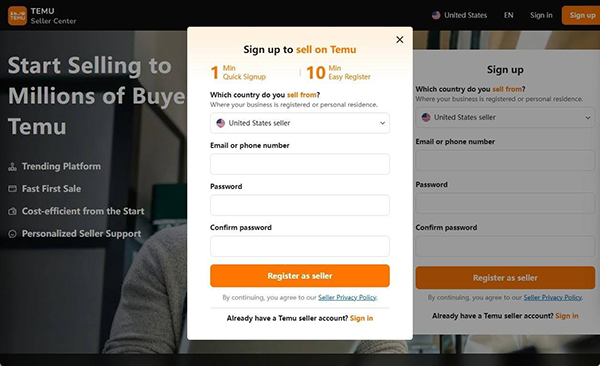
Step 1: Create Your Seller Account
Begin by visiting the Temu Seller Center (https://seller.temu.com/login.html?redirectUrl=https%3A%2F%2Fseller.temu.com%2F) and clicking "Sign up." You will need to provide an email address or phone number and create a secure password (minimum 8 characters, with a mix of letters, numbers, and symbols). Avoid using your email address or its prefix as your password. Click "Register as seller" to proceed.
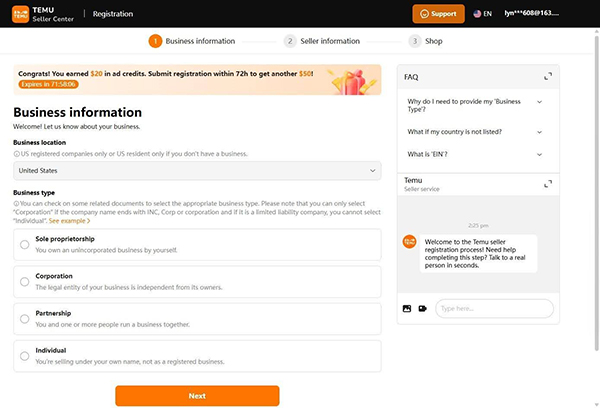
Step 2: Provide Business Information
Upon registration, you will be directed to the Business Information page. Here, you must select your business location and then choose the business type that accurately reflects your legal structure. Options typically include Sole Proprietorship, Corporation, Partnership, or Individual.
Step 3: Enter Business Registration Details (if applicable)
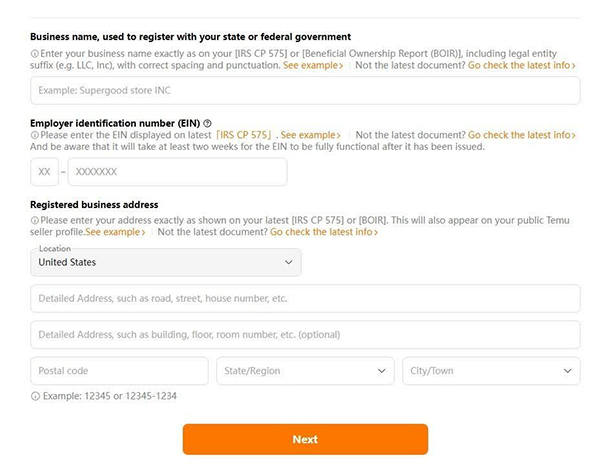
For structures like Sole Proprietorship, Corporation, or Partnership, you will need to input your official business registration details. This commonly includes your registered business name, Employer Identification Number (EIN) in the US (or equivalent tax identification number in other regions), and your registered business address. It is crucial that this information precisely matches your official government registration documents.
- Business Name: Enter the name exactly as it appears on your official documentation, including any legal entity suffixes (e.g., LLC, Inc.).
- Employer Identification Number (EIN): Provide the EIN precisely as it is shown on your IRS CP 575 form or equivalent official tax document.
- Registered Business Address: Input the registered business address exactly as it is listed on your official documents. This address may also be visible on your public Temu seller profile.
Step 4: Complete Seller Verification and Shop Setup
The next crucial step involves verifying the identity of the business representative. You will select the country or region that issued the identification document and choose the type of ID (e.g., driver’s license, passport). High-quality photos of the ID will be required for verification, a process often facilitated by identity-verification specialists like Jumio to ensure security and prevent fraud. You can either take photos directly through the platform or upload existing images from your device.
- ID Photo Upload Requirements: Ensure that the uploaded ID photos are clear, legible, and capture all four corners of the document. Avoid glare or obstructions.
- Representative Details: After uploading the ID, you will need to provide the business representative’s personal details as they appear on the document, including legal name, ID number, expiry date, citizenship, place of birth, and date of birth. You will also need to provide their address, which can be a business or a personal address depending on the program’s requirements.
Once these steps are completed, you will proceed to finalize your shop setup, making your products available for purchase on Temu. For comprehensive guidance, the Temu Seller Academy (https://seller.temu.com/seller-academy/index.html) offers detailed resources and tutorials.
Comprehensive Support for Sellers
Temu is committed to providing robust support to its sellers, encompassing platform infrastructure, operational tools, and dedicated service resources. This multifaceted support system is designed to simplify the selling experience and maximize efficiency.
Key Support Pillars:
- Dedicated Seller Support Teams: Accessible teams are available to promptly address seller inquiries and resolve any operational issues, ensuring a smooth selling journey.
- Platform Traffic and Engagement: Sellers benefit from Temu’s substantial platform traffic and direct customer engagement features, helping to drive sales and build brand loyalty.
- Integrations and Partnerships: Temu facilitates integrations with Enterprise Resource Planning (ERP) systems and works closely with logistics and payment partners to streamline order management, fulfillment, and transaction processing. This network of partnerships allows sellers to focus on their core business while Temu handles much of the backend complexity.
Logistics and Payment Infrastructure
Temu has established strong partnerships with leading logistics providers and payment processors to ensure seamless operations.
- Logistics: In the US, Temu collaborates with carriers such as USPS, UPS, and DHL. Across Europe, the platform partners with over 150 logistics providers, including strategic alliances with more than 10 national postal service operators.
- Payments: Sellers can accept payments through widely used methods, including Google Pay, Apple Pay, PayPal, and major credit card networks like Visa.
- Operational Tools: Temu also partners with ERP and fulfillment providers such as Rithum, ShipBob, ShipStation, and Linnworks, offering integrated solutions that help sellers manage their operations more effectively.
Proven Success: Seller Testimonials and Performance Data
The efficacy of Temu’s Local Seller Program is demonstrably supported by the success stories of numerous businesses worldwide. These testimonials offer tangible proof of the program’s ability to drive significant sales and foster business growth.
Notable Success Stories:
- Shop Succulents (US): This California-based live plant seller experienced a remarkable surge in sales after joining Temu in February 2025. Within its first four months, it generated approximately 3,500 sales, nearly matching its sales on another platform over the preceding decade. By April 2026, cumulative sales on Temu surpassed 11,000 orders, a significant achievement for a business dealing with the complexities of shipping perishable goods.
- PopMarket (US): An online retailer specializing in collectibles and entertainment, PopMarket, owned by Alliance Entertainment, reported Temu as its fastest-growing digital marketplace in over ten years. In its initial eight months on the platform, it sold more than 450,000 items.
- Grumpy Butcher (US): This premium frozen steak seller from New York saw over 12% of its online sales attributed to Temu within just five weeks of onboarding.
- Patch Party Club (US): A family-run patch maker, Patch Party Club, sold over 300 patches in three weeks, with approximately 90% of these sales originating from new customers acquired through Temu.
- Lay It Flat Bookshop (US): This independent bookseller based in North Carolina achieved sales of over 100,000 units within a few months on the platform.
- Mcslots (UK): A family-run toy retailer, Mcslots, saw its daily orders increase by over 40% within three months of listing a portion of its inventory on Temu, with the platform contributing half of its total sales.
- Ubedia (France): This startup, specializing in ube powder, sold over 1,300 units in its first three months on Temu, providing the founders with the traction and capital to transition to full-time entrepreneurship.
- AMF Creation (Germany) & Fruta de Toro (Spain): These businesses leveraged Temu to expand their reach across the EU and establish direct-to-consumer online sales channels, respectively.
Differentiating Temu in the Marketplace Landscape
Temu’s Local Seller Program distinguishes itself from other e-commerce marketplaces through its unique emphasis on accessibility and seller empowerment. Unlike some established platforms that can present significant hurdles for smaller sellers seeking visibility, Temu adopts a more discovery-driven approach. This model is designed to give merchants greater autonomy and control over their online operations.
The program’s third-party partnership strategy is central to its mission of broadening participation among local businesses, rather than concentrating market advantages among a select few dominant players. For merchants, this translates into enhanced flexibility in managing their operations, fulfilling orders, and scaling their businesses. By reducing the reliance on proprietary systems and fostering an open ecosystem, Temu empowers businesses to chart their own growth trajectory and achieve sustainable success in the global e-commerce arena.

 Raul Delapena Setiawan
 Ammar Sabilarrohman