rifanmuazin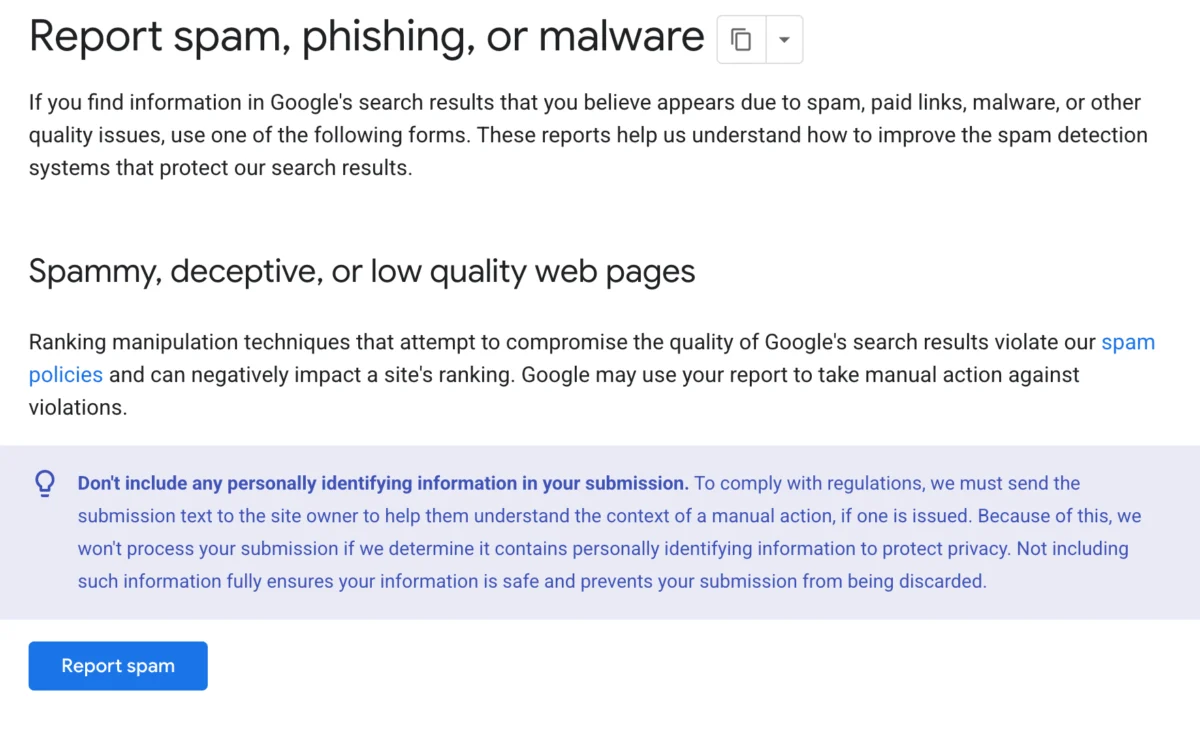
Google has swiftly reversed a recently introduced policy concerning spam reports, announcing that it will no longer process submissions that contain personally identifying information (PII). This significant pivot comes less than a week after the search giant initially stated it would pass the full text of spam reports to site owners when those reports resulted in manual actions. The initial policy, designed to enhance transparency for webmasters facing penalties, triggered a substantial backlash from the SEO community and privacy advocates, who raised immediate concerns about the potential for doxing and misuse of personal data.
The Initial Policy Shift: An Attempt at Transparency
For years, Google has relied on a combination of sophisticated algorithms and human review to combat web spam, which aims to manipulate search rankings through deceptive practices. User-submitted spam reports have consistently formed a crucial component of Google’s anti-spam arsenal, providing valuable intelligence that helps the company identify new spam tactics and target egregious violators. These reports, submitted through a dedicated interface, allow users to flag websites engaging in practices like keyword stuffing, cloaking, link schemes, or scraped content.
Approximately a week prior to the recent reversal, Google updated its policy regarding these spam reports. The original announcement indicated that if a spam report led to a manual action — a penalty imposed directly by a Google reviewer rather than an algorithm — the full text of the report would be shared with the affected site owner. The stated rationale behind this change was to offer greater transparency. Google aimed to help site owners "understand the context of a manual action," allowing them to identify the specific issues reported and take corrective measures more effectively. This move was perceived by some as a step towards fostering a more collaborative environment, where webmasters could gain clearer insights into the reasons behind penalties, moving beyond generic notifications.
However, the implications of this transparency immediately sparked widespread debate. While the intention to provide context was understandable from Google’s perspective, the practical execution raised a critical privacy red flag.
Community Outcry and Privacy Concerns
The SEO community, webmasters, and digital privacy advocates reacted with considerable alarm to Google’s initial policy update. The core concern revolved around the potential for Personally Identifying Information (PII) to be inadvertently or even maliciously included in a spam report. PII can encompass a wide range of data, including names, email addresses, phone numbers, physical addresses, IP addresses, or any other information that could reasonably be used to identify an individual.
Critics quickly pointed out that if a reporter, perhaps frustrated by a spamming website, included their email address, social media handle, or even their name in the report text, that information would then be directly transmitted to the very site owner they were accusing. This scenario presented a significant risk of doxing, harassment, or retaliation, particularly if the accused site owner was engaged in illicit or aggressive online activities. The potential for a spammer to gain access to the personal details of their accuser created a chilling effect, threatening to deter legitimate users from submitting valuable spam reports for fear of personal repercussions.
Prominent figures in the search industry, such as Glenn Gabe, a widely respected SEO consultant, quickly voiced their concerns. Gabe’s tweet, dated April 24, 2024 (correcting the likely typo in the original source of 2026), captured the sentiment: "Spam Report Update: We’ve got another change on the spam report front! And it’s a good one from Google. After they explained they would send spam reports to site owners when a manual action resulted from the spam report, they heard feedback that having any personal identifiable…". This public feedback, amplified across social media platforms and industry forums, underscored the severity of the privacy implications and the unanimous call for Google to reconsider its stance. The consensus was clear: while transparency is valuable, it must not come at the expense of user privacy and safety.
Google’s Swift Reversal and Clarification
Responding rapidly to the widespread feedback and concerns, Google moved to "further clarify" its policy, effectively reversing the problematic aspect of the initial update. The company officially stated its intention to "address feedback we received about the change on using spam reports to take manual action." This prompt response highlights Google’s sensitivity to community sentiment and its commitment to user privacy.
The revised policy now explicitly states that spam reports containing Personally Identifying Information will not be processed at all. This means that if Google’s systems detect PII within a submitted report, that report will be discarded, and no action will be taken based on its content, nor will it be shared with any third party. This critical safeguard is designed to protect the privacy of the individual submitting the report.
To reinforce this new directive and educate users, Google has updated the spam report submission interface with a clear warning box. The text within this box explicitly instructs users:
"Don’t include any personally identifying information in your submission. To comply with regulations, we must send the submission text to the site owner to help them understand the context of a manual action, if one is issued. Because of this, we won’t process your submission if we determine it contains personally identifying information to protect privacy. Not including such information fully ensures your information is safe and prevents your submission from being discarded."
This updated guidance delivers two key messages to users:

- Strict Prohibition: Users must refrain from including any personally identifying information in their spam report submissions.
- Processing Veto: Google will automatically reject and discard any submission identified as containing PII, prioritizing the reporter’s privacy above the report’s content.
This revised approach aims to strike a delicate balance: maintaining the transparency benefit for site owners (who will still receive non-PII containing reports if a manual action is issued) while rigorously upholding the privacy of individuals contributing to Google’s spam fighting efforts.
Implications for Spam Reporting and Webmasters
The updated policy carries significant implications for various stakeholders within the digital ecosystem.
For Spam Reporters:
The onus is now firmly on the individual submitting the report to ensure it is free of PII. While this adds a layer of responsibility, it also offers a clear assurance that their personal data will not be exposed. Reporters must focus solely on providing factual, objective details about the spamming activity itself, without including their own contact information or any other data that could identify them. This might lead to more concise, fact-focused reports, potentially improving the signal-to-noise ratio for Google’s review teams. However, it also means that if a reporter accidentally includes PII, their legitimate report will be ignored, rendering their effort futile. Public awareness campaigns from Google or SEO educators might be necessary to ensure reporters understand these new guidelines fully.
For Site Owners:
Site owners who receive a manual action will still benefit from the transparency aspect, as they will be provided with the text of the spam report that triggered the action. This allows them to understand precisely what issues were flagged and work towards remediation, a significant improvement over vague manual action notifications of the past. Crucially, they are now protected from receiving any PII about the individual who reported them, mitigating the risk of confrontation or misuse of personal data. This strikes a fairer balance, providing valuable context without facilitating potential harassment.
For Google:
This policy adjustment underscores Google’s commitment to user privacy and its responsiveness to community feedback. By acting swiftly, Google reinforces trust among its user base, demonstrating that it takes privacy concerns seriously. However, the implementation introduces a new technical challenge: developing robust and accurate systems to detect PII within free-text submissions. False positives (incorrectly identifying PII) could lead to legitimate reports being discarded, while false negatives (missing PII) would negate the policy’s intent. This requires sophisticated natural language processing and PII detection algorithms to function effectively. The administrative overhead of monitoring and maintaining these systems will be a continuous effort.
The Broader Landscape of Web Spam and Google’s Efforts
Google’s battle against web spam is an enduring and complex endeavor that is central to maintaining the quality and trustworthiness of its search results. Web spam encompasses a diverse array of deceptive tactics designed to manipulate search engine rankings, often at the expense of user experience. Common forms include:
- Link Schemes: Artificially inflating a site’s authority through unnatural backlinks.
- Keyword Stuffing: Overloading content with keywords in an attempt to rank higher, making text unreadable.
- Cloaking: Presenting different content to search engines than to users.
- Doorway Pages: Creating multiple similar pages optimized for specific keywords, funneling users to a single destination.
- Scraped Content: Copying content from other websites without adding value.
- AI-Generated Spam: Increasingly, low-quality content generated by artificial intelligence is being used to flood search results.
Google employs a multi-faceted approach to combat these threats. Its algorithms, such as the various iterations of Panda, Penguin, and numerous core updates, are continuously refined to identify and demote spammy content programmatically. Beyond algorithmic detection, Google maintains a dedicated team of human reviewers who manually assess websites for compliance with its Webmaster Guidelines. These manual review teams rely heavily on internal tools, proactive identification, and, significantly, user-submitted spam reports.
Manual actions, unlike algorithmic penalties, are direct interventions by Google’s human reviewers. They are typically issued for severe or persistent violations of guidelines and can result in significant drops in ranking or even de-indexing of a site. Spam reports play a vital role here, acting as early warning signals or confirming algorithmic suspicions, especially for novel spam techniques that algorithms might not yet fully detect. The history of Google’s fight against spam is long, dating back to the early days of the web, with figures like Matt Cutts leading the charge against black-hat SEO tactics for many years. The ongoing evolution of spam strategies necessitates a constant adaptation of Google’s defenses, making policies around spam reporting critical for its effectiveness.
Privacy, Regulations, and User Trust
The prompt reversal of Google’s spam report policy highlights the increasing importance of data privacy in the digital age and the influence of regulatory frameworks worldwide. Laws such as the General Data Protection Regulation (GDPR) in Europe and the California Consumer Privacy Act (CCPA) in the United States have set high standards for how companies handle personal data. These regulations mandate transparency, user consent, and robust protection mechanisms for PII. While Google’s initial policy might have been conceived with good intentions (transparency), it inadvertently clashed with these fundamental privacy principles by creating a pathway for PII exposure.
By swiftly rectifying the policy, Google reaffirms its commitment to compliance with these stringent privacy regulations and, more broadly, to maintaining user trust. Trust is a cornerstone of any successful online service, and users need to feel confident that their data is handled responsibly and securely. Exposing the PII of a spam reporter, even in a small number of cases, could severely erode that trust, leading to a reluctance to engage with Google’s reporting mechanisms and, consequently, a less effective fight against web spam. The delicate balance between enabling transparency, effectively combating spam, and rigorously protecting user privacy is a continuous challenge for large technology companies like Google. This incident serves as a clear reminder that user privacy must be paramount in the design and implementation of any data-handling policy.
Conclusion
Google’s rapid policy reversal on spam reports containing Personally Identifying Information underscores a critical lesson in balancing operational transparency with fundamental privacy rights. What began as an attempt to provide greater clarity to webmasters facing manual actions quickly evolved into a privacy debate, compelling Google to recalibrate its approach. The new directive, which sees PII-containing reports discarded without processing, firmly prioritizes the safety and anonymity of those who contribute to the cleanliness of the web.
This incident highlights Google’s responsiveness to community feedback and its commitment to adhering to stringent data protection principles. For users, the message is clear: exercise caution and ensure anonymity when submitting spam reports to guarantee their effectiveness. For webmasters, the transparency benefit remains, offering valuable context for manual actions, but without the problematic exposure of reporter PII. As the digital landscape continues to evolve, so too must the strategies for maintaining its integrity, with privacy and user trust remaining at the forefront of these efforts.