Lina Irawan

The burgeoning landscape of artificial intelligence (AI) has profoundly reshaped digital content creation, with platforms like TikTok at the forefront of this transformation. Recognizing the immense potential of AI while navigating the critical need for transparency, TikTok has implemented a stringent policy requiring creators to label AI-generated content, particularly when it features realistic-looking people or scenes. This directive, which has already seen over one billion videos tagged, underscores both the rapid adoption of AI tools by its vast user base and the platform’s proactive stance on maintaining authenticity and trust. The policy outlines specific criteria for what necessitates a label, what remains exempt, and provides creators with the necessary mechanisms to comply, including the option for TikTok to automatically apply labels when detection systems identify AI-generated elements. For brands and individual creators alike, understanding and adhering to these guidelines is paramount to ensuring content integrity, fostering audience trust, and avoiding potential penalties such as content restriction or removal.

The exponential growth of generative AI tools, capable of producing highly convincing images, videos, and audio, has ushered in a new era of digital creativity. From sophisticated deepfakes that mimic real individuals to entirely synthetic virtual environments, AI-generated content (AIGC) has become increasingly accessible and difficult to distinguish from authentic media. This technological advancement, while offering unprecedented creative possibilities, simultaneously raises significant ethical and societal concerns, primarily revolving around misinformation, disinformation, and the erosion of trust in digital media. Public discourse has increasingly focused on the potential for AI to mislead, manipulate, or even harm individuals and public discourse, particularly in sensitive areas such as political campaigns, public health information, or personal reputation.
In response to these evolving challenges, major social media platforms and tech companies have begun to roll out policies aimed at increasing transparency around AIGC. TikTok, with its short-form video format often lending itself to rapid content consumption and viral trends, found itself at the nexus of this discussion. The platform’s commitment to "integrity and authenticity," as outlined in its Community Guidelines, necessitated a clear framework for managing AI-generated media. This framework seeks to strike a balance: embracing the innovative potential of AI for creative expression while safeguarding users from potentially deceptive content. The policy is not merely a suggestion but a mandatory requirement, reflecting a broader industry trend towards responsible AI deployment and content governance.

TikTok’s AI disclosure policy is comprehensive, specifically targeting content where AI is used to create or significantly alter realistic depictions of people or scenes. This includes instances where AI generates entire videos or images, or where it significantly modifies existing media to create a realistic illusion. Key areas requiring disclosure include:
- Realistic AI-generated visuals: Any video or image that depicts realistic people, objects, or environments entirely created by AI.
- Voice cloning: Audio content that mimics the voice of a real person using AI.
- Manipulated speech: Using AI to alter what someone genuinely said in a video or audio clip.
- Face swapping: Superimposing one person’s face onto another, creating a "deepfake" effect.
- Significant alterations: Adding or removing people, objects, or backgrounds in a way that could mislead viewers about the authenticity of the scene or person, moving beyond minor cleanup or enhancement.
Conversely, the policy clearly delineates what does not require an AI label. Minor edits that do not fundamentally alter the realism or narrative of the content are exempt. This includes common post-production techniques such as color correction, cropping, reframing, or the application of everyday filters (e.g., makeup filters). Generic text-to-speech voiceovers, which are clearly synthetic and do not mimic a specific real person’s voice, also fall outside the labeling requirement. Similarly, AI tools used for generating scripts or captions do not necessitate a disclosure, unless the script is then read by an AI voice designed to sound like a real person or performed by a realistic synthetic avatar.

A chronology of such policies often begins with initial concerns about "deepfakes" in the late 2010s, leading to fragmented responses from platforms. TikTok’s policy has evolved from general guidelines to specific, enforceable rules, reflecting the rapid advancement and proliferation of AIGC. While precise public timelines for each granular policy update can be complex to track, TikTok has consistently communicated its stance through its Newsroom and Community Guidelines updates, emphasizing a progressive tightening of rules as AI capabilities have advanced. The platform’s initiative to label over a billion videos indicates a significant, ongoing enforcement effort rather than a one-time rollout, showcasing a continuous adaptation to the dynamic nature of AI technology and its creative applications. This proactive approach positions TikTok among leading platforms striving for greater transparency and accountability in the digital content ecosystem.
TikTok employs three distinct methods for applying AI labels:

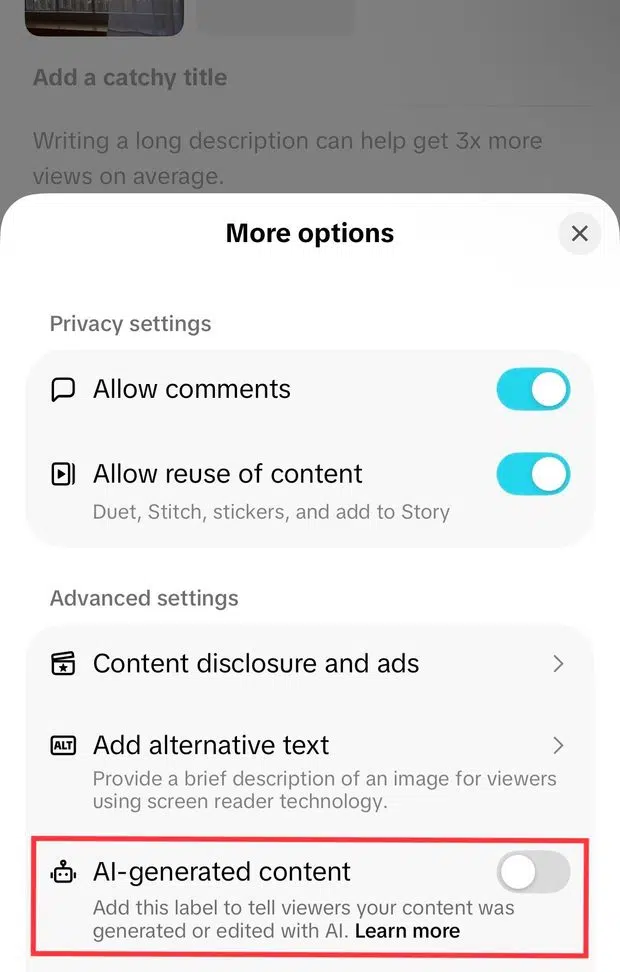
- Creator Toggle: This is a manual option available to creators during the upload process for organic posts. It allows them to proactively disclose AI use, displaying a "Creator labeled as AI-generated" tag.
- Auto Label: TikTok’s internal detection systems automatically apply labels to content created using its proprietary AI effects or third-party tools that embed Content Credentials (metadata indicating AI generation). This acts as a safety net when creators might overlook manual labeling.
- Ad Disclosure: For paid advertising content, advertisers are required to apply a specific AI disclosure within the TikTok Ads Manager, especially for ads featuring realistic AI-generated or significantly AI-edited elements. This is crucial for maintaining advertising integrity and consumer trust.
For brands, compliance with TikTok’s AI disclosure policy is not merely a matter of avoiding penalties; it is fundamental to safeguarding brand reputation and fostering audience trust. In an era where consumers are increasingly wary of deceptive marketing practices and manipulated media, transparency becomes a critical differentiator. As Brittany Garcia, Social Media & Content Strategist at Social By Brittany, aptly notes, "As synthetic content gets harder to spot, disclosure gives people the context to decide what they trust." Brands attempting to pass off AI-generated content as genuine customer testimonials or authentic product experiences risk severe public backlash, which can be far more damaging than any platform-imposed restriction. The public’s sensitivity to perceived deception, especially regarding AI, makes proactive disclosure a strategic imperative.
Beyond reputational concerns, non-compliance carries tangible risks. A missing AI label can lead to content restrictions, where posts receive reduced reach, or outright removal. For advertisers, failing to disclose AI in ads can result in campaign rejections, wasting significant budget and effort. Furthermore, in the context of influencer marketing, brands must extend their AI disclosure expectations to their partners. While a brand might have strict internal guidelines on AI use, an influencer might have different practices. Clear communication within creator briefs ensures that all sponsored content adheres to both TikTok’s policies and the brand’s ethical standards, preventing unintended non-compliance and maintaining the integrity of sponsored posts. The Federal Trade Commission (FTC) in the United States, for instance, provides guidance on endorsements and disclosures, and platforms’ AI policies align with the broader regulatory push for consumer protection against misleading advertising.

To label AI-generated content on TikTok, creators follow a straightforward process. For organic content, after creating or editing a video, users proceed to the "Post" screen. Here, they tap "More options," which reveals a menu including the "AI-generated content" toggle. Activating this toggle automatically adds the disclosure tag to the video. Alternatively, creators can use clear captions, stickers, or watermarks to signify AI generation, though the toggle is the most direct method. For paid advertisements, the disclosure process is integrated into the TikTok Ads Manager. During ad creation, advertisers must navigate to the "Creatives" section and enable the "AI disclosure" setting. It is critical to remember that this setting resets if a campaign is duplicated, requiring re-application for each new instance. Spark Ads, which promote existing organic TikTok posts, follow the organic content disclosure process, meaning the original post must be correctly labeled before being boosted.
Failure to disclose AI content on TikTok can lead to a tiered system of consequences, depending on the nature and potential harm of the content. At the lowest level, TikTok may automatically add an AI label to the content if its detection systems identify AI-generated elements. More severe cases can lead to reduced reach, limiting the content’s visibility to a smaller audience. In instances where the content violates broader Community Guidelines or poses a significant risk of misleading users, it can be removed entirely. Crucially, TikTok has stated that merely adding an AI label does not inherently penalize content distribution. However, the platform is exploring options that allow users to filter out or see less AI-generated content in their feeds, suggesting that labeled synthetic media might reach fewer people who opt for such settings in the future. This emphasizes that while disclosure is essential, the broader acceptance and reach of AI content may still be subject to user preferences and platform evolutions.
Building a robust internal AI disclosure process is crucial for any team regularly creating content for TikTok. This involves establishing clear guidelines, tracking AI usage, and integrating disclosure checks into the existing publishing workflow.
- Platform-Specific Disclosure Rules: Content strategies often involve cross-posting across multiple platforms. It is vital to recognize that AI disclosure policies can vary significantly between platforms (e.g., TikTok vs. Instagram vs. YouTube). Brands must ensure that content meets the specific requirements of each platform before publishing. The example of Samsung, which was observed labeling AI ads on YouTube but not TikTok for identical content, highlights the importance of this granular attention to detail.
- AI Expectations in Creator Briefs: When collaborating with influencers or external creators, brands must explicitly outline their AI usage policies within creator briefs. This includes specifying when AI is permissible, what level of AI-generated content requires approval, and the mandatory disclosure requirements. This proactive communication prevents misunderstandings and ensures brand consistency.
- Flagging AI Use During Handoffs: Content often passes through multiple hands—designers, editors, copywriters, social media managers—before publication. Establishing a system where AI-generated elements are clearly flagged during content handoffs ensures that the person responsible for final scheduling is aware of the need for disclosure. Simple notes in project management tools or content calendars can streamline this process.
- Integrating Disclosure Checks into Approval Workflows: The most effective way to ensure compliance is to build an AI disclosure check directly into the content approval process. Before any content goes live, a designated team member or legal reviewer should confirm whether an AI label is required and that it has been correctly applied. Tools like Hootsuite’s Perch can facilitate this by enabling custom approval flows, routing posts to the appropriate reviewers for a final disclosure check before scheduling.
Hootsuite offers a suite of tools designed to help teams navigate the complexities of TikTok’s AI disclosure policies and maintain overall compliance. Perch empowers teams to integrate AI disclosure checks directly into their content approval workflows. By setting up custom approval flows, posts requiring review can be routed to specific team members who are responsible for verifying AI labels before publication, making disclosure a routine part of the content lifecycle. Vigil, as the governance layer within Hootsuite Social OS, provides granular control over permissions and approvals across all social accounts. This ensures that only authorized personnel and approved AI tools have the ability to publish content, mitigating risks associated with unauthorized or non-compliant posts. Finally, Lumen offers robust social listening capabilities, tracking brand mentions, sentiment, and conversations across a vast array of sources and platforms. This allows teams to monitor public reaction to their AI-generated campaigns, detect any dips in sentiment early, and respond proactively to manage brand reputation effectively.
In conclusion, TikTok’s AI disclosure policy represents a critical step towards greater transparency in the rapidly evolving digital landscape. By mandating labels for realistic AI-generated content, TikTok aims to foster a more authentic and trustworthy environment for its users. For brands and creators, compliance is not merely about avoiding penalties; it’s about building and maintaining trust with their audience, protecting brand reputation, and navigating the ethical considerations of AI in content creation. Proactive engagement with these policies, coupled with robust internal processes and supportive social media management tools, will be essential for success in this new era of AI-driven digital content.

 Siti Muinah
 Jia Lissa