Ali Ikhwan
Landing page best practices are widely recognized within the digital marketing sphere, often serving as foundational principles for optimizing conversion rates. These guidelines are typically derived from extensive A/B testing conducted globally, revealing patterns that historically correlate with enhanced performance. Common tenets include ensuring a direct match between keywords, ad copy, and landing page content, employing color schemes believed to foster trust, minimizing distractions, and strategically placing critical information above the fold. Resources such as PPC Hero’s comprehensive guide by Alexandria Nixon further elaborate on these effective practices, highlighting elements like font size, text simplicity, and the judicious use of taglines or potentially confusing phrases to maintain focus on the core product.
However, a critical juncture arises when these empirically derived principles are treated as immutable laws rather than as hypotheses warranting rigorous testing within a specific context. The genesis of most landing page best practices lies in A/B tests conducted under a unique confluence of conditions. Each published case study represents a snapshot of a particular audience, product, industry, budget, traffic source, pricing structure, competitive landscape, and sales cycle. These variables can diverge significantly from the specific environment of a new A/B test being initiated. Consequently, while best practices offer a valuable starting point, especially for campaigns lacking prior landing page optimization data, their applicability is not universal.
The Foundation of Trust: When Best Practices Serve as a Reliable Baseline
Best practices are most valuable when they provide a solid, data-backed foundation for PPC campaigns that are in their nascent stages of landing page optimization. They offer a crucial benchmark, grounded in statistical patterns that have demonstrated efficacy. This initial phase allows marketers to launch tests with a defensible control variant and a realistic performance metric against which to evaluate results.
Trust in established best practices is particularly warranted under the following circumstances:
- Limited Historical Data: When a campaign or account possesses minimal prior A/B testing data for landing pages, relying on widely accepted best practices offers a prudent starting point. This minimizes the risk of introducing variables that could inherently underperform.
- New Market Entry or Product Launch: For businesses entering new markets or launching entirely novel products, where audience response and conversion drivers are largely unknown, established best practices provide a safe and effective initial framework.
- Budgetary Constraints: In scenarios where resources for extensive, exploratory A/B testing are limited, adhering to proven best practices can maximize the impact of each test iteration.
- Unfamiliar Audience or Industry: When targeting an audience or operating within an industry that is outside the marketer’s core expertise, leveraging established best practices can mitigate the risk of misinterpreting audience behavior or industry-specific nuances.
In these specific situations, adopting best practices effectively sidesteps unnecessary conjecture. Marketers can commence A/B testing with a well-reasoned control and a quantifiable benchmark for subsequent analysis, thereby accelerating the learning curve.
The Imperative of Scrutiny: When to Challenge Conventional Wisdom
The utility of best practices diminishes, and indeed, a critical examination becomes imperative, when a business’s unique circumstances demonstrably contradict or bear no relation to the conditions under which a particular best practice was established. This divergence can manifest in several ways:

- Brand Aesthetics and Perceived Value: Some best practices advocate for minimalist, clean designs, often using neutral color palettes. However, certain brands, particularly in luxury or premium sectors, may benefit from bolder, more distinct visual identities that can enhance perceived value and exclusivity. For instance, a high-end fashion brand might find a minimalist landing page less impactful than one that mirrors its opulent brand imagery.
- Complex Product Offerings or Decision Cycles: For products or services with intricate features or requiring a prolonged decision-making process, a landing page that presents a comprehensive overview, rather than a singular focus, might be more effective. This allows potential customers to explore the full scope of benefits before committing to an inquiry or purchase.
- Niche or Highly Specialized Industries: Industries with unique jargon, established conventions, or specific customer expectations may necessitate a departure from generic best practices. Landing pages that resonate with the specific language and cultural nuances of a niche market are likely to perform better than those adhering to broad, industry-agnostic principles.
- Audience Sophistication and Information Needs: Highly informed or technically proficient audiences may require more detailed information and less simplification than a general audience. A landing page that oversimplifies may alienate these users, while one that provides in-depth technical specifications could foster greater confidence.
PPC Hero contributor Kate Wilcox has previously documented instances where established landing page best practices faltered under real-world testing. This phenomenon is not isolated; firsthand experience across distinct PPC accounts often reveals similar discrepancies.
Case Studies: When Data Deviated from the Norm
Two illustrative case studies highlight how established landing page best practices can be challenged by specific market dynamics and audience behaviors.
Case Study 1: The Power of a Dark Aesthetic in B2B SaaS
In the first instance, a specialized B2B SaaS company catering to the trucking and logistics sector conducted an A/B test comparing a dark-themed landing page against a lighter counterpart. Over a four-week period, the darker landing page demonstrated a remarkable 32% higher conversion rate across both Google Search and Meta advertising campaigns. Customer feedback provided valuable insight into this outcome. Respondents described the black background as conveying a sense of luxury and premium quality, attributes that may not be universally associated with dark design in other industries. Furthermore, the red-outlined call-to-action (CTA) button, while potentially a departure from conventional contrast recommendations, did not deter users; instead, it aligned with the company’s established brand colors, reinforcing brand consistency and recognition. This case underscores how industry-specific perceptions of design and color psychology can significantly influence conversion rates.
Case Study 2: The Unexpected Success of a Broad Product Page
The second account involved a test between a broad, platform-specific landing page showcasing all available products and a highly personalized landing page focused on a single product. The expectation was that the personalized page, offering a tighter message match and appearing more relevant to specific search queries, would outperform the broader page. However, the opposite occurred: the broad landing page, which presented the entire range of available products, generated 71% more conversions over a six-week period, including a higher volume of sales. Although search queries were often feature-specific, the ultimate buying decision was influenced by a broader understanding of the platform. Potential customers might have initiated their search with a particular product in mind, but the comprehensive landing page enabled them to grasp the full capabilities of the platform before submitting an inquiry.
This second scenario was further influenced by traffic volume. Certain ad groups received fewer than 1,000 clicks per week. When limited traffic is fragmented across multiple personalized landing pages, each individual page may not receive sufficient data for optimization algorithms to effectively identify and capitalize on conversion opportunities. This highlights the interconnectedness of traffic volume, page strategy, and platform optimization, a challenge previously addressed by PPC Hero’s Jacob Baadsgaard in his article on optimizing landing pages with low traffic volume.

It is crucial to note that these individual case studies, including those from Kate Wilcox and this author, do not invalidate the original best practices in a general sense. Instead, they serve as potent reminders that established standards often fail to account for the unique interplay of audience behavior, buying decision processes, industry dynamics, and other contextual factors inherent to each specific account.
The Evolving Landscape: AI and the Future of Landing Page Optimization
The advent of Artificial Intelligence (AI) is significantly transforming the landscape of landing page creation and optimization. AI tools can expedite critical stages, including initial research, copy development, design conceptualization, and production. This acceleration allows marketers to incorporate personalized safeguards and leverage account-specific data more efficiently. However, the proliferation of AI-generated content does not guarantee universal success or increased conversion rates.
AI-generated landing pages, by their nature, are influenced by the patterns and data fed into them. While AI can produce aesthetically polished pages that adhere to every known landing page standard, they may still falter if they fail to grasp the subtle nuances of human behavior. This nuanced understanding can encompass industry-specific jargon, emerging trends, and the socio-economic factors that may influence consumer preferences and decision-making.
The SIGNAL Strategy: A Framework for Contextualized Testing
To navigate the complexities of landing page optimization in an era of both data-driven best practices and AI-powered generation, a structured approach to A/B testing is essential. The SIGNAL strategy offers a methodological framework for developing and evaluating landing page tests:
- S – Strategic Alignment: Before initiating any test, it is paramount to align the landing page strategy with overarching business objectives and campaign goals. What specific outcome is desired? Is the goal lead generation, direct sales, brand awareness, or something else?
- I – Insights Gathering: Delve deeply into available data. This includes historical A/B test results, customer feedback, market research, competitor analysis, and audience segmentation. Understanding the existing landscape is crucial for formulating informed hypotheses.
- G – Hypothesis Generation: Based on strategic alignment and insights, formulate clear, testable hypotheses. These hypotheses should articulate a specific change and the expected impact on a defined metric. For example, "Changing the CTA button color from blue to green will increase form submissions by 5% due to a stronger perceived urgency."
- N – Nurturing the Test Environment: Ensure the testing environment is robust and that all variables are controlled. This includes ensuring consistent traffic sources, accurate tracking, and sufficient sample sizes for statistically significant results.
- A – Analysis and Action: Rigorously analyze the test results. Determine if the hypothesis was supported, rejected, or inconclusive. Based on the findings, take decisive action: implement the winning variation, iterate on the losing variation, or develop a new hypothesis.
- L – Learning and Iteration: Every test, regardless of outcome, provides valuable learning opportunities. Document the findings, update internal knowledge bases, and continuously iterate on landing page strategies. The goal is not to blindly follow best practices or to eschew them entirely, but to use them as a springboard for informed experimentation and strategic deviation.
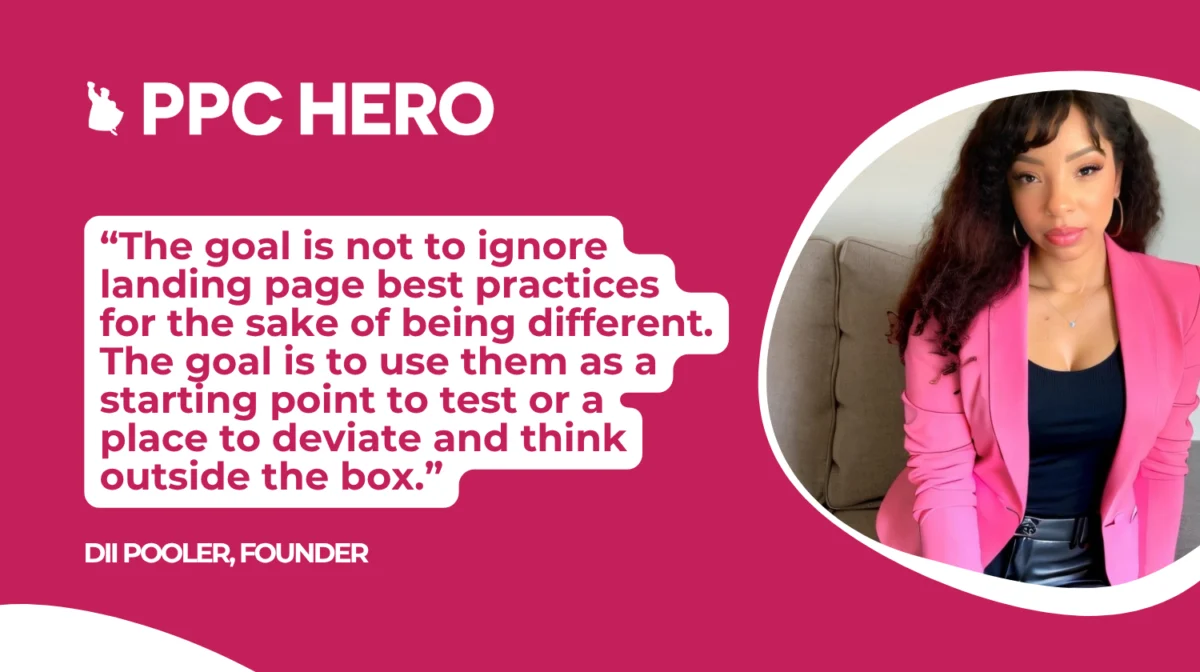
The ultimate objective in landing page optimization is not to be different for the sake of being unconventional. Rather, it is to leverage established best practices as a starting point for rigorous testing, or as a foundation from which to intelligently deviate and explore innovative solutions that resonate with a specific audience and business context. This dynamic approach, combining data-backed principles with critical analysis and contextual understanding, is key to achieving sustained success in the ever-evolving digital marketing landscape.


 Basiran
 Muslim