Ammar Sabilarrohman
In the contemporary landscape of software engineering and product management, the traditional "big bang" release—where new code is deployed to an entire user base simultaneously—has largely been replaced by more nuanced, risk-averse methodologies. At the heart of this shift is the concept of full-stack experimentation, a sophisticated framework that allows teams to decouple code deployment from feature release. While the terms feature flags, rollouts, and feature testing are frequently used interchangeably in industry discourse, they represent distinct strategic functions within the product lifecycle. Understanding the technical and operational boundaries between these three pillars is essential for organizations seeking to optimize user experience while maintaining high system stability.
The Technical Foundation of Full-Stack Experimentation
To understand the specific tools, one must first define the environment in which they operate. Full-stack experimentation represents a significant evolution from traditional client-side testing. In client-side A/B testing, changes are typically executed within the user’s browser via JavaScript, modifying elements that have already been rendered. While effective for cosmetic changes like button colors or headline text, client-side testing is often plagued by "flicker"—a brief flash of the original content before the variant appears—and is limited to the front-end interface.
Full-stack experimentation, conversely, operates deeper within the technology stack. It allows for the testing of backend logic, database queries, search algorithms, and infrastructure-level changes. By bucketing users into specific variants before the application or page even renders, full-stack tools eliminate performance issues like flicker and allow for more complex experiments, such as testing the efficacy of a new pricing engine or a revamped checkout flow. Modern platforms, such as Convert Experiences, facilitate this through SDKs (Software Development Kits) in various languages including JavaScript/TypeScript, PHP, Python, Ruby, iOS, and Android, ensuring that a user’s experience remains consistent across multiple touchpoints and devices.
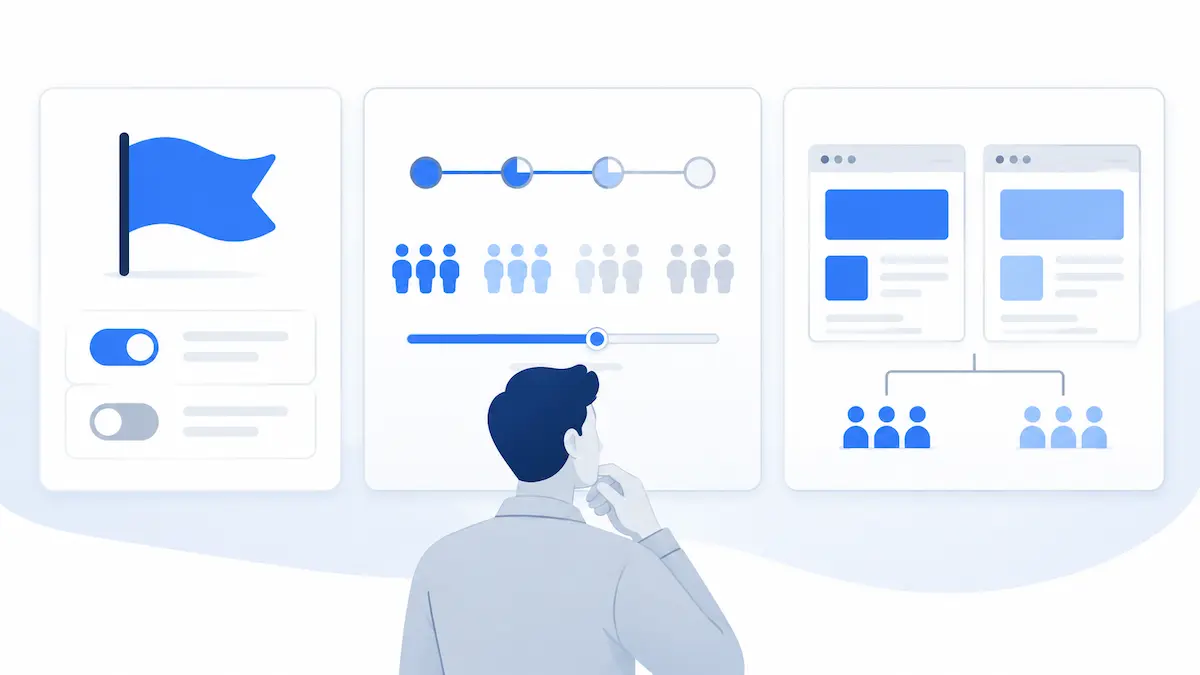
Feature Flags: The Strategic Decoupling of Code and Release
A feature flag, also known as a feature toggle, is essentially a conditional logic statement embedded within the source code. It acts as a remote-controlled switch that allows developers to enable or disable functionality at runtime without necessitating a new code deployment. This capability has fundamentally changed the DevOps "deployment pipeline," allowing teams to ship "dark" code—functionality that is present in the production environment but hidden from the end user.
Historically, the use of feature flags gained prominence as part of the Continuous Integration and Continuous Deployment (CI/CD) movement. By wrapping new code in a flag, developers can merge their work into the main codebase frequently, avoiding the "merge hell" associated with long-lived feature branches.
There are several categories of feature flags, each with varying lifespans:
- Release Toggles: Used to facilitate the flow of continuous delivery. These are temporary and are removed once a feature is fully launched.
- Ops Toggles: Often called "kill switches," these are used to protect system integrity. If a new integration causes a spike in latency or error rates, the Ops toggle can disable the feature instantly.
- Permission Toggles: Used to manage access for specific user segments, such as "early access" groups or premium subscribers. These may remain in the codebase for years.
The risk of feature flags lies in "flag debt" or "flag sprawl." When teams fail to remove temporary flags, the codebase becomes cluttered with dead logic branches, increasing complexity and the potential for technical debt.

Feature Rollouts: Managing the Blast Radius
If a feature flag is a binary switch, a rollout is a dimmer. A feature rollout is the process of progressively widening the exposure of a new feature to the user base. The primary objective of a rollout is risk mitigation—managing what engineers call the "blast radius" of a new release.
In a typical rollout scenario, a product team might release a new search algorithm to only 1% or 5% of their traffic. Engineering teams monitor critical "guardrail metrics"—such as server response times, error logs, and memory usage—to ensure the new code doesn’t degrade system performance. If the metrics remain stable, the exposure is increased to 20%, then 50%, and eventually 100%.
Data from the DevOps Research and Assessment (DORA) group indicates that high-performing technology organizations are twice as likely to use progressive rollouts compared to low performers. This is because rollouts provide a safety net. If a critical bug is discovered at the 5% exposure level, it only impacts a small fraction of the audience, and the feature can be rolled back to 0% in seconds through the experimentation dashboard, without requiring an emergency code fix or a redeploy.
Feature Testing: The Science of Impact Validation
While rollouts focus on safety, feature testing (often called full-stack A/B testing) focuses on performance and business impact. Feature testing is a scientific method used to determine which version of a feature best achieves a specific objective, such as increasing conversion rates, reducing churn, or improving user engagement.
Unlike a rollout, where there is usually only one version of a new feature being ramped up, a feature test involves a control group (the original experience) and one or more variations. Traffic is split evenly or according to a specific ratio, and the results are analyzed using statistical models to determine if the observed changes in user behavior are significant or merely the result of random chance.
In the context of software quality assurance (QA), "feature testing" refers to checking if a feature works as intended. However, in the realm of product experimentation, it refers to whether the feature works for the business. For example, a travel booking site might use feature testing to determine if a "recommended hotels" algorithm based on machine learning outperforms a simpler algorithm based on popularity. The test would run until statistical significance is reached, providing the product team with the data needed to make a "ship or scrap" decision.
Comparative Analysis: Strategic Differences and Operational Ownership
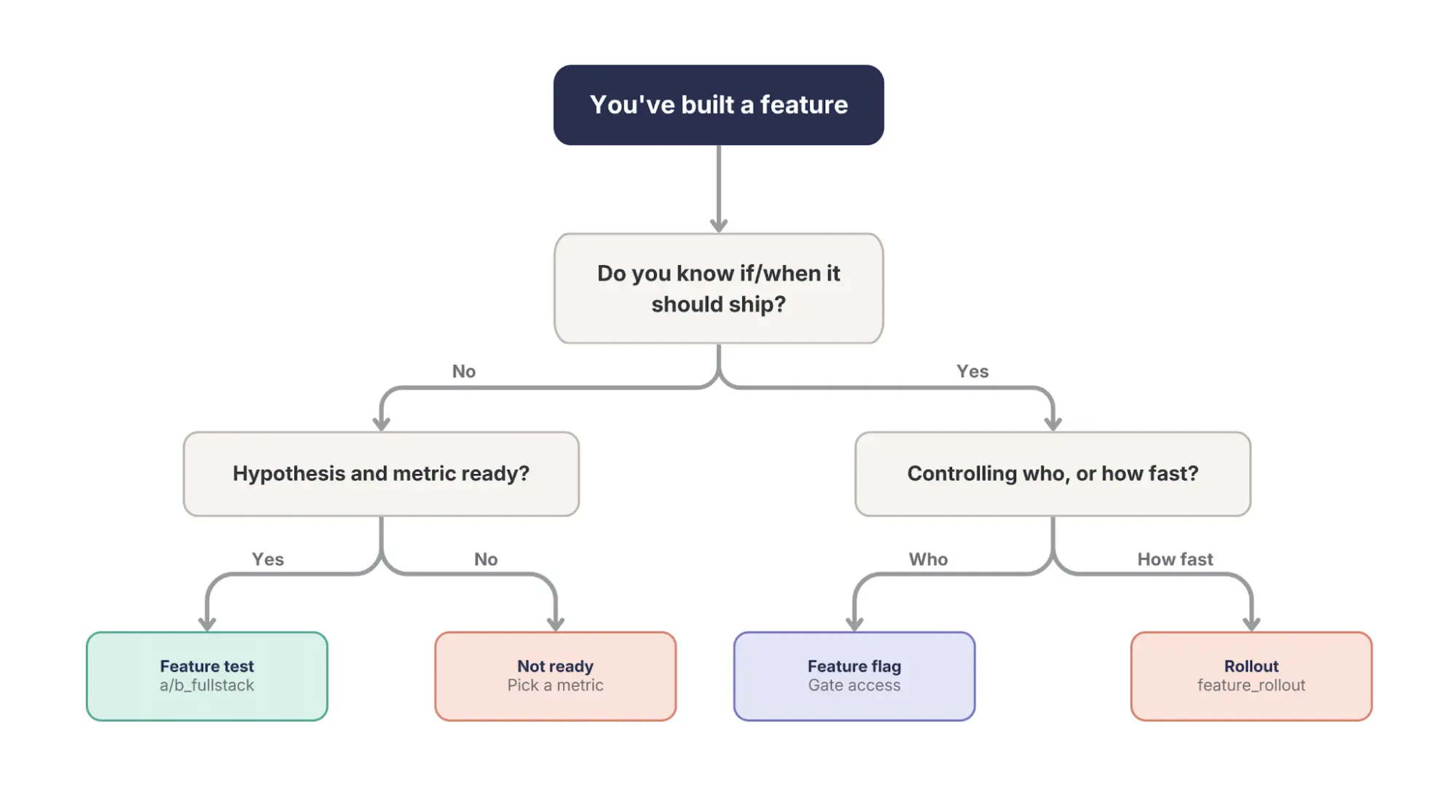
The distinction between these three mechanisms can be summarized by the questions they answer and the teams that operate them.
| Factor | Feature Flags | Rollouts | Feature Testing |
|---|---|---|---|
| Primary Question | Can this be switched on/off? | Is it safe to show this to more people? | Does version A perform better than version B? |
| Control Group | No | No | Yes |
| Traffic Allocation | Binary (On/Off) or Targeted | Incremental Ramp (e.g., 5% to 100%) | Fixed Split (e.g., 50/50) |
| Primary Operator | Engineering | Engineering & Product | Product, Growth, & CRO |
| Success Metric | System Availability | System Stability (Error Rates) | Business KPIs (Conversion, Revenue) |
In a mature organization, these three tools are used in a logical sequence. A feature flag gates the code during development. Once the code is ready, a feature test is conducted to see if the new functionality actually improves the user experience. If the test is successful, a rollout is used to safely deploy the winning variation to the entire global audience.

The Broader Impact on Organizational Culture
The adoption of these full-stack methodologies has profound implications for organizational culture, shifting it from one of "opinion-driven" development to "data-driven" development. When the cost of failure is high, teams become risk-averse, leading to slower release cycles and less innovation. By using flags, rollouts, and tests, the cost of failure is drastically reduced.
Industry analysts suggest that the "experimentation-first" approach allows companies to avoid the "sunk cost fallacy." Without these tools, a company might spend six months developing a feature, release it to everyone, realize it doesn’t work, but keep it anyway because of the effort invested. With feature testing, that same company can validate a "Minimum Viable Product" (MVP) version of the feature in two weeks and decide whether to continue investing or pivot based on real user data.
Furthermore, the consistency provided by modern full-stack platforms ensures that the "user journey" remains intact. If a user is assigned to a specific variant on a mobile app, the SDK ensures they see the same variant when they log in via a desktop browser. This cross-platform bucketing is crucial for accurate data collection and a seamless user experience.
Timeline of Development in Release Management
The transition to these methods has occurred over several distinct eras:

- The Manual Era (Pre-2000s): Releases were physical or manual, involving long lead times and high risk.
- The Agile/DevOps Era (2000s-2010s): The rise of automated testing and CI/CD pipelines. Feature flags began as home-grown configuration files.
- The Experimentation Era (2015-Present): The emergence of dedicated full-stack experimentation platforms. These platforms provide standardized SDKs, sophisticated statistical engines, and user-friendly dashboards that allow non-engineers to manage flags and tests.
Conclusion: Integrating the Switch, the Dimmer, and the Scale
As software systems grow in complexity, the ability to control, observe, and measure changes in real-time becomes a competitive necessity. Feature flags provide the foundational control (the switch), rollouts provide the safety of progressive delivery (the dimmer), and feature testing provides the empirical evidence for product decisions (the scale).
For organizations utilizing platforms like Convert Experiences, the integration of these three functions into a single workflow allows for a holistic approach to product optimization. By leveraging SDKs that span the entire technology stack—from the edge (like Cloudflare Workers) to the backend server and the native mobile environment—companies can ensure that every change they ship is not only safe and functional but also demonstrably valuable to their users and their bottom line. The future of product development lies not in bigger releases, but in smarter, more controlled experiments.


 Layla Zulfa

 Lina Irawan