Early indicators from Adobe’s comprehensive "AI Traffic Trends Report" released in August 2026 suggest a significant potential for artificial intelligence to reshape the economics of e-commerce by directly addressing one of its most enduring and costly challenges: product returns. While the report, which analyzes over a trillion visits to U.S. retail sites and encompasses 100 million stock-keeping units (SKUs), delves into a broad spectrum of AI’s impact on online retail, a key insight buried within its extensive findings points to a future where AI-assisted shopping leads to a tangible reduction in returned merchandise. This potential benefit, though not the report’s primary focus, could represent a paradigm shift for online retailers struggling to mitigate the financial drain of product returns, a perennial issue that eats into profit margins and complicates logistics.
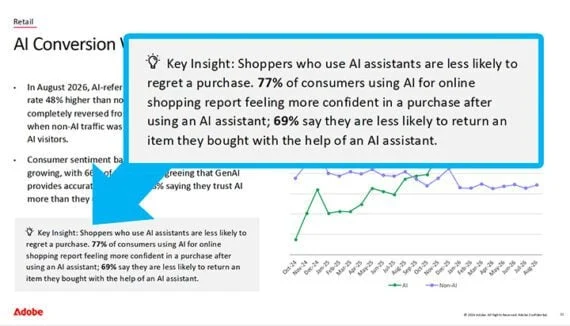
The report, drawing upon data aggregated through Adobe Analytics and supplemented by a survey of 5,000 U.S. consumers conducted in July 2026, paints a compelling picture of how AI is beginning to influence consumer behavior and purchasing decisions. The survey results, in particular, offer concrete evidence of AI’s positive influence on shopper confidence and purchase accuracy. A substantial 69% of respondents who reported using AI for their online shopping indicated they were less likely to return an item when guided by AI assistance. Complementing this, a remarkable 77% of these same users stated that interacting with an AI assistant enhanced their confidence in making a purchase. These figures, while derived from a specific survey sample, align with broader trends observed in e-commerce adoption of AI technologies, suggesting a growing consumer trust in AI’s ability to facilitate more informed and satisfying transactions.
The Genesis of AI-Driven Confidence
The integration of AI into the shopping journey is not a sudden phenomenon but rather a culmination of advancements in natural language processing, machine learning, and data analytics that have been developing over the past decade. By the mid-2020s, AI assistants had evolved from rudimentary chatbots to sophisticated tools capable of understanding complex user queries, performing extensive product comparisons, and even simulating virtual shopping experiences. This evolution has positioned AI not merely as a customer service tool but as an integral part of the pre-purchase research and decision-making process.
The timeline leading to this report’s findings can be traced back to the early adoption of AI in e-commerce around the late 2010s and early 2020s. Initially, AI was primarily employed for personalized product recommendations and inventory management. However, as AI capabilities expanded, so did its application in customer-facing roles. The development of virtual try-on technologies, AI-powered size guides, and sophisticated search engines capable of understanding nuanced product attributes laid the groundwork for the AI assistants described in the Adobe report. The surge in e-commerce during the COVID-19 pandemic further accelerated the adoption of digital tools, including AI, as retailers sought to enhance online customer experiences and streamline operations. By 2025 and 2026, AI had become a more ubiquitous presence, with many consumers actively seeking out AI-powered tools to navigate the complexities of online shopping.
Informed Shoppers, Higher Conversions
Adobe’s data provides a quantifiable measure of AI’s impact on shopper behavior. The report highlights that consumers who arrive at merchant websites via AI platforms tend to be more decisive and better prepared. In July 2026, a significant finding emerged: AI-referred retail visitors exhibited a 60% higher conversion rate compared to traffic originating from non-AI sources. Furthermore, these AI-influenced consumers generated 53% more revenue per visit. This suggests that AI is not only driving more sales but also increasing the value of each transaction.
The underlying mechanism for this enhanced performance is straightforward. Traditionally, consumers would spend considerable time navigating multiple e-commerce sites, meticulously comparing product features, dimensions, compatibility, customer reviews, and pricing. This often led to decision fatigue and, consequently, a higher likelihood of purchasing an item that didn’t fully meet expectations, thus increasing the probability of a return. AI assistants, however, can consolidate much of this laborious research. By acting as an intelligent intermediary, an AI can sift through vast amounts of product data and present curated recommendations, effectively narrowing down choices and resolving pre-purchase uncertainties before the shopper even lands on a specific retailer’s website.
A relevant example illustrating this dynamic is Meta’s Muse. This AI-powered tool can autonomously browse numerous e-commerce platforms using its integrated virtual web browsers. Before directing a user to a specific product or store, Muse conducts extensive research, fulfilling the shopper’s need for comprehensive information and reducing ambiguity. This referral often occurs after the shopper, guided by the AI, has already significantly refined their options and gained a clearer understanding of their desired product. This proactive approach to information gathering and problem-solving is a key differentiator that AI brings to the e-commerce landscape.
The Crucial Role of Rich Product Information
For e-commerce merchants, the implications of these findings extend beyond merely optimizing AI referral traffic. The core takeaway for businesses lies in the critical importance of product information. The ability of AI assistants to effectively reduce purchase uncertainty and guide consumers towards the right products hinges entirely on the quality, accuracy, and comprehensiveness of the data they can access.
AI assistants are only as effective as the information they are fed. To accurately assess whether a product aligns with a shopper’s specific needs, AI requires access to detailed and meticulously organized product data. This includes, but is not limited to:

- Precise Specifications: Detailed technical attributes, dimensions, weight, materials, and performance metrics.
- Compatibility Details: Information on how a product interacts with other devices, software, or systems.
- Variant Information: Clear distinctions between different colors, sizes, configurations, and model numbers.
- Delivery Estimates: Accurate projections for shipping times and availability.
- Verified Reviews: Aggregated customer feedback, including star ratings, qualitative comments, and common themes.
- Frequently Asked Questions (FAQs): Answers to common consumer queries that address potential concerns.
- Comparative Data: Information that allows for direct comparison of features and benefits against competing products.
When this rich product information is readily available and accurately maintained, AI assistants can perform their function with a higher degree of precision. They can identify potential mismatches, highlight crucial differences, and confidently recommend products that are a strong fit for the individual consumer. This not only increases the likelihood of a sale but, more importantly, significantly reduces the probability of a return due to a product not meeting expectations.
The potential benefit for merchants is twofold: securing a sale and, crucially, avoiding the associated costs and complexities of processing a return. A product that is correctly matched to a consumer’s needs from the outset is a product far more likely to be kept. This symbiotic relationship between robust product data and AI-driven recommendations could redefine the profitability of online retail.
Addressing the Returns Epidemic
The persistent problem of product returns has long plagued the e-commerce industry. Estimates vary, but studies have consistently shown that return rates in online retail can be significantly higher than in brick-and-mortar stores, sometimes reaching as high as 30% or more for certain product categories. These returns incur substantial costs for retailers, including:
- Shipping Costs: The expense of shipping the item back to the retailer.
- Restocking Fees: Labor and overhead associated with inspecting, repackaging, and returning items to inventory.
- Processing Costs: Administrative costs for managing return authorizations and refunds.
- Inventory Depreciation: Items may be returned in a condition that reduces their resale value or makes them unsellable.
- Customer Dissatisfaction: Repeated negative return experiences can lead to customer churn.
The early data from Adobe’s report offers a glimmer of hope in mitigating these challenges. While it is indeed premature to definitively declare that AI-aided shopping will revolutionize return rates across the entire e-commerce ecosystem, the underlying logic is sound and the initial evidence is compelling. Shoppers who are better informed, whose purchase decisions are guided by a more complete understanding of a product’s suitability, are inherently more likely to be satisfied with their purchase and therefore less inclined to initiate a return.
The implications of even a moderate reduction in return rates could be substantial. For a retailer with millions of dollars in annual sales, a 5% to 10% decrease in returns could translate into millions of dollars in saved costs and improved profitability. Beyond the financial benefits, a reduction in returns also contributes to greater operational efficiency and a more sustainable e-commerce model, as fewer products are shipped, handled, and potentially discarded.
Future Outlook and Industry Reactions
The findings from Adobe’s report are likely to resonate across the e-commerce and technology sectors. Industry analysts and e-commerce executives are expected to closely monitor the continued development and adoption of AI in shopping.
Reactions from E-commerce Platforms: Companies like Shopify, Amazon, and other major online retailers are undoubtedly paying close attention. While some platforms may be investing heavily in their own AI development (as seen with Meta’s Muse, for example), others might focus on integrating third-party AI solutions or enhancing their data infrastructure to better support AI-driven recommendations. The imperative will be to leverage AI not just for customer acquisition but for customer retention through satisfaction, which directly impacts return rates.
Consumer Technology Providers: Developers of AI tools and platforms will likely see increased demand for solutions that can integrate seamlessly with e-commerce sites and provide granular product data analysis. The focus will shift towards creating AI assistants that can offer a truly personalized and error-minimizing shopping experience.
Logistics and Supply Chain Companies: While a reduction in returns might seem counterintuitive for businesses that profit from reverse logistics, it signifies a more efficient and less wasteful e-commerce ecosystem. The focus might shift from managing high volumes of returns to optimizing inbound logistics and product delivery.
The Path Forward: As AI continues to evolve, its role in pre-purchase decision-making will only grow. The key for merchants will be to invest in robust product data management systems and to embrace AI as a strategic tool, not just a technological add-on. The potential for AI to foster more informed consumer choices, leading to fewer returns and increased customer satisfaction, presents a significant opportunity to enhance the long-term viability and profitability of the e-commerce industry. The "AI Traffic Trends Report" serves as an important early signal, highlighting a promising avenue for addressing one of e-commerce’s most persistent and costly operational headaches.