A significant operational glitch has been identified within Google Search’s experimental "Web Guide" feature, preventing users from seamlessly reverting to the traditional "classic search" interface. The bug, first reported on September 20, 2026, by observant users and subsequently confirmed by search industry professionals, traps individuals within the Web Guide environment despite attempts to select the "Classic search" option. This issue highlights the complexities inherent in integrating advanced AI functionalities with established search paradigms, underscoring the delicate balance between innovation and user experience stability in a product relied upon by billions globally.
Understanding Google’s Web Guide: A Hybrid Search Experience
Google’s Web Guide, introduced as an opt-in beta feature, represents a strategic evolution in the company’s approach to information retrieval. Launched around September 2023, as referenced by earlier reports, it was designed as a unique amalgamation of Google’s burgeoning AI-powered search results interface and its long-standing, familiar web search interface. The primary objective of Web Guide appears to be an attempt to bridge the gap between generative AI summaries and direct links to web pages, offering users a more curated, context-rich search experience without entirely abandoning the traditional link-based results that have defined Google Search for decades.
In an increasingly competitive landscape where rivals like Microsoft’s Copilot (formerly Bing Chat) and independent AI search engines such as Perplexity AI are pushing the boundaries of conversational and summarized search, Google has been under pressure to demonstrate its leadership in AI integration. Web Guide serves as one such testing ground, allowing Google to experiment with new ways of presenting information, offering a "mix" that aims to provide both synthetic answers and direct pathways to source material. This hybrid model is particularly relevant as search queries become more complex and users increasingly expect immediate, comprehensive answers alongside the ability to deep-dive into source content. The beta nature of Web Guide implies ongoing development, user feedback collection, and iterative improvements before any potential wider rollout or integration into the core search experience.
The Unraveling of a Bug: A Chronology of Discovery
The discovery of this critical bug unfolded rapidly within the vigilant community of search engine observers and professionals.
September 2023 (Approximate): Google begins rolling out or actively testing Web Guide as a beta opt-in feature, allowing select users to experiment with the new hybrid search interface. Initial reports suggest its aim to blend AI summaries with traditional web listings.
September 20, 2026: The bug is first publicly identified and reported by Damien Andell, a keen observer of Google’s search developments. Andell took to X (formerly Twitter) to articulate his findings, stating, "Google search bug: impossible to return to ‘classic search,’ it always redirects to Web Guide. There’s another error with a link that returns ‘null://null’ instead of the site name." His initial report highlighted not only the primary functional failure but also an associated technical anomaly concerning broken links.
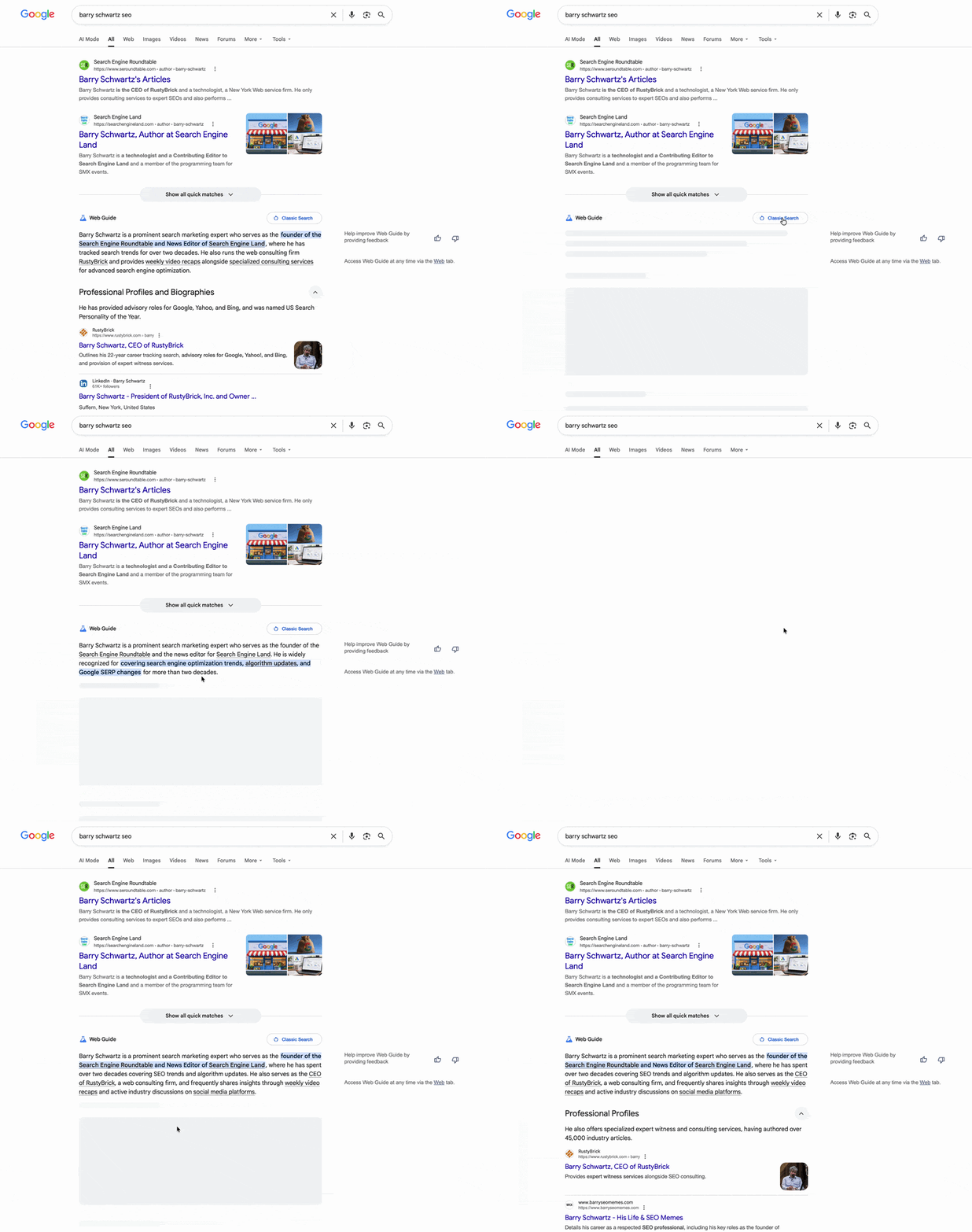
Shortly After Andell’s Report (September 20, 2026): Barry Schwartz of SERoundtable, a prominent industry publication known for its rapid reporting on Google’s changes, attempted to replicate the issue. His tests confirmed the presence of the bug, demonstrating through a visual GIF that clicking the "Classic search" button merely reloaded the existing Web Guide results, effectively trapping the user within the beta interface. Schwartz’s report provided crucial independent verification of Andell’s initial claims, lending credibility to the severity of the issue.
Later on September 20, 2026: Glenn Gabe, a highly respected search marketing expert with extensive knowledge of Google’s intricate search algorithms and experimental features, weighed in on the discussion. Gabe, acknowledging his familiarity with Web Guide, corroborated the intermittent nature of the bug. He posted on X, "Ah, new bug as of this morning. I am sometimes stuck in Web Guide and can’t get out. Just tried again, and I was able to get the standard SERPs. So a weird one." Gabe’s statement confirmed that the issue was not universally constant but rather sporadic, adding a layer of complexity to its diagnosis and potential resolution.
Ongoing Observations (September 20, 2026): Damien Andell further elaborated on his observations, providing additional visual details of the bug’s manifestation. He noted specific UI anomalies, such as "text from the Web Guide below the knowledge panel, which shouldn’t be there," and partial visibility of the word "Access," indicating a rendering or display error alongside the functional one. He also provided a visual contrast of what a successful "Classic Search" transition should look like, further illustrating the deviation caused by the bug. This collective reporting established a clear timeline of discovery and confirmation, drawing attention to a significant flaw in a key beta feature.
Detailed Examination of the Glitch
The core of the reported problem lies in the dysfunctional "Classic search" button within the Web Guide interface. This button, presumably intended to act as an escape hatch, allowing users to opt out of the experimental AI-driven view and return to the familiar, link-heavy traditional search results page (SERP), fails to execute its function. Instead of navigating away, users experience a refresh of the current Web Guide page, effectively creating a loop that holds them captive within the beta environment. This behavior is not merely an inconvenience but a fundamental breakdown of user control within a Google product.
Beyond the primary functional failure, Damien Andell’s initial report also highlighted a secondary, equally concerning technical anomaly: the appearance of a "null://null" error in place of an expected site name or URL. This type of error typically signifies a broken or improperly configured link, where the system is unable to retrieve or render the intended destination. While distinct from the "Classic search" button issue, its co-occurrence suggests potential underlying instability or incomplete integration within the Web Guide’s infrastructure. Such errors can lead to a degraded user experience, broken navigation, and an overall perception of a buggy or unfinished product.
Furthermore, Andell’s detailed visual observations pointed to user interface inconsistencies. The presence of "text from the Web Guide below the knowledge panel, which shouldn’t be there," along with fragmented text like "Access," suggests rendering issues or improper layering of UI elements. These visual glitches, while perhaps less critical than the functional lockout, contribute to the overall impression of a system that is not fully polished or stable. They hint at potential conflicts between different display components or an incomplete separation of the Web Guide’s visual elements from those of the standard SERP.
The intermittent nature of the bug, as confirmed by Glenn Gabe, adds another layer of complexity. While some users might consistently experience the lockout, others might find themselves able to switch to classic search on certain attempts. This inconsistency can be more frustrating than a constant failure, as users cannot predict when the feature will work as intended. Intermittent bugs are often harder to diagnose and reproduce, requiring more sophisticated logging and testing mechanisms for developers to pinpoint the root cause effectively. This variability could stem from server-side load, specific user browser configurations, cached data, or subtle timing issues within the Web Guide’s code execution.
The Broader Context: Google’s AI Search Evolution
The emergence of this bug within Web Guide is not an isolated incident but rather a symptom of the broader, ongoing transformation within Google’s search ecosystem. Google, holding an overwhelming majority of the global search market share (consistently above 90% according to various analytics firms like StatCounter and Similarweb), faces the dual challenge of innovating rapidly in AI while maintaining the unparalleled reliability of its core search product. The imperative for AI integration in search is driven by several factors: the rise of large language models, the increasing sophistication of user queries, and aggressive moves by competitors.
Google’s competitive landscape has significantly intensified with the advent of advanced generative AI. Microsoft, a long-standing rival, has integrated OpenAI’s GPT models into its Bing search engine (now Copilot), offering conversational AI capabilities directly within the search experience. Other players, including startups focused purely on AI-driven answers, are also vying for user attention. This pressure necessitates Google’s proactive development of features like Web Guide and Search Generative Experience (SGE), which aim to harness AI to deliver more direct answers, summarize complex topics, and enhance user interaction.
Beta programs, such as Web Guide, are crucial components of Google’s product development lifecycle. They allow the company to test new features with a segment of its user base, gather real-world feedback, identify unforeseen issues, and iterate rapidly before a wider release. This agile approach is essential for staying at the forefront of technological innovation, especially in fast-moving fields like AI. However, beta programs inherently carry the risk of bugs and incomplete functionalities. Users opting into these programs generally understand and accept this risk, providing valuable data that helps refine the product.
Despite the focus on innovation, user expectations for Google Search remain incredibly high. Decades of consistent, reliable performance have ingrained a sense of trust and dependency. For many, Google Search is not just an application but a fundamental utility, integral to daily work, education, and personal information seeking. Any disruption, even in a beta feature, can lead to frustration and erode this trust. The "classic search" experience, with its predictable link-based results, remains the bedrock for billions of users worldwide, particularly those who prioritize direct navigation to websites, specific SEO analysis, or simply prefer the familiar interface. The bug preventing a return to this classic view therefore touches upon a core aspect of user reliance and comfort.
Reactions from the Search Community and Potential Official Response
The search community, particularly those active on platforms like X, reacted to the Web Guide bug with a mix of frustration, technical curiosity, and professional insight. Damien Andell’s initial report garnered immediate attention, serving as a focal point for discussion. His detailed observations, including the "null://null" error and UI inconsistencies, provided concrete evidence for others to investigate. Barry Schwartz’s swift replication and public confirmation through SERoundtable underscored the gravity of the issue, bringing it to a wider audience of webmasters, SEO professionals, and digital marketers who closely monitor Google’s every move.
Glenn Gabe’s contribution was particularly valuable, as his expertise in Google’s complex search features allowed him to contextualize the bug. His acknowledgment of its intermittent nature ("weird one") validated the experiences of users who might not consistently encounter the problem, while also indicating the potential difficulty for Google’s engineering teams to consistently reproduce and diagnose it. The collective sentiment from these experts and others in the community highlighted a shared understanding: while beta features are expected to have kinks, a bug that traps users and prevents them from accessing the fundamental "classic search" experience is a significant misstep.
From the perspective of webmasters and SEO professionals, such glitches in Google’s interface are more than mere annoyances. They can impact their ability to accurately analyze search engine results pages (SERPs), understand user behavior, and monitor the effectiveness of their optimization strategies. A stable and predictable search environment is crucial for their work, and any disruption, even in a beta feature, warrants close scrutiny.
While Google has not issued an official statement regarding this specific Web Guide bug at the time of this report, a typical response from the company in such situations can be anticipated. Google is generally proactive in acknowledging and addressing bugs, especially those impacting user experience. An expected official statement would likely involve:
- Acknowledgement: Confirming the existence of the bug within the Web Guide beta feature.
- Investigation: Stating that their engineering teams are actively investigating the root cause.
- Assurance: Reassuring users of their commitment to providing a stable and high-quality search experience.
- Resolution: Indicating that a fix is being developed and will be deployed as soon as possible.
- Beta Context: Reiterating that Web Guide is a beta feature and feedback from users is vital for its development, implicitly reminding users that beta features may contain imperfections.
This kind of response would align with Google’s established communication protocols for issues affecting its products, balancing transparency with an emphasis on problem resolution.
Implications for Users and the Future of Search
The Web Guide "Classic search" bug carries several implications for both individual users and the broader trajectory of search technology. For users, the immediate impact is one of frustration and disruption. Being trapped in an experimental interface when desiring the familiarity and predictable results of classic search can hinder productivity and lead to a negative perception of new features. While Web Guide is opt-in, the inability to opt-out effectively defeats the purpose of providing user choice. This incident could lead some users to be more hesitant in adopting future beta features, eroding the willingness to provide valuable early feedback that Google relies upon for innovation.
From a product development and quality assurance standpoint, this bug serves as a crucial lesson. It underscores the technical challenges of integrating complex AI models into a mature, high-traffic product like Google Search, especially when needing to maintain compatibility and fallback options to legacy features. Ensuring robust quality assurance, comprehensive regression testing, and fail-safe mechanisms are paramount, particularly when dealing with core functionalities like navigation. The intermittent nature of the bug also highlights the need for advanced monitoring and debugging tools capable of capturing sporadic issues across diverse user environments.
The incident also highlights the delicate balance Google must strike between aggressive innovation and maintaining user trust and stability. As Google continues its ambitious integration of generative AI into its core search product, it navigates a landscape where users are eager for advancements but equally reliant on the foundational stability of the service. The "classic search" experience, while potentially less cutting-edge than its AI-driven counterparts, remains the gold standard for many users who value direct links, precise control over their search parameters, and a familiar interface. The bug underscores the enduring importance of ensuring that this foundational experience remains accessible and reliable, even as new paradigms emerge.
Ultimately, the Web Guide bug, though specific to a beta feature, is indicative of the growing pains inherent in transforming a global utility. It reinforces the notion that while AI promises revolutionary changes to information access, the journey from experimental concept to seamless integration is fraught with technical hurdles. Google’s ability to swiftly address such issues, learn from them, and continue to refine its hybrid search offerings will be critical in shaping the future of search and ensuring its continued dominance in an increasingly AI-driven world. The feedback from the search community, particularly from diligent reporters like Damien Andell and experts like Glenn Gabe, remains invaluable in this ongoing evolution.