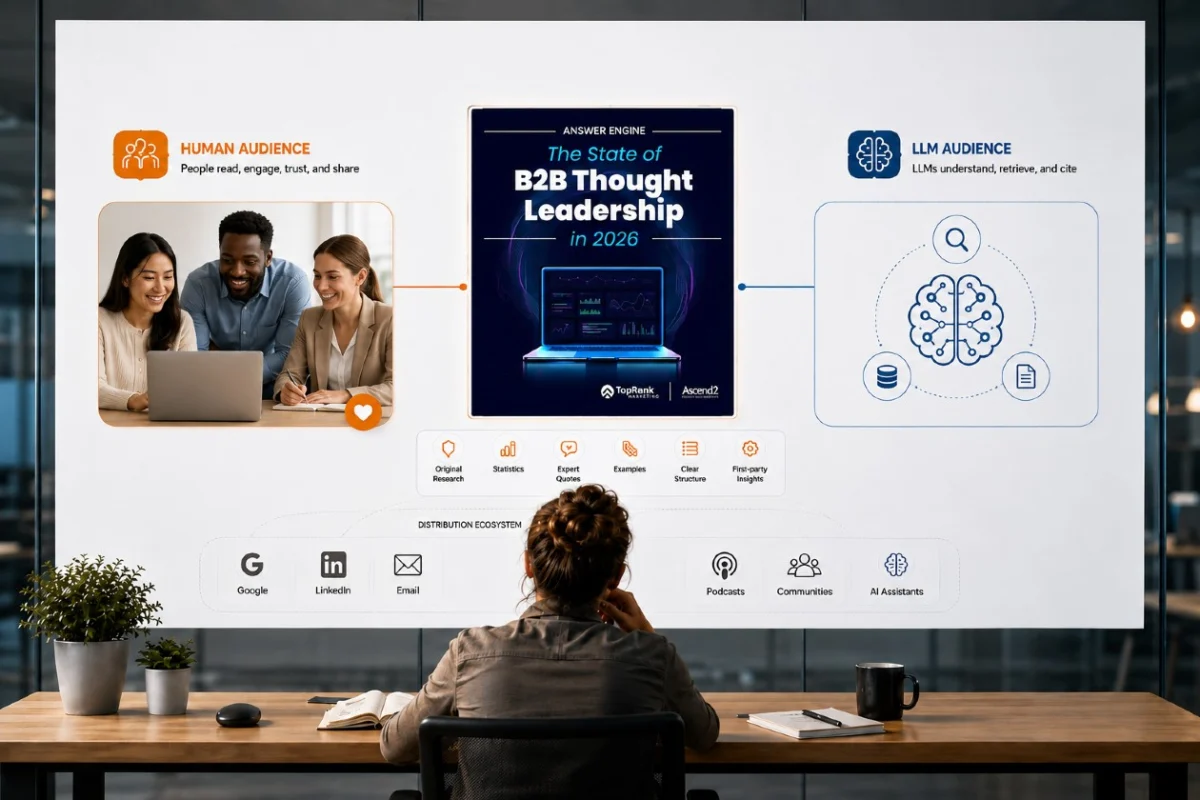
In the rapidly evolving digital arena of 2026, B2B marketers face a dual audience challenge, a complex interplay between human buyers and increasingly sophisticated AI answer engines. This dynamic shift necessitates a fundamental re-evaluation of content strategy, with original research and validated insights emerging as critical differentiators. A comprehensive new report, "Answer Engine: The State of B2B Thought Leadership in 2026," conducted in partnership with Ascend2, surveyed 797 B2B marketers, revealing that 97% consider thought leadership essential for full-funnel success. The research underscores a significant trend: the content that resonates most deeply and earns both human and machine trust is deeply rooted in proprietary data and amplified by credible voices.
The core of this transformation lies in how both human decision-makers and AI algorithms are evaluating B2B content. Modern buyers, often comprising a committee of eight to ten individuals, are pressed for time, highly discerning, and acutely aware of the personal repercussions of misguided recommendations. Simultaneously, AI-driven retrieval and reasoning systems, such as those powering ChatGPT, Perplexity, Google AI Mode, and Claude, are meticulously parsing, summarizing, and ranking content to provide definitive answers to user queries. These AI engines, much like their human counterparts, are programmed to seek proof, source authority, and consensus among reputable sources.
The Ascend2 survey highlights the profound impact of research-based content, with 93% of B2B marketers reporting its effectiveness in driving engagement and generating leads. Furthermore, a stark contrast emerges when analyzing the role of influencers: 72% of marketers who frequently collaborate with influencers deem their research content "very effective," significantly outpacing the 29% effectiveness rate reported by those who do not engage with influencers. This symbiotic relationship between original data and expert validation is becoming the bedrock of successful B2B thought leadership.
The Rise of AI as a Content Curator
A particularly striking finding from the report is the emergence of Generative AI (GenAI) as a significant channel for content discovery. As of 2026, a notable 32% of B2B buyers are now discovering thought leadership through GenAI tools, a pathway that was virtually non-existent in most marketer distribution strategies just a year prior. This statistic underscores the imperative for marketers to optimize their content not only for human consumption but also for machine comprehension and attribution.
The report’s authors emphasize that the criteria AI answer engines use to evaluate content mirror those of discerning human buyers. Both seek verifiable evidence that can be defended internally or attributed externally. Original research and proprietary data offer the "proof" that satisfies this need. Credible industry influencers, seasoned executives, and satisfied customers provide the "credible voices" that lend weight and context to this data. Thought leadership, in this context, acts as the connective tissue, weaving these elements into a cohesive narrative that earns visibility and cultivates belief across the entire buyer journey.
Original Research: The Differentiator in a Crowded Digital Space
The value proposition of original research in B2B marketing has never been clearer. The Ascend2 study reveals that 35% of B2B marketers consider original research significantly more valuable than AI-generated content for building trust and authority, with an additional 32% finding it more impactful overall. This insight is particularly crucial for organizations that may be tempted to rely solely on AI for content creation. The fundamental truth is that the content most likely to be replicated and amplified by machines is content that machines themselves could not have originated. Even the synthetic data that fuels AI models is ultimately derived from original source material.
New knowledge, generated through proprietary research, is one of the few assets in a content program that cannot be synthesized or summarized from existing external sources. When a brand publishes unique insights, it establishes itself as the definitive source for that information. This authority translates into tangible benefits: journalists cite the research, analysts reference it, influencers engage in discourse around it, and AI systems attribute it. Each of these actions serves as a powerful signal of trust, directing attention back to the originating brand.
The performance data further validates the investment in research-based content. As previously mentioned, 93% of B2B marketers employing original research-based content report its effectiveness in driving engagement and leads, with 48% describing it as "very effective." This compelling performance is driving increased investment, with 47% of B2B marketers planning to expand their use of original research and data-driven content in the coming year.
The genesis of impactful original research is also a critical factor. The survey indicates that 53% of B2B marketers prioritize direct customer feedback when selecting research topics, followed closely by CRM data (44%) and competitor or market trend analysis (44%). Research that directly addresses questions already being posed by buyers is far more likely to be utilized and shared. Conversely, research that merely validates pre-existing opinions risks being overlooked.
The Amplifying Power of Influencer Collaboration
While original research provides the foundational data, its true power is unlocked when it is contextualized and validated by trusted voices within the industry. Data alone can be sterile; its relevance is amplified when individuals that buyers already rely upon engage with it, adding depth and credibility.
This is a cornerstone finding of the B2B thought leadership research: marketers who frequently collaborate with influencers rate their research-based content as "very effective" at a rate of 72%, compared to just 29% for those who do not. This represents a significant disparity in outcome for the same category of content. One version benefits from third-party endorsement, while the other is perceived as a mere brand assertion. In an era of heightened buyer skepticism, brand claims alone are increasingly insufficient.
B2B marketers are aware of this dynamic, with 45% indicating that featuring industry influencers or experts would significantly enhance the impact of their thought leadership content. The challenge, however, lies in the consistent execution of such collaborations.
Independent research further corroborates the importance of trust and influencer validation. A study titled "The Credibility Code," conducted by the B2B Institute at LinkedIn and Ipsos, revealed that 94% of B2B marketers identify trust as paramount to success. Moreover, 82% of B2B buyers report that creator content influences their purchasing decisions.
However, a nuanced perspective is required when interpreting the role of influencers. While platforms like LinkedIn may frame creators as a means to scale credibility within a single professional feed, this perspective often overlooks the broader B2B buying journey. The Ascend2 research indicates a divergence between where marketers distribute thought leadership and where professionals actually consume it. For instance, LinkedIn is used by 54% of marketers for distribution, but only 38% of professionals report consuming thought leadership there most frequently. YouTube exhibits a similar pattern (50% distribution vs. 34% consumption), as do webinars (48% vs. 34%). This suggests a concentration of marketing efforts on platforms where consumption may not be as robust as anticipated.
The critical takeaway is that credibility built within a single platform often remains confined to that ecosystem. Conversely, credibility forged through demonstrable evidence, validated and contextualized by recognized experts, and disseminated across multiple channels, possesses a far greater reach. This robustly constructed credibility travels across search results, media coverage, peer communities, and, crucially, into the training and retrieval data that AI answer engines utilize. This portability is the essence of becoming the "best answer" for buyers.
The Six Drivers of Best Answer Marketing
The "Best Answer Marketing" framework, as outlined in the report, proposes six interconnected drivers that work synergistically to engage both human audiences and AI discovery systems. Implementing any single driver can yield marketing results, but their combined effect creates a compounding impact. These drivers are designed to ensure that content is not only informative but also discoverable, attributable, and trustworthy in the eyes of both human and artificial intelligence.
Content Formats that Unify Research, Influence, and Thought Leadership
To effectively bridge the gap between original research, influencer validation, and thought leadership, content formats must exhibit three key characteristics: they must be conducive to in-depth exploration, facilitate expert contribution, and be adaptable for broad distribution.
The research highlights what B2B marketers believe would make their thought leadership more impactful:
- Original Research: The foundation of authoritative content.
- Industry Influencers/Experts: Essential for adding credibility and context.
- Customer Insights: Providing real-world application and validation.
- Executive Opinions: Offering strategic perspective and leadership.
- Data Visualization: Making complex information accessible and engaging.
- Subject Matter Experts: Deepening the content’s technical or niche expertise.
Translating these beliefs into a concrete B2B content mix, the report suggests several high-impact formats:
- Flagship Original Research Report: This cornerstone asset, published with a documented methodology, serves as the primary source from which all other content formats draw. Its unique insights are a fact that competitors must credit.
- Research Statistics Hub: A permanently structured web page presenting key findings as discrete statistics, complete with dates, sample sizes, and methodologies. Such pages are highly conducive to citations and inbound links, providing AI answer engines with unambiguous attribution.
- Video Podcast Series: Recorded conversations featuring practitioners and analysts reacting to research findings in their own words. A single production can yield video, audio, transcripts, quote graphics, and short clips, with transcripts being particularly valuable for search and AI indexing.
- Research-Backed Webinars and Virtual Roundtables: Live sessions where credible voices interpret data for specific audience segments. These events offer live debate and nuance, and their recordings serve as on-demand assets with searchable transcripts.
- Interactive Data Experiences: Tools like assessments, benchmark tools, and data explorers allow buyers to see their own situations reflected in the research, generating first-party insights for the brand and personalized results for the buyer.
- Earned Media and Digital PR: Pitching research findings to trade publications, industry newsletters, and analysts. Third-party coverage validates the work for human readers and generates crucial off-site mentions that influence AI system rankings.
- Co-created Guides and eBooks: Longer-form assets where influencers and internal experts contribute original commentary alongside the data. Contributors gain a credible byline and become active distribution partners.
- Executive and Influencer Bylines: Opinion pieces published in respected industry publications, authored by recognized individuals, carry authority that brand-authored content often struggles to achieve.
- Real-World Events: Conference sessions, executive dinners, and on-site recordings at industry events foster relationships with experts and generate a pipeline of content.
- Digital Events and Livestreams: Consistent, recurring sessions like LinkedIn Live, AMAs, and virtual panels, even with minimal production, are effective for reacting to industry news with data.
- Short-Form Video: Concise, person-on-camera presentations of individual findings (under 90 seconds) help move statistics into feeds where buyers are scrolling, extending the life of research reports.
- Documentary and Masterclass Content: Cinematic or instructional treatments that transform research into narratives featuring customers and experts.
- Newsletters, Owned and Sponsored: Leveraging owned email lists and paid placements in trusted industry newsletters expands reach beyond organic social media visibility.
- Peer Communities and Slack Groups: Active participation in private forums where buyers engage in candid discussions. Top-performing marketers are significantly more likely to diversify distribution across emerging channels like YouTube, podcasts, and peer communities.
- Serialized Blog and Article Program: Publishing research as a sustained sequence of articles, each addressing a specific buyer question, creates an ongoing supply of indexed, citable answers, transforming a single report into a continuous resource.
Redefining Measurement in the Age of AI
The advent of AI answer engines complicates traditional B2B marketing funnel reporting. A buyer’s journey might begin with encountering research in an AI summary, followed by hearing a podcast guest reference it, seeing an influencer post about it, and finally landing on the company website via branded search, with no clear attribution for the initial touchpoints.
Unified measurement, therefore, becomes paramount. This involves connecting brand engagement, demand signals, and revenue outcomes within a single view, crucially incorporating visibility in answer engines as a tracked metric alongside organic rankings. The difficulty in achieving this unified measurement is cited by 41% of marketers as the primary cause of underperforming content, making it a significant differentiator for those who can effectively address it.
Charting the Course Forward: A Strategic Imperative
The opportunity presented by the dual audience of human buyers and AI answer engines is clear. The starting point for building a robust B2B content strategy in this new landscape is to identify a persistent question within a specific market that has yet to be definitively answered with evidence. Developing a focused piece of primary research to address this question, followed by engaging five credible voices in its interpretation before publication, lays the groundwork for impactful content. Subsequent development of the aforementioned formats around this core insight over the next two quarters can transform a brand from a competitor for attention into the definitive answer.
Original research grants a brand the authority to hold a distinct point of view. Credible voices lend believability to that perspective. Consistent, multi-format publishing ensures findability across all channels where buyers and their AI assistants are actively seeking information. The fundamental question for every B2B organization is: what unique data can your team provide that no one else in your market can? Answering this question is the genesis of a winning "best answer" marketing strategy.