A new European Union regulation, Regulation (EU) 2024/1689, informally known as the E.U. AI Act, aims to foster transparency in the burgeoning field of artificial intelligence by mandating the identification of "synthetic" or AI-generated content. While ostensibly designed to combat misinformation and ensure accountability, the mechanisms required to achieve this identification could inadvertently create infrastructure with surveillance-like consequences, particularly impacting the marketing industry. The core of the regulation lies in its requirement for AI-generated content to be machine-detectable, a feature that, critics argue, could empower governments and platforms to segregate and potentially censor text based on its origin rather than its inherent quality or veracity.
In anticipation of this regulatory shift, leading AI developer Anthropic has announced a proactive measure: all future iterations of its Claude models will embed identifiable, text-based "watermarks." This move signals a broader trend likely to be adopted by other major AI companies as they seek to comply with the forthcoming E.U. legislation. This development arrives at a critical juncture, as the rapid evolution of AI content generation increasingly blurs the lines between human and machine-produced text, making simple stylistic analysis an unreliable method for identification.
The Genesis of E.U. AI Content Identification
The European Union’s impetus for mandating AI content identification stems from a growing concern over the proliferation of AI-generated disinformation, deepfakes, and the potential for AI to manipulate public discourse. The E.U. AI Act, after extensive deliberation and negotiation, was formally adopted in June 2024, with provisions designed to apply progressively over the coming years. The specific requirement for content identification is a crucial component aimed at enhancing transparency and user awareness. However, the technical implementation of this requirement has raised significant debate.
Initial discussions around identifying AI content often revolved around stylistic quirks, such as the use of em dashes or colons, which some observers mistakenly believed were definitive indicators of AI authorship. However, such assumptions are quickly becoming obsolete. The sophisticated nature of modern Large Language Models (LLMs) means that AI-generated text is increasingly indistinguishable from human writing, evolving daily by design to mimic natural language patterns. This rapid advancement renders traditional methods of stylistic analysis unreliable and highlights the need for more robust technical solutions.
Anthropic’s Proactive Watermarking Strategy: SynthID-Text
To address the E.U.’s requirement for machine-detectable AI content, Anthropic has adopted a Google-developed watermarking approach known as SynthID-Text. This innovative method embeds a hidden watermark directly into the text as it is generated by the AI model. The key advantage of SynthID-Text is its ability to be detected without the need to revert to the original Large Language Model, access an external database, or expend significant computational resources. This efficiency is crucial for widespread adoption and real-time detection.
The underlying principle of SynthID-Text leverages the probabilistic nature of AI text generation. In the context of AI, a "token" represents a fundamental unit of data, which can be a part of a word, a whole word, a number, or a punctuation mark. When an LLM is prompted to generate content, such as a blog post, product description, or email marketing message, it begins with an initial token and then probabilistically selects the subsequent token. For instance, if prompted with "my favorite tropical fruit is," a model like Google Gemini would use statistical probability to choose the next token. This choice is not deterministic; the model might select "mango" one time and "durian" another, based on its training data and internal algorithms.
The "Tournament" Mechanism for Watermarking
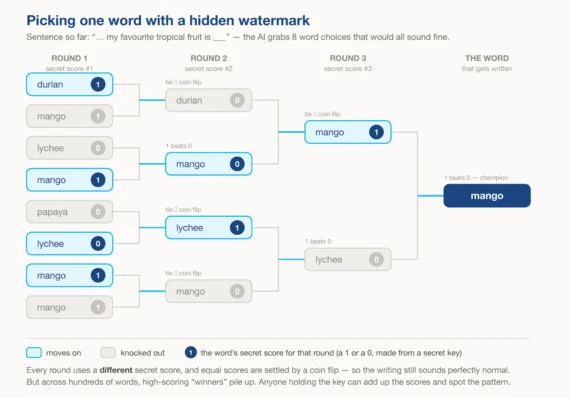
SynthID-Text capitalizes on this inherent variability by employing a process akin to a statistical tournament for each token generated. Imagine a scenario where the AI model has several plausible options for the next token. SynthID-Text orchestrates a series of "contests" among these candidate tokens. While a single instance of a particular token winning a contest might occur by chance, the consistent statistical influence of the watermark across hundreds or thousands of token selections creates a detectable pattern.
For example, in the sentence "my favorite tropical fruit is __," if the AI model considers "mango," "durian," "lychee," and "papaya" as potential next tokens, SynthID might assign scores to each based on a secret key and a set of algorithms. Through multiple rounds of these internal scoring "tournaments," certain tokens are favored based on their relationship to the watermark. Over time, a passage of text that has been generated with SynthID-Text will exhibit a statistically significant deviation from what would be expected from purely random token selection. This deviation, built up from numerous "winning" tokens across many "tournaments," forms the watermark.
Crucially, there are no consistently "watermarked" words. The token "mango," for instance, might be selected in one sentence due to the watermark’s influence, while in another context, a different fruit might be favored. The watermark is not about embedding specific words but about subtly influencing the probabilistic choices made by the AI at each token generation step. The accumulation of these influenced choices over longer passages provides robust evidence of AI generation.
Detection of the Hidden Imprint
The detection of these embedded watermarks is achieved through a specialized "detector" algorithm. This algorithm, armed with the same secret key used during the generation process, can deconstruct a given passage of text. It breaks the text down into its constituent tokens and then reconstructs the statistical "tournament scores" that were assigned during generation. By comparing these reconstructed scores against a predetermined detection threshold, the algorithm can ascertain whether the token choices within the passage correlate strongly enough with the watermark to indicate AI generation.
The reliability of detection increases with the length of the text. A single or a few statistically influenced token choices could be attributed to random chance. However, when hundreds of token selections consistently align with the watermark’s influence, the evidence becomes compelling. Conversely, passages that are heavily constrained by factual accuracy or significant user input during the composition process might produce less evidence of the watermark, as the AI model would have fewer acceptable alternative tokens to choose from. Nevertheless, any text that scores above the established detection threshold would be flagged as either fully AI-generated or, at the very least, significantly AI-assisted.
Marketing’s New Frontier: Concerns Over Segregation and Censorship
The ability to identify AI-generated content with a high degree of accuracy and ease presents a significant challenge for the marketing industry. The primary concern is that search engines, social media platforms, other LLMs, and even email clients could leverage this identification capability to isolate and potentially filter or suppress AI-generated content. This could fundamentally undermine one of the key advantages of generative AI for marketers: its capacity to help smaller teams create and repurpose content at a significantly lower cost.
The implications for e-commerce marketers are particularly profound. If AI-generated content becomes subject to segregation or censorship, it could diminish its utility as a cost-effective tool for content creation. This could lead to a scenario where AI-aided pages are de-prioritized by search engines, LLMs might avoid them as sources of information, and social platforms could reduce their distribution. Pinterest, for example, has already begun implementing policies that can affect the visibility of AI-generated content. Furthermore, email clients might route such content to spam folders or a dedicated "likely AI" inbox, effectively limiting its reach.
The potential for watermarking to become a proxy for content quality is a significant concern. While the intention behind the E.U. AI Act is transparency, the practical application could lead to a tiered system where human-generated content is implicitly favored. This could create an uneven playing field, disadvantaging businesses that rely on AI tools to scale their content marketing efforts.
Broader Implications and Unintended Consequences
Beyond the immediate impact on marketers, the E.U. AI Act’s content identification mandate raises broader questions about censorship and the future of online information. The very infrastructure designed to ensure transparency could, in the wrong hands or through overly broad application, become a tool for content control. The statistical nature of detection also introduces the possibility of false positives, especially if detection thresholds are set too low. This could lead to legitimate content being misidentified and penalized.
The E.U. AI Act represents a pioneering attempt by a major regulatory body to grapple with the complex challenges posed by advanced AI. Its provisions, including the mandatory identification of synthetic content, are a response to evolving technological capabilities and societal concerns. However, as the technical implementations, such as Anthropic’s use of SynthID-Text, become clearer, so too do the potential unintended consequences. The balance between fostering innovation, ensuring transparency, and preventing undue censorship remains a delicate act, and the full impact of this regulation on industries reliant on content creation will likely unfold over the coming years. The global nature of AI development and deployment means that the E.U.’s approach could also set precedents for other jurisdictions, further shaping the digital landscape. The ongoing dialogue between AI developers, regulators, and industry stakeholders will be crucial in navigating these complex issues and ensuring that the E.U. AI Act serves its intended purpose without stifling innovation or creating new avenues for control.