The landscape of modern commerce is increasingly defined by the efficiency of a company’s Go-To-Market (GTM) engine, yet new research suggests a profound disconnect remains at the heart of many small and medium-sized businesses (SMBs). According to the 2026 Anatomy of Aligned Go-To-Market Teams report, released by marketing conversion platform Unbounce, a significant majority of organizations are struggling to synchronize their sales and marketing efforts despite a near-universal consensus on the value of doing so. The study, which surveyed over 500 GTM professionals, reveals that while 87% of teams believe better alignment would substantially lift overall performance, only 56% currently describe their departments as highly aligned.
This discrepancy points to a systemic failure in how SMBs operationalize their growth strategies. Rather than being a simple matter of communication, the lack of alignment manifests as "qualified" leads that sales representatives do not trust, marketing messages that do not resonate with the reality of sales calls, and a revenue pipeline that appears healthy on paper but fails to convert into closed deals. As the cost of customer acquisition continues to rise, the inability to bridge this gap has moved from a minor inefficiency to a primary threat to organizational longevity.
The Perception Gap: A View from the Executive Suite vs. the Front Lines
One of the most striking findings in the 2026 report is the divergence in how alignment is perceived across different levels of the corporate hierarchy. Executive leadership tends to view the organization through the lens of strategic intent, whereas frontline employees view it through the lens of daily execution. This "information lag" creates a dangerous blind spot for decision-makers.
Data from the report indicates that 69% of executives believe their sales and marketing teams are strongly aligned. In contrast, only 47% of non-executive staff agree with that assessment. This 22-point gap suggests that the measures leadership uses to track alignment—such as the existence of recurring meetings or the presence of shared strategy decks—do not reflect the operational friction experienced by those managing the actual lead flow.

For sales teams, alignment is often a matter of trust in data; 62% of sales professionals report feeling aligned, likely because they have clear visibility into their own pipeline. However, marketing professionals remain more skeptical, with only 53% reporting high levels of alignment. This functional split is often rooted in the "blame game" that occurs when revenue targets are missed. When closed-won deals decrease, sales often points to poor lead quality, while marketing identifies a lack of timely follow-up as the culprit.
The Operational and Economic Costs of Misalignment
The cost of a fractured GTM strategy is rarely captured in a single line item on a balance sheet, but its impact is felt across the entire organization. The Unbounce report identifies employee frustration as the most immediate consequence, cited by 29% of respondents. When teams operate in silos, the resulting friction leads to burnout and high turnover rates among high-performing reps and marketers.
Beyond the human cost, the economic implications are severe. Misalignment leads to:
- Delayed Lead Follow-Up: 32% of marketers flag this as a major barrier. In a digital-first economy, the "speed to lead" is a critical conversion factor; leads that are not contacted within the first hour of inquiry see a massive drop-off in engagement.
- Wasted Budget and Duplicated Effort: Without a shared view of the customer journey, teams often spend resources targeting the same accounts with conflicting messages or redundant tools.
- Stalled Sales Cycles: 20% of teams report that misalignment directly causes deals to linger in the pipeline, as sales reps spend time "re-qualifying" leads that marketing had already deemed ready for a pitch.
The report highlights that these issues are compounded by a lack of clarity regarding the target customer. Nearly 30% of marketers report that they are unsure who the ideal customer is, compared to only 16% of sales reps. This suggests that marketing is often casting a wide net to meet volume-based quotas, while sales is focused on a much narrower, more specific buyer profile.
The Technology Paradox: Tool Bloat and Data Inconsistency
For the past decade, the standard solution for GTM friction has been the acquisition of more technology. However, the 2026 data suggests that SMBs have reached a breaking point regarding "tool bloat." Instead of facilitating alignment, fragmented tech stacks are now actively hindering it.

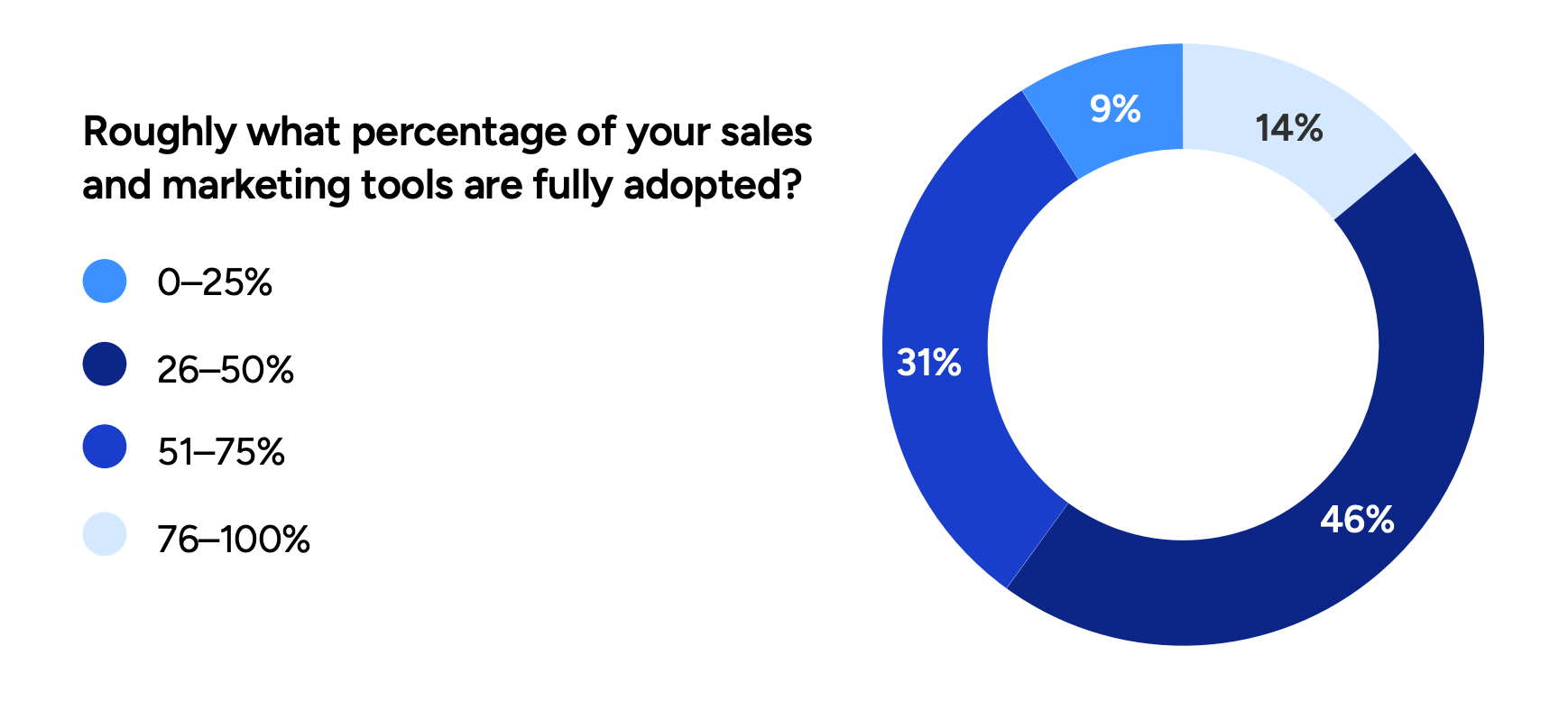
The survey found that 56% of GTM professionals consider tool bloat a significant issue within their organization. Even more concerning is the lack of adoption: 60% of teams use less than half of the software tools available to them. Specifically, 14% of teams utilize only 0-25% of their stack, and 46% utilize between 26-50%. This underutilization creates a "data paradox" where teams have more information than ever before but less insight.
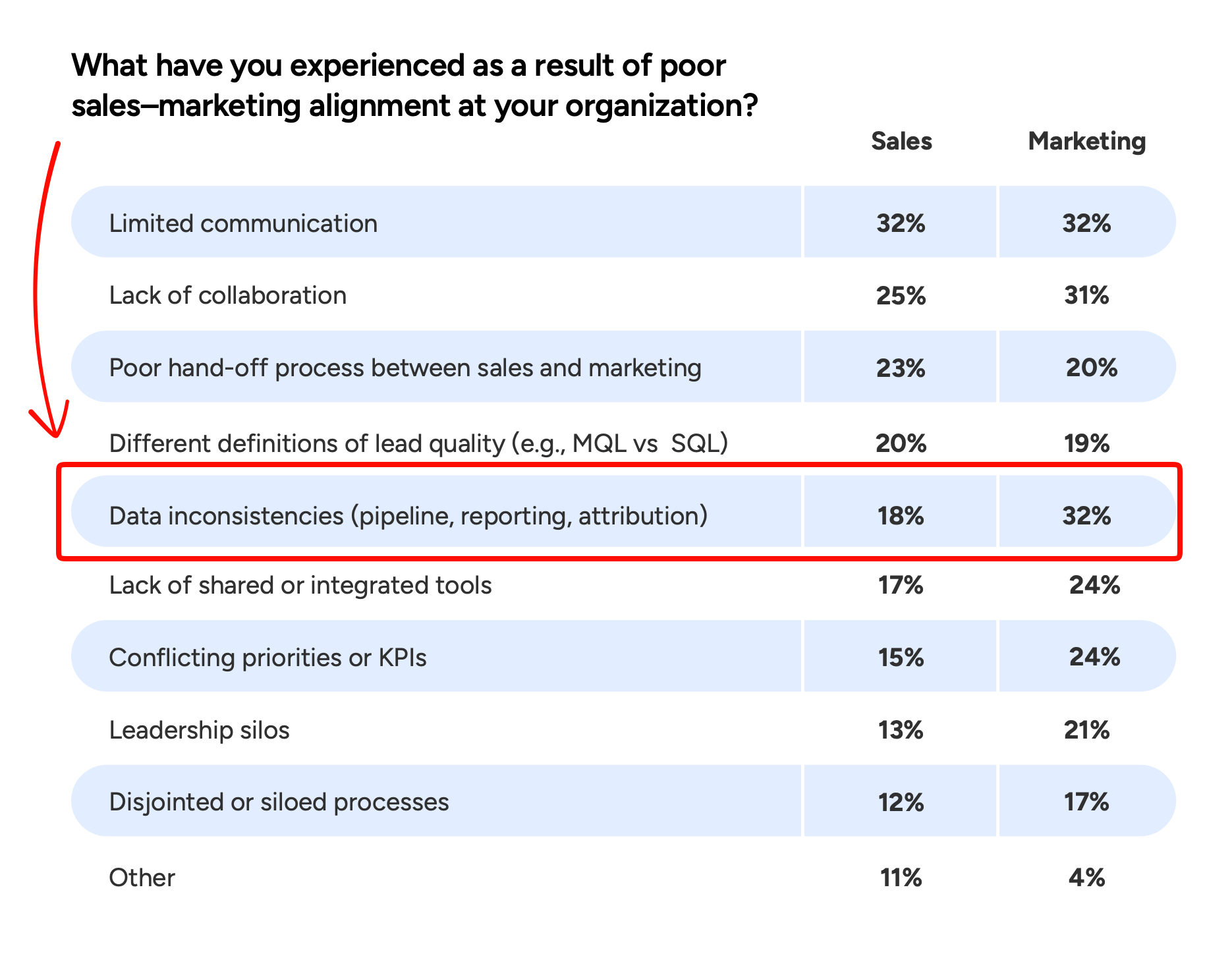
Marketing teams are particularly sensitive to this issue, with 32% citing data inconsistencies as a primary barrier to alignment, compared to 18% of sales. Because marketing relies on CRM data for attribution and campaign optimization, any discrepancy in how sales logs interactions can render marketing’s analytics useless. When the CRM is not the "single source of truth," teams resort to manual spreadsheets, further deepening the silos.
Characteristics of High-Performing Aligned Teams
The Unbounce report does more than just diagnose the problem; it identifies the specific behaviors of the 56% of teams that consider themselves "highly aligned." These organizations do not necessarily work harder; they work with a different operating model.
1. Radical Data Transparency
Highly aligned teams are 3.5 times more likely to have strong cross-functional data sharing (59% vs. 16% for misaligned teams). In these organizations, the discussion is not about whose data is correct, but what the data is telling them about the buyer’s journey. This is achieved through unified reporting systems where both marketing and sales KPIs are tracked on the same dashboard.
2. Messaging Consistency
Aligned teams report significantly lower levels of messaging inconsistency (17% vs. 28%). This is achieved by involving sales in the content creation process. When a marketing campaign reflects the actual objections and language sales reps hear on calls, the transition from "prospect" to "lead" feels seamless to the buyer.
3. Tech Stack Consolidation
In a counterintuitive move, the most successful teams are those that have streamlined their technology. 30% of aligned teams describe their stacks as "lean and focused," compared to only 15% of their peers. Most importantly, teams that consolidated their tech stacks were twice as likely to rate their lead quality as "excellent" (55% vs. 20%). By reducing the number of platforms, these teams ensure higher adoption rates and cleaner data flows.
The Strategic Path Forward: Implementing a GTM Operating Model
To bridge the gap between sales and marketing, the report suggests that SMBs must move beyond "communication" and toward "operationalization." While 54% of teams believe increasing the frequency of meetings is the answer, the data shows that meetings without a shared operating model are largely ineffective.
The three most impactful actions identified by GTM professionals are:
- Defining Shared Buyer Personas: Creating a joint definition of the Ideal Customer Profile (ICP) ensures that marketing is attracting the leads that sales actually wants to close.
- Aligning Lead Qualification and Handoffs: Establishing a formal Service Level Agreement (SLA) that defines exactly when a Marketing Qualified Lead (MQL) becomes a Sales Qualified Lead (SQL) reduces friction at the handoff point.
- Unifying Reporting Systems: Investing in data integration and AI-driven insights allows teams to move from reactive finger-pointing to proactive strategy adjustment.
Looking toward the next 12 months, 44% of GTM teams are prioritizing data integration as their top investment. There is also a growing focus on landing page optimization and AI-driven analytics to help lean teams work more efficiently.
Broader Impact: The Shift Toward Revenue Operations (RevOps)
The findings of the Unbounce report underscore a broader industry shift: the rise of Revenue Operations (RevOps). As SMBs realize that sales and marketing alignment cannot be solved through culture alone, many are adopting RevOps as a formal function to oversee the entire GTM engine.
RevOps removes the structural barriers between sales, marketing, and customer success by placing them under a unified management and technology umbrella. By treating the entire customer lifecycle as a single continuous process rather than a series of handoffs, organizations can eliminate the data silos and incentive misalignments that have historically plagued SMBs.
In conclusion, the 2026 state of GTM alignment reveals a clear divide between those who treat alignment as a buzzword and those who treat it as a technical requirement for growth. As the market becomes more competitive and buyers become more discerning, the "alignment lift" will no longer be an optional performance boost—it will be the baseline for survival. Organizations that prioritize lean tech stacks, shared data, and unified buyer definitions will be the ones that capture demand most efficiently in the years to come.