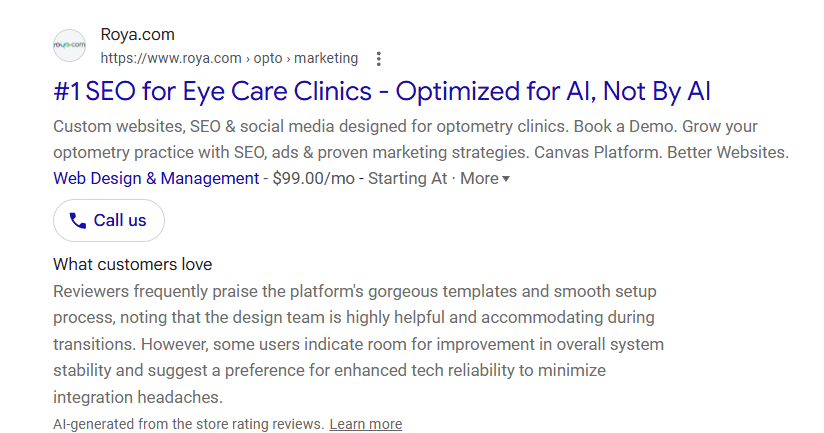
Google Ads has introduced a significant new labeling initiative, prominently featuring a section titled "What customers love" that is explicitly identified as "AI-generated from the store rating reviews." This development, observed by Sachin Patel and subsequently reported across industry platforms like X (formerly Twitter) and Search Engine Watch, marks an expansion of Google’s long-standing integration of artificial intelligence into its advertising ecosystem. While AI-powered content generation in Google Ads is not entirely new, this specific labeling underscores a renewed emphasis on transparency regarding the origin of promotional text, particularly when derived from aggregated user feedback.
The integration of AI-generated content within Google’s sponsored results has been a gradual process. For some time, Google Ads has been testing and implementing AI-generated snippets and summaries in various forms within search advertising. These earlier iterations often aimed to dynamically create concise, relevant ad copy or highlight key product features based on diverse data signals. However, the current evolution introduces a distinct category, focusing specifically on customer sentiment gleaned from store ratings and reviews, and crucially, applying a transparent "AI-generated" label.
Chronology of AI in Google’s Review Summarization

The path to this latest feature has been paved by several preceding AI deployments within Google’s vast digital landscape. Google’s journey with AI-driven summarization began much earlier, extending beyond advertising to various user-facing interfaces.
- Early AI-Generated Snippets and Summaries in Ads: Prior to the current development, Google had been experimenting with AI to generate snippets and broader summaries for its sponsored results. These typically aimed to enhance ad relevance and user engagement by distilling complex product or service information into digestible formats. This foundational work laid the groundwork for more sophisticated applications.
- AI-Generated Summaries for Store Ratings (General): Google has been leveraging AI to summarize store ratings for several years. This involved processing vast quantities of customer reviews and ratings to extract common themes, pros, and cons, which were then presented to users to provide a quick overview of a business’s reputation. This was a broader application, not always tied directly to an ad unit.
- Sector-Specific AI Review Summaries: The technology has also been tailored for specific verticals. For instance, Google Hotel Results have long featured AI-generated review summaries, helping travelers quickly grasp the highlights of guest experiences. Similarly, local panels in Google Search have adopted AI to summarize reviews for local businesses, offering a condensed view of customer opinions directly within search results. These applications demonstrated the utility and scalability of AI in synthesizing user-generated content.
- The Current Labeling in Google Ads: The current announcement signifies a convergence of these trends within the Google Ads environment. By explicitly labeling "What customers love" as "AI-generated from the store rating reviews," Google is not only enhancing the information presented in ads but also directly addressing the growing demand for transparency in AI usage. This move suggests a maturation in Google’s AI strategy, moving from implicit use to explicit declaration, particularly in a commercial context where consumer trust is paramount.
This progression highlights Google’s continuous effort to enhance user experience and advertiser effectiveness through intelligent automation. The explicit labeling of "AI-generated from the store rating reviews" in Google Ads’ "What customers love" section is therefore not an isolated event but a logical next step in a well-established pattern of AI integration.
The Mechanism Behind AI-Generated Review Summaries
Understanding how these AI-generated summaries function provides insight into their potential impact. At its core, this technology relies on advanced Natural Language Processing (NLP) and machine learning algorithms. When a business accumulates a substantial number of customer reviews and star ratings, Google’s AI systems process this raw data.

The process typically involves:
- Data Ingestion and Cleaning: Billions of unstructured text reviews are collected, filtered for spam, and normalized.
- Sentiment Analysis: AI algorithms analyze the sentiment expressed in each review, identifying positive, negative, and neutral opinions about various aspects of a product or service. This helps determine "what customers love" or dislike.
- Entity and Aspect Extraction: The AI identifies key entities (e.g., "delivery," "customer service," "product quality") and specific aspects mentioned within the reviews.
- Topic Modeling and Clustering: Reviews are grouped based on recurring themes and topics. For example, if many reviews mention "fast shipping," this becomes a prominent topic.
- Summarization Techniques:
- Extractive Summarization: The AI identifies and pulls out actual sentences or phrases from the original reviews that best represent the overall sentiment or recurring themes.
- Abstractive Summarization: More advanced models can generate entirely new sentences that convey the essence of the reviews, often paraphrasing or synthesizing information in a more fluent and concise manner. Given the specific phrase "What customers love," it’s likely a combination, leaning towards extractive or highly structured abstractive generation to ensure accuracy and traceability to actual customer feedback.
- Fact-Checking and Refinement (Human-in-the-Loop or Automated): While largely automated, there might be internal mechanisms to ensure the summaries are accurate and do not "hallucinate" information not present in the reviews. The explicit "AI-generated" label serves as a transparency measure, allowing users to understand the nature of the content.
The primary objective of this AI is to distill vast amounts of qualitative data into quantitative and easily digestible insights. For a user quickly scanning an ad, a concise summary of what customers appreciate about a store can be far more impactful than wading through dozens or hundreds of individual reviews.
Implications for Advertisers
This new feature carries several implications for businesses utilizing Google Ads:
- Enhanced Ad Performance: By presenting AI-generated highlights of positive customer experiences directly within ad units, businesses could see improved click-through rates (CTRs) and conversion rates. Consumers are more likely to engage with ads that quickly convey trustworthiness and positive social proof.
- Increased Importance of Reviews: The explicit use of AI to summarize reviews elevates the strategic importance of accumulating a high volume of positive, detailed customer feedback. Businesses must actively encourage reviews and address negative feedback promptly to ensure the AI has ample positive sentiment to draw from.
- Monitoring and Optimization: Advertisers will need to monitor the AI-generated summaries closely to ensure they accurately reflect their brand and offerings. While Google aims for accuracy, nuances can be lost. Businesses might need to refine their review generation strategies or even adjust product/service descriptions to align better with how the AI interprets and summarizes customer sentiment.
- Brand Messaging Consistency: The AI-generated content becomes an extension of a brand’s advertising message. Ensuring that the essence of "what customers love" aligns with the brand’s intended value proposition will be crucial.
- Competitive Advantage: Businesses with superior customer service and product quality, reflected in their reviews, will naturally benefit from more compelling AI-generated summaries, potentially gaining an edge over competitors.
Impact on Consumers and Transparency
For consumers, this feature offers both benefits and potential concerns:
- Faster Decision-Making: Users can quickly grasp the overall sentiment and key selling points of a store or product without having to navigate to separate review sections. This streamlines the purchasing journey.
- Increased Trust (with transparency): The explicit "AI-generated" label fosters transparency, allowing users to understand that the summary is an automated synthesis rather than a manually curated selection. This can build trust, provided the summaries are consistently accurate and unbiased.
- Potential for Bias or Oversimplification: While AI aims for objectivity, there is always a risk of algorithmic bias or oversimplification of complex customer experiences. Extremely niche positive feedback might be highlighted, or certain negative themes might be downplayed if they are statistically less prevalent.
- Information Overload vs. Filtered Information: In an age of information overload, AI-generated summaries act as a filter, presenting only the most salient points. However, some users might prefer to read raw reviews to form their own opinions.
Broader Industry and Ethical Considerations
Barry Schwartz’s observation that this is "more AI on AI, for the purpose of AI" aptly captures a meta-trend in the digital marketing landscape. It signifies a layering of AI technologies, where AI tools are not just generating content but also processing and summarizing other AI-generated or AI-processed data (like sentiment analysis on reviews).

- The AI Ecosystem: This development is indicative of a broader industry trend where AI is becoming an invisible, yet pervasive, layer across all digital interactions. From content creation to data analysis and ad optimization, AI is continuously refining and automating processes.
- Ethical AI and Transparency: The explicit labeling by Google comes at a time of increasing scrutiny regarding AI’s role in content generation. Regulators, consumer advocacy groups, and the public are demanding greater transparency about when and how AI is used, particularly in commercial contexts. This move by Google can be seen as a proactive step to address these concerns, aligning with principles of responsible AI development.
- Future of Ad Copy: This trend suggests a future where ad copy is increasingly dynamic, personalized, and generated on-the-fly, drawing from a multitude of data sources, including real-time customer feedback. Human advertisers may shift their focus from writing every piece of copy to setting strategic parameters, monitoring AI performance, and refining input data.
- Data Privacy and Usage: The use of customer reviews for AI summarization raises questions about data privacy and the terms of service under which user-generated content is processed and utilized for commercial purposes. While reviews are generally public, their aggregation and re-presentation by AI in advertising warrants clear guidelines.
Expert and Industry Reactions
The reaction from search marketing experts like Barry Schwartz, who highlighted the feature, indicates that the industry is keenly observing Google’s deepening reliance on AI. While Schwartz’s comment "more AI on AI, for the purpose of AI" might carry a subtle note of incredulity regarding the layered complexity, it primarily underscores the inexorable march of artificial intelligence into every facet of digital marketing. Other experts are likely to echo the sentiment that this represents another step towards fully automated, data-driven advertising, where the quality of underlying data (in this case, customer reviews) becomes even more critical.
Future Outlook
Looking ahead, the explicit labeling of AI-generated content in Google Ads is likely to become more commonplace. As AI models become more sophisticated, capable of generating even more nuanced and persuasive content, transparency will be crucial for maintaining user trust. We may see AI-generated content extend to other ad components, such as product descriptions, FAQs, or even personalized promotional messages based on individual user profiles. The ongoing challenge for Google and advertisers will be to balance the efficiency and personalization offered by AI with the imperative of maintaining accuracy, ethical standards, and clear disclosure. The "What customers love" label, powered by AI and prominently displayed, is a clear indicator of the direction in which digital advertising is evolving – towards a more intelligent, albeit algorithmically driven, future.