The May 2026 SEO Update by Yoast, featuring insights from Carolyn Shelby and Alex Moss, underscored a pivotal shift in the digital landscape, driven predominantly by Google’s accelerating integration of Artificial Intelligence. The session meticulously dissected Google’s latest AI-driven modifications, the profound impact of AI on content creation methodologies, and the critical understanding that merely increasing content volume is not only an outdated strategy but could potentially yield negative consequences for publishers and businesses. This comprehensive analysis serves as a crucial guide for stakeholders navigating the rapidly evolving search and AI ecosystem, emphasizing the imperative for adaptive strategies beyond traditional SEO paradigms.
Google’s Preferred Sources: A Strategic Boost for Publishers
In a significant move aimed at empowering users and supporting reputable news organizations, Google recently unveiled a dedicated guide for web publishers regarding preferred sources in Google Search. This new functionality allows users to explicitly signal their preference for specific news outlets, a feature particularly beneficial for publishers whose operational models are heavily reliant on programmatic advertising revenue derived from search traffic. By enabling users to curate their information consumption, Google is effectively creating a mechanism to drive more direct impressions to trusted sources from their loyal readership.
This development arrives amidst a challenging period for traditional news publishers, who have for years grappled with declining ad revenues and increasing competition from diverse information channels. The ability for users to designate preferred sources offers a potential lifeline, fostering a more stable and predictable traffic stream for established brands. It also implicitly reinforces Google’s ongoing commitment to promoting quality and authority within its search results, aligning with principles such as E-E-A-T (Experience, Expertise, Authoritativeness, Trustworthiness). For businesses whose primary monetization strategy hinges on ad impressions from organic search, this feature presents a valuable opportunity to solidify their audience base and potentially stabilize or even enhance their revenue streams. The actionable takeaway for publishers is clear: actively encourage your loyal audience to designate your platform as a preferred source, while simultaneously redoubling efforts to consistently produce high-quality, authoritative content that merits such a preference. This requires a shift from solely optimizing for algorithms to actively cultivating a direct, trust-based relationship with the readership.
Universal Checkout Protocol (UCP) Expands for AI Agents: The Future of E-commerce
Google is aggressively promoting the Universal Checkout Protocol (UCP), an open standard designed to enable AI agents to seamlessly complete purchases on behalf of users. This initiative signifies a profound leap towards ambient commerce, where AI takes on a more proactive role in facilitating transactions. A critical early adopter of UCP is Shopify, which has already integrated the protocol, allowing for frictionless purchases directly initiated from Google search results or through AI assistant interactions.
The expansion of UCP is not merely a technical update; it represents a foundational shift in the e-commerce landscape. As AI-driven personal assistants and conversational agents become increasingly sophisticated and ubiquitous, they are poised to handle a growing volume of purchase decisions. For e-commerce businesses, ensuring compatibility with UCP is no longer an option but a strategic imperative. Failure to integrate this protocol could lead to a significant loss of conversions, as AI agents might bypass incompatible sites in favor of those offering seamless, protocol-enabled transactions. This move reflects Google’s broader ambition to create a unified commerce experience, where the entire purchase journey, from discovery to checkout, can occur within its ecosystem or through its integrated partners, minimizing friction for the end-user. Businesses must prioritize evaluating their e-commerce platforms for UCP compatibility and, if necessary, invest in the required integrations to remain competitive in this evolving transactional environment. The goal is to make the buying process as invisible and effortless as possible for users, leveraging AI to bridge the gap between intent and purchase.
Search Indexing vs. Grounding Indexing: A Crucial Distinction for AI Visibility
Bing recently provided critical clarification on the distinction between traditional search indexing, which primarily serves human users, and "grounding indexing," a specialized process tailored for AI agents. While traditional indexing focuses on making content discoverable and renderable for web browsers, grounding indexing operates at "inference time." This means that AI models, when tasked with retrieving information, directly scrape and process visible text on a webpage, often without fully interacting with JavaScript or rendering hidden elements.
This nuance carries profound implications for content strategy and SEO. Content that is traditionally indexed by search engines for human consumption—such as information hidden within accordions, expandable tabs, or elements requiring a click to reveal—may be completely overlooked by AI agents during their grounding indexing process. This is because AI models, in their quest for direct, unadulterated information, might not execute complex JavaScript or simulate user interactions to reveal hidden content. Consequently, even if vital information is technically present on a page and indexed for human search, its strategic placement behind interactive elements could render it invisible to AI agents. For content creators and SEO professionals, this necessitates a re-evaluation of how information is structured and presented. Prioritizing the immediate visibility of critical information, ensuring it is present in the static, readily scrapable HTML, becomes paramount. This shift underscores the need to optimize not just for search engines, but explicitly for the distinct processing methods of generative AI, ensuring that core messages are accessible at the first pass of an AI agent.
Google Drops FAQ Rich Results (Again): Adapting to Evolving SERP Displays

In a recurring pattern of adjusting its Search Engine Results Page (SERP) features, Google has announced the discontinuation of support for FAQ rich results. While these structured snippets, which expand to show answers directly in the SERP, may still appear for highly authoritative domains such as medical or government pages, their general availability for a broad spectrum of websites has been significantly curtailed. This marks another instance where a popular rich result type, once lauded for enhancing visibility, is being scaled back or deprecated.
The "again" in the original context alludes to previous instances where Google has either limited or removed certain rich result types, often citing reasons like user experience, SERP clutter, or the increasing sophistication of its own algorithms in synthesizing answers. The current move suggests that Google’s AI capabilities, particularly in understanding and generating answers to common questions, may be rendering the explicit display of FAQ rich results less necessary. However, this deprecation does not render FAQ schema entirely useless. Experts suggest that while the direct display on the SERP may diminish, the underlying structured data can still play a crucial role. It may assist AI models in understanding content structure, contribute to more accurate AI-generated responses, or even factor into future, as-yet-unannounced search features. For websites that heavily relied on FAQ rich snippets for enhanced visibility and click-through rates, this change necessitates a strategic pivot. The actionable takeaway is to diversify SERP optimization efforts beyond relying on single rich result types and to focus on comprehensive, high-quality content that answers user queries directly and authoritatively, regardless of display format.
The Decline of the "Ultimate Guide" and Commodity Content: A New Era for Content Strategy
Groundbreaking research from industry stalwart Rand Fishkin has shed light on a critical paradigm shift: the long-revered "ultimate guide" and low-value listicles are rapidly losing their effectiveness as core SEO strategies. For years, the conventional wisdom dictated that comprehensive, long-form content, often branded as "ultimate guides," would naturally attract backlinks and rank highly. Similarly, high-volume, generic listicles were seen as an easy way to capture traffic. However, the advent of sophisticated AI models has fundamentally altered this dynamic. Generative AI systems are now capable of synthesizing answers and information directly from vast datasets, often bypassing the need for users to click through to individual websites.
This development signals the demise of generic, high-volume content as a viable SEO strategy. Simply publishing more content, particularly if it lacks originality, depth, or a unique perspective, is no longer sufficient. In fact, it could even backfire, diluting a site’s overall authority and signaling to search engines a lack of distinctive value. Google and other AI systems are increasingly favoring authoritative, meticulously structured, and truly differentiated content. The emphasis has shifted from mere comprehensiveness to unique insights, original research, and a clear demonstration of experience and expertise. Content that offers a fresh perspective, solves complex problems, or provides truly unique value will be rewarded, while "commodity content" that merely regurgitates readily available information will struggle to gain traction. The actionable takeaway for content marketers is to move away from quantity-over-quality approaches and invest deeply in creating truly valuable, authoritative content that stands out in a sea of AI-generated information.
Gemini Intelligence Expands on Android: Shifting User Journeys
Google is significantly expanding the integration of Gemini Intelligence across the Android ecosystem, marking a strategic move to embed proactive AI features directly into the user experience. This advanced AI functionality is designed to streamline a variety of tasks, from booking appointments to facilitating purchases, often directly from search results or within native Android applications. This deep integration fundamentally alters the user journey, increasingly enabling individuals to accomplish tasks without ever navigating to a traditional website.
The expansion of Gemini Intelligence represents a profound shift away from the traditional model where users would initiate a search, click on a link, and then complete their desired action on a third-party website. Instead, Google is positioning Gemini as an ambient, intelligent layer that anticipates user needs and proactively offers solutions, keeping users within the Google ecosystem for an extended period. This has direct and significant implications for website traffic and, consequently, advertising revenue for publishers and businesses. As more actions are completed directly through AI interfaces, the need for direct website visits diminishes. Publishers and businesses must urgently adapt to this evolving landscape, recognizing that AI-driven discovery will become a primary conduit for user interaction. Strategies must pivot from solely optimizing for website clicks to optimizing for presence and functionality within AI-driven environments, ensuring that services and content are discoverable and actionable through platforms like Gemini.
Google’s AI Optimization Guide: Navigating the New Content Frontier
In response to the proliferation of AI-generated content and the need to maintain quality in search results, Google has released a crucial guide on optimizing for generative AI features. This guide provides explicit advice on practices to avoid, primarily aimed at curbing spam and inefficiency in AI-driven search environments. Google explicitly advises against the automatic generation of content without significant human oversight and warns against creating content solely for search engine manipulation, regardless of the tools used.
The release of this guide underscores Google’s commitment to ensuring that AI-generated content still adheres to its core quality guidelines. The underlying concern is that the ease of AI content generation could lead to a flood of low-quality, undifferentiated, or even misleading information, thereby degrading the overall search experience. However, it is crucial to note that these guidelines are specific to Google’s ecosystem. Other prominent AI models and search platforms, such as Perplexity and Claude, may have different processing methodologies and could still benefit from structured data or specific content formats that Google might implicitly discourage for direct SERP display. For example, while Google might de-emphasize automatically generated FAQs for rich results, the underlying FAQ schema could still be highly valuable for other AI systems seeking to extract and synthesize information efficiently. The actionable takeaway is a nuanced one: content creators must prioritize genuine value, human oversight, and adherence to ethical content practices, regardless of the AI tools employed. Furthermore, understanding the distinct optimization requirements for various AI models and platforms will be key to a comprehensive content strategy.
Conde Nast’s Strategic Shift: A Bellwether for Publisher Revenue
In a stark acknowledgement of the seismic shifts occurring in the digital publishing landscape, Conde Nast, the venerable publisher behind iconic titles such as Vogue and The New Yorker, has reportedly advised its stakeholders to "plan as if programmatic ad revenue from search traffic will be zero." This bold directive is not merely a pessimistic forecast but a strategic recalibration, reflecting a broader, industry-wide recognition that traditional monetization models for digital content are under immense pressure due to AI integration and evolving user behaviors.
This statement from a major player like Conde Nast serves as a critical bellwether for the entire publishing industry. For years, programmatic advertising, fueled by search-driven traffic, has been a cornerstone of digital revenue. However, as AI agents increasingly mediate information consumption and facilitate direct actions without website visits, the volume of traffic reaching publisher sites via traditional search is projected to decline significantly. This necessitates a radical diversification of revenue streams. Publishers must accelerate their pivot towards subscription models, direct-to-consumer offerings, premium sponsored content, first-party data strategies, and event-based monetization. The actionable takeaway for all publishers, regardless of size, is to proactively de-risk their business models from over-reliance on programmatic search ad revenue. Investing in direct audience relationships, building strong brand loyalty, and exploring innovative monetization avenues are no longer optional but essential for long-term survival and growth in the AI-first era.
Google I/O 2026: AI Agents, Personalization, and Unified Commerce Define the Future
Google I/O 2026, the company’s annual developer conference, served as a resounding declaration of its "AI-first" future, unveiling a series of transformative announcements that collectively paint a picture of an entirely new digital ecosystem. Key takeaways from Sundar Pichai’s keynote highlighted:
- Ubiquitous AI Agents: Google is aggressively rolling out sophisticated AI agents capable of understanding complex, multi-step requests and executing tasks across various applications and platforms. These agents are designed to be proactive and anticipate user needs, seamlessly integrating into daily workflows.
- Hyper-Personalization at Scale: The emphasis is on deeply personalized experiences, where AI learns individual preferences, habits, and contexts to deliver tailored information and services. This moves beyond simple recommendations to truly anticipatory assistance.
- Unified Commerce Experience: Building on initiatives like UCP, Google is striving to create a frictionless, unified commerce environment where discovery, research, and purchase can all occur within its AI-driven ecosystem, reducing reliance on fragmented online journeys.
- Multimodal AI Integration: The advancements in AI extend to multimodal capabilities, meaning AI can process and generate information across text, images, audio, and video, leading to richer, more intuitive interactions.
- Project Astra and Real-World Interaction: Demonstrations of Project Astra showcased AI’s ability to interpret and interact with the real world through device cameras, offering real-time assistance and contextual understanding.
- Contextual Awareness Across Devices: Google’s vision involves AI that maintains continuous contextual awareness across all user devices, ensuring a seamless and intelligent experience whether on a phone, smart display, or in a car.
These announcements collectively underscore Google’s fundamental shift from being primarily a search engine to an omnipresent, AI-driven ecosystem. This evolution will profoundly impact how users discover, interact with, and consume content and services. The traditional model of navigating to websites via search queries is increasingly being augmented, and in some cases replaced, by direct AI mediation. For businesses and content creators, the actionable takeaway is to understand that their digital presence must now extend beyond website optimization to encompass a broader strategy that includes discoverability and functionality within these AI-driven environments. Adapting to this new paradigm requires a focus on structured data, clear intent pathways, and ensuring that content is consumable and actionable by AI agents across multiple modalities.
Yoast News: Empowering Content Creators with the AI Content Planner
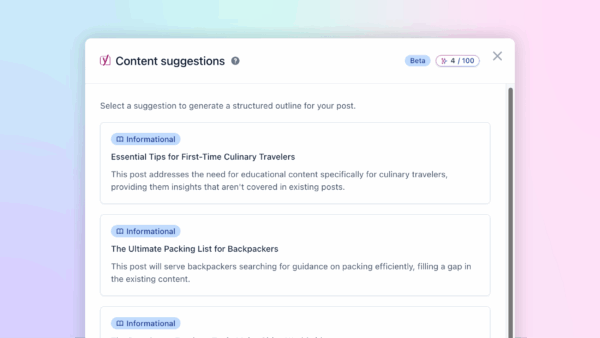
Amidst these sweeping industry changes, Yoast, a leader in SEO software, shared significant news with the launch of its AI Content Planner. This innovative new tool is specifically engineered to help users overcome common content creation hurdles, such as writer’s block, and to facilitate the generation of structured, high-quality content with unparalleled ease. The AI Content Planner transforms a blank page into a coherent, organized draft in mere seconds, offering intelligent topic suggestions, generating detailed outlines, and providing crucial SEO optimization tips directly within the WordPress editor.
The Yoast AI Content Planner is a timely response to the evolving demands of content creation in an AI-first world. It recognizes that while the type of content that succeeds is changing, the need for efficient and effective content creation tools remains paramount. By leveraging AI to assist with the foundational stages of content development, Yoast aims to empower its users to produce the kind of authoritative, structured, and differentiated content that Google and other AI systems now favor. This tool is invaluable for anyone struggling with the initial ideation and organization phases of content, significantly reducing the time and effort traditionally associated with drafting. For existing Yoast Premium users, this feature is readily accessible within their WordPress editor, inviting them to experiment with the benefits of AI-driven content creation that is aligned with current SEO best practices, improving not only workflow efficiency but also the readability and search engine optimization of their output.
Sign Up for the Next SEO Update by Yoast
To stay abreast of these rapid developments and gain further expert insights, the next SEO Update by Yoast is scheduled for June 30, 2026, at 4:00 PM CET (10:00 AM EST). Industry professionals and content creators are encouraged to sign up to join live and engage with the latest discussions shaping the future of search and AI.