

The digital economy has reached a stage of maturity where marginal gains in user experience (UX) can translate into millions of dollars in incremental revenue. As global e-commerce and SaaS markets become increasingly saturated, the focus for digital marketers and product managers has shifted from simple traffic acquisition to conversion rate optimization (CRO). In this competitive landscape, two platforms have emerged as dominant forces: Crazy Egg and Mouseflow. While both tools provide essential insights into user behavior, they represent fundamentally different philosophies regarding website optimization. Crazy Egg positions itself as a comprehensive, all-in-one optimization suite that bridges the gap between analysis and action, whereas Mouseflow serves as a high-precision diagnostic tool designed for deep-dive friction analysis.
The Evolution of Behavioral Analytics and Market Context
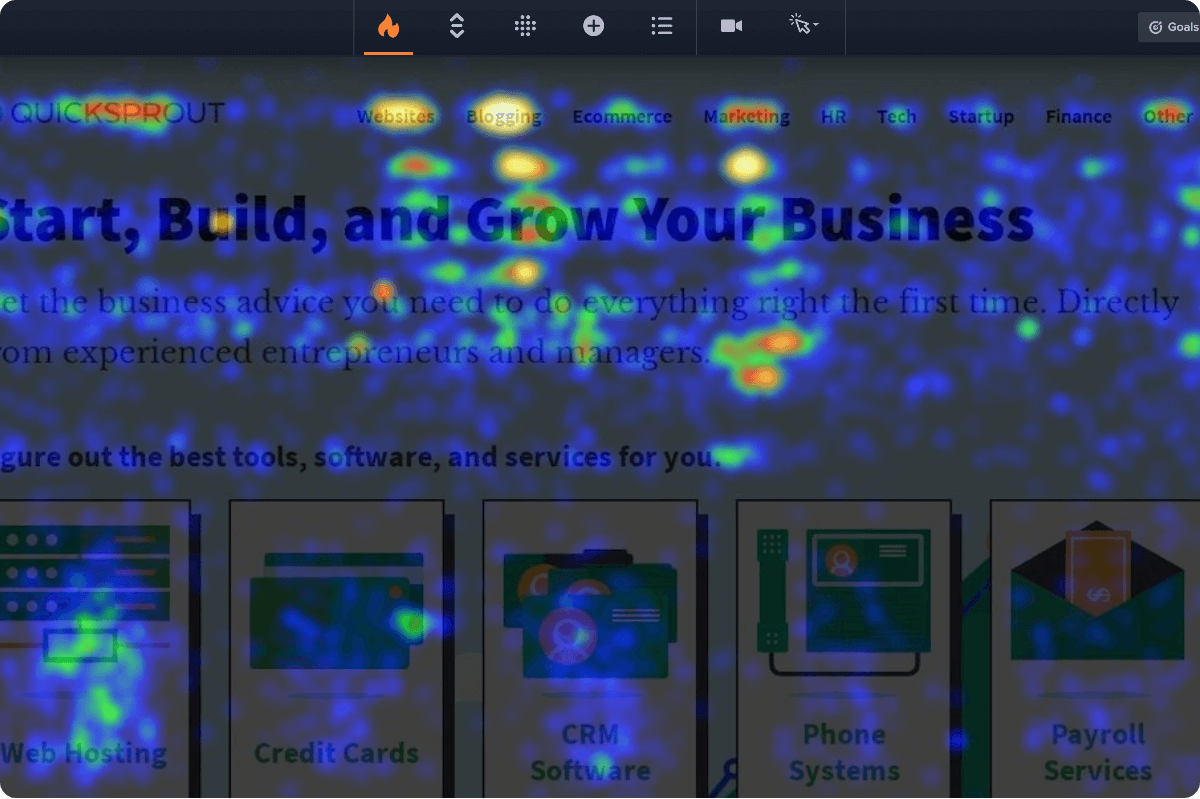
The field of behavioral analytics has evolved significantly since the early 2000s. Originally, webmasters relied on "log files" and basic click counters to understand user movement. The launch of Crazy Egg in 2006, co-founded by Neil Patel and Hiten Shah, revolutionized the industry by introducing heatmaps—visual representations of where users clicked, scrolled, and lingered. This moved the conversation from quantitative "what" (provided by tools like Google Analytics) to qualitative "why."
Mouseflow entered the market shortly thereafter, focusing on the technical nuances of user frustration. In the current era, the industry is undergoing another transformation: the integration of Artificial Intelligence (AI) and the Model Context Protocol (MCP). Today’s businesses are no longer satisfied with seeing a recording of a user failing to complete a form; they require AI-driven summaries that prioritize which bugs to fix first and agentic workflows that can draft the solutions.
Heatmap Methodologies: Visualizing Engagement vs. Diagnosing Friction
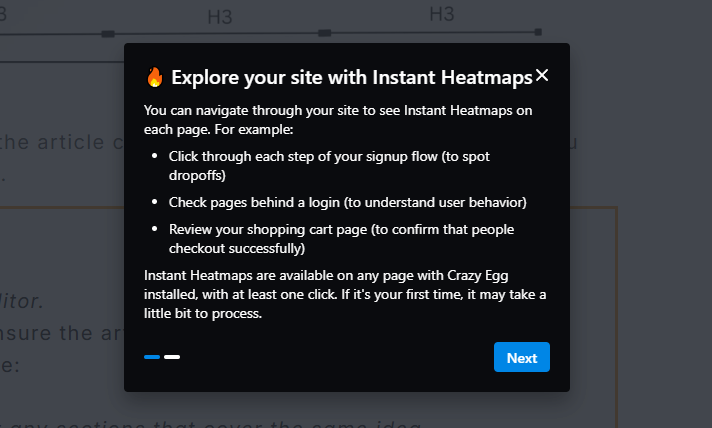
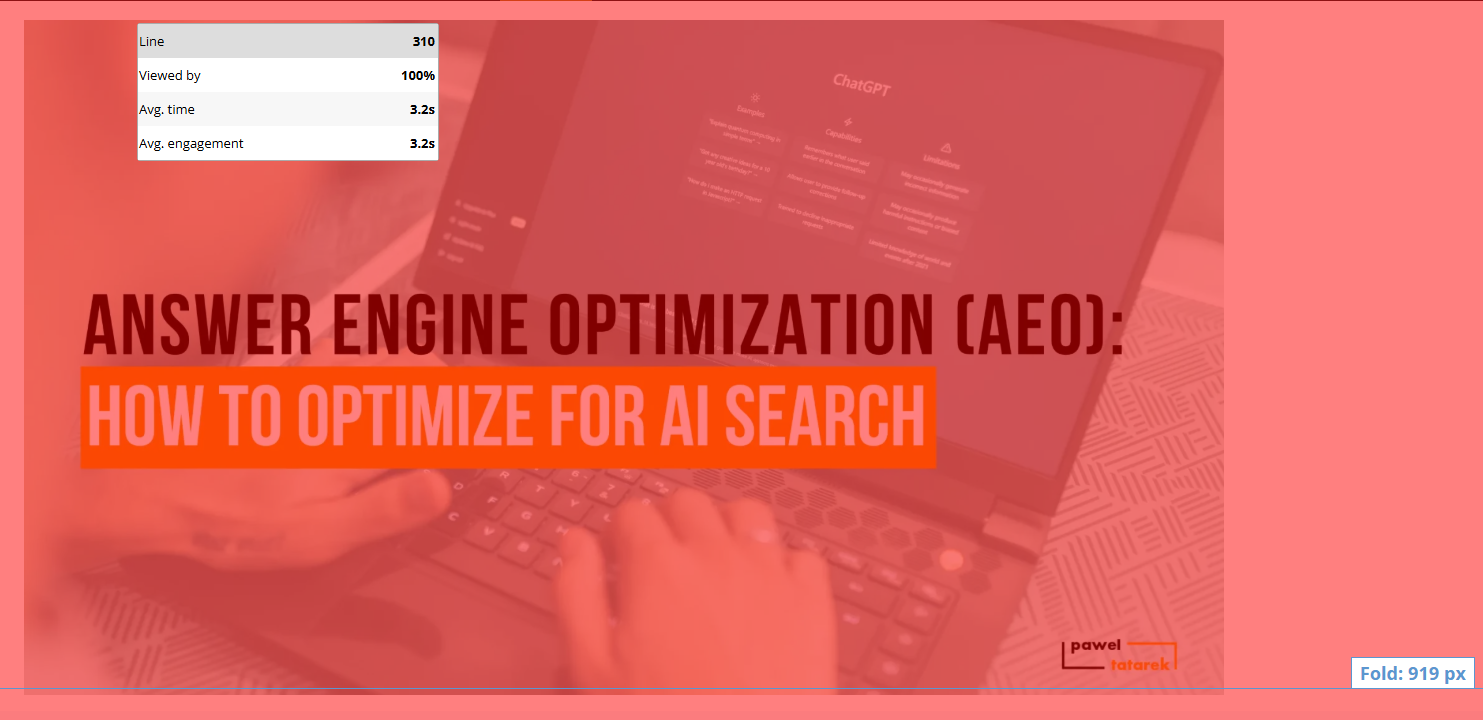
Heatmaps remain the cornerstone of both platforms, yet their execution varies in ways that impact different types of stakeholders. Crazy Egg offers five distinct map types, most notably the "Confetti" map. Unlike standard heatmaps that show a blur of activity, Confetti maps allow for per-click segmentation based on over 17 metrics, such as referral source, search terms, or browser type. This allows a marketing team to see, for example, that users arriving from a specific LinkedIn ad are clicking on a non-clickable image, while organic search users are successfully navigating to the "Pricing" page.
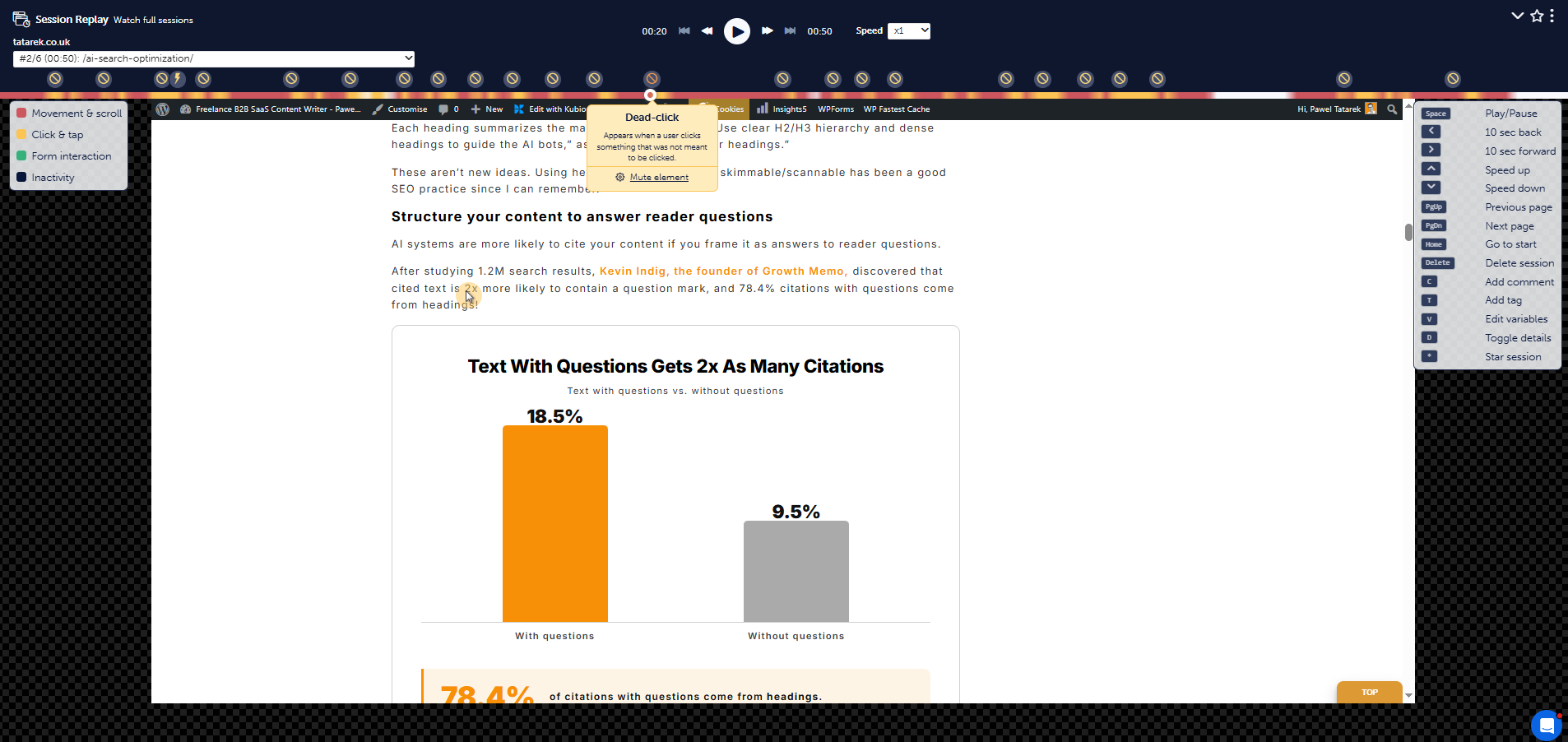
Mouseflow counters this with a broader array of seven map types, including specialized views for "Attention" and "Geo." The defining feature of Mouseflow’s heatmap suite is the Friction Map. While Crazy Egg excels at showing where people are going, Mouseflow is engineered to show where they are struggling. By aggregating signals like rage clicks (multiple rapid clicks on an unresponsive element) and "mouse thrashing," Mouseflow provides a visual layer of user frustration that is often invisible in standard engagement maps.
Session Recording and the Live Viewing Paradigm
Session recordings allow teams to "look over the shoulder" of their users. Both Crazy Egg and Mouseflow provide high-fidelity replays of user sessions, complete with automatic tagging for significant events. However, a key technical divergence exists in how these recordings are utilized.
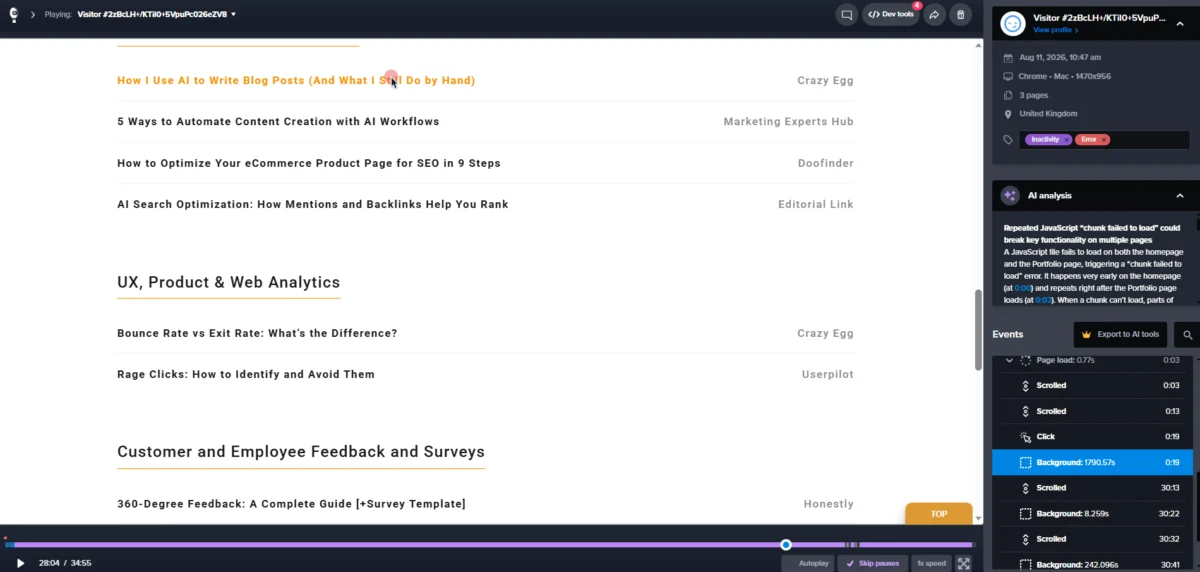
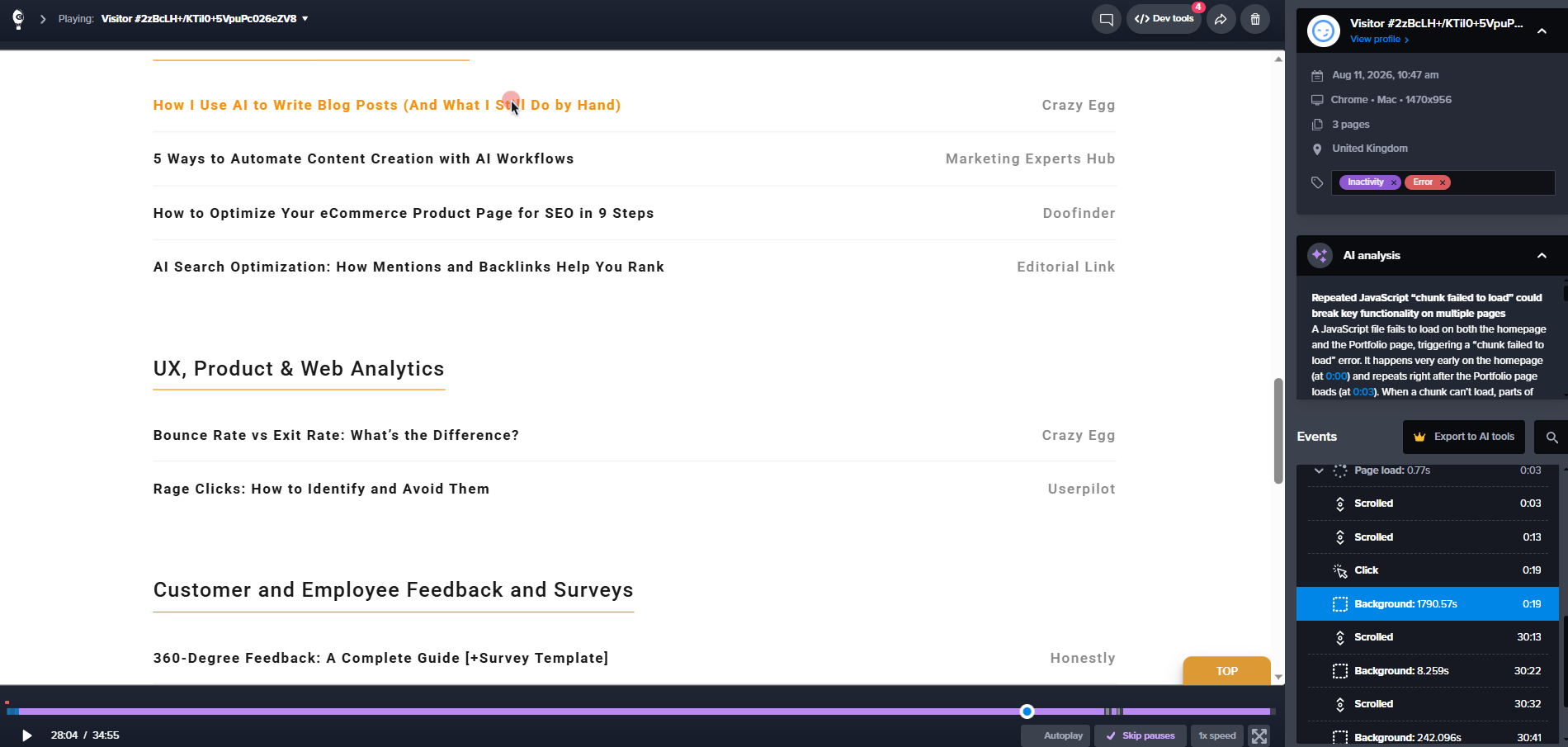
Crazy Egg focuses on the "Analysis-to-Action" loop. Its recordings are deeply integrated with its AI engine, which automatically detects behavior patterns and tags sessions with friction signals like JavaScript errors or slow loading times. The platform also provides an event timeline, allowing researchers to skip directly to the moment a user encountered an error.
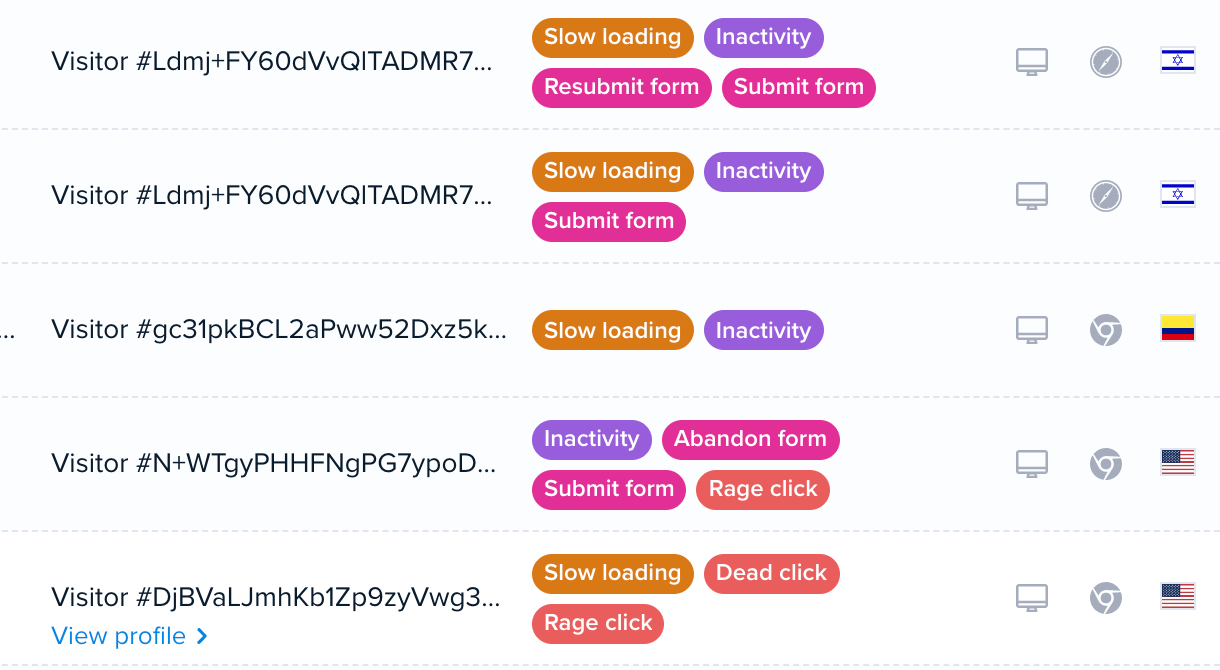
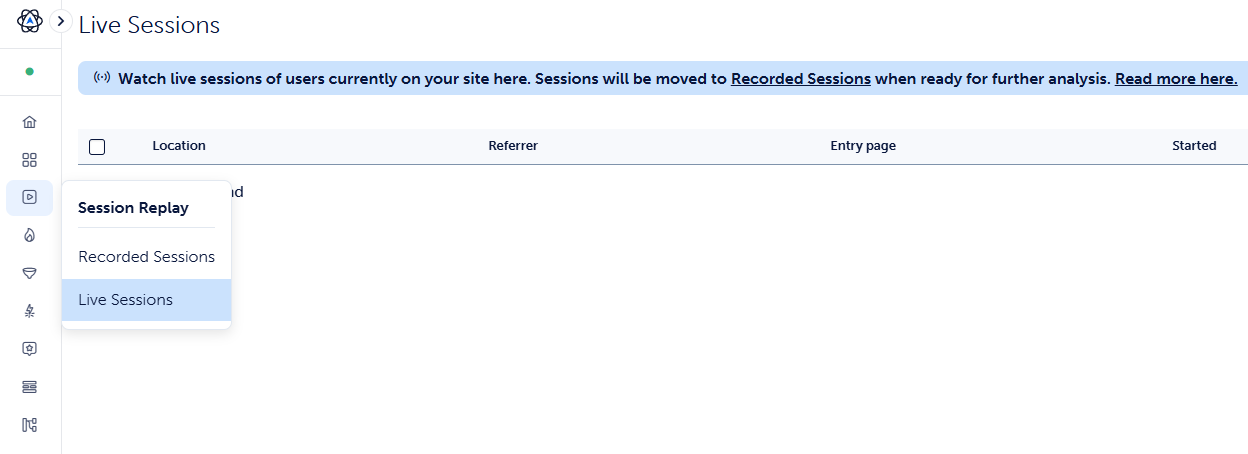
Mouseflow offers a feature that Crazy Egg currently lacks: Live Session Viewing. For customer support teams or technical developers troubleshooting a site launch in real-time, the ability to watch a live stream of current visitors is invaluable. Mouseflow also provides a quantitative "Friction Score" for every session, allowing teams to sort thousands of recordings by the level of frustration experienced by the user, rather than watching sessions at random.
The Integration of Native A/B Testing
The most significant structural difference between the two platforms lies in the inclusion of native A/B testing. Crazy Egg includes a visual editor and URL split-testing capabilities within its core subscription. This allows a team to identify a problem through a heatmap, hypothesize a fix, and launch a test to verify that fix without ever leaving the platform. This consolidation reduces "tool fatigue" and ensures that data remains consistent across the analysis and testing phases.
Mouseflow does not offer native page testing. Instead, it is designed to be a "best-in-class" diagnostic tool that feeds data into external experimentation platforms like Optimizely or VWO. For organizations that already have a dedicated, enterprise-level A/B testing stack, Mouseflow’s lack of native testing is a non-issue. However, for mid-market companies or agile marketing teams looking for a streamlined workflow, Crazy Egg’s integrated approach offers a lower total cost of ownership and faster speed-to-market for optimizations.
Conversion Funnels and Revenue Attribution
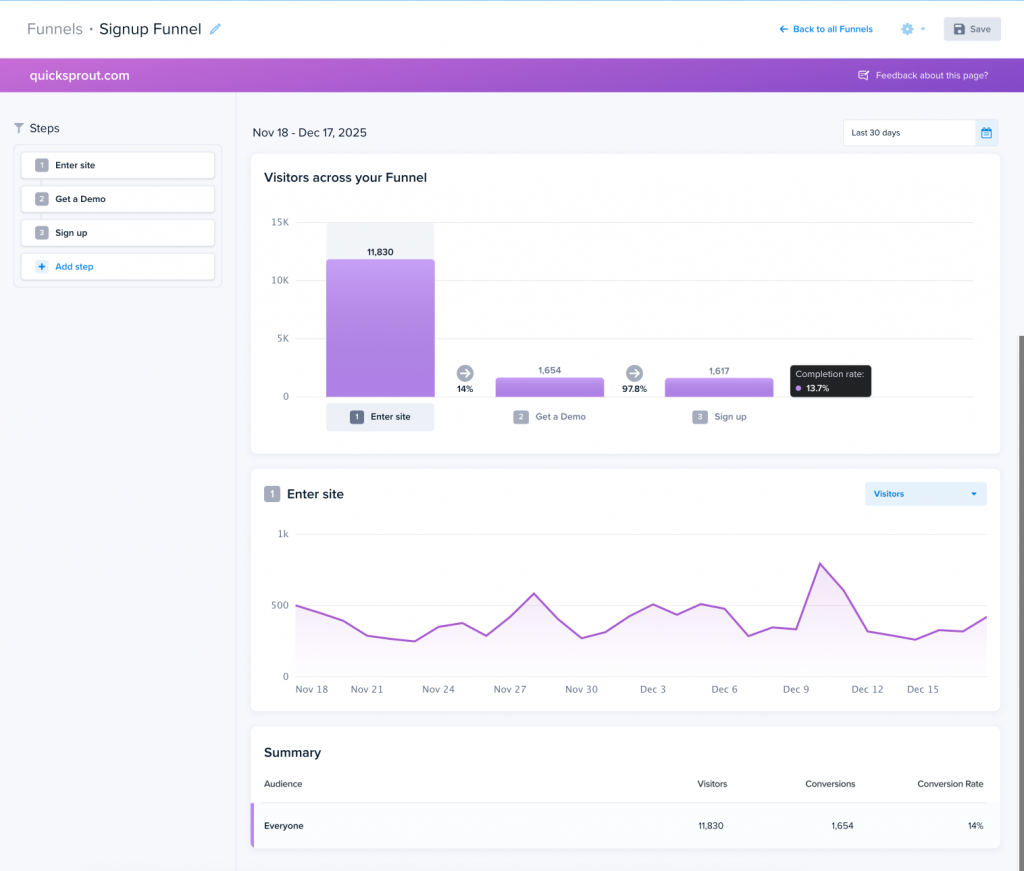
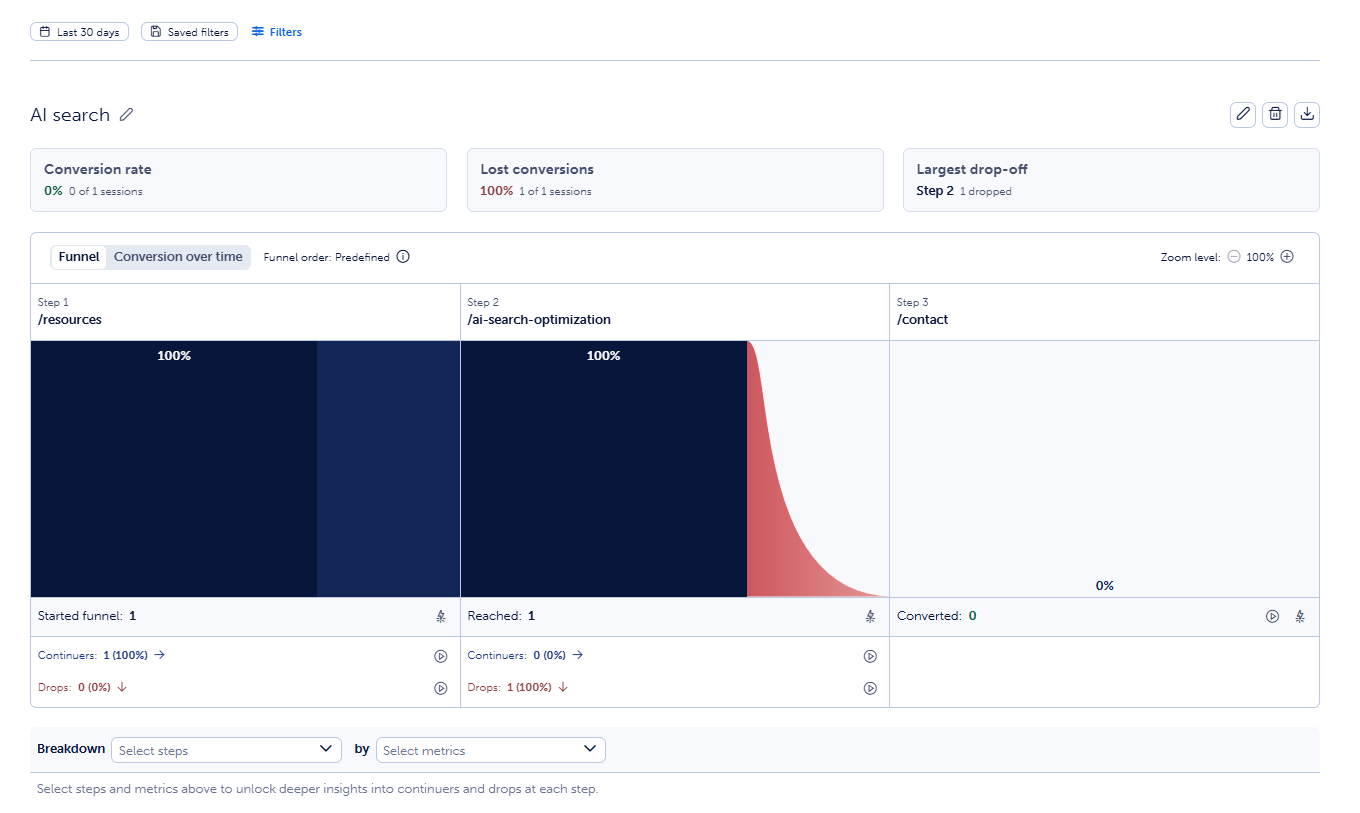
Understanding where users drop out of a purchase or signup process is critical for ROI. Both platforms offer retroactive funnels, meaning they can analyze historical data to build a funnel report instantly without waiting for new traffic.
Crazy Egg offers unlimited funnels across its paid plans and allows for highly specific step triggers, including ad-pixel events and e-commerce-specific goals. This makes it a favorite for growth hackers and performance marketers. Mouseflow, conversely, emphasizes the financial impact of UX. Its "Revenue Insights" feature allows businesses to attach a monetary value to each funnel step. This enables stakeholders to see the exact dollar amount lost to abandoned carts or form errors. Mouseflow’s "Advanced Revenue Insights" can even project the potential revenue lift from a hypothetical 1% improvement in conversion rate, providing a powerful data point for securing budget for UX projects.
The AI Frontier: Agentic Workflows vs. Conversational Assistants
In 2024 and 2025, the integration of Large Language Models (LLMs) has become a primary differentiator. Both Crazy Egg and Mouseflow have adopted the Model Context Protocol (MCP), allowing users to query their behavioral data directly from AI tools like ChatGPT, Claude, or Microsoft Copilot.
Crazy Egg has taken a more "agentic" approach with its "Tasks" feature. This is a guided optimization workflow where the AI reads the data from heatmaps and recordings, identifies the most pressing issues, and generates an executive-ready PDF report with prioritized recommendations. It can even draft variants for A/B tests. Mouseflow utilizes "Mina AI," a conversational assistant that helps users navigate the platform and produces site-wide trend summaries. While Mina AI is an excellent tool for data discovery, Crazy Egg’s AI is more focused on automating the labor-intensive process of reporting and hypothesis generation.
Security, Compliance, and Data Governance
As data privacy regulations like GDPR and CCPA become more stringent, the "security posture" of these tools is a major factor in the procurement process. Both platforms offer robust privacy features, including the masking of keystrokes to protect Personal Identifiable Information (PII) and the anonymization of IP addresses.
Mouseflow holds a slight edge for highly regulated industries, such as healthcare or finance, as it offers HIPAA compliance on its Enterprise plan and maintains ISO 27001 and SOC 2 Type II certifications. Crazy Egg remains a leader in accessibility, with its survey tools meeting WCAG AAA standards, ensuring that data collection is inclusive and compliant with public-sector requirements.
Chronology of Choice: Which Platform Fits Which Need?
The decision between Crazy Egg and Mouseflow typically follows a specific organizational logic.
The Case for Mouseflow:
If an organization already has a robust A/B testing infrastructure and requires deep technical diagnostics, Mouseflow is the superior choice. Its field-level form analytics (which track which specific form fields cause users to quit) and its aggregate Friction Score make it a powerhouse for UX researchers and technical product managers who need to find "needles in the haystack" of user data.
The Case for Crazy Egg:
If an organization is looking to consolidate its tech stack and move quickly from insight to implementation, Crazy Egg is the logical choice. By combining web analytics, heatmaps, recordings, surveys, and A/B testing into a single subscription with unlimited seats, it removes the friction of cross-departmental tool access. It is particularly effective for agencies managing multiple client domains and marketing teams that need to justify their activities with clear, AI-assisted reporting.
Final Analysis and Implications
The ongoing rivalry between Crazy Egg and Mouseflow highlights a broader trend in the software industry: the move toward "platformization" versus "specialization." Crazy Egg is winning the battle for the "all-in-one" market, appealing to teams that value simplicity and integrated workflows. Mouseflow is maintaining its stronghold among specialists who require the most granular data possible to solve complex technical UX issues.
As AI continues to mature, the gap between these tools will likely be defined by how well they can predict user behavior rather than just reporting on it. For now, businesses must weigh the value of Crazy Egg’s native testing and agentic AI against Mouseflow’s deep friction diagnostics and revenue-focused funnel analysis. In either case, the shift toward data-driven user empathy is no longer optional; it is the baseline for survival in the modern digital landscape.







