The Data & Marketing Association (DMA) UK Email Benchmarking Report for 2026, sponsored by Validity, offers a comprehensive deep dive into the dynamic and increasingly complex world of email marketing. As one of the most competitive digital channels, email demands constant evolution from marketers, and this year’s report provides critical insights into the shifting benchmarks that define "good" from "great" in the pursuit of substantial revenue uplift. Drawing on an unparalleled dataset from six prominent email service providers (ESPs), this report stands as the most complete and authoritative assessment of UK email performance currently available, offering a vital compass for brands navigating the intricate currents of inbox delivery and audience engagement. The findings underscore a pivotal moment for the industry, where traditional metrics are being re-evaluated and strategic priorities are shifting in response to technological advancements and evolving consumer behavior.
The State of UK Email: A Positive Trajectory with Underlying Nuances
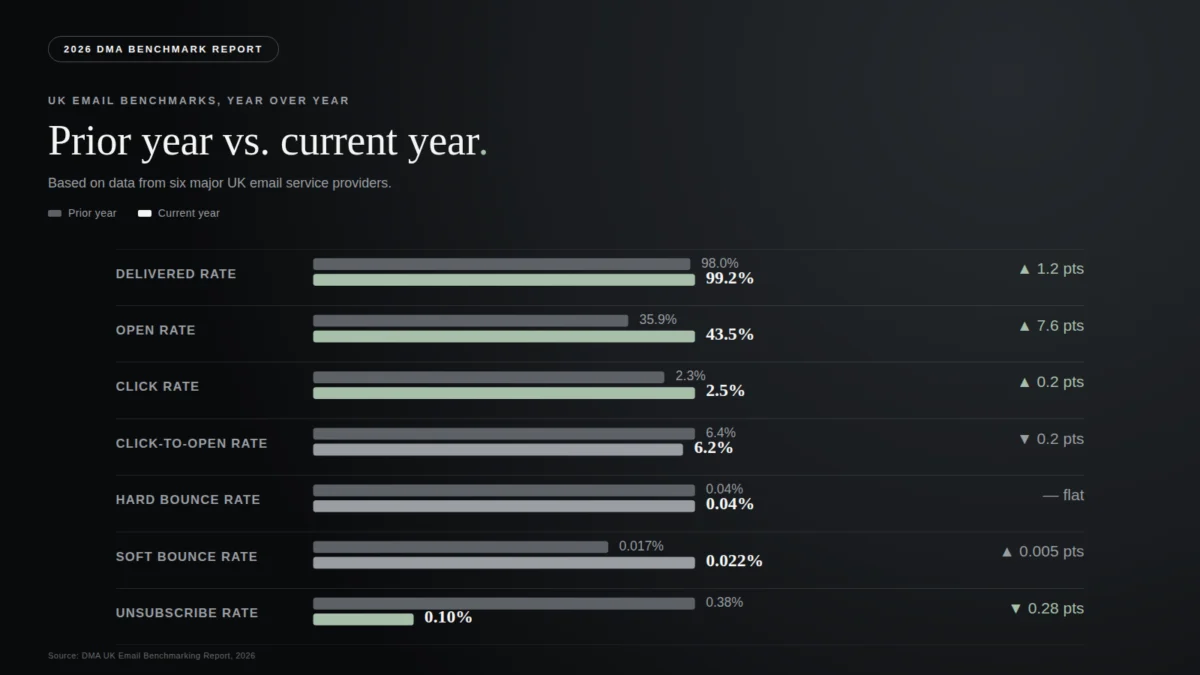
On the surface, the 2026 report paints a largely positive picture for the email channel, reflecting its enduring power and resilience in the digital marketing ecosystem. Year-over-year data indicates a steady improvement across several key performance indicators (KPIs), suggesting that marketers are, on average, refining their strategies and maintaining the channel’s efficacy. The overall delivered rate saw a marginal but significant increase of 0.1%, reaching an impressive 99.2%. This high delivery rate is a testament to improved technical infrastructure and basic list hygiene practices across the industry. Similarly, the average open rate climbed by 0.5% to 22.8%, while the click rate saw a 0.1% rise, settling at 2.2%. Concurrently, bounce rates registered a slight decrease of 0.1% to 0.8%, with unsubscribe rates holding steady at 0.1%, indicating a relatively stable subscriber base. These headline figures suggest a robust and healthy channel, consistently delivering messages and driving engagement.
However, a closer examination reveals significant variances at the sector level, highlighting disparate levels of maturity and effectiveness across different industries. The retail and travel sectors, traditionally heavy users of email, recorded the lowest click rates, at 1.0% and 1.2% respectively. This divergence from the overall trend suggests that these sectors might be facing unique challenges, perhaps stemming from highly saturated inboxes, promotional fatigue, or a slower adoption of innovative engagement strategies. Conversely, the Business-to-Business (B2B) sector demonstrated the most marked improvement in delivered rates, escalating from 90.7% to an impressive 95.6%. This substantial leap signals a concerted effort by B2B marketers to enhance their acquisition practices, implement more rigorous list hygiene, and invest in better sender reputation management, recognizing the critical role of email in complex sales cycles. For revenue leaders and marketing strategists, these aggregate numbers serve as a starting point, prompting deeper questions about the underlying drivers of performance and the untapped opportunities that lie beneath the surface.
Chronology of Email Evolution: From Broadcast to Personalization and Beyond
The journey of email marketing has been one of continuous adaptation. Originating in the 1970s as a simple communication tool, it rapidly evolved in the 1990s and early 2000s into a powerful mass marketing channel. The early days were characterized by broad-brush campaigns and a focus on sheer volume. However, as inboxes became increasingly cluttered and user expectations rose, the emphasis shifted towards personalization, segmentation, and permission-based marketing. The introduction of robust spam filters and regulatory frameworks like CAN-SPAM in the US and later GDPR in Europe fundamentally reshaped the landscape, pushing marketers towards more ethical and user-centric practices. The rise of mobile devices in the late 2000s and early 2010s transformed how and when emails are consumed, demanding responsive design and concise messaging. The concept of "customer journey mapping" became central, integrating email into a broader omnichannel strategy.
The last decade has witnessed an acceleration of this evolution, driven by advanced data analytics, sophisticated marketing automation platforms, and, more recently, artificial intelligence. This ongoing chronology underscores that "good" email marketing is not a static concept but a moving target, constantly influenced by technological innovation and shifts in consumer interaction paradigms. The increasing sophistication of both senders and mailbox providers has created an intricate dance, where maintaining effective communication requires constant vigilance and adaptation.
Delivery Versus Deliverability: Unpacking the Inbox Placement Imperative
One of the most critical distinctions highlighted in the DMA report, and a persistent challenge for marketers, is the difference between "delivery" and "deliverability." While the headline 99.2% delivered rate appears robust, it merely signifies that an email has been accepted by the recipient’s mail server. It offers no guarantee that the email actually landed in the primary inbox, rather than a spam folder, promotions tab, or being blocked entirely. This crucial metric – the Inbox Placement Rate (IPR) – is the true determinant of whether an email investment translates into tangible revenue.

Globally, the average IPR currently hovers around 87%, implying that approximately one in eight legitimate, permission-based marketing emails never reaches its intended destination within the inbox. This represents a significant leakage in marketing spend and a direct impediment to ROI. The UK average IPR, while slightly better at around 91%, has seen a concerning decline of more than two percentage points over the past year. This downward trend is largely attributed to the tightening enforcement of bulk sender requirements by major mailbox providers. Companies like Microsoft, which commands a substantial share of approximately 30% of UK inboxes, have become particularly stringent, making it increasingly challenging for senders to consistently achieve primary inbox placement. These providers continuously update their algorithms to combat spam and protect user experience, scrutinizing sender reputation, authentication protocols (such as DMARC, SPF, and DKIM), and engagement metrics with unprecedented rigor. Poor IPR can stem from various issues, including outdated mailing lists, sending to spam traps, inconsistent sending volume, or a history of low engagement and high complaint rates.
For any marketing leader focused on maximizing email ROI, monitoring and optimizing IPR should be the paramount priority. Even a modest improvement in IPR can yield an immediate, double-digit lift in engagement and conversions, often without requiring any additional expenditure on content, creative, or promotional offers. Strategies to bolster IPR include rigorous list hygiene (regularly removing inactive or invalid addresses), maintaining a strong sender reputation (avoiding spam traps, managing bounce rates), implementing robust email authentication, and segmenting audiences to send highly relevant content, thereby fostering positive engagement signals that mailbox providers favor.
The Complex Click Story: AI’s Influence and Attribution Challenges
While overall click rates saw a slight increase, the report delves into a more nuanced reality, particularly concerning the impact of artificial intelligence on subscriber behavior. The traditional pathway of "open, then click" is increasingly being disrupted by AI-generated email summaries and assistants that can surface call-to-action (CTA) links directly within the inbox preview, even before a subscriber formally "opens" the message. This phenomenon, driven by advancements in natural language processing and personalized AI assistants (such as Google’s Gemini, Microsoft’s Copilot, or even sophisticated email clients), allows users to interact with email content in entirely new ways. For instance, a user might see a summary of a retail email highlighting a "20% off sale" and click directly on a link to "Shop Now" without ever entering the email itself.
While this capability can undoubtedly drive immediate traffic by making CTAs more accessible, it introduces a significant shift in control. Marketers are, in essence, ceding the initial click decision to an AI’s judgment about which link is most pertinent or actionable. This dynamic likely contributes to the observed weak sector numbers for retail and travel, where reported click performance might appear to have declined significantly year-over-year. However, as the report suggests, it is improbable that these programs genuinely lost half their click performance. Instead, AI summaries and assistants are likely activating fewer but potentially higher-intent clicks. Subscribers who click directly from a summary are often more decisive and further along their purchasing journey, having been pre-qualified by the AI’s interpretation of their needs.
This evolution presents a critical challenge for traditional attribution models, which often struggle to credit conversions accurately when the initial engagement bypasses a direct open. The "real story," therefore, isn’t necessarily declining performance but an urgent and growing need for better, more sophisticated attribution methodologies. Multi-touch attribution models, view-through conversion tracking, and deeper integration of email engagement data with broader customer journey analytics become imperative. "Marketers must adapt their attribution models to account for these pre-open interactions," states Amelia Thorne, a lead marketing strategist at Digital Ascent Consulting. "Understanding the full path to conversion, including AI-driven touchpoints, is crucial for accurately valuing email’s contribution and optimizing future campaigns. This means looking beyond the immediate click and considering the preceding context provided by AI." This shift demands a holistic view of the customer experience, moving beyond last-click metrics to understand the cumulative impact of all interactions.
The Brand Billboard Effect: Unlocking the Value of Inactive Subscribers
One of the most counterintuitive yet compelling findings of the report revolves around the "brand billboard effect" and the surprising value held within an email program’s inactive segment. It’s a common practice for email lists to carry a substantial proportion of inactive subscribers—individuals who haven’t opened or clicked an email in months, or even years. This segment can often comprise as much as 50% of a total list, and many senders are understandably reluctant to mail to them, fearing negative impacts on deliverability and sender reputation.
However, this reluctance often overlooks a crucial, indirect benefit: the sheer presence of a brand’s email in the inbox. Even if a subscriber doesn’t open or click, they still encounter the sender name and subject line. This repeated, passive exposure acts as a powerful brand billboard, subtly reinforcing brand awareness, recall, and trust. While not generating direct engagement metrics, this continuous exposure can prompt subscribers to respond in other, unmeasured ways: visiting a physical store, conducting an independent search for a product review, navigating directly to the brand’s website, or even making a purchase through another channel entirely, spurred by the subtle reminder of the brand’