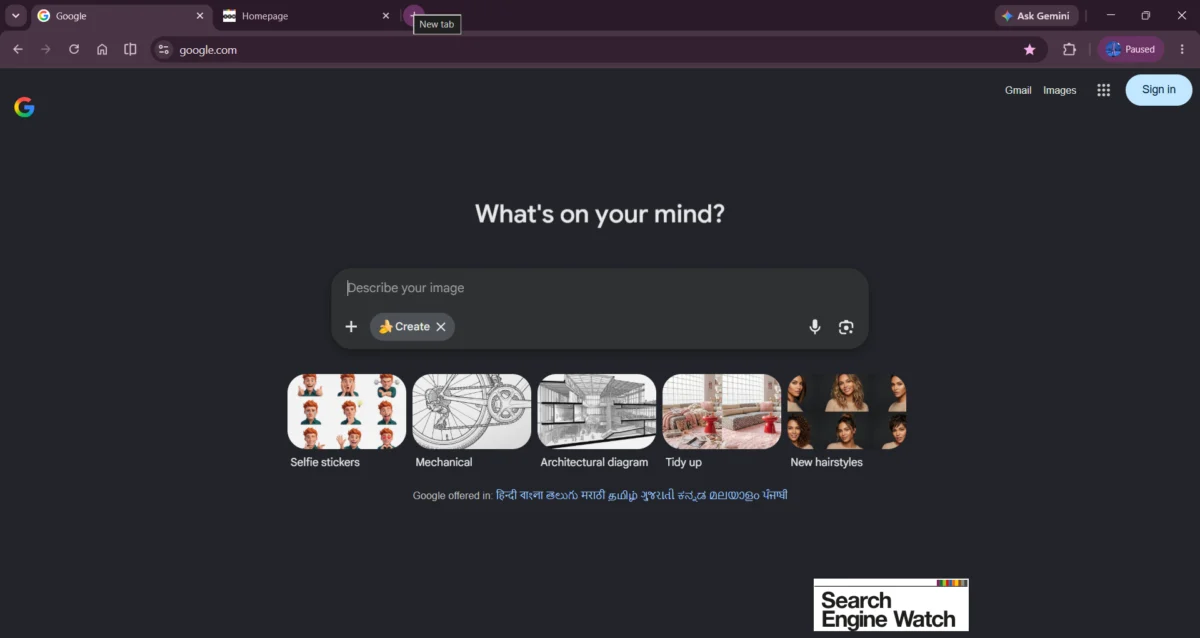
The most striking alteration is the disappearance of the iconic "Google Search" button, a staple of the homepage for decades. In its place, users are presented with a trio of distinct AI-driven options positioned directly beneath the search box: "Create images," "Ask about files," and "Brainstorm." Furthermore, an "AI Mode" button has been subtly incorporated within the search field itself, hinting at a more deeply embedded AI experience. This new layout was initially spotted while utilizing Google Search within the stable version of Chrome without an active Google sign-in. Subsequent observations confirmed the same interface across other browsers, including Microsoft Edge and Perplexity’s Comet browser, indicating a broader, potentially server-side, experimental rollout rather than a browser-specific anomaly.
A Deep Dive into the New AI-Centric Features
The introduction of "Create images," "Ask about files," and "Brainstorm" directly on the homepage marks a significant departure from Google’s minimalist aesthetic, traditionally focused on a single search bar and two buttons. These new controls are not merely promotional placeholders; extensive testing reveals that "Ask about files" and "Brainstorm" are fully functional without the necessity of a Google Account login. The "AI Mode" button, nestled within the search bar, also operates seamlessly for signed-out users, democratizing access to Google’s generative AI tools.

The "Ask about files" shortcut is particularly noteworthy for its immediate utility and privacy implications. Upon selecting this option, a distinctive "+" button materializes within the search box, enabling users to attach a file directly. Crucially, queries related to the uploaded document can then be posed and answered by Google’s AI without any requirement for user authentication. This functionality could revolutionize how users interact with personal or work-related documents, offering on-demand summarization, data extraction, or analytical insights without the overhead of signing into a cloud service. For instance, a user could upload a PDF of a research paper and ask for its main conclusions, or a spreadsheet and inquire about specific data trends, all in a transient, anonymous session.
Similarly, the "Brainstorm" feature offers a powerful creative and problem-solving tool accessible to all. When activated, it presents users with a prompt field to describe their needs, subsequently generating ideas, outlines, or creative solutions. This could range from suggesting marketing slogans to outlining a story plot, or even generating potential solutions for a complex problem, all without the friction of a login. The ability to brainstorm freely and anonymously could appeal to a wide array of users, from students seeking project ideas to professionals needing quick conceptual development.
However, a distinction exists with the "Create images" option. While prominently displayed, this feature mandates a Google Account sign-in before users can proceed to generate images. This selective requirement likely stems from several factors: the computational intensity of image generation, the need for content moderation and accountability for generated visuals, and potentially Google’s strategy to incentivize account creation or leverage existing user data for personalized image outputs. This tiered access strategy highlights a careful balance between broad AI accessibility and the necessity for user accountability and resource management.
Historical Context: Google’s Evolution in Search and AI

Google’s journey from a simple search engine to an AI powerhouse has been gradual yet relentless. Since its inception, the company has consistently invested heavily in artificial intelligence and machine learning, leveraging these technologies to refine its search algorithms, improve ad targeting, and power a myriad of services. The current AI-first homepage test can be viewed as a culmination of years of research and development, particularly in the wake of the generative AI boom ignited by models like OpenAI’s ChatGPT.
Historically, Google’s homepage has been a bastion of simplicity, famously featuring just its logo, a search bar, and the "Google Search" and "I’m Feeling Lucky" buttons. This minimalist design aimed to convey speed and efficiency, allowing users to quickly navigate to their desired information. Over time, subtle additions like trending searches or doodles were incorporated, but the core interaction remained unchanged. The current test, however, represents the most radical redesign of the Google homepage in recent memory, signaling a foundational shift in how Google envisions user interaction with its primary product.
The timing of this rollout is also critical. The years leading up to 2026 have witnessed an unprecedented acceleration in AI development and adoption. Competitors like Microsoft have aggressively integrated AI into their Bing search engine and Windows operating system through Copilot, directly challenging Google’s dominance. Other AI-native platforms, such as Perplexity AI, have also gained traction by offering conversational search experiences from the outset. Google’s own Search Generative Experience (SGE), which integrates AI-powered summaries and conversational capabilities directly into search results, has been in testing for some time. This new homepage interface appears to be a natural extension of SGE, pushing AI capabilities to the forefront even before a query is entered. It’s a strategic move to preemptively demonstrate Google’s AI prowess and guide users towards these advanced functionalities, ensuring they remain at the cutting edge of information retrieval and creation.
The Strategic Importance of Signed-Out Users

The decision to offer these advanced AI functionalities to signed-out users carries significant strategic weight. Traditionally, Google has used account sign-ins to personalize experiences, track user preferences, and offer seamless integration across its vast ecosystem of services (Gmail, Drive, YouTube, etc.). However, a substantial portion of internet users, for reasons ranging from privacy concerns to sheer convenience, prefer to use search engines without logging into an account. By making core AI features accessible to this demographic, Google achieves several key objectives:
- Broadened Adoption: It removes a barrier to entry for AI tools, encouraging a wider audience to experiment with and adopt generative AI, regardless of their Google Account status. This could be particularly impactful in regions or demographics where Google Account penetration is lower or where privacy is a heightened concern.
- Competitive Edge: It positions Google’s AI offerings as more accessible than some competitors that might require account creation or subscription for similar advanced features. This "try before you buy" approach could attract new users to the Google ecosystem.
- Data Collection (Anonymized): While not tied to a specific user account, Google can still gather valuable anonymized data on how these AI features are used, what types of queries are made, and which functionalities are most popular. This data is crucial for refining its AI models and user experience.
- Demonstrating Leadership: It sends a clear message about Google’s commitment to AI innovation, showcasing its capabilities prominently to every visitor, even casual ones.
Implications for User Experience and Digital Marketing
This AI-first homepage could dramatically reshape user behavior. For many, Google’s homepage has been a gateway to factual information, direct website navigation, or quick queries. With "Ask about files" and "Brainstorm" at their fingertips, users might increasingly turn to Google not just for information retrieval but for content generation, complex problem-solving, and creative assistance. This could lead to a reduction in traditional search queries for certain tasks, as users find their needs met directly on the homepage or through AI-generated answers.
From a digital marketing and SEO perspective, the implications are profound. If users can "Brainstorm" ideas or "Ask about files" directly on the Google homepage, the pathways to organic traffic could shift. Websites relying heavily on informational content or basic "how-to" guides might see reduced click-through rates if Google’s AI can provide satisfactory answers instantly. SEO strategies would need to evolve beyond traditional keyword optimization to focus more on entity-based SEO, ensuring content is structured in a way that Google’s AI can easily understand and synthesize, and potentially focusing on more complex queries that require deeper dives beyond AI summaries.

Furthermore, the "Create images" feature, despite requiring a login, hints at Google’s ambitions in creative AI. As more users adopt AI for image generation, the demand for stock photos or basic graphic design services might see a transformation, potentially opening new avenues for marketers to leverage AI-generated visuals directly within Google’s ecosystem.
The Nature of Google’s Testing and Future Outlook
It is crucial to emphasize that this AI-centric homepage appears to be part of an ongoing test or a server-side rollout. Google has a long-standing practice of conducting A/B tests, where different versions of its products are shown to a subset of users to gather data and feedback before a wider deployment. The observed behavior – the AI shortcuts disappearing after signing in and reappearing after signing out – further reinforces the idea that this is a carefully controlled experiment. Google typically refrains from commenting on unannounced product tests, maintaining a veil of secrecy around its development pipeline.
The outcome of this test will likely dictate whether this AI-first homepage becomes a permanent fixture for signed-out users, or even a default experience for all. Factors such as user engagement with the new features, the quality and relevance of AI-generated responses, potential system load, and any unforeseen user feedback will all play a role in Google’s decision-making process.

Looking ahead, this experiment signals Google’s unwavering commitment to embedding artificial intelligence at the very core of its user experience. The future of Google Search is undeniably AI-driven, moving beyond mere information indexing to becoming an intelligent assistant capable of understanding, generating, and even creating content. This move to empower signed-out users with sophisticated AI tools underscores a broader industry trend towards democratizing AI access, while simultaneously positioning Google at the forefront of this technological evolution. The traditional search button may be gone for some, but in its place stands a glimpse into a more interactive, generative, and intelligent future of web interaction, spearheaded by Google.