The landscape of digital marketing is in constant flux, and one of the most persistent questions echoing through client consultations today revolves around the enduring relevance of blogs. As artificial intelligence rapidly reshapes how users discover information and content becomes increasingly commoditized, the role of blogs as foundational content factories is being rigorously scrutinized. While some may perceive a decline in traditional search traffic as an indicator of obsolescence, a deeper dive into recent data and evolving AI behaviors reveals a more nuanced and potentially optimistic outlook for the strategic use of blogs in B2B marketing.
The skepticism surrounding blogs is understandable. The advent of AI-powered search, particularly generative AI chatbots, has fundamentally altered the search engine results page (SERP). Instead of presenting a list of blue links, AI is increasingly synthesizing information and delivering direct answers, potentially bypassing traditional content sources altogether. This shift has led to observable declines in organic search volume for many websites, prompting business leaders to question the return on investment (ROI) of their blog content. In some instances, reallocating resources to other channels may indeed be the most prudent course of action. However, for many, the narrative is far from over. Emerging data suggests that while the quantity of traffic may be decreasing, the quality and value of the traffic that does arrive through AI-driven discovery can be significantly higher.
The Shifting Tides of Search Discovery: From Volume to Value
The most prominent concern regarding blog performance is the documented decline in traditional search engine traffic. Gartner, a leading research and advisory company, projected in February 2024 that traditional search engine volume would drop by 25% by 2026. This prediction was largely attributed to the growing adoption of AI chatbots and virtual agents, a trend that has become increasingly evident in website analytics dashboards worldwide. For organizations that have historically based their ROI calculations on organic traffic volume derived from search, this presents a clear challenge. Fewer queries are now resolving to a traditional list of links, and more are being answered directly by AI. Consequently, even exceptionally well-crafted blog posts may not receive the click-throughs they once did.
However, this narrative of decline is incomplete. A crucial counterpoint emerges when examining conversion rates. Research by SEMrush indicates that visitors arriving via AI-powered search are, on average, 4.4 times more valuable than those from traditional organic search, based on conversion rates. Further reinforcing this, Similarweb data published in May of the current year revealed that traffic referred from ChatGPT converted at a 7.1% rate, second only to paid search.
This phenomenon can be attributed to several factors. Firstly, the trust signals associated with a high search ranking, or increasingly, with the authoritative assessment of AI systems, transfer to the user who clicks through. AI models are designed to evaluate authority and relevance with a greater depth and robustness than ever before. When an AI system surfaces a piece of content, it implies a level of credibility that predisposes the user to higher engagement and conversion. In essence, the clicks that do come through AI-driven discovery are often from users with a more clearly defined intent and a higher degree of trust in the information presented. For many B2B companies, particularly those that have invested heavily in building topical authority through their blogs, this translates into a more qualified and valuable audience.
What AI Systems Actually Cite: The Rise of Informational Content

A critical recalibration in thinking about blog investment for B2B marketing comes from understanding what AI systems are actually citing. Raw citation volume across major AI platforms reveals that brand-owned content does not always dominate, which can initially seem disheartening. However, the data also highlights that blogs, by their very nature, are highly citable. This presents a clear pathway for brands to become part of the AI discovery ecosystem, provided the right strategic approach is adopted.
Wix’s AI Search Lab, in an analysis of 75,000 AI answers, discovered that articles are cited 2.7 times more often for informational queries. Combined, articles and listicles account for a significant 67% of informational citations. This finding is echoed by Otterly’s research, which consistently shows editorial and informational content outperforming purely commercial pages. The inherent structure of blog content – its focus on providing information, detailed explanations, and thought leadership, rather than direct sales pitches – aligns precisely with the type of structured, non-transactional data that Large Language Models (LLMs) seek when synthesizing answers.
Therefore, while a blog might not be the single most cited source in the universe, it often represents the most accessible and controllable owned asset for producing content in a format that AI systems actively favor. This is a crucial distinction for B2B marketers aiming to establish thought leadership and brand authority within the AI-driven information landscape.
The Query Fan-Out Effect and the Power of Topical Breadth
One of the more counterintuitive findings in recent research pertains to how AI search engines process queries. Instead of a simple one-to-one match between a question and a result, AI systems often decompose queries into multiple parallel sub-queries. This process, known as "query fan-out," involves retrieving content for each sub-query and then synthesizing the information into a comprehensive answer. This has profound implications for content strategy.
Crucially, studies indicate that a significant percentage of pages cited in AI Overviews do not rank within the top 10 organic search results. Approximately 90% of citations from platforms like ChatGPT originate from beyond the first or second page of traditional search results. This suggests that the long tail of content, often found in niche blog posts addressing highly specific questions, can be particularly valuable. For enterprises with extensive legacy blog libraries, this means that carefully optimized cornerstone content might not be the primary driver of AI citations. Instead, a less prominent, yet highly specific, post from years ago answering a granular question could be precisely what matches one of those AI sub-queries.
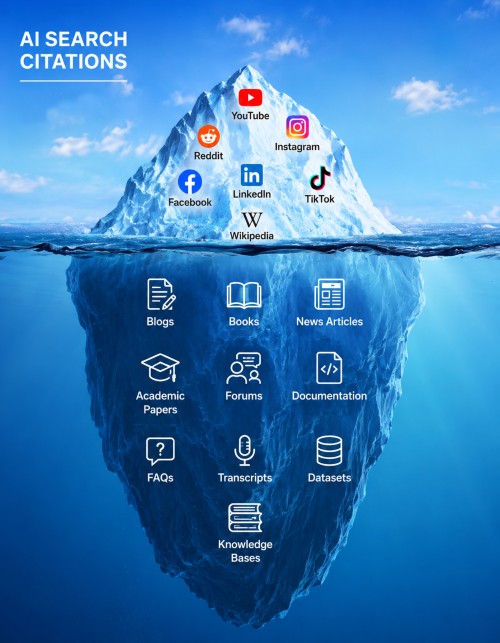
As Lee Odden, CEO of TopRank Marketing, aptly describes, "Blogs are now the iceberg beneath the water." The visible tip of the iceberg – the prominent, high-ranking articles – may be less frequently surfaced by AI. However, the vast, submerged portion of the iceberg, representing a diverse and comprehensive archive of content, holds immense potential for being discovered through the multifaceted query decomposition process of AI. This underscores the importance of maintaining a broad topical inventory and ensuring that even older, niche content remains accessible and discoverable.
What Doesn’t Work Anymore: The Demise of Scale-Based Content Playbooks

The notion that simply churning out a high volume of content will guarantee AI visibility is a misconception that recent research aims to dispel. Two key findings from recent studies highlight the obsolescence of scale-based content strategies:
- Mediocre content is increasingly useless: The ease with which AI can generate vast quantities of generic content means that "more of the same" is no longer an effective strategy. AI systems are designed to identify and prioritize high-quality, informative, and authoritative content. A deluge of mediocre, keyword-stuffed articles will likely be ignored or de-prioritized.
- Commercial intent content is less likely to be cited: While transactional pages are essential for conversion, they are less likely to be cited by AI for informational queries. AI’s primary function is to educate and inform, not to directly sell. Therefore, content that is perceived as overly promotional or sales-oriented will likely be bypassed.
Instead, what correlates to AI visibility are elements such as original research, proprietary data, demonstrated expertise, a clear and distinct point of view, and structured content that can be easily extracted at the passage level without losing its intended meaning. AI systems are not merely ranking pages; they are evaluating specific passages of text. A concise, well-structured 800-word post that presents a clear claim supported by data is far more likely to outperform a sprawling, generic overview. This shift emphasizes the importance of depth, specificity, and evidence-based insights over sheer volume.
The Critical Role of Content Freshness and Regular Refresh Cadence
In the dynamic realm of AI-driven information retrieval, content recency is emerging as a significant factor. ZipTie reports that AI-cited content is, on average, 25.7% fresher than traditionally ranked content. Furthermore, a substantial 76.4% of the top-cited pages by ChatGPT were updated within the last 30 days.
This highlights a structural advantage for blogs over more static website content. For blog strategies, a regular refresh cadence is as vital as net-new publishing. Updating a high-performing post with current statistics, recent references, and evolving industry insights is not merely a matter of good content hygiene; it is a direct citation signal to AI systems. According to ZipTie, a structured content refresh strategy can elevate citation rates by an impressive 292%. This approach is also significantly more cost-efficient than the perpetual creation of entirely new URLs and content pieces, allowing brands to leverage and amplify their existing high-value assets.
The Brand Entity and its Influence on AI Visibility
Beyond direct citations, blogs play a crucial role in building the overall "brand entity" that AI systems learn from over time. Ahrefs research indicates a strong correlation (0.66-0.71) between branded web mentions and AI visibility across various AI search interfaces, including ChatGPT, AI Mode, and AI Overviews. The more frequently a brand appears across the web – through third-party coverage, user-generated content, and citations of its original research – the more likely it is to surface in AI-generated responses.
Blogs serve as a foundational source for these brand mentions. When a company publishes original data, a well-articulated perspective, or in-depth analysis, it creates the raw material that other websites cite, practitioners share in online forums, and ultimately, AI systems learn to associate with that brand. As Otterly.AI suggests, businesses should "treat your blog like a source, not a sales brochure." This philosophy positions the blog as a primary information hub, a reservoir of expertise that AI can draw upon to build a comprehensive understanding of a brand’s authority and relevance.
Conclusion: The Enduring Value of Strategic Blogging for B2B
So, are blogs still worth the investment for today’s B2B marketing efforts? The answer, as with many strategic questions, is nuanced and depends heavily on the specific approach.
If a blog’s primary purpose is to churn out keyword-targeted posts designed solely to capture mid-funnel clicks, then the ROI case is indeed becoming more challenging. This model, already showing signs of strain before the advent of AI search, is unlikely to yield the same results as in the past.
However, if a blog functions as an authoritative reference point – consistently publishing original research, delving deeply into specific use cases, maintaining a regular refresh cadence, and diligently building genuine topical authority – then the data unequivocally supports continued investment. Blogs may no longer be the primary drivers of sheer traffic volume they once were, but they remain as influential as any other channel in the context of AI citation and discovery. Moreover, they often require a comparatively lower publishing lift to achieve significant impact when executed strategically. In an era where AI is fundamentally reshaping how information is accessed and consumed, a well-managed, content-rich blog can serve as a critical asset for establishing and maintaining brand relevance and authority.
About the Author:
Nick Nelson, Associate Content Director at TopRank Marketing, is dedicated to energizing brand narratives with intelligent, engaging, and sharp wordplay. His mission is to harness the power of language to create impactful content. Outside of his professional endeavors, Nick is an avid, albeit often long-suffering, fan of Minnesota sports teams, a connoisseur of groan-inducing puns, and believes that buffalo sauce can improve almost any dish.