Apple’s advertising division has achieved a new June-quarter revenue record, according to statements made during the technology giant’s latest earnings call for its fiscal third quarter, ending June 27, 2026. Despite this significant milestone, the precise financial contribution of advertising remains an enigma, as Apple steadfastly refrains from disclosing its advertising revenue separately within its financial reports. This continued lack of transparency leaves market analysts and industry observers to decipher clues from the broader Services segment, which itself posted robust growth figures.
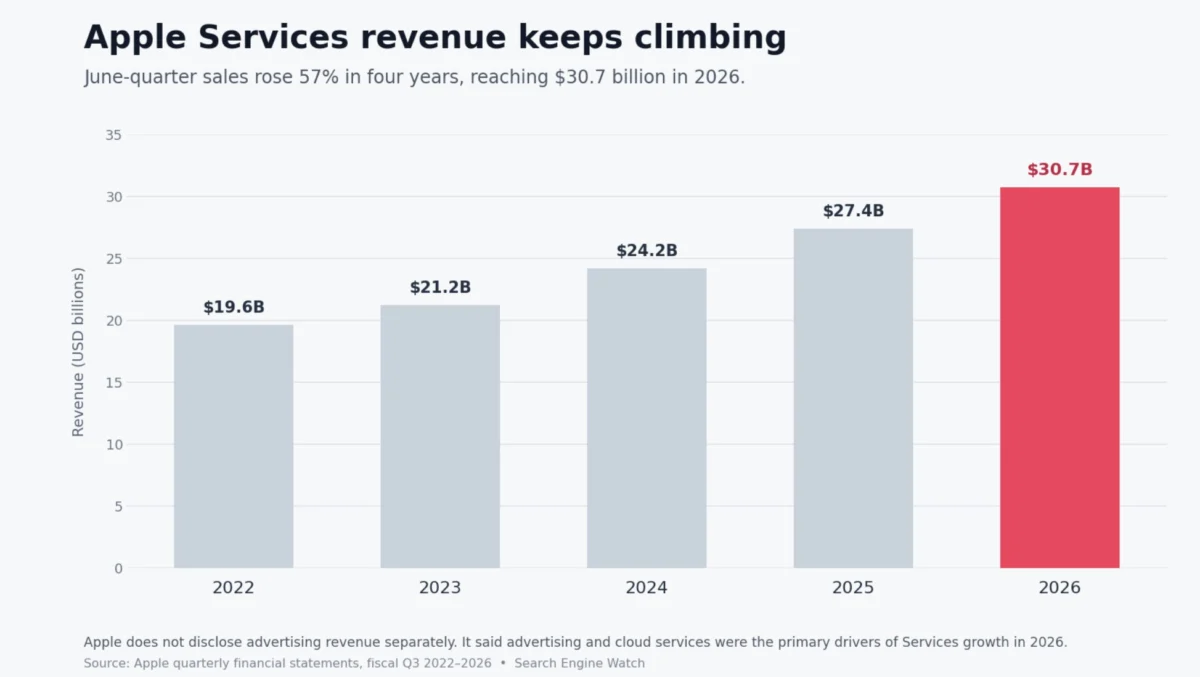
The Services segment as a whole generated an impressive $30.74 billion during Apple’s fiscal third quarter, marking a substantial 12% increase from the $27.42 billion reported in the same period a year prior. According to Apple’s regulatory filing (referenced as aapl-20260627.htm), this considerable uplift was primarily driven by the strong performance of both advertising and cloud-services sales. This granular insight from the filing provides the clearest indication yet of advertising’s burgeoning importance within Apple’s diverse portfolio.
The Ascent of Apple Services: A Decade of Strategic Growth
The long-term trajectory of Apple’s Services division underscores a deliberate and successful diversification strategy. Tracing back just a few years, the June-quarter Services revenue has ascended remarkably from $19.6 billion in 2022 to the current $30.7 billion in 2026. This represents an astonishing increase of nearly 57% over a four-year period, transforming Services into a cornerstone of Apple’s financial health and a vital counterweight to the cyclical nature of hardware sales. This consistent growth highlights Apple’s successful pivot towards a more recurring revenue model, leveraging its immense installed base of over two billion active devices globally.
During the earnings call, Apple CFO Kevan Parekh explicitly highlighted that advertising delivered "strong double-digit growth," placing it alongside other high-performing categories such as cloud, video, and payment services. While Parekh’s statement confirms advertising’s significant contribution, it falls short of providing the specific figures that industry stakeholders crave. The broad Services category encompasses a vast array of offerings, including the highly lucrative App Store, iCloud storage, Apple Music, Apple TV+, AppleCare extended warranties, and various payment services. Therefore, the $30.7 billion figure represents the collective performance of this expansive segment, not solely the revenue generated by Apple’s advertising platforms.
The Opaque Advertising Engine: A Strategic Veil
For marketers and advertisers globally, the record-breaking performance of Apple’s advertising business, even if undisclosed in detail, confirms a clear and accelerating trend. Apple is methodically converting its colossal installed base of users into a valuable, albeit increasingly "walled garden," advertising inventory. This strategy allows Apple to monetize its ecosystem more aggressively while largely keeping the financial specifics under wraps. This stands in stark contrast to industry giants like Google and Meta, which routinely publish detailed breakdowns of their advertising revenues, offering transparency to investors and the market. Apple, conversely, continues to provide only tantalizing clues, forcing analysts to piece together its advertising narrative through inferences and the occasional executive remark. The latest financial results, particularly the emphasis in the regulatory filing and Parekh’s comments, offer the most compelling evidence to date that advertising is rapidly becoming an indispensable, and perhaps one of the largest, components of Apple’s Services business, even if its true scale remains obscured.
A Chronology of Apple’s Advertising Evolution
Apple’s journey into advertising has been marked by both ambitious attempts and strategic pivots.
-
2010: The Dawn of iAds: Apple initially ventured into mobile advertising with the launch of iAds, a platform designed to deliver rich, interactive ads within iOS applications. Positioned as a premium alternative to Google’s AdMob, iAds aimed to provide a high-quality advertising experience. However, despite initial hype, iAds struggled to gain traction against Google’s more extensive network and developer-friendly terms. By 2016, Apple decided to discontinue iAds, signaling a retreat from its first major advertising foray.
-
2016: The Strategic Re-entry with App Store Search Ads: Learning from the iAds experience, Apple re-entered the advertising arena with a more focused approach: App Store Search Ads. This platform allowed developers to bid on keywords to promote their apps directly within App Store search results. This move proved highly successful, as it leveraged Apple’s first-party data and directly addressed a critical need for app discovery in an increasingly crowded marketplace. Its success laid the groundwork for future expansions.
-
2019-2021: Expansion Across Apple’s Ecosystem: Building on the success of Search Ads, Apple gradually expanded its advertising offerings. Ads began appearing in Apple News and Apple Stocks, delivering targeted content to users within these native applications. Furthermore, Apple TV+ later incorporated advertising models, especially for live sports content and certain premium tiers, diversifying its revenue streams beyond subscriptions. These expansions demonstrated Apple’s growing commitment to advertising as a significant revenue driver.
-
22021: The App Tracking Transparency (ATT) Framework: A pivotal moment arrived with the introduction of App Tracking Transparency (ATT) in iOS 14.5. This privacy-focused framework required apps to explicitly ask users for permission to track their activity across other apps and websites. While lauded by privacy advocates, ATT severely disrupted the digital advertising ecosystem, particularly impacting third-party ad networks and companies like Meta and Google, which rely heavily on cross-app tracking for personalized advertising. Ironically, ATT also created a competitive advantage for Apple. By limiting external tracking, Apple’s own advertising platforms, which operate within its first-party ecosystem and utilize aggregated, anonymized data, became more attractive to advertisers seeking effective reach on iOS devices. This move, whether intentionally or not, significantly bolstered Apple’s internal advertising capabilities and market position.
-
2023-2026: Accelerated Growth and Platform Refinement: In the years following ATT’s implementation, Apple has reportedly ramped up its efforts to build out its advertising infrastructure. This includes hiring experienced ad tech professionals, enhancing its self-serve ad platforms, and exploring new ad formats and placements within its growing suite of services. The "strong double-digit growth" mentioned by CFO Parekh is a direct reflection of these accelerated efforts and the strategic benefits reaped from the post-ATT landscape.
The Strategic Imperative: Leveraging the Ecosystem
Apple’s intensified focus on advertising is a clear strategic imperative. With iPhone sales potentially plateauing in mature markets, and the increasing global competition in the smartphone sector, diversifying revenue streams beyond hardware has become paramount. The Services segment, with advertising as a key component, offers higher profit margins and more predictable, recurring revenue compared to hardware sales. By monetizing its vast user base and the rich first-party data generated within its ecosystem, Apple can unlock significant new revenue opportunities. This strategy not only strengthens its financial position but also tightens its control over the user experience within its walled garden, further integrating advertisers into its proprietary ecosystem.
Industry Reactions and Analyst Perspectives
The latest financial results, while lacking granular detail, have resonated across the digital advertising industry. Marketing executives are increasingly acknowledging the necessity of allocating a growing portion of their budgets to Apple’s advertising platforms, especially for reaching high-value iOS users. "We’re seeing an undeniable shift," stated Sarah Chen, a senior media buyer at a global advertising agency, speaking generally about market trends. "The efficacy of Apple Search Ads, for instance, combined with the limitations imposed by ATT, means we simply have to play in Apple’s playground more than ever before. It’s a powerful channel, but the lack of transparent reporting makes optimizing and justifying spend a constant challenge."
Financial analysts have consistently attempted to estimate Apple’s true advertising revenue. While estimates vary widely, many suggest that Apple’s ad business could already be generating upwards of $10 billion to $20 billion annually, potentially placing it among the top five digital ad sellers globally, even without official disclosure. "The consistent ‘strong double-digit growth’ commentary from Apple’s executives strongly suggests advertising is a multi-billion dollar business, likely contributing significantly to the Services segment’s overall expansion," noted an analyst from a leading investment bank, speaking on background. "The question isn’t if it’s big, but how big, and why they continue to keep it under wraps."
Privacy advocates, while initially praising Apple for ATT, have expressed growing concern over the company’s expanding advertising footprint. "Apple championed user privacy, and rightly so, by giving users control over third-party tracking," commented a spokesperson for a digital rights organization. "However, the simultaneous growth of Apple’s own advertising business, which leverages its first-party data, raises questions about potential hypocrisy and market dominance. There needs to be clear, consistent standards for data usage and advertising practices across the board, not just for third parties."
Implications for the Digital Advertising Landscape
Apple’s ascendancy in advertising carries profound implications for the broader digital advertising landscape:
- Shift in Ad Spend: Advertisers are increasingly reallocating budgets towards platforms that offer direct access to iOS users and utilize first-party data, with Apple’s own platforms being a prime beneficiary. This shift is likely to continue, especially for app developers and brands targeting affluent consumers.
- Increased Competition and Market Power: While not directly competing across all segments, Apple’s growth undoubtedly adds pressure on traditional digital advertising behemoths like Google and Meta. In certain niches, particularly app install ads and native placements within Apple’s own apps, Apple holds a significant competitive advantage due to its control over the iOS ecosystem and first-party data. This growing market power could attract regulatory scrutiny regarding potential anti-competitive practices, particularly given Apple’s dual role as a platform gatekeeper and an advertising provider.
- Data Privacy and Walled Gardens: Apple’s success reinforces the trend towards "walled gardens," where companies leverage their proprietary ecosystems and first-party data to create effective advertising channels, often at the expense of independent ad tech firms reliant on third-party cookies and identifiers. This trend fundamentally reshapes how data is collected, processed, and utilized for advertising, pushing the industry towards more privacy-centric, but also more fragmented, approaches.
- Innovation and New Ad Formats: Apple’s deep integration with its hardware and software allows for unique ad formats and experiences that other platforms may struggle to replicate. This could drive innovation in mobile advertising, pushing the boundaries of what is possible within a privacy-respecting framework.
The Road Ahead: Pressure for Transparency
The persistent lack of specific advertising revenue disclosure by Apple remains a contentious issue. While the company attributes its reticence to a policy of not breaking out specific revenue streams within larger segments, industry experts and investors argue that the scale and strategic importance of advertising now warrant greater transparency. The reasons for Apple’s opacity could be multifaceted: to avoid drawing unwanted attention from regulators, to maintain a competitive advantage by keeping its rivals guessing, or simply to manage investor expectations around a rapidly growing but still relatively nascent segment compared to its hardware sales.
However, as Apple’s advertising business continues its record-breaking growth and becomes an increasingly integral part of its financial success, the pressure for greater transparency is only expected to mount. Both financial markets and the advertising industry will likely continue to demand more detailed insights into a business segment that is rapidly transforming Apple into an unexpected, yet formidable, advertising powerhouse. Until then, analysts and marketers will continue to rely on the "strongest clues yet" to gauge the true scale and impact of Apple’s expanding advertising empire.