The divide between sales and marketing departments has long been a fixture of corporate discourse, but new data from the 2026 Anatomy of Aligned Go-to-Market Teams report reveals that this misalignment is no longer merely a cultural friction point; it is a significant operational tax on small and medium-sized businesses (SMBs). According to the comprehensive survey conducted by Unbounce, which reached over 500 go-to-market (GTM) professionals, a staggering 87% of teams expect better sales and marketing alignment to directly lift organizational performance. However, a significant "alignment gap" remains, as only 56% of these professionals describe their current teams as highly aligned.
This discrepancy highlights a critical paradox in modern business strategy: while leadership teams acknowledge the theoretical necessity of synchronization, the practical implementation remains elusive. The report suggests that misalignment rarely presents as a single catastrophic failure. Instead, it manifests as a series of "micro-leaks" in the revenue funnel—qualified leads that sales reps do not trust, marketing messages that sales teams ignore, and a pipeline that appears robust until the final stages of the conversion process, where revenue realization begins to stall.
The Perception Gap: A View from the C-Suite vs. the Front Lines
One of the most striking findings in the 2026 report is the structural information lag between executive leadership and operational staff. The data indicates that 69% of executives believe their sales and marketing teams are strongly aligned. In contrast, only 47% of non-executive staff share this sentiment. This 22-point gap suggests that executives are often viewing alignment through the lens of high-level strategy decks and scheduled meetings, while those responsible for executing the strategy are grappling with the day-to-day realities of broken processes.

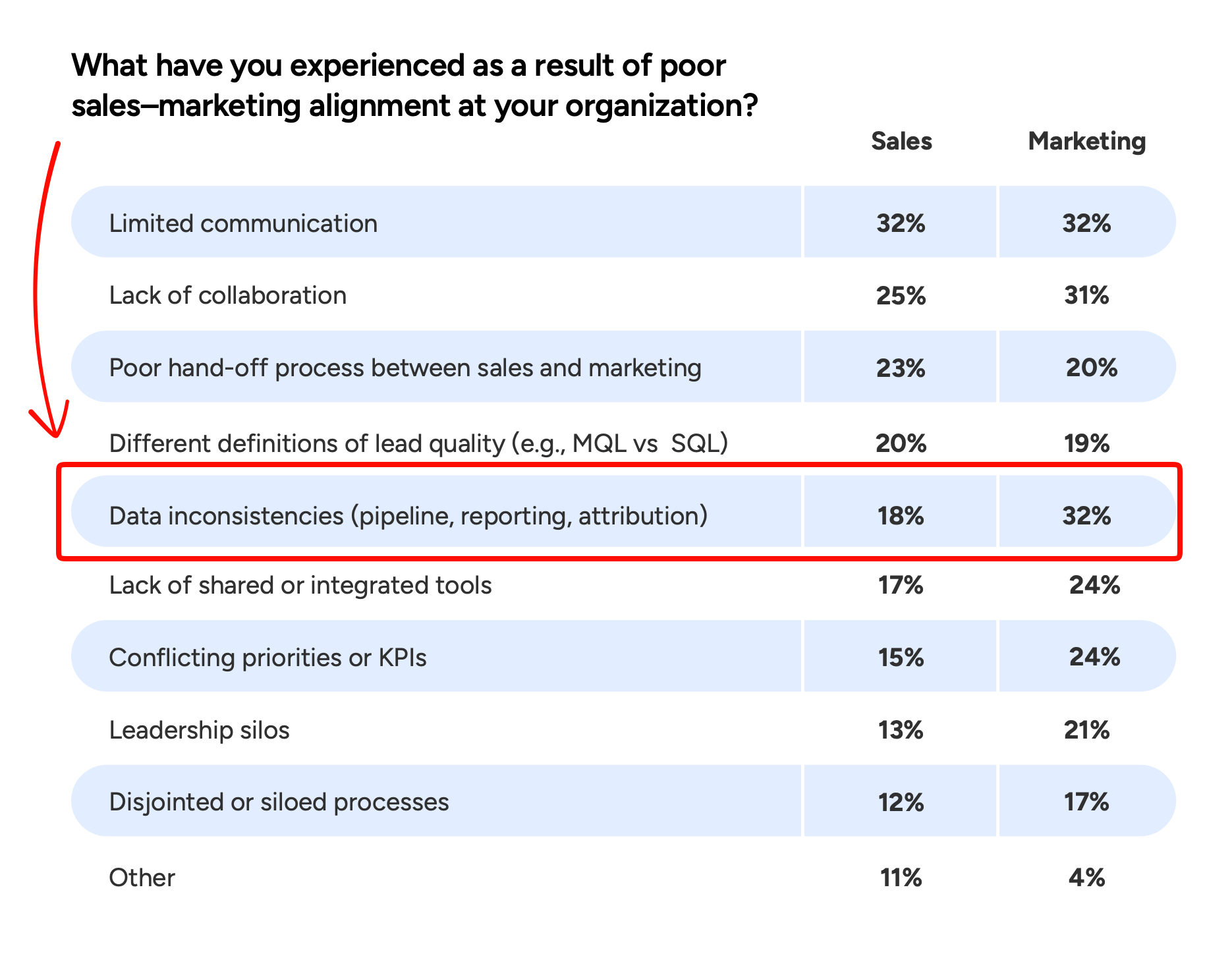
This perception gap is further complicated by functional biases. The report finds that 62% of sales professionals feel highly aligned, compared to only 53% of marketing professionals. Experts suggest this may be because sales teams often view alignment as "marketing providing what we need," whereas marketing teams view alignment as a complex, two-way integration of data and feedback loops. When these expectations are not met, marketing teams are more likely to identify structural barriers such as data inconsistencies (32% for marketing vs. 18% for sales) and unclear target customer definitions (29% vs. 16%).
The Chronology of Misalignment: From Lead Generation to Revenue Loss
To understand how misalignment erodes a business, one must examine the chronology of a typical lead’s journey through a disjointed GTM system. The process generally breaks down across four distinct stages:
- The Definition Phase: Marketing creates campaigns based on a specific set of buyer personas. However, if sales has not provided input, these personas often lack the nuance of real-world objections.
- The Qualification Phase: Marketing generates "Marketing Qualified Leads" (MQLs). Without a shared Service Level Agreement (SLA), marketing may prioritize volume to hit their KPIs, while sales ignores these leads due to perceived low quality.
- The Handoff Phase: This is the primary point of failure. According to the report, 23% of sales professionals cite a poor handoff process as a top barrier. Leads often sit in a CRM without follow-up, or are contacted with messaging that contradicts the initial marketing offer.
- The Feedback Phase: In misaligned teams, the feedback loop is non-existent. Sales does not report back why leads didn’t close, and marketing continues to spend budget on underperforming channels.
The consequences of this breakdown are immediate and measurable. The report identifies employee frustration as the most common result of poor alignment (29%), followed closely by delayed lead follow-up (28%), missed opportunities (25%), and duplicated work (19%). For an SMB, these inefficiencies represent a direct drain on the bottom line, often resulting in a bloated Customer Acquisition Cost (CAC).
The Technology Trap: Why More Tools Do Not Equal Better Alignment
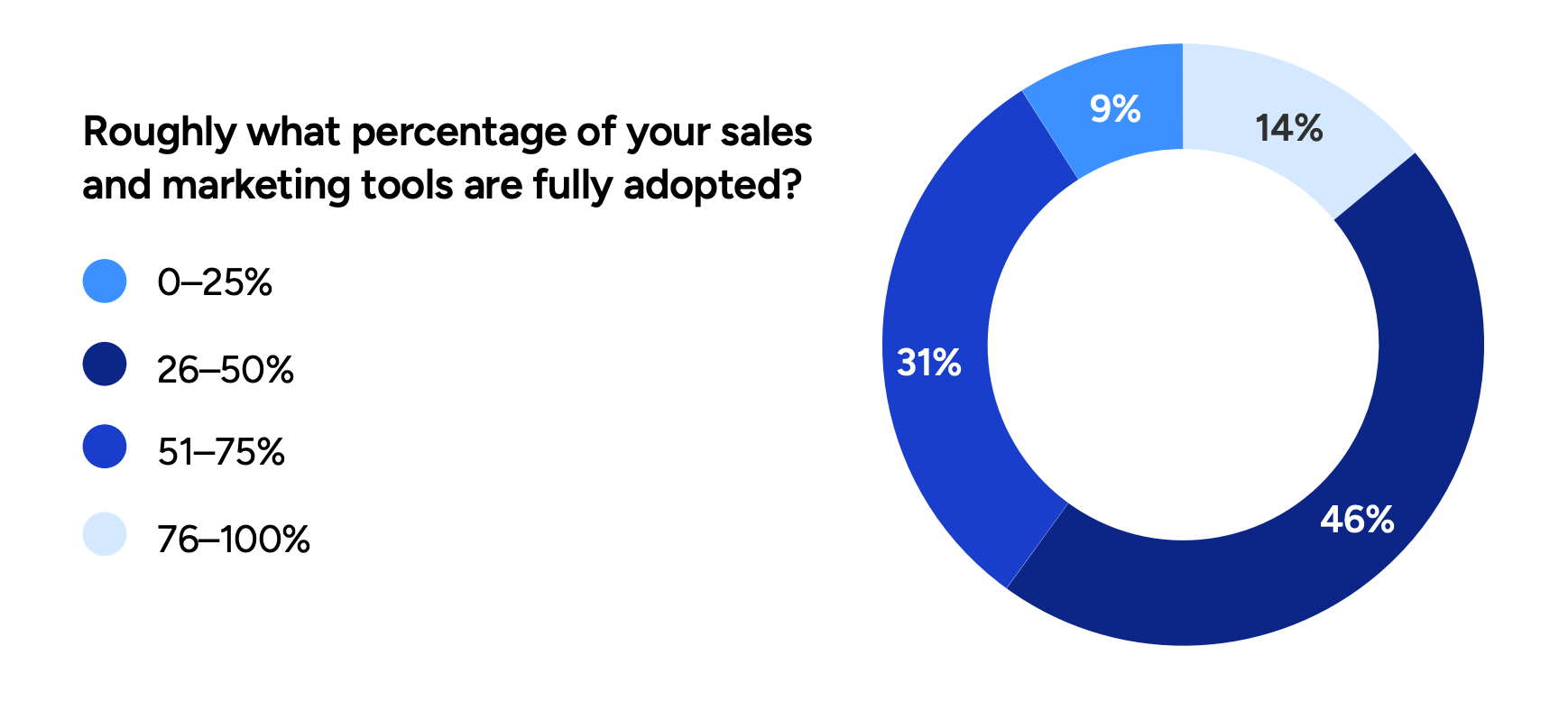
A common reaction to GTM friction is the acquisition of new technology. However, the 2026 data suggests that "tool bloat" is actually a primary driver of misalignment. Approximately 56% of GTM professionals admit that tool bloat is a significant issue within their organization. Perhaps more concerning is the lack of adoption: 60% of teams use less than half of the tools available in their tech stack.

The report reveals a stark correlation between lean technology stacks and high performance. Aligned teams are twice as likely to report having a "lean and focused" tech stack compared to their misaligned counterparts. Furthermore, teams that significantly consolidated their technology are 2.5 times more likely to rate their lead quality as "excellent" (55% vs. 20%).
The "Data Paradox" also plays a role here. While 40% of GTM teams report excellent cross-functional data sharing, 68% of those same teams encounter regular data inconsistencies. This suggests that even when teams have access to the same platforms, they are not looking at the same "source of truth." Marketing may pull reports from an automation platform, while sales works from a separate CRM view or an offline spreadsheet, leading to conflicting interpretations of pipeline health.
Supporting Data: What Separates Top Performers?
The Unbounce report provides a clear blueprint of what highly aligned teams do differently. These organizations do not simply "talk more"; they operate on a fundamentally different model.
- Shared Data Infrastructure: Aligned teams are 3.5 times more likely to have strong cross-functional data sharing (59% vs. 16%).
- Messaging Consistency: Only 17% of aligned teams report messaging inconsistencies across the buyer’s journey, compared to 28% for misaligned teams.
- Tool Adoption: Highly aligned teams report significantly higher tool usage rates, with 12% utilizing over 75% of their stack, compared to just 4% of other teams.
- KPI Ownership: Top-performing teams move away from siloed metrics (like MQLs for marketing and Closed-Won for sales) and toward shared KPIs such as pipeline velocity and customer lifetime value.
Industry Reactions and Expert Analysis
Industry analysts suggest that the findings of the 2026 report reflect a broader shift in the B2B landscape. With the rising cost of digital advertising and the increasing complexity of the buyer’s journey, businesses can no longer afford the "revenue leakage" caused by internal silos.
"The data confirms what many of us have suspected for years," says Josh Gallant, founder of Backstage SEO and a contributor to the report. "Alignment isn’t a cultural ‘nice-to-have.’ It’s an infrastructure problem. If your marketing data doesn’t talk to your sales CRM in a way that both teams trust, you aren’t just losing leads—you’re losing your competitive edge."
Others in the RevOps (Revenue Operations) space point to the report as evidence that the "meeting-first" approach to alignment is failing. While 54% of teams try to fix misalignment by increasing the frequency of meetings, the report shows that operationalization—building shared rules for lead routing and qualification—is the actual lever for growth.
Broader Impact and Future Implications
As we look toward 2027, the implications of this report are clear: the role of the "Generalist Marketer" or the "Lone Wolf Sales Rep" is diminishing in favor of integrated GTM units. The rise of AI-driven insights is expected to further bridge the gap, but only for teams that have already solved the fundamental problem of data clean-up and process definition.
The report highlights that 44% of GTM teams are prioritizing data integration and AI-driven analytics over the next twelve months. This suggests an industry-wide recognition that the next frontier of growth is internal efficiency. For SMBs, the path forward involves three critical steps:
- Establishing a Common Language: Defining exactly what constitutes a "qualified lead" through joint persona exercises.
- Formalizing the Handoff: Implementing automated lead routing and strict follow-up timelines (SLAs).
- Consolidating the Stack: Removing redundant tools to ensure that every team member is working from a single, unified dataset.
In conclusion, the 2026 Anatomy of Aligned Go-to-Market Teams report serves as a wake-up call for SMBs. While the desire for alignment is nearly universal, the execution remains a significant hurdle. Organizations that move beyond the "meeting cadence" and focus on the "operating model"—unifying their data, thinning their tech stacks, and sharing their incentives—will be the ones to capture the 87% performance lift that alignment promises. In an era where every lead counts, the cost of staying misaligned is simply too high to ignore.