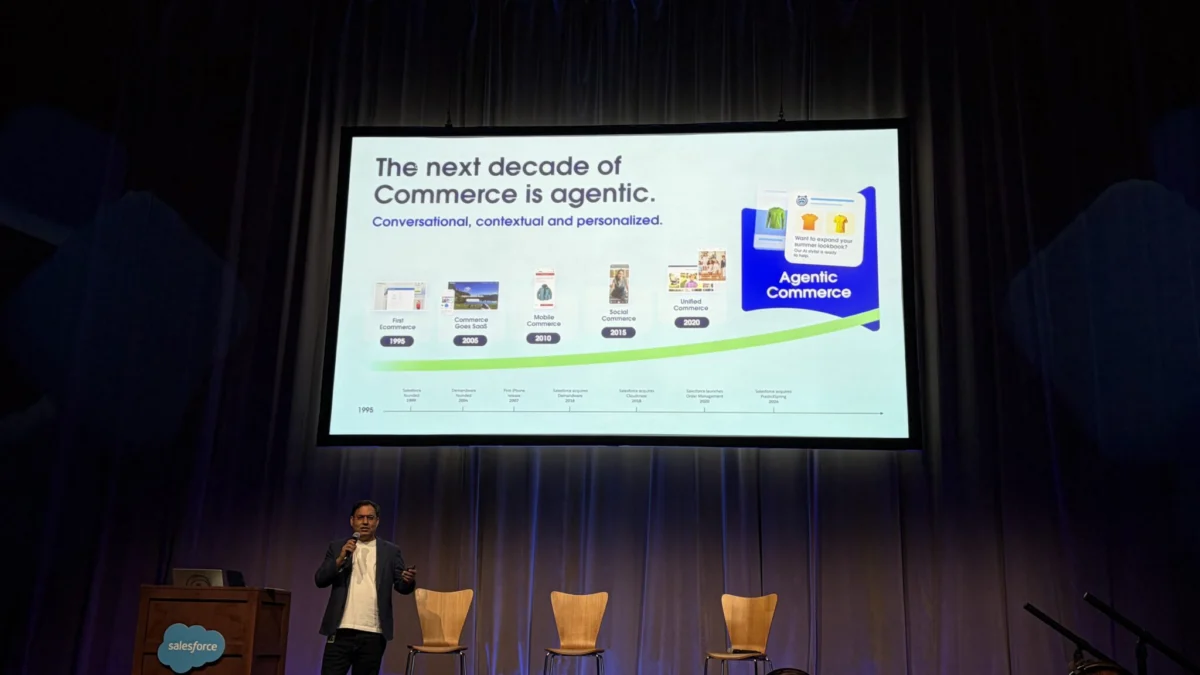
Salesforce has launched what its Executive Vice President of Agentforce Commerce & Retail Cloud, Nitin Mangtani, hails as its "biggest release in the past five years," fundamentally reshaping its e-commerce platform with a deep integration of agentic artificial intelligence. This significant update, now generally available, introduces a suite of innovations designed to redefine the online shopping experience for both consumers and businesses.
The centerpiece of this release is the official integration of Cimulate technology, an AI-powered product discovery startup acquired by Salesforce earlier in the year. This acquisition bolsters Salesforce’s capabilities in intelligent product recommendation and search. Alongside Cimulate, the platform now features sophisticated shopper agents for brand websites, encompassing both product discovery and seamless checkout processes. Complementing these advancements is Storefront Next, a new front-end experience built on vibe coding, empowering brands with enhanced flexibility to design custom user interfaces, according to Mangtani.
"If you don’t have agentic live as of yesterday morning, you’re already behind," Mangtani declared in a statement to Digital Commerce 360, underscoring the perceived urgency and transformative potential of agentic AI in the current e-commerce landscape. He elaborated on various use cases for this technology and Salesforce’s strategic positioning within this rapidly evolving sector.
The impact of Salesforce’s e-commerce solutions is substantial. According to Digital Commerce 360 data, 78 of the Top 2000 online retailers in North America utilize Salesforce as their e-commerce platform. In 2025 alone, these retailers collectively generated over $192.60 billion in web sales, highlighting the platform’s significant market presence and influence. The Top 2000 database ranks North America’s largest online retailers by their annual e-commerce sales.
The Three Pillars of Agentforce Commerce’s Evolution
Mangtani articulated three primary dimensions of Agentforce Commerce’s latest overhaul:
- Cimulate Integration: The official rollout of Cimulate technology brings advanced AI-driven product discovery capabilities to Salesforce users. This integration aims to enhance how consumers find products by understanding intent and context more deeply than traditional search methods.
- Shopper Agents: The introduction of intelligent shopper agents directly on brand websites represents a significant leap in customer engagement. These agents are designed to guide shoppers through their entire journey, from initial product exploration to a frictionless checkout, offering personalized assistance at every touchpoint.
- Storefront Next: This new front-end experience leverages vibe coding, offering brands unprecedented control over their digital storefronts. It allows for the creation of highly customized and engaging user interfaces, moving beyond generic templates to reflect unique brand identities and improve user experience.
The Inevitable Shift to Conversational Commerce
Mangtani emphasized a crucial distinction in how agentic AI is being adopted, categorizing its application in e-commerce into two main areas: consumer-facing experiences and the underlying product and engineering infrastructure.
On the consumer side, he argued that agentic AI is fundamentally shifting the paradigm towards conversational interactions. This approach, he posited, is inherently more natural and intuitive for humans, contrasting it with the mouse-and-keyboard interface that has dominated digital interactions for decades. "When we think about agentic, people are like, ‘Oh, how long will it take for people to get used to conversations?’ Wrong question," Mangtani stated. "We got used to a wrong form factor, which was the mouse. That was foreign to us. But conversation is not foreign to us. That’s how people start."
He pointed to the rapid adoption of generative AI platforms like OpenAI’s ChatGPT, Google’s Gemini, and Anthropic’s Claude as evidence of this shift. With approximately a billion monthly active users across these platforms within their first two years, consumers are demonstrably comfortable engaging in extended conversations with AI. "So we are definitely away from a two-keyword world that Google taught us, to now real conversations," Mangtani observed. "Once the consumer behavior shifts, it shifts for everything."
Differentiating Agentic Shopping and Agentic Commerce
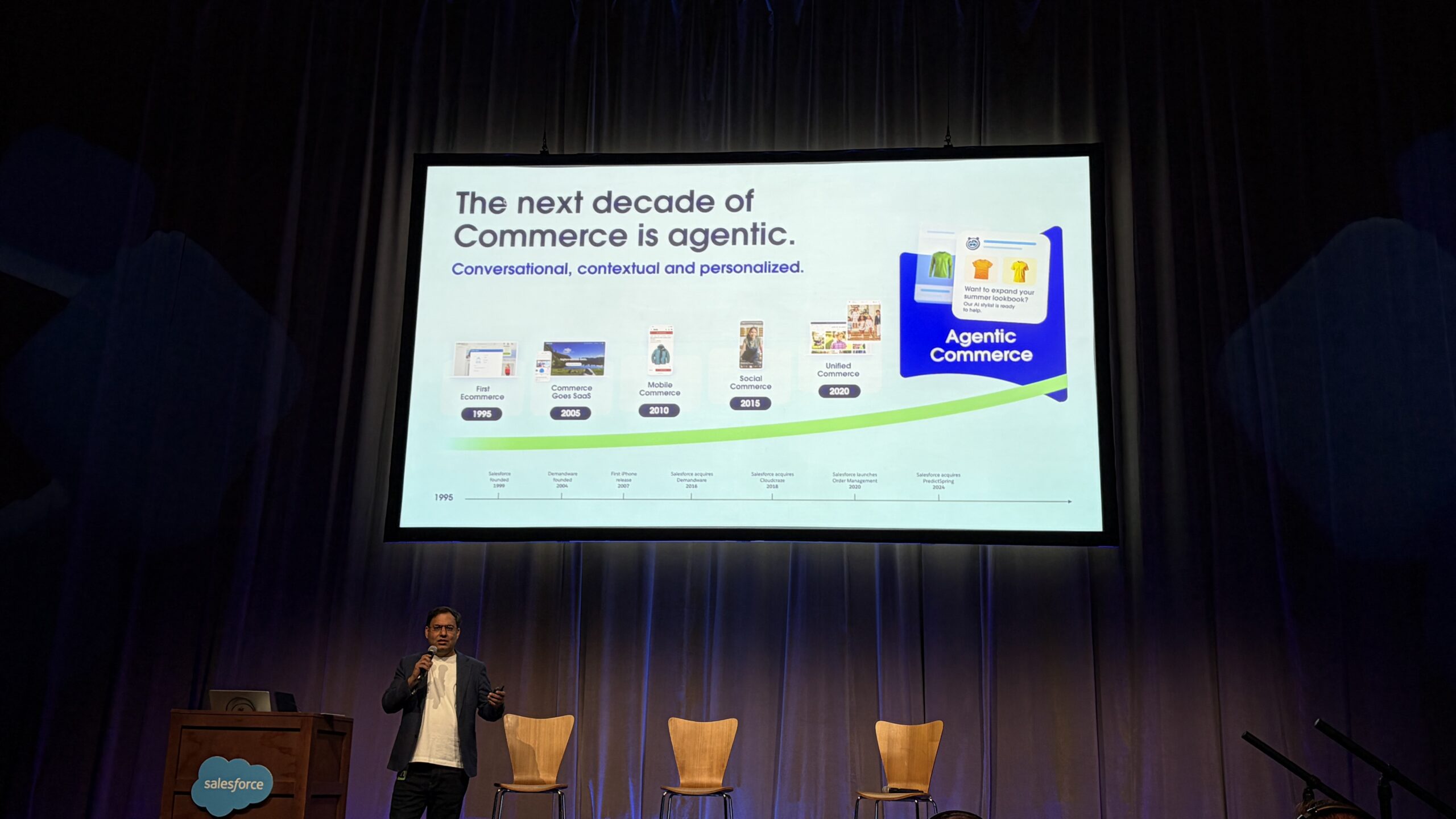
A key aspect of Salesforce’s strategy is to distinguish between "agentic shopping" – interactions occurring within broad AI platforms like ChatGPT – and "agentic commerce," where these AI capabilities are embedded directly into a brand’s own e-commerce environment.
"From my lens, every single e-commerce brand will have an agentic experience on their property, which is different than shopping while you are inside ChatGPT and Gemini," Mangtani explained. "Those are two different things. In a lot of ways, I think a lot of articles in the press mix those two things. They just call it agentic shopping. But they are materially different – shopping happening inside Gemini versus shopping happening on SharkNinja.com. And we are powering both."
Salesforce’s role in enabling these experiences includes its collaboration with Google on the Universal Commerce Protocol (UCP). This initiative aims to standardize how AI agents interact with e-commerce platforms. Salesforce is focusing on two primary areas within the agentic commerce framework:
- Product Catalog Syndication: This enables consumers to discover products through third-party large language models (LLMs) like ChatGPT. The goal is to ensure that rich, accurate product information is readily available to these AI discovery engines.
- Agentic AI-Powered Checkout: Implementing seamless and intelligent checkout experiences where AI agents can facilitate transactions efficiently.
Mangtani illustrated this with a personal anecdote from Salesforce Connections 2026 in Chicago. Experiencing dry skin, he used an agentic AI tool within Uber Eats to find a suitable moisturizer. The AI not only provided recommendations based on active ingredients but also suggested specific products. He then cross-referenced these suggestions, taking screenshots of product details and ingredients to allow the AI to rank brands and identify pros. Ultimately, he made the purchase through Uber Eats, receiving the product from a local CVS within 20 minutes.
"I would’ve picked the wrong product if I didn’t go to Gemini and ask that question," Mangtani admitted. "But the actual commerce happened on Uber. It didn’t happen on Gemini. That’s why it’s important that brands think about this 360 [view]. There’s no doubt in my mind: Discovery of products is going to – close to 100% – move from search to agentic." He anticipates that traditional search and agentic discovery will eventually merge, especially as platforms like Google are expected to make AI modes the default.
Enabling Agentic AI Search: The Crucial Role of Data Accuracy
For products to be effectively discoverable within the burgeoning AI landscape, Mangtani stressed the paramount importance of accurate and comprehensive data. This includes precise details on inventory levels, available sizes, color options, and pricing.
"It sounds very mundane. But having lived at Google for seven years on the other side, that was my biggest problem," Mangtani reflected. "It wasn’t some a-ha moment. It was just the quality of the content." His tenure at Google from 2006 to 2013 provided him with firsthand experience of the challenges posed by mislabeled product categories, poor image quality, and outdated inventory data.
Salesforce’s acquisition of Cimulate plays a critical role in addressing these issues. The company can now analyze product catalogs and images to augment them in real-time, leveraging its integrated, cloud-based data infrastructure. This allows retailers to provide optimized, up-to-date, and accurate product details to LLMs like ChatGPT and Gemini.
"We have an API-based approach, so we could basically do constant updates," Mangtani explained. "We don’t need to wait. It’s all integrated. The beauty of Salesforce is this: We are powering their actual e-commerce and stores. We have access to both the inventories: what’s in the warehouse but also in the stores." This direct access to real-time inventory data across all channels eliminates the need for intermediaries and ensures that AI agents are working with the most current information.
Navigating the Protocols: UCP vs. A2A
Salesforce’s engagement with agentic AI extends to its participation in different communication protocols, notably the Universal Commerce Protocol (UCP) and Agent-to-Agent (A2A) protocols.
Mangtani described the UCP as a human-to-agent process. In this model, consumers utilize agentic AI tools for product research, and the LLM then directs them to a retailer’s website to complete the purchase. "My philosophy is it’s in the retailer’s best interest if the checkout happens on their website," Mangtani stated. This ensures that retailers retain valuable customer data, "own the customer relationship," and have opportunities for upsells. The UCP streamlines the complex API calls required for creating shopping carts and managing transactions, allowing AI agents to act as shopping assistants rather than needing to replicate the entire back-end retail infrastructure.
"They don’t want to," Mangtani said of LLMs replicating complex retail functions like tax calculations based on location and local laws. "They are calling our APIs to do that, so we are doing the work for the agent. And that’s a benefit to our brands because they don’t need to do any work."
In contrast, the A2A protocol is designed for agent-to-agent communication. This is particularly useful for routine purchases where deep human interaction is not necessary. Mangtani cited examples like replenishing essentials such as shaving cream, body wash, shampoo, or paper towels. In these scenarios, AI agents can handle replenishment automatically within predefined parameters, freeing up human users from repetitive tasks.
The strategic implementation of both UCP and A2A protocols highlights Salesforce’s comprehensive approach to integrating agentic AI across the entire e-commerce ecosystem, from initial discovery to automated replenishment, catering to a wide spectrum of consumer needs and business objectives. This release signals a proactive stance by Salesforce to lead the charge in shaping the future of commerce through intelligent automation and enhanced customer experiences.